Quantum chemistry is the branch of chemistry that uses the principles of quantum mechanics to understand how atoms and molecules behave. It focuses on how electrons move, interact, and form chemical bonds at the smallest scales of matter.
Unlike classical chemistry, which often describes reactions and structures using simplified models, quantum chemistry explains chemical behavior using mathematical and physical laws that govern subatomic particles.
This field helps scientists understand why molecules form the shapes they do, how chemical reactions occur, and how energy moves through atomic systems.
Understanding Quantum Chemistry
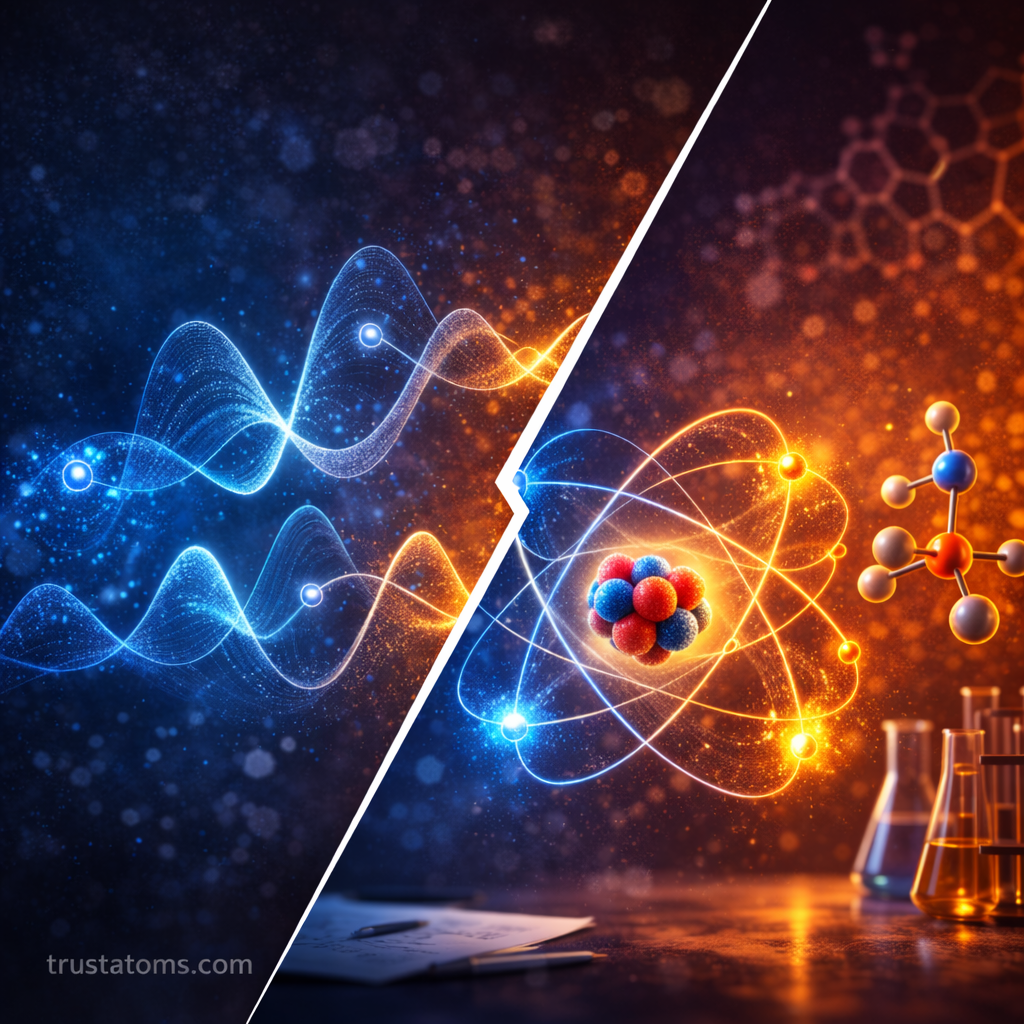
Quantum chemistry applies the rules of quantum mechanics to chemical systems. Instead of treating electrons as particles that follow predictable paths, quantum chemistry describes them as wave-like entities that exist in probability regions.
At this scale, particles behave differently than objects in the everyday world.
Key principles include:
- Electrons behave as both particles and waves
- Their exact position cannot be known with certainty
- Energy levels in atoms are quantized, meaning they exist in specific discrete values
By studying these behaviors, quantum chemists can predict how atoms interact and bond.
How Quantum Chemistry Explains Atomic Structure
One of the most important roles of quantum chemistry is explaining the structure of atoms.
In early atomic models, electrons were thought to orbit the nucleus like planets around the sun. Quantum chemistry replaced this idea with a more accurate description using orbitals.
Orbitals represent regions where electrons are most likely to be found.
Quantum chemistry helps explain:
- Electron configurations
- Atomic energy levels
- Orbital shapes and orientations
- Electron interactions within atoms
These insights form the foundation of modern chemistry.
The Role of the Schrödinger Equation
At the center of quantum chemistry is the Schrödinger equation, which describes how quantum systems behave.
This equation allows scientists to calculate:
- The energy of electrons
- The probability of finding electrons in certain regions
- The structure of atoms and molecules
Although solving the equation exactly can be difficult for complex systems, scientists use approximations and computational methods to study chemical behavior.
Quantum Chemistry and Chemical Bonding
Quantum chemistry provides a deeper explanation of how chemical bonds form.
When atoms approach one another, their orbitals interact. These interactions determine how electrons are shared, transferred, or distributed between atoms.
Quantum chemistry explains bonding through two major theories:
Valence Bond Theory
Valence bond theory describes chemical bonds as the overlap of atomic orbitals.
Key ideas include:
- Bonds form when orbitals overlap
- Electrons pair within the overlapping region
- Bond strength depends on the degree of overlap
This theory helps explain many molecular structures.
Molecular Orbital Theory
Molecular orbital theory describes electrons as occupying orbitals that belong to the entire molecule rather than individual atoms.
Important features include:
- Atomic orbitals combine to form molecular orbitals
- Electrons can spread across the molecule
- Bonding and antibonding orbitals determine molecular stability
This theory provides a more detailed explanation of molecular behavior.
Computational Quantum Chemistry
Because quantum equations are complex, scientists often rely on powerful computers to perform calculations.
Computational quantum chemistry allows researchers to simulate chemical systems and predict molecular behavior.
Common uses include:
- Predicting molecular structures
- Calculating reaction pathways
- Studying catalysts
- Designing new materials
- Modeling biological molecules
These simulations help scientists test ideas before performing physical experiments.
Applications of Quantum Chemistry
Quantum chemistry plays an important role in many scientific and technological fields.
Examples include:
Drug Discovery
Pharmaceutical researchers use quantum chemistry to model how molecules interact with biological targets. This helps design effective medications.
Materials Science
Quantum chemistry helps scientists develop new materials with specific electrical, mechanical, or chemical properties.
Nanotechnology
Understanding atomic interactions is essential for designing nanoscale devices and structures.
Energy Research
Quantum chemistry helps improve technologies such as:
- Solar cells
- Batteries
- Catalysts for clean energy
These advancements contribute to sustainable energy solutions.
Why Quantum Chemistry Is Important
Quantum chemistry provides the theoretical foundation for much of modern chemistry.
It helps scientists:
- Understand atomic and molecular structure
- Predict chemical reactions
- Explain periodic trends
- Design new molecules and materials
- Develop advanced technologies
Without quantum chemistry, many of the tools used in chemistry, physics, and materials science would not exist.
Final Thoughts
Quantum chemistry is the study of chemical systems using the laws of quantum mechanics. It explains how electrons behave, how atoms bond, and how molecules form their structures.
By applying quantum principles to chemical problems, scientists gain a deeper understanding of matter at the atomic scale.
From drug development to advanced materials and energy technologies, quantum chemistry continues to play a critical role in scientific discovery and innovation.