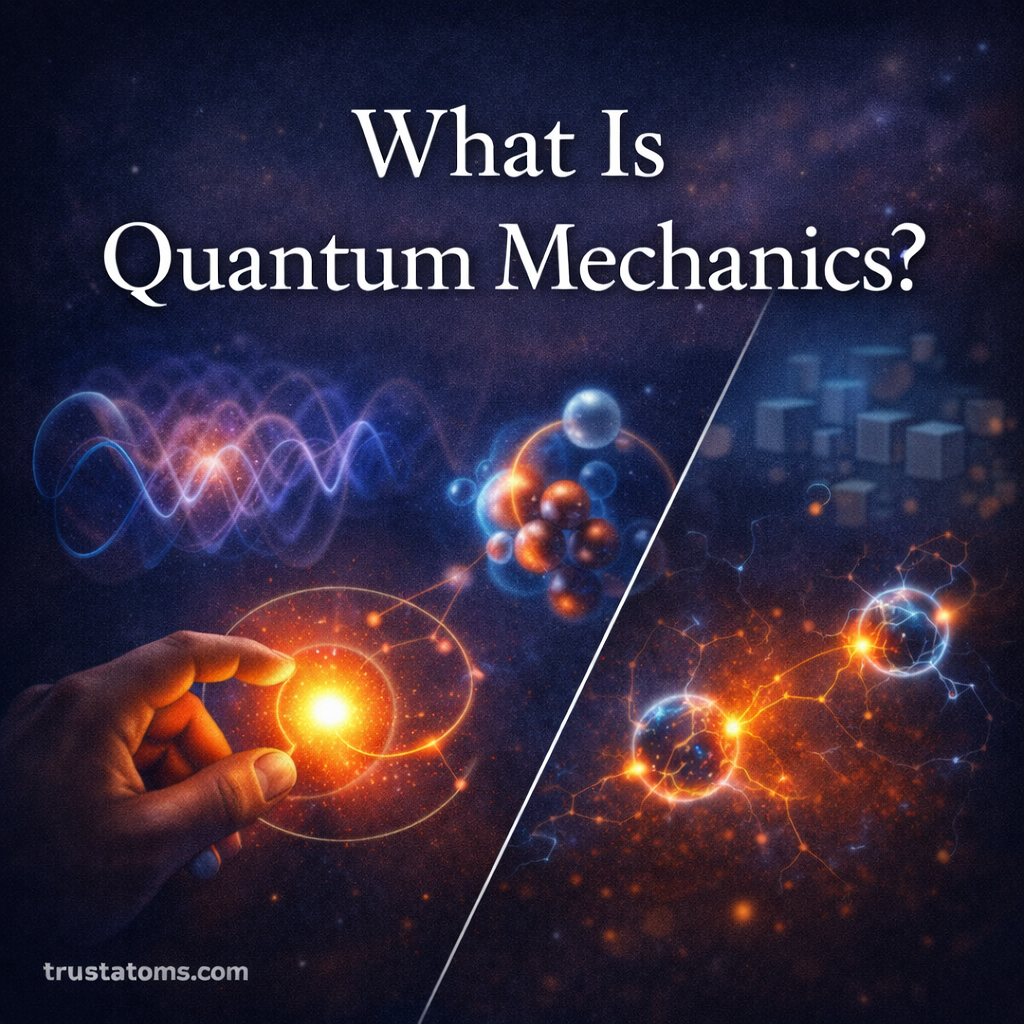
Quantum mechanics is the branch of physics that explains how matter and energy behave at the smallest scales — atoms, electrons, photons, and other subatomic particles.
While classical physics describes everyday objects like cars and planets, quantum mechanics governs the strange and fascinating world of the microscopic.
It is one of the most successful scientific theories ever developed, forming the foundation of modern electronics, chemistry, and even emerging technologies like quantum computing.
What Is Quantum Mechanics in Simple Terms?
Quantum mechanics is the study of how particles behave when they are extremely small.
At the quantum level:
- Particles can behave like waves.
- Energy exists in discrete packets.
- The act of observing something can affect its behavior.
- Outcomes are described by probabilities, not certainties.
Unlike classical physics, which feels predictable, quantum mechanics often challenges our intuition.
Why Classical Physics Wasn’t Enough
In the late 19th and early 20th centuries, scientists discovered that classical physics could not explain certain experimental results, including:
- The behavior of light at very small scales
- The energy emitted by heated objects
- The structure of atoms
These problems led to the development of quantum theory.
Key Principles of Quantum Mechanics
Quantum mechanics rests on several foundational ideas.
1. Quantization of Energy
Energy is not continuous at small scales.
Instead, it exists in fixed amounts called quanta.
For example, electrons in atoms can only occupy specific energy levels.
2. Wave–Particle Duality
Particles such as electrons and photons behave like both particles and waves.
They can show interference patterns (a wave property) but also collide like tiny particles.
This dual nature is central to quantum theory.
3. The Uncertainty Principle
It is impossible to know certain pairs of properties — such as position and momentum — with perfect accuracy at the same time.
The more precisely you measure one, the less precisely you can measure the other.
This is not a limitation of technology — it is a fundamental property of nature.
4. Superposition
Quantum particles can exist in multiple states simultaneously until measured.
For example, an electron can occupy multiple possible positions at once in a probabilistic sense.
When observed, the system “collapses” into one outcome.
5. Entanglement
Two particles can become linked so that the state of one instantly influences the other, even if separated by large distances.
This phenomenon has been experimentally confirmed and is one of the most intriguing aspects of quantum mechanics.
How Quantum Mechanics Describes Reality
Instead of describing particles with precise trajectories, quantum mechanics uses a mathematical function called a wave function.
The wave function:
- Describes all possible states of a particle
- Provides probabilities of different outcomes
- Evolves over time according to specific equations
Rather than predicting exact results, quantum mechanics predicts the likelihood of different possibilities.
Real-World Applications of Quantum Mechanics
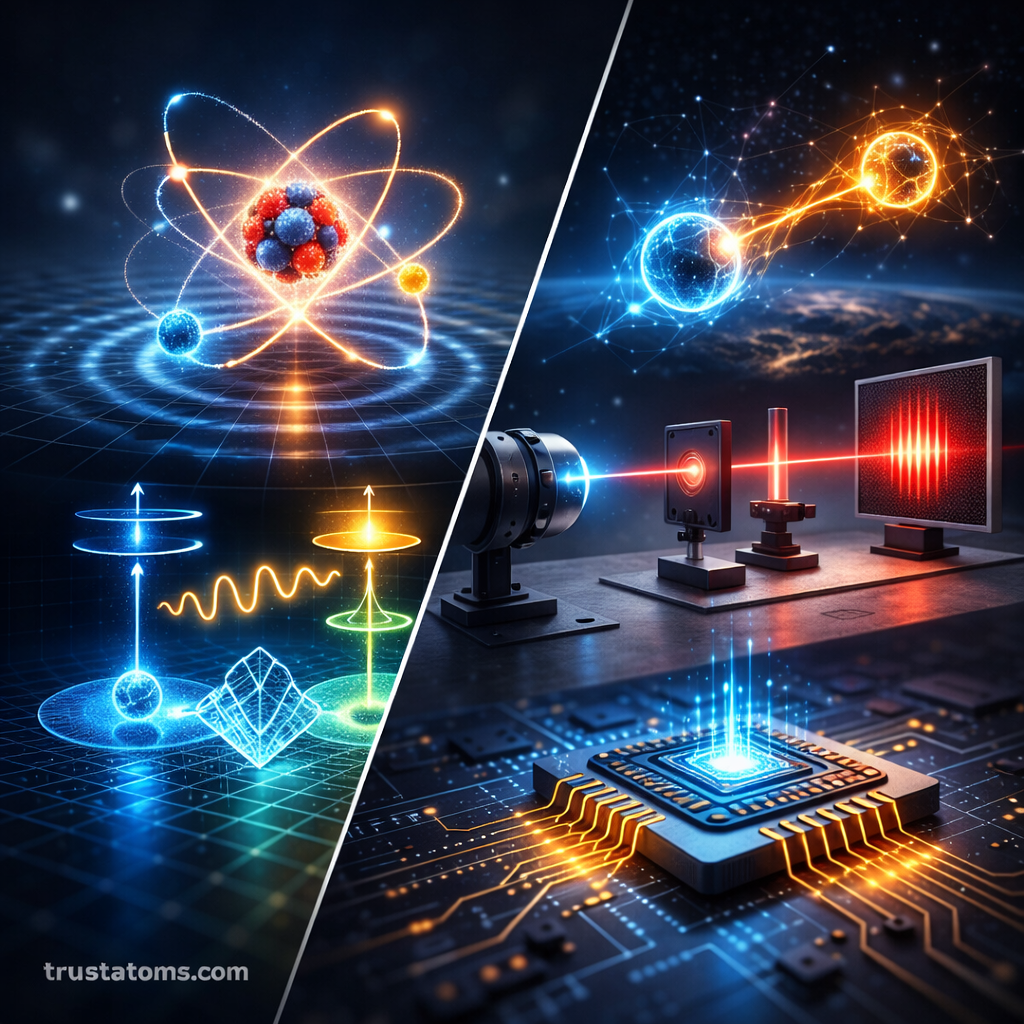
Quantum mechanics is not just theoretical — it powers much of modern technology.
Electronics
Semiconductors and transistors rely on quantum behavior of electrons.
Without quantum mechanics, computers and smartphones would not exist.
Lasers
Lasers operate based on controlled quantum energy transitions in atoms.
MRI Machines
Magnetic resonance imaging depends on quantum properties of atomic nuclei.
Solar Panels
The photoelectric effect — a quantum phenomenon — enables sunlight to be converted into electricity.
Quantum Computing
Quantum computers use superposition and entanglement to process information in new ways.
Quantum Mechanics vs. Classical Physics
The two theories describe different scales of reality.
Classical Physics:
- Applies to large objects
- Predictable and deterministic
- Describes motion with clear trajectories
Quantum Mechanics:
- Applies to atoms and subatomic particles
- Probabilistic
- Describes systems using wave functions
At everyday scales, quantum effects average out, making classical physics appear accurate.
Why Quantum Mechanics Matters
Quantum mechanics reshaped our understanding of reality.
It revealed that:
- Nature is fundamentally probabilistic at small scales
- Energy and matter behave differently than we once thought
- Observation plays a role in physical outcomes
Despite its counterintuitive nature, quantum mechanics has been confirmed through countless experiments.
It remains one of the most accurate scientific theories ever developed.
Common Misconceptions About Quantum Mechanics
Because it sounds mysterious, quantum mechanics is often misunderstood.
Clarifications include:
- It does not mean “anything is possible.”
- It does not imply magic or supernatural forces.
- It applies specifically to microscopic systems.
Its predictions are precise and mathematically rigorous.
Final Thoughts
Quantum mechanics is the physics of the very small.
It explains how atoms, electrons, and light behave — revealing a world that operates differently from everyday experience.
Though complex and sometimes counterintuitive, quantum mechanics underpins much of modern science and technology.
From semiconductors to lasers and emerging quantum computers, its impact is everywhere.
Understanding quantum mechanics helps us grasp the fundamental structure of reality itself.