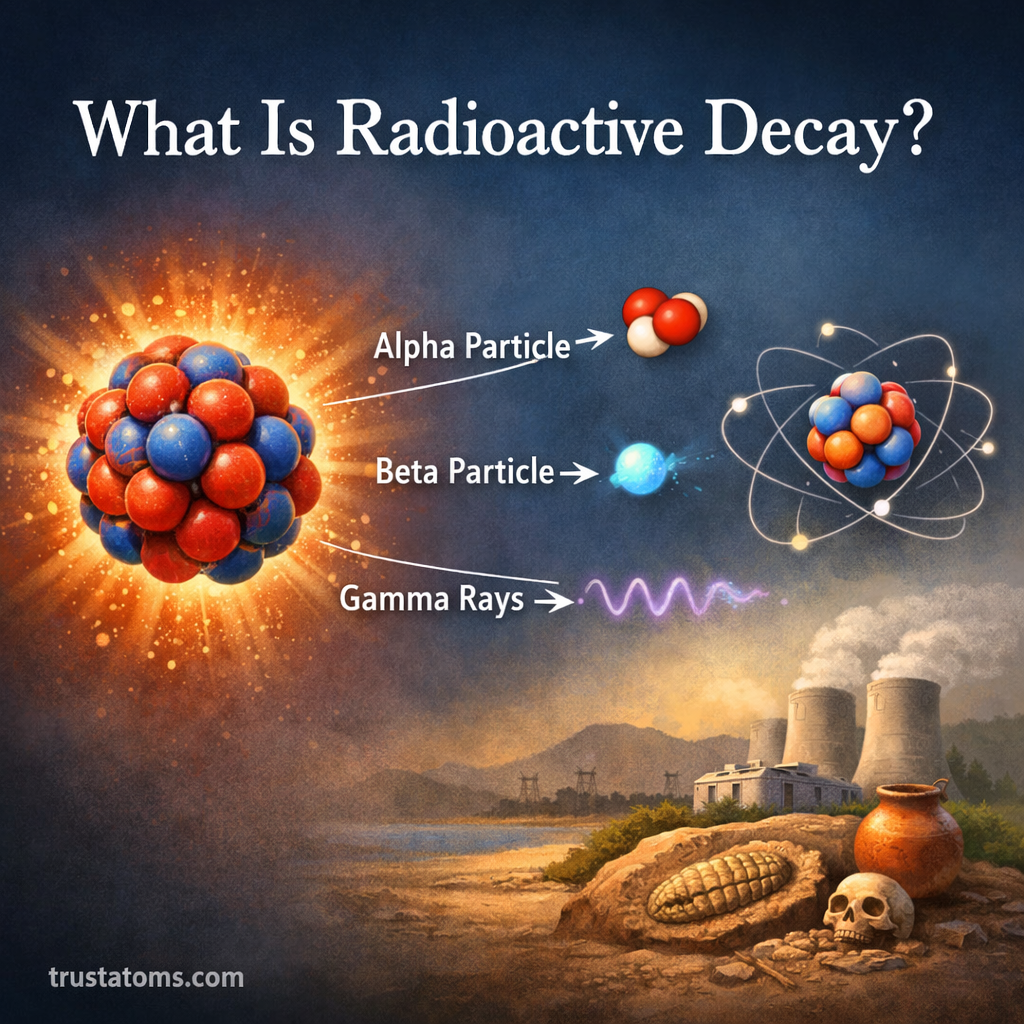
Radioactive decay is a natural process where an unstable atomic nucleus releases energy by emitting radiation. Over time, this process transforms the original atom into a different element or a more stable form of the same element.
Radioactive decay happens spontaneously. It does not require heat, pressure, or chemical reactions. It is driven entirely by the internal structure of the atom’s nucleus.
Understanding radioactive decay is essential in physics, nuclear energy, medicine, geology, and even archaeology.
Understanding Atomic Stability
Every atom has a nucleus made of:
- Protons (positively charged particles)
- Neutrons (neutral particles)
Atoms are stable when the balance between protons and neutrons is just right. If there are too many or too few neutrons relative to protons, the nucleus becomes unstable.
An unstable nucleus tries to reach stability by releasing excess energy. That release of energy is what we call radioactive decay.
Atoms that undergo this process are known as radioactive isotopes, or radioisotopes.
What Is Radiation?
When radioactive decay occurs, the nucleus emits radiation in the form of particles or energy waves.
There are three main types of radioactive decay:
1. Alpha Decay
In alpha decay, the nucleus emits an alpha particle.
An alpha particle consists of:
- 2 protons
- 2 neutrons
This is essentially a helium nucleus.
Alpha decay:
- Reduces the atomic number by 2
- Reduces the mass number by 4
- Produces a new element
Alpha particles are heavy and cannot travel far. A sheet of paper can stop them.
2. Beta Decay
In beta decay, a neutron converts into a proton (or vice versa), releasing a beta particle.
There are two forms:
- Beta-minus decay (electron emitted)
- Beta-plus decay (positron emitted)
Beta decay:
- Changes the atomic number by 1
- Does not significantly change the mass number
Beta particles can travel farther than alpha particles but can be stopped by materials like aluminum.
3. Gamma Decay
Gamma decay releases excess energy in the form of high-energy electromagnetic waves called gamma rays.
Gamma decay:
- Does not change the atomic number
- Does not change the mass number
- Often follows alpha or beta decay
Gamma rays are highly penetrating and require thick lead or concrete for shielding.
Why Does Radioactive Decay Happen?
Radioactive decay happens because some atomic nuclei are energetically unstable.
Instability can result from:
- Too many neutrons
- Too many protons
- An imbalance between nuclear forces
- Excess internal energy
The nucleus “rearranges” itself to reach a lower-energy, more stable configuration.
This process is governed by the fundamental forces of physics, especially the strong nuclear force and the weak nuclear force.
What Is Half-Life?
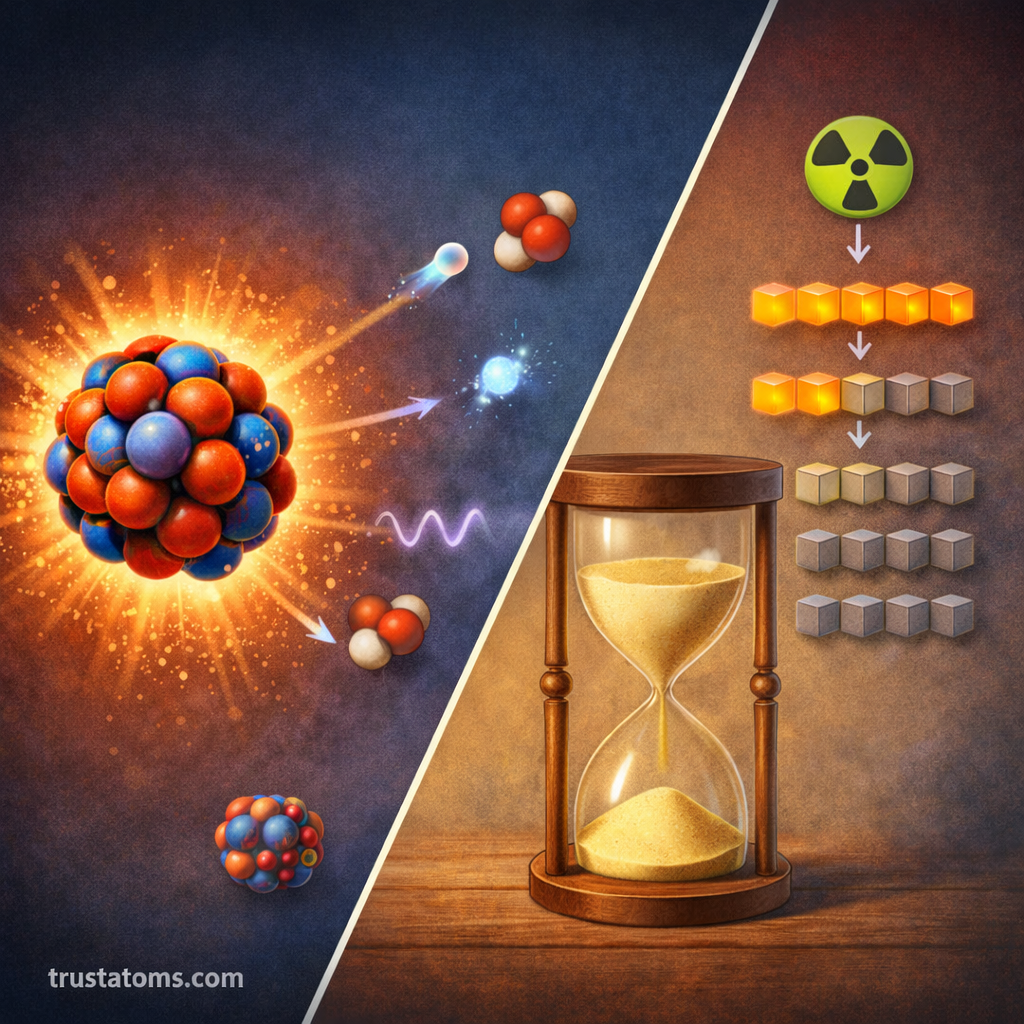
Half-life is the amount of time it takes for half of a radioactive substance to decay.
Key points about half-life:
- It is constant for each radioactive isotope.
- It cannot be sped up or slowed down by normal physical conditions.
- It can range from fractions of a second to billions of years.
For example:
- Some isotopes decay almost instantly.
- Others, like those used in geological dating, decay very slowly.
Half-life allows scientists to:
- Estimate the age of ancient rocks.
- Date archaeological remains.
- Measure radioactive exposure.
- Manage nuclear materials safely.
Real-World Applications of Radioactive Decay
Radioactive decay is not just a theoretical concept. It has practical uses across many fields.
Medicine
Radioactive isotopes are used in:
- Cancer treatments (radiation therapy)
- Medical imaging (such as PET scans)
- Sterilization of equipment
Energy Production
Nuclear power plants rely on controlled radioactive decay (specifically nuclear fission) to generate heat, which produces electricity.
Archaeology and Geology
Radiometric dating techniques use radioactive decay to determine the age of:
- Fossils
- Rocks
- Ancient artifacts
Industry
Radioactive materials are used in:
- Smoke detectors
- Thickness gauges
- Tracing leaks in pipelines
Is Radioactive Decay Dangerous?
Radiation can be harmful if exposure levels are high. However, risk depends on:
- Type of radiation
- Duration of exposure
- Distance from the source
- Shielding used
Alpha radiation is dangerous if inhaled or ingested.
Gamma radiation is more penetrating and requires proper shielding.
Beta radiation falls in between.
In controlled environments, radioactive materials are handled safely using strict scientific protocols.
Key Characteristics of Radioactive Decay
Radioactive decay has several defining properties:
- It is random at the level of individual atoms.
- It follows predictable statistical patterns for large numbers of atoms.
- It cannot be influenced by temperature or pressure.
- It transforms one element into another (a process called transmutation).
Even though we cannot predict when a single atom will decay, we can precisely predict how a large sample will behave over time.
The Big Picture
Radioactive decay is a fundamental process in physics that reveals how atomic nuclei behave.
It explains:
- How unstable atoms become stable
- How elements transform
- How nuclear energy is produced
- How scientists measure time across millions of years
From powering cities to diagnosing disease to unlocking Earth’s history, radioactive decay plays a central role in modern science and technology.
Understanding it deepens our appreciation of how matter changes at the smallest scales.