Resistance is one of the core concepts in electricity and physics. It explains why electric current doesn’t flow freely through every material and why some wires heat up when electricity passes through them.
In simple terms, resistance is the opposition to the flow of electric current.
If voltage is the push and current is the flow, resistance is what pushes back.
Let’s break it down clearly.
The Basic Definition of Resistance
Electrical resistance is defined as:
The measure of how strongly a material opposes the flow of electric charge.
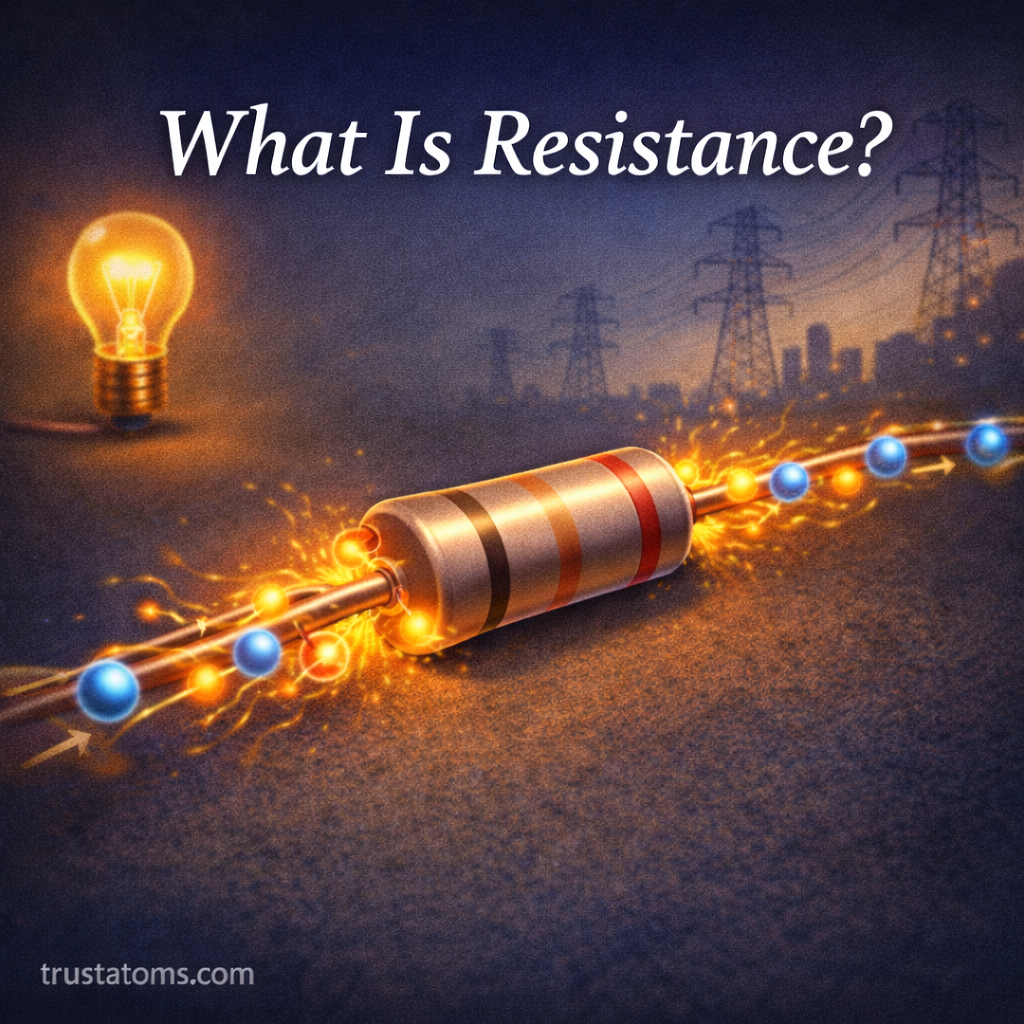
When electrons move through a conductor, they collide with atoms inside the material. These collisions slow them down.
That slowing effect is resistance.
The standard unit of resistance is the ohm (Ω), named after German physicist Georg Ohm.
One ohm represents the amount of resistance that allows one ampere of current to flow when one volt is applied.
Why Resistance Happens
At the microscopic level, electric current is the movement of electrons through a material.
As electrons travel:
- They bump into atoms.
- They collide with impurities.
- They interact with vibrations in the material.
Each collision reduces their smooth movement.
More collisions = more resistance.
This is why not all materials conduct electricity equally well.
Conductors vs. Insulators
Different materials have different levels of resistance.
Low Resistance (Good Conductors)
These materials allow current to flow easily:
- Copper
- Silver
- Aluminum
- Gold
They are commonly used in electrical wiring.
High Resistance (Insulators)
These materials strongly resist current flow:
- Rubber
- Glass
- Plastic
- Wood (dry)
They are used to protect us from electric shock.
The Formula for Resistance
Resistance is connected to voltage and current through Ohm’s Law:
V = I × R
This can be rearranged to find resistance:
R = V / I
Where:
- R = resistance (ohms)
- V = voltage (volts)
- I = current (amps)
From this relationship:
- If resistance increases, current decreases (for the same voltage).
- If resistance decreases, current increases.
This relationship is fundamental in circuit design.
What Affects Resistance?
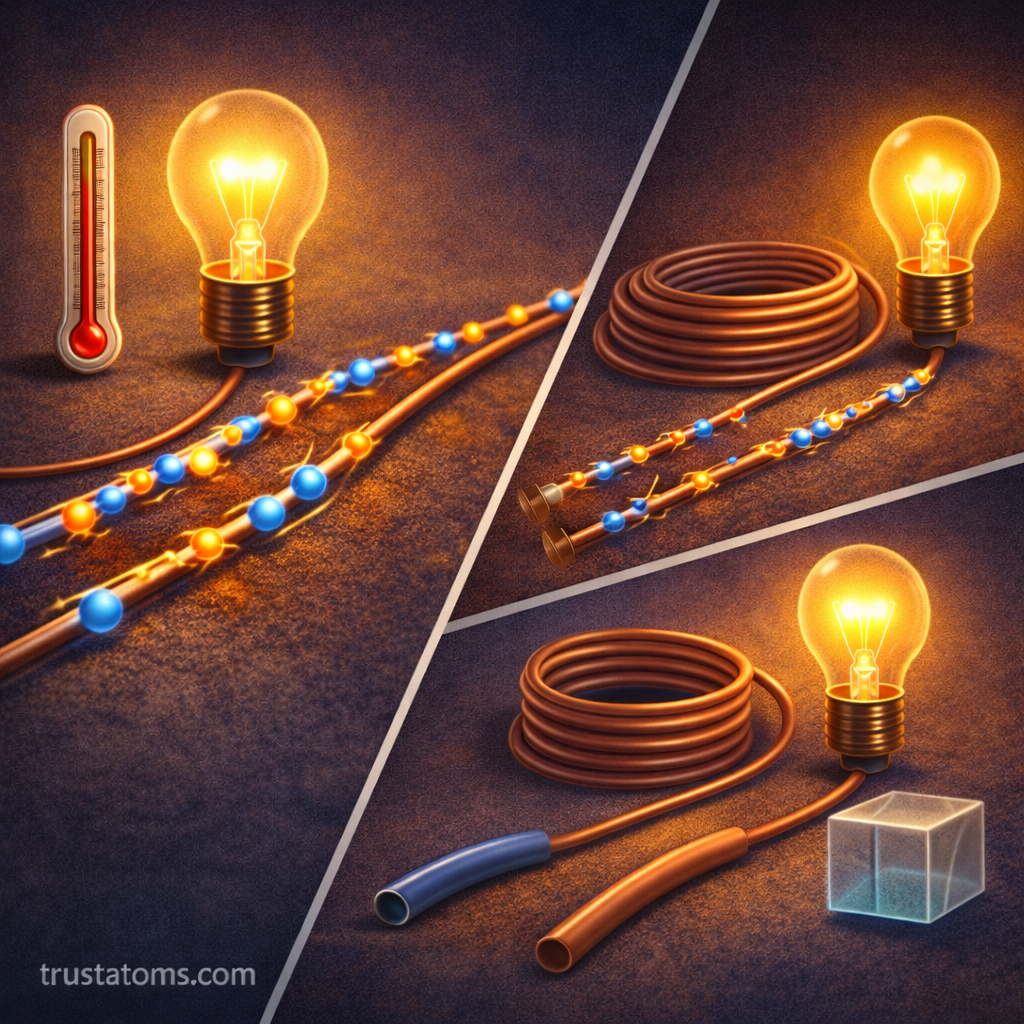
Several physical factors influence resistance in a material.
1. Material Type
Some materials naturally allow electrons to move more freely.
Copper has much lower resistance than rubber.
2. Length of the Conductor
Longer wires have more resistance.
Why?
Because electrons must travel farther and experience more collisions.
3. Thickness (Cross-Sectional Area)
Thicker wires have less resistance.
A wider path gives electrons more room to move.
4. Temperature
For most metals:
- Higher temperature → higher resistance.
As temperature rises, atoms vibrate more intensely, increasing collisions with electrons.
This is why electrical devices can heat up under heavy use.
Resistance and Heat
When current flows through resistance, energy is converted into heat.
This effect is called Joule heating.
Examples include:
- Electric heaters
- Toasters
- Incandescent light bulbs
- Hair dryers
In these devices, resistance is intentionally used to generate heat.
However, in most circuits, excessive resistance is unwanted because it wastes energy.
Fixed vs. Variable Resistance
Electrical components are often designed with specific resistance values.
Fixed Resistors
- Have a constant resistance.
- Used to control current in circuits.
- Common in electronics and circuit boards.
Variable Resistors
- Allow adjustment of resistance.
- Used in dimmer switches and volume controls.
- Also called potentiometers.
By adjusting resistance, you can control how much current flows.
Why Resistance Matters
Resistance plays a critical role in:
- Protecting circuits from excessive current
- Controlling brightness in lights
- Regulating motor speeds
- Preventing overheating
- Designing safe electrical systems
Without resistance, electrical systems would be unstable and dangerous.
Common Misconceptions About Resistance
Here are a few misunderstandings people often have:
“Resistance stops electricity completely.”
Resistance slows current — it doesn’t necessarily stop it.
Only an open circuit (a break in the path) completely stops current.
“More resistance always means safer.”
Not necessarily.
Too much resistance in a power line can cause overheating and energy loss.
“All metals have the same resistance.”
Different metals have very different resistance values.
Silver is one of the best conductors, while iron has significantly higher resistance.
Simple Summary
Resistance is:
- The opposition to electric current
- Measured in ohms
- Caused by collisions between electrons and atoms
- Affected by material, length, thickness, and temperature
- Essential for safe and controlled electrical systems
Understanding resistance helps you understand why circuits behave the way they do.
Final Thoughts
Resistance is one of the three fundamental electrical quantities, along with voltage and current.
Together, they explain how electricity moves, how energy is used, and how devices function.
Whether you’re studying physics, building circuits, or simply curious about how your electronics work, understanding resistance gives you a clearer picture of how electricity behaves in the real world.