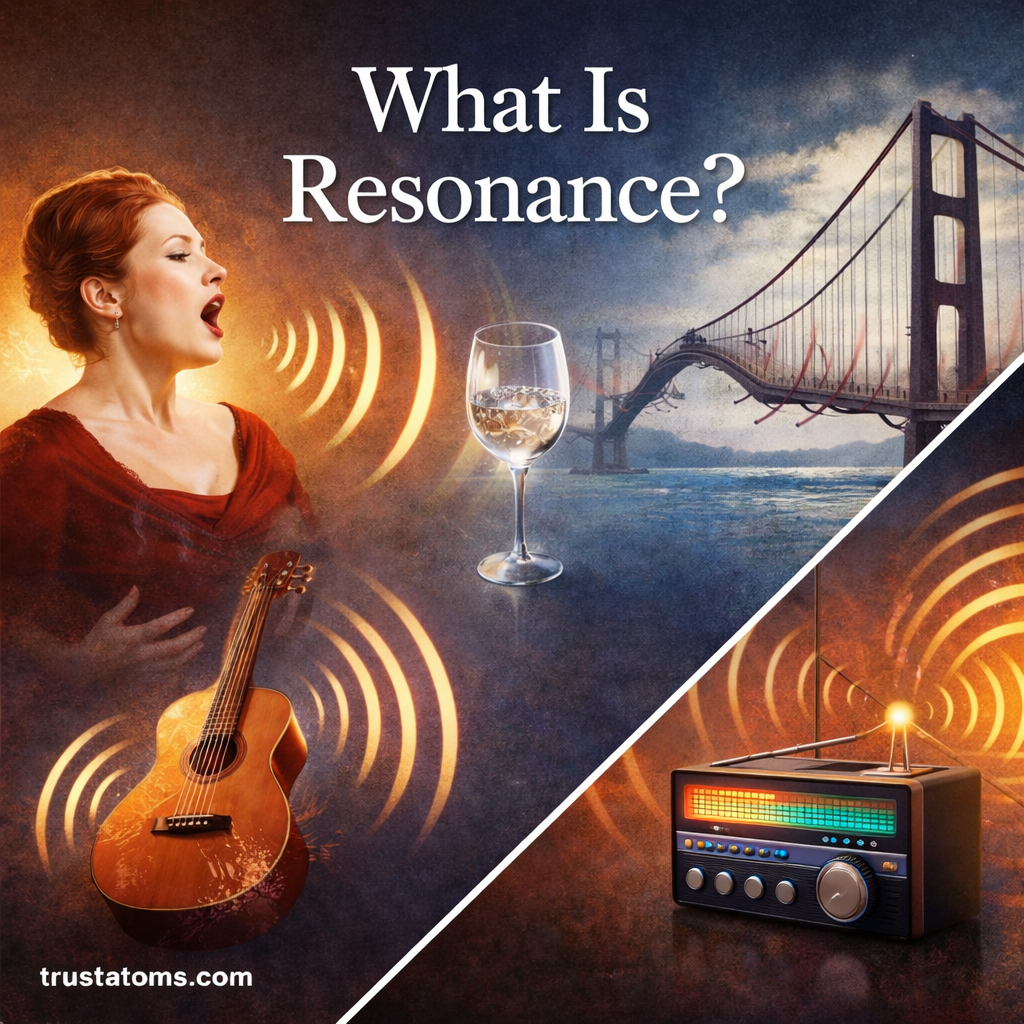
Resonance is the phenomenon that occurs when an object vibrates at its natural frequency after being exposed to matching vibrations from an external source.
In simple terms:
When something is pushed at just the right rhythm, it vibrates more strongly.
Resonance explains why a singer can shatter glass, why bridges can wobble dramatically, and why musical instruments produce rich sound.
In this guide, you’ll learn:
- What resonance means in physics
- What natural frequency is
- Everyday examples
- Why resonance can be powerful — and sometimes dangerous
- How resonance is used in science and engineering
What Is Resonance in Simple Terms?
Every object has a natural frequency.
This is the specific rate at which it prefers to vibrate.
When an outside force vibrates at that exact same frequency, energy transfers very efficiently. The object begins vibrating with larger amplitude (bigger motion).
That amplification is resonance.
No extra force is required — just the right timing.
What Is Natural Frequency?
Natural frequency depends on an object’s:
- Size
- Shape
- Mass
- Material
- Tension (if stretched or suspended)
For example:
- A short guitar string vibrates faster (higher pitch).
- A long, loose string vibrates slower (lower pitch).
- A heavy object tends to vibrate more slowly than a lighter one.
Every physical system — from atoms to skyscrapers — has one or more natural frequencies.
How Resonance Works
Imagine pushing someone on a swing.
If you push randomly, the swing barely moves.
But if you push at the exact moment the swing comes toward you — matching its rhythm — the motion grows higher and higher.
That’s resonance.
Energy builds because the timing aligns perfectly with the system’s natural motion.
Key idea:
Resonance is about timing, not force.
Everyday Examples of Resonance
Resonance appears all around us.
1. Musical Instruments
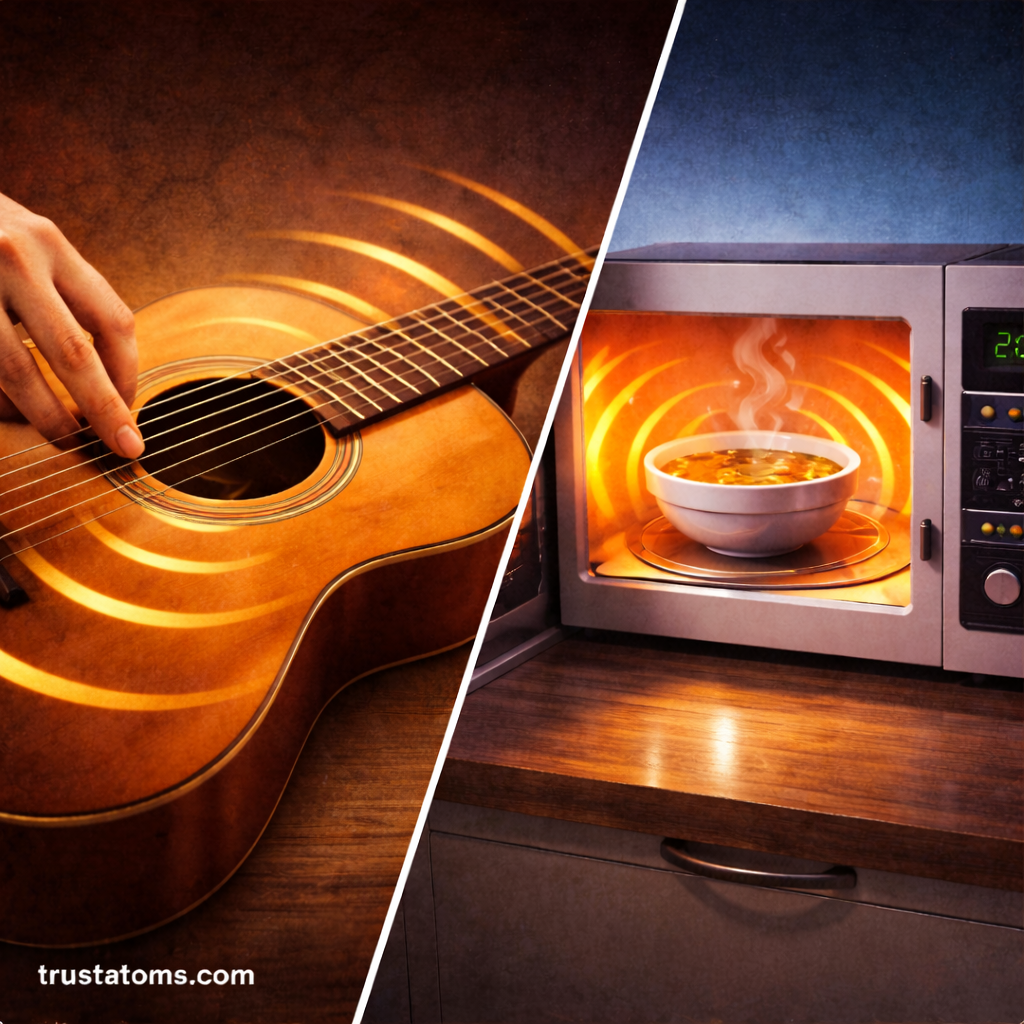
Guitars, violins, and pianos rely on resonance.
When a string vibrates:
- The wooden body resonates.
- The air inside resonates.
- The sound becomes louder and richer.
Without resonance, instruments would sound weak and quiet.
2. Singing and Shattering Glass
If a singer matches the natural frequency of a glass:
- The glass vibrates strongly.
- Vibrations increase.
- If the amplitude becomes too large, the glass can break.
This works because energy builds at the glass’s natural frequency.
3. Microwave Ovens
Microwaves use electromagnetic resonance to excite water molecules in food.
The molecules absorb energy efficiently at a specific frequency, causing them to vibrate and heat up.
4. Radio Tuning
Radios use resonance to select specific frequencies.
When you tune a station:
- The circuit resonates at one frequency.
- Other frequencies are ignored.
This allows you to hear one station clearly.
When Resonance Becomes Dangerous
Resonance can cause structural failure if not controlled.
Famous Example: Tacoma Narrows Bridge
In 1940, the Tacoma Narrows Bridge collapsed after wind caused vibrations that matched the bridge’s natural frequency.
The motion amplified until the structure failed.
Engineers now design buildings and bridges to avoid dangerous resonance effects.
Resonance in Physics and Engineering
Resonance plays a major role in:
- Mechanical systems (bridges, engines, buildings)
- Electrical circuits
- Acoustic systems
- Quantum physics
- Medical imaging (MRI)
Engineers often either:
- Design systems to avoid resonance
- Or design them to use resonance intentionally
It depends on the goal.
Types of Resonance
Resonance can occur in different systems.
Mechanical Resonance
Occurs in physical objects like springs, beams, and bridges.
Acoustic Resonance
Occurs in air columns and sound systems.
Electrical Resonance
Occurs in circuits when inductors and capacitors oscillate at specific frequencies.
Electromagnetic Resonance
Occurs in atoms and molecules interacting with electromagnetic waves.
What Factors Affect Resonance?
Resonance strength depends on:
- How closely the driving frequency matches the natural frequency
- Damping (energy lost due to friction or resistance)
- The material and structure of the object
High damping reduces resonance.
Low damping allows vibrations to grow larger.
Key Differences: Resonance vs. Forced Vibration
Forced vibration occurs whenever an external force makes something vibrate.
Resonance is a special case of forced vibration.
It only happens when:
Driving frequency = Natural frequency
At that point, energy transfer is most efficient.
Key Takeaways
- Resonance occurs when an object vibrates at its natural frequency due to an external force.
- Every object has one or more natural frequencies.
- Matching frequencies lead to amplified motion.
- Resonance can be useful (music, radios, microwaves).
- It can also be dangerous (bridge collapse, structural failure).
Resonance shows how timing and frequency shape motion in the physical world — from tiny molecules to massive structures.
Frequently Asked Questions
Is resonance always dangerous?
No. Most uses of resonance are intentional and safe, such as in musical instruments and electronics.
Does resonance require a lot of force?
No. Even small forces can produce large vibrations if the timing matches perfectly.
Does resonance only happen with sound?
No. Resonance can occur in mechanical systems, electrical circuits, and electromagnetic waves.
Final Thoughts
Resonance is one of the most powerful concepts in physics because it explains how small, repeated forces can create large effects.
When timing aligns with natural frequency, energy builds.
Understanding resonance helps engineers build safer structures, musicians create better sound, and scientists develop advanced technologies.
It’s a simple idea with enormous impact.