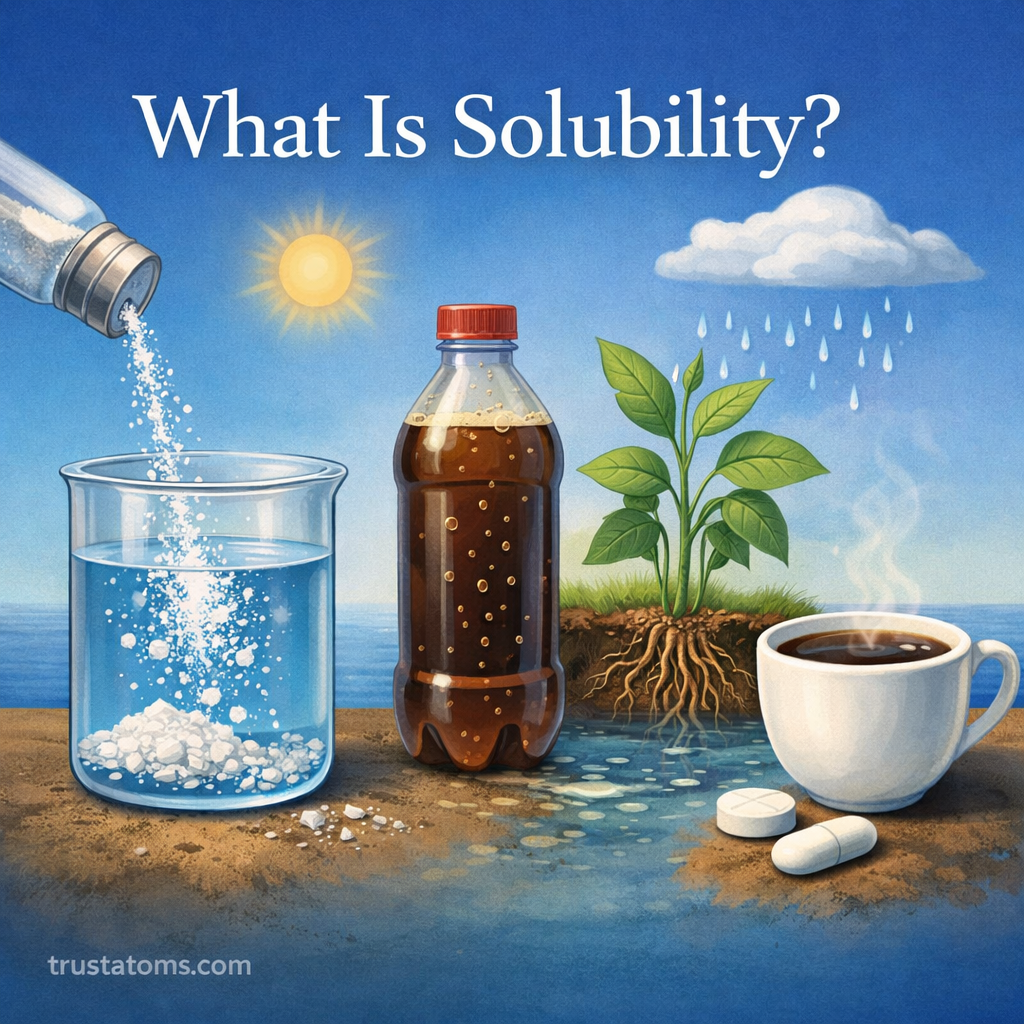
Solubility is one of the most important concepts in chemistry because it explains how and why substances dissolve in liquids. From sugar dissolving in coffee to oxygen dissolving in water for fish to breathe, solubility helps scientists understand how different materials interact.
In simple terms, solubility describes the ability of a substance to dissolve in another substance, usually a liquid. Understanding solubility helps explain many natural processes, industrial applications, and everyday experiences.
What Solubility Means in Chemistry
Solubility refers to the maximum amount of a substance (solute) that can dissolve in a given amount of another substance (solvent) at a specific temperature and pressure.
The substance that dissolves is called the solute, and the substance doing the dissolving is called the solvent.
For example:
- Sugar dissolving in water
- Salt dissolving in soup
- Carbon dioxide dissolving in soda
When the solute spreads evenly throughout the solvent, the result is a solution.
Solute, Solvent, and Solution
Understanding solubility becomes easier when you know the three main components involved.
Solute
The solute is the substance being dissolved.
Examples include:
- Salt
- Sugar
- Oxygen gas
- Carbon dioxide
Solvent
The solvent is the substance that dissolves the solute.
Common solvents include:
- Water
- Alcohol
- Oils
- Other liquids
Water is often called the universal solvent because it dissolves more substances than most other liquids.
Solution
A solution is the final mixture created when a solute dissolves in a solvent.
Examples of solutions include:
- Saltwater
- Sweet tea
- Soda
- Vinegar
How Solubility Works
Solubility happens because of interactions between molecules.
When a solute dissolves:
- The solvent molecules pull apart the solute particles.
- The solute particles spread throughout the solvent.
- The particles become evenly distributed.
This process occurs on a molecular level, meaning the particles become too small to see individually.
For example, when salt dissolves in water, the salt crystals break apart into tiny charged particles called ions, which spread evenly throughout the liquid.
Factors That Affect Solubility
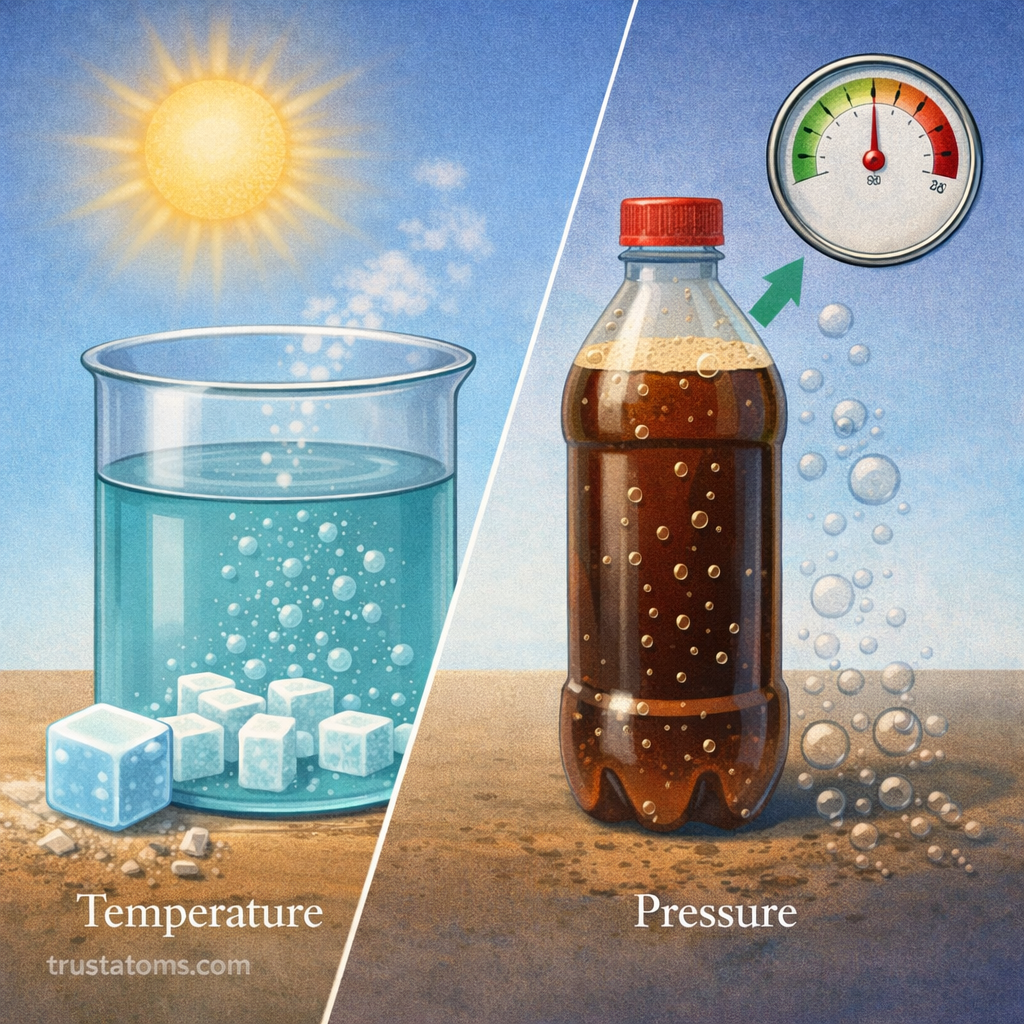
Several factors determine how well a substance dissolves.
1. Temperature
Temperature often affects how much solute can dissolve.
For many solids:
- Higher temperature = higher solubility
This is why sugar dissolves faster in hot tea than in iced tea.
However, gases behave differently. Gas solubility usually decreases as temperature increases.
Example:
Warm soda loses carbonation faster than cold soda.
2. Pressure
Pressure mainly affects gases dissolved in liquids.
Higher pressure increases gas solubility.
Example:
- Carbon dioxide is dissolved in soda under high pressure.
- When the bottle is opened, pressure drops and bubbles form.
3. Nature of the Substances
The chemical properties of the solute and solvent matter.
A common rule in chemistry is:
“Like dissolves like.”
This means:
- Polar substances dissolve in polar solvents.
- Nonpolar substances dissolve in nonpolar solvents.
Examples:
- Salt dissolves in water.
- Oil does not dissolve in water.
Saturated, Unsaturated, and Supersaturated Solutions
Solutions can contain different amounts of dissolved solute.
Unsaturated Solution
An unsaturated solution contains less solute than the maximum amount that could dissolve.
More solute can still dissolve.
Example:
A small amount of sugar dissolved in water.
Saturated Solution
A saturated solution contains the maximum amount of solute that can dissolve at a certain temperature.
Any additional solute will not dissolve.
Example:
Salt crystals remaining at the bottom of very salty water.
Supersaturated Solution
A supersaturated solution contains more dissolved solute than normally possible under stable conditions.
These solutions are unstable and can quickly form crystals.
Example:
Rock candy forming from a concentrated sugar solution.
Examples of Solubility in Everyday Life
Solubility appears in many common situations.
Food and Cooking
- Sugar dissolves in coffee or tea
- Salt dissolves in soup or sauces
- Flavorings dissolve in drinks
Nature
- Oxygen dissolves in lakes and oceans for aquatic life
- Minerals dissolve in groundwater
- Nutrients dissolve in soil water for plants
Medicine
Many medicines rely on solubility to work effectively.
For example:
- Tablets dissolve in the stomach
- Liquid medicines dissolve in water
- Nutrients dissolve in the bloodstream
Why Solubility Is Important in Chemistry
Solubility helps scientists understand and control chemical processes.
It plays a key role in:
- Chemical reactions
- Environmental science
- Medicine and pharmaceuticals
- Food science
- Industrial manufacturing
By understanding solubility, chemists can predict which substances will dissolve together and how solutions will behave.
Final Thoughts
Solubility describes how well a substance can dissolve in another substance. It depends on factors such as temperature, pressure, and the chemical nature of the materials involved.
From everyday activities like making tea to complex scientific processes in medicine and industry, solubility is a fundamental concept that helps explain how substances mix and interact.
Understanding solubility provides a foundation for learning more advanced topics in chemistry, including chemical reactions, equilibrium, and solution chemistry.