The cell membrane is a thin, flexible layer that surrounds and protects every cell. It acts as a boundary between the inside of the cell and the external environment, controlling what enters and leaves the cell.
Often described as the cell’s protective barrier, the cell membrane plays a crucial role in maintaining the cell’s internal balance. By regulating the movement of molecules and signals, it ensures that the cell can function properly and respond to changes in its surroundings.
Understanding the cell membrane is fundamental to biology because it is involved in nearly every cellular process.
The Basic Function of the Cell Membrane
The primary role of the cell membrane is to regulate the movement of substances into and out of the cell.
This regulation helps cells:
- Maintain stable internal conditions
- Obtain nutrients needed for energy and growth
- Remove waste products
- Communicate with other cells
- Protect internal cellular structures
Because of these roles, the cell membrane is essential for the survival of all living cells.
Structure of the Cell Membrane
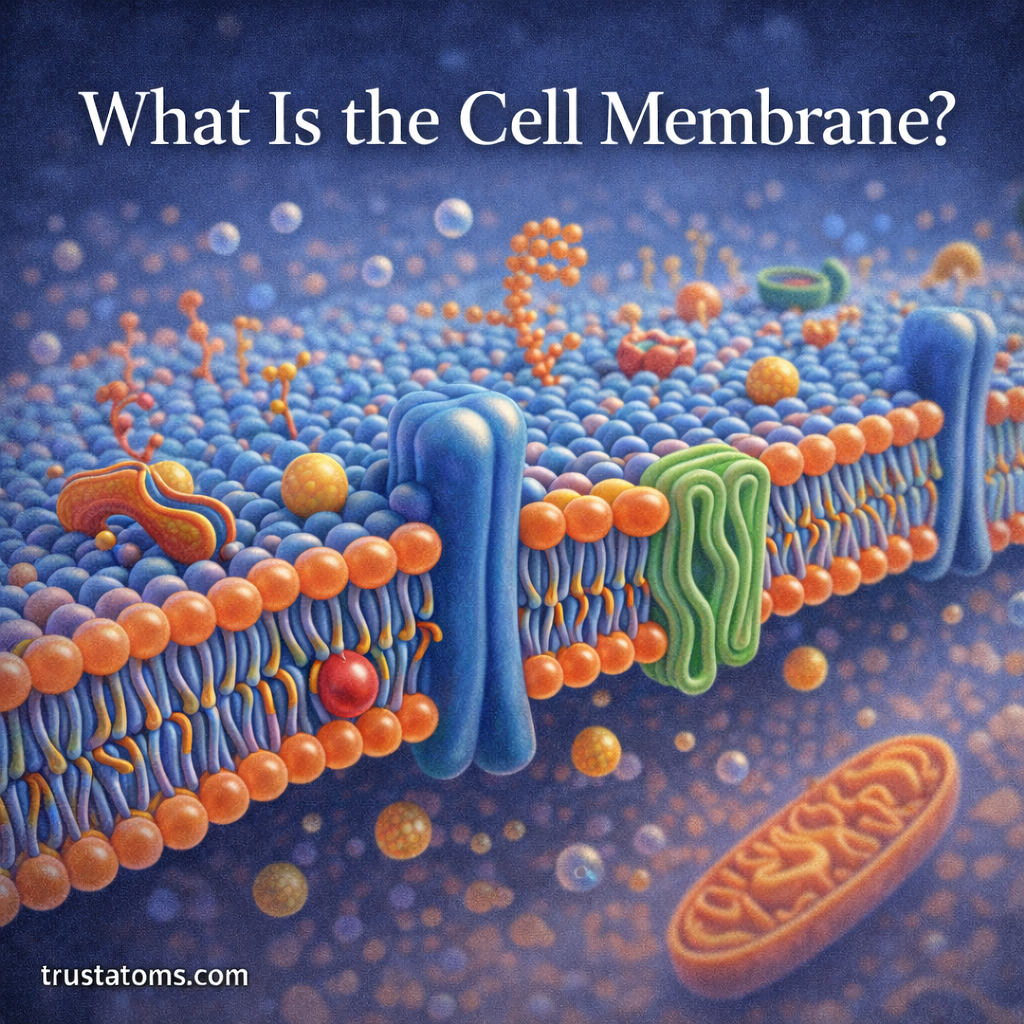
The cell membrane is made of a structure known as a phospholipid bilayer. This structure forms a flexible and dynamic barrier that separates the cell from its environment.
Phospholipid Bilayer
Phospholipids are special molecules that have two parts:
- A hydrophilic head that is attracted to water
- A hydrophobic tail that repels water
In the membrane, phospholipids arrange themselves into two layers, with their heads facing outward toward water and their tails facing inward.
This arrangement forms the basic framework of the cell membrane.
Membrane Proteins
Proteins embedded within the membrane perform many important tasks.
These proteins help with:
- Transporting molecules across the membrane
- Acting as receptors for chemical signals
- Anchoring the cell to surrounding structures
- Facilitating communication between cells
Some proteins span the entire membrane, while others are attached to one side.
Cholesterol and Stability
In many animal cells, cholesterol molecules are also present within the membrane.
Cholesterol helps:
- Maintain membrane flexibility
- Stabilize the membrane structure
- Prevent the membrane from becoming too rigid or too fluid
This contributes to the membrane’s overall stability.
Selective Permeability
One of the most important properties of the cell membrane is selective permeability.
Selective permeability means the membrane allows some substances to pass through while blocking others.
Substances that commonly pass through include:
- Small nonpolar molecules such as oxygen and carbon dioxide
- Water molecules
- Certain small nutrients
Larger molecules or charged particles often require special transport proteins to cross the membrane.
This selective control helps maintain proper cellular conditions.
How Materials Move Across the Cell Membrane
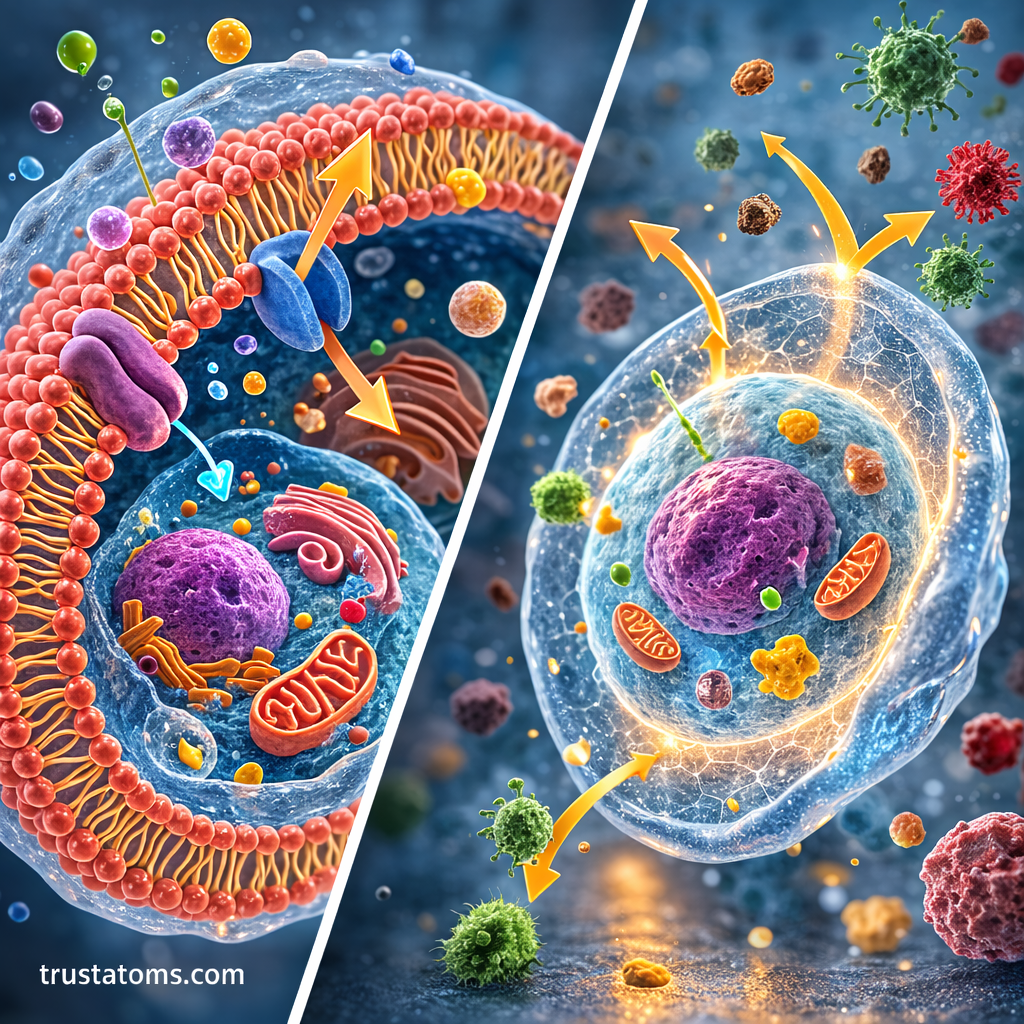
Cells move substances across the membrane through several mechanisms.
Passive Transport
Passive transport does not require energy from the cell. Instead, substances move naturally from areas of higher concentration to lower concentration.
Types of passive transport include:
- Diffusion – molecules move directly through the membrane
- Facilitated diffusion – molecules move through protein channels
- Osmosis – water moves across the membrane
Passive transport helps maintain equilibrium inside and outside the cell.
Active Transport
Active transport requires energy, usually in the form of ATP.
In this process, cells move substances against their concentration gradient, from areas of lower concentration to higher concentration.
Specialized proteins known as pumps carry out active transport.
This mechanism allows cells to maintain important chemical balances.
Vesicle Transport
Some materials are too large to pass through membrane proteins.
In these cases, cells use vesicles—small membrane-bound sacs—to move materials.
Examples include:
- Endocytosis, where the cell takes in substances
- Exocytosis, where the cell releases substances outside
These processes are essential for communication, secretion, and nutrient uptake.
The Fluid Mosaic Model
The structure of the cell membrane is often described using the fluid mosaic model.
This model explains that the membrane is:
- Fluid, meaning its components can move within the layer
- Mosaic, meaning it contains a variety of proteins, lipids, and carbohydrates arranged in a complex pattern
Because of this fluidity, the membrane can adapt to different conditions and maintain flexibility.
Why the Cell Membrane Is Essential for Life
The cell membrane performs several critical functions that support life.
These include:
- Protecting the internal components of the cell
- Regulating the exchange of materials
- Supporting cellular communication
- Maintaining homeostasis
- Allowing cells to interact with their environment
Without the cell membrane, cells would not be able to control their internal conditions, which would disrupt essential biological processes.
Cell Membranes in Different Organisms
Although all cells have membranes, their structure and composition can vary slightly among different organisms.
For example:
- Animal cells often contain cholesterol in their membranes
- Plant cells have membranes surrounded by rigid cell walls
- Bacterial membranes may contain different lipid compositions
Despite these differences, the fundamental structure of the phospholipid bilayer remains consistent across most living organisms.
Final Thoughts
The cell membrane is a vital structure that protects cells while allowing them to interact with their environment. Its phospholipid bilayer, embedded proteins, and selective permeability make it one of the most important components of cellular biology.
By controlling the movement of molecules and supporting communication between cells, the cell membrane helps maintain the balance necessary for life.
Studying the cell membrane provides valuable insight into how cells function, adapt, and survive within complex biological systems.