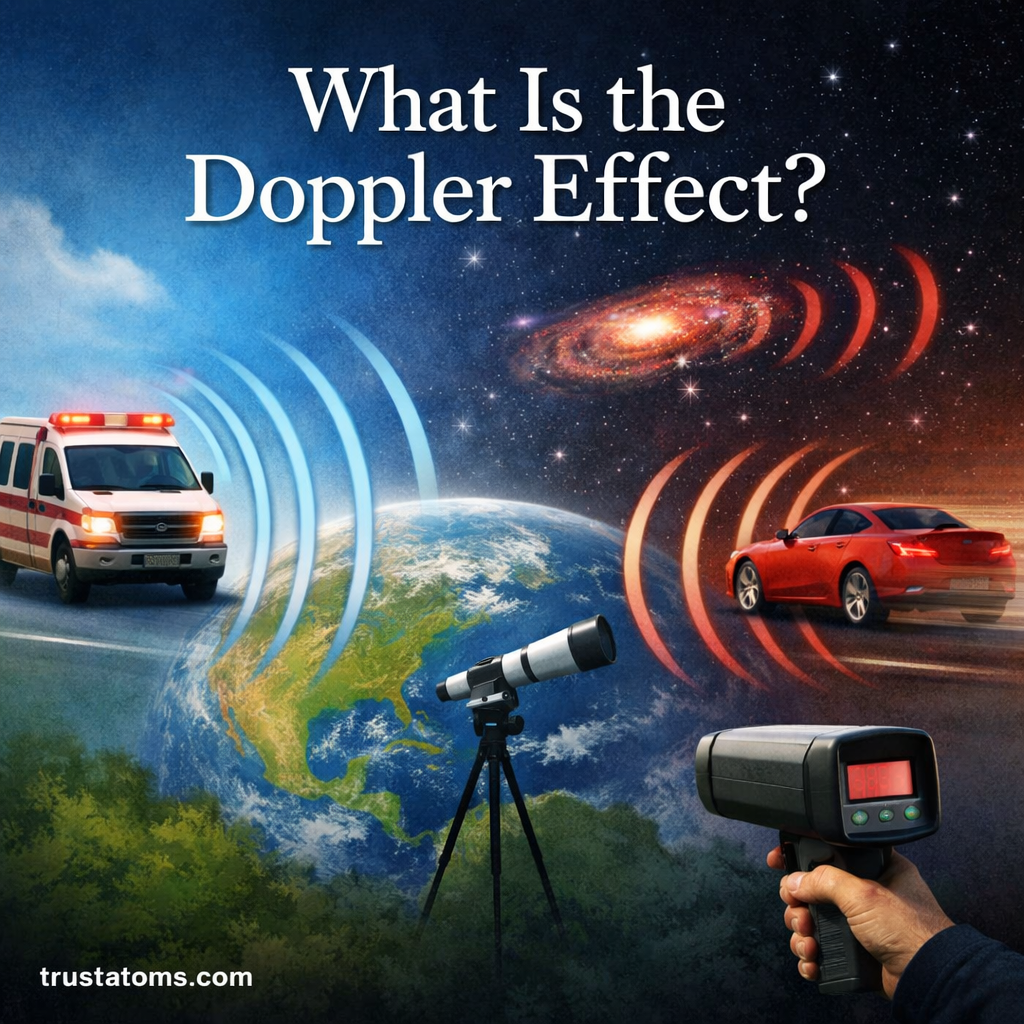
The Doppler Effect is the change in frequency (or wavelength) of a wave as the source of the wave and the observer move relative to each other.
You’ve experienced it many times — even if you didn’t realize it.
When an ambulance drives past you, the siren sounds higher-pitched as it approaches and lower-pitched as it moves away. That shift in sound is the Doppler Effect in action.
In this guide, you’ll learn:
- What the Doppler Effect is
- Why it happens
- Real-life examples
- How it applies to sound and light
- Why it matters in astronomy, weather, and medicine
What Is the Doppler Effect in Simple Terms?
The Doppler Effect occurs when waves are compressed or stretched due to motion.
If the source of waves moves toward you:
- Waves bunch up
- Wavelength becomes shorter
- Frequency increases
- Pitch (for sound) becomes higher
If the source moves away from you:
- Waves spread out
- Wavelength becomes longer
- Frequency decreases
- Pitch becomes lower
The key idea: motion changes how often wave crests reach you.
Why Does the Doppler Effect Happen?
Waves travel outward from a source in all directions.
When the source is moving:
- In front of the motion → waves get squeezed together
- Behind the motion → waves get stretched apart
Imagine tossing a ball into a calm lake while standing still. The ripples spread evenly in circles.
Now imagine walking forward while tossing balls regularly. The ripples in front of you overlap more closely. The ripples behind you are spaced farther apart.
The spacing between waves changes — and that spacing determines frequency.
The Doppler Effect and Sound Waves
Sound waves travel through air as vibrations.
When a sound source moves:
If it moves toward you:
- Sound waves compress
- You hear a higher pitch
If it moves away:
- Sound waves stretch
- You hear a lower pitch
Common examples:
- Ambulance sirens
- Passing motorcycles
- Race cars speeding by
- Trains blowing their horns
The faster the object moves, the more dramatic the pitch change.
The Doppler Effect and Light
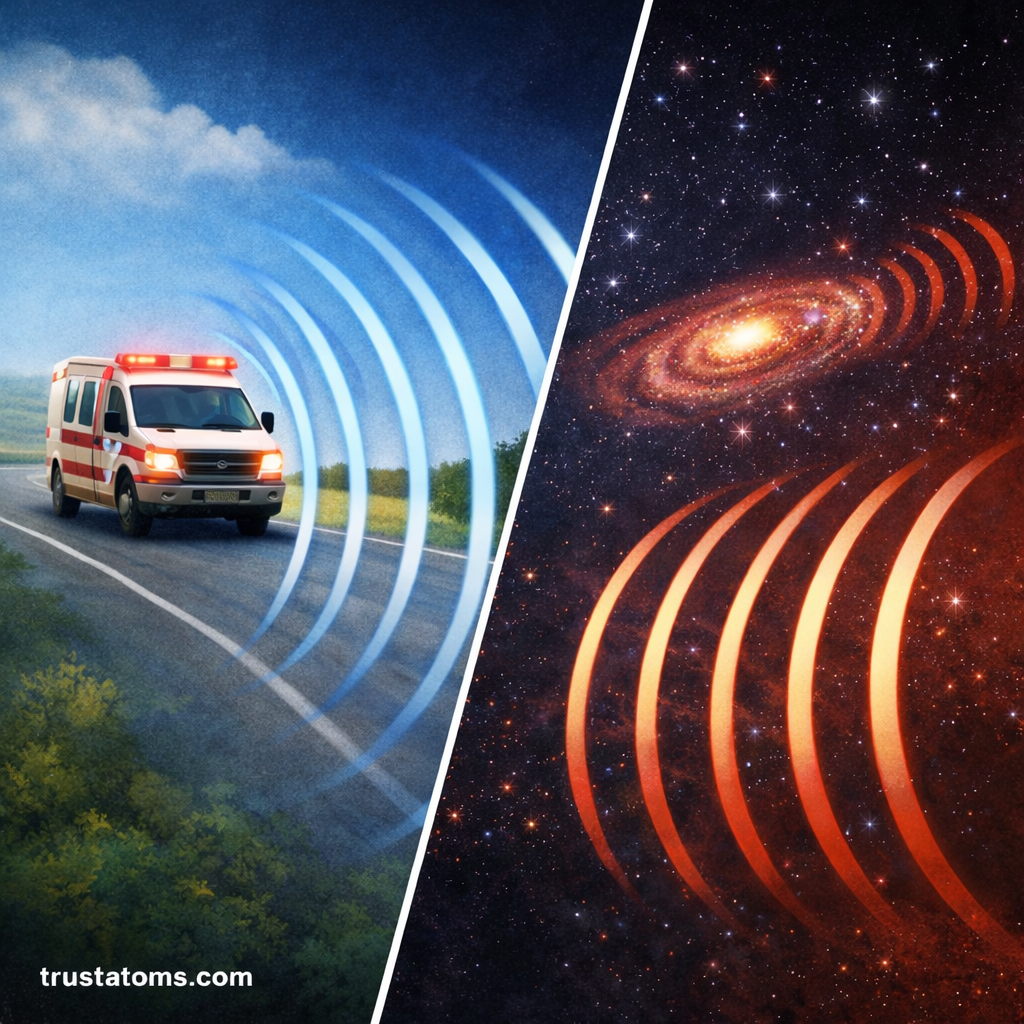
The Doppler Effect also applies to light — but instead of pitch, we observe color shifts.
Light has different wavelengths:
- Shorter wavelengths → blue light
- Longer wavelengths → red light
When a light source moves:
- Toward us → wavelengths shorten → blue shift
- Away from us → wavelengths lengthen → red shift
This is called:
- Blueshift (moving closer)
- Redshift (moving away)
Astronomers use redshift to determine how fast galaxies are moving away from Earth.
This discovery helped confirm that the universe is expanding.
Real-World Applications of the Doppler Effect
The Doppler Effect isn’t just a classroom concept — it’s used in modern technology.
1. Astronomy
Scientists measure redshift in distant galaxies to understand cosmic expansion.
2. Weather Radar
Meteorologists use Doppler radar to detect storm movement, wind speed, and tornado rotation.
3. Medical Imaging
Doppler ultrasound measures blood flow in arteries and veins.
It helps doctors detect:
- Blood clots
- Blockages
- Circulation problems
4. Police Radar Guns
Speed detectors use the Doppler shift of reflected radio waves to measure vehicle speed.
What Affects the Doppler Effect?
Several factors influence how noticeable the effect is:
- Speed of the source
- Speed of the observer
- Speed of the wave itself
- Direction of motion
If there is no relative motion between source and observer, there is no Doppler shift.
Doppler Effect vs. Actual Change in Frequency
Important distinction:
The source does not change the frequency it produces.
The change happens because of relative motion between the source and the observer.
This is why two different observers may hear different pitches from the same moving object.
Key Takeaways
- The Doppler Effect is a change in frequency caused by motion.
- It affects both sound and light waves.
- Approaching sources increase frequency.
- Receding sources decrease frequency.
- It plays a major role in astronomy, weather science, and medicine.
The Doppler Effect shows how motion shapes the way we perceive the world — from sirens on the street to galaxies billions of light-years away.
Frequently Asked Questions
Is the Doppler Effect only for sound?
No. It applies to all types of waves, including light and radio waves.
Why does pitch change when a car passes?
Because the sound waves compress as the car approaches and stretch as it moves away.
Does the Doppler Effect work in space?
Yes. Light waves from stars and galaxies shift depending on their motion relative to Earth.
Final Thoughts
The Doppler Effect is one of the clearest demonstrations of how motion affects perception.
It connects everyday experiences — like hearing a passing siren — to the largest discoveries in physics, including the expansion of the universe.
Understanding it helps explain not just sound, but how scientists measure motion across vast distances.