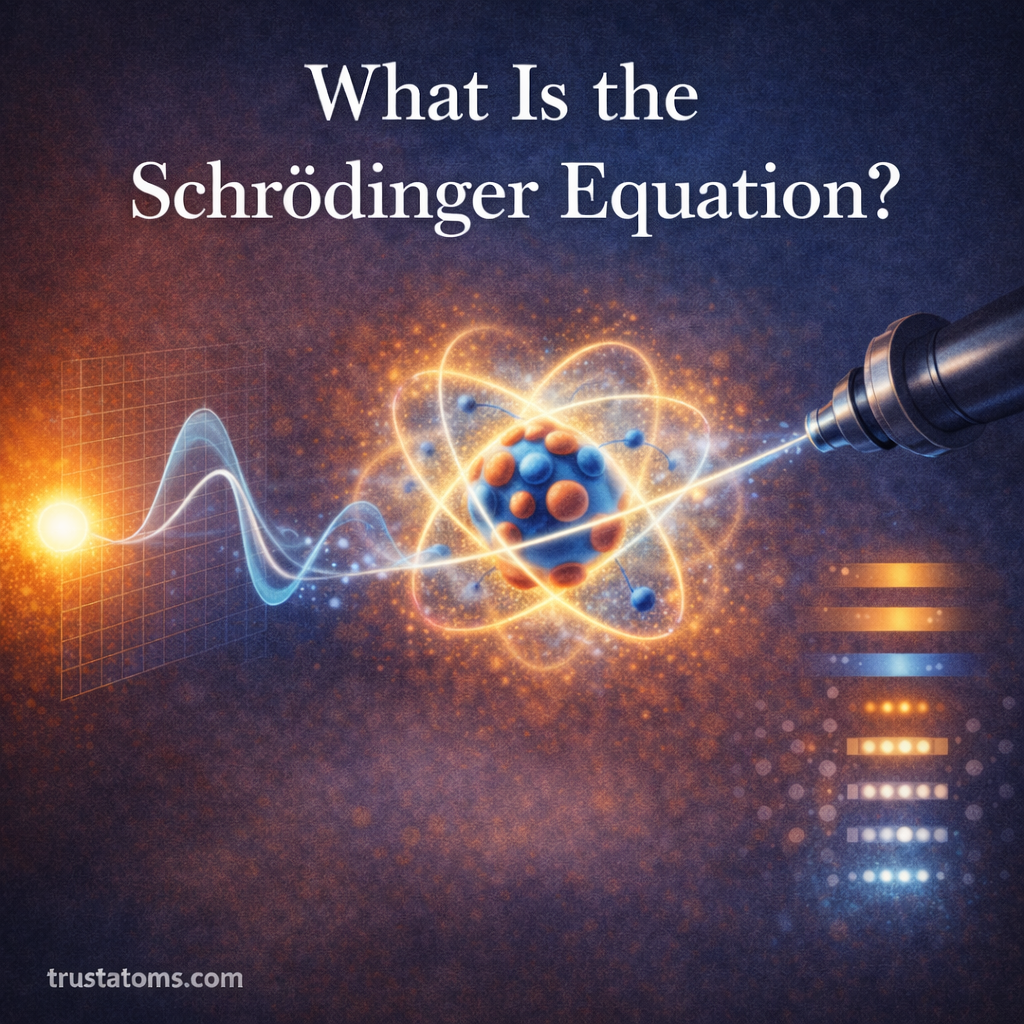
The Schrödinger equation is one of the most important equations in quantum mechanics. It describes how quantum systems — such as electrons, atoms, and molecules — behave over time.
In simple terms, the Schrödinger equation tells us how the wave function of a particle evolves. The wave function contains all the measurable information about a quantum system.
Just as Newton’s laws describe motion in classical physics, the Schrödinger equation describes motion at the atomic and subatomic scale.
Why the Schrödinger Equation Matters
In classical physics, we can predict exactly where a ball will land if we know its speed and direction.
In quantum physics, things work differently.
Instead of predicting exact positions, the Schrödinger equation allows us to calculate:
- The probability of finding a particle in a certain place
- The allowed energy levels of atoms
- How quantum systems change over time
Without this equation, modern physics — and much of modern technology — would not exist.
What Is a Wave Function?
The Schrödinger equation revolves around something called the wave function.
The wave function:
- Is usually represented by a symbol called psi
- Describes the state of a quantum system
- Contains information about position, energy, and momentum
Important: the wave function itself is not directly observable.
Instead, when we take the square of its magnitude, we get the probability of finding a particle at a specific location.
This is why quantum mechanics is fundamentally probabilistic rather than deterministic.
Time-Dependent vs. Time-Independent Forms
There are two main versions of the Schrödinger equation.
Time-Dependent Schrödinger Equation
This version describes how a quantum system evolves over time.
It is used when:
- A system is changing
- External forces are acting on it
- Energy is not fixed
This form helps physicists study dynamic quantum behavior.
Time-Independent Schrödinger Equation
This version is used when the system’s energy remains constant.
It is especially useful for:
- Atoms
- Molecules
- Quantum wells and barriers
It allows scientists to calculate discrete energy levels, such as the allowed energy states of an electron in an atom.
How the Schrödinger Equation Explains Atomic Structure
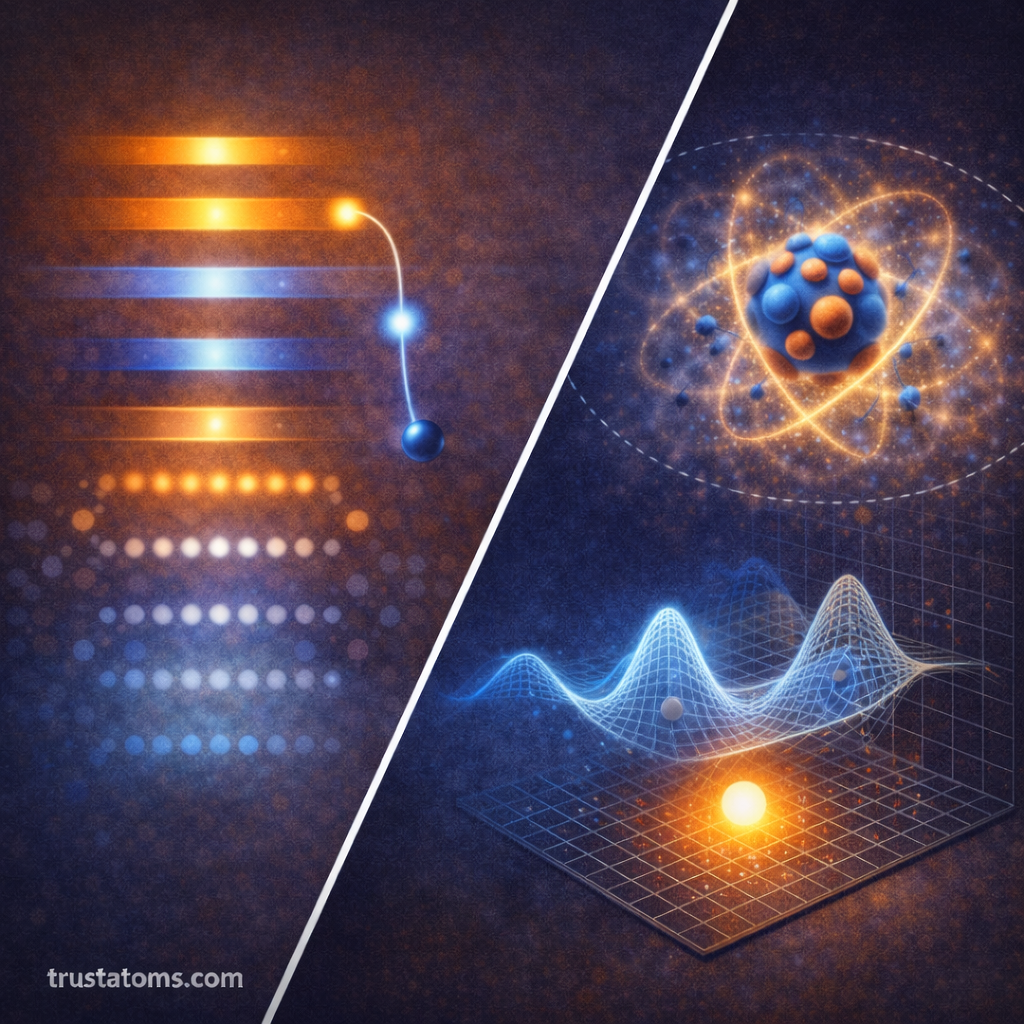
One of the biggest breakthroughs in physics came when scientists applied the Schrödinger equation to the hydrogen atom.
The results showed that:
- Electrons do not orbit the nucleus like planets.
- Instead, they exist in probability clouds.
- Only specific energy levels are allowed.
These allowed energy levels explain:
- Atomic emission and absorption spectra
- The structure of the periodic table
- Chemical bonding
The equation replaced earlier models and provided a much more accurate description of atomic behavior.
Key Concepts Behind the Equation
To understand the Schrödinger equation conceptually, it helps to know a few core ideas.
1. Quantization of Energy
Energy in quantum systems comes in discrete amounts.
Electrons cannot have just any energy. They can only occupy specific energy states.
2. Probability, Not Certainty
The equation does not give exact paths.
Instead, it provides probability distributions.
This means:
- We cannot know precisely where a particle is before measurement.
- We can calculate where it is most likely to be found.
3. Wave–Particle Duality
The Schrödinger equation mathematically supports wave–particle duality.
Particles such as electrons are treated as wave-like entities described by wave functions.
This framework explains interference and diffraction at the quantum scale.
Real-World Applications
The Schrödinger equation is not just theoretical. It underpins many modern technologies.
Electronics and Semiconductors
Understanding how electrons behave in materials allows engineers to design:
- Transistors
- Microchips
- Solar cells
Chemistry and Molecular Modeling
Chemists use quantum calculations based on the Schrödinger equation to predict:
- Molecular shapes
- Reaction rates
- Bond strengths
Medical Imaging and Lasers
Quantum principles derived from the equation contribute to:
- MRI technology
- Laser systems
- Advanced imaging tools
How It Changed Physics
Before quantum mechanics, classical physics could not explain:
- Atomic stability
- Blackbody radiation
- The photoelectric effect
The Schrödinger equation helped resolve these mysteries.
It became one of the central pillars of 20th-century physics, alongside:
- Relativity
- Quantum field theory
It shifted our understanding of nature from certainty to probability.
Common Misconceptions
There are several misunderstandings about the Schrödinger equation.
- It does not describe cats being alive and dead at the same time (that is a thought experiment).
- It does not mean reality is purely random.
- It does not eliminate physical laws.
Instead, it provides a precise mathematical framework for predicting quantum behavior.
The Big Picture
The Schrödinger equation is the foundational equation of non-relativistic quantum mechanics.
It:
- Describes how quantum systems evolve
- Determines allowed energy levels
- Predicts probability distributions
- Explains atomic and molecular structure
Although the full mathematics can be complex, the core idea is powerful and elegant: at the smallest scales, nature is governed by wave functions and probabilities rather than definite trajectories.
Understanding the Schrödinger equation opens the door to understanding the quantum world.