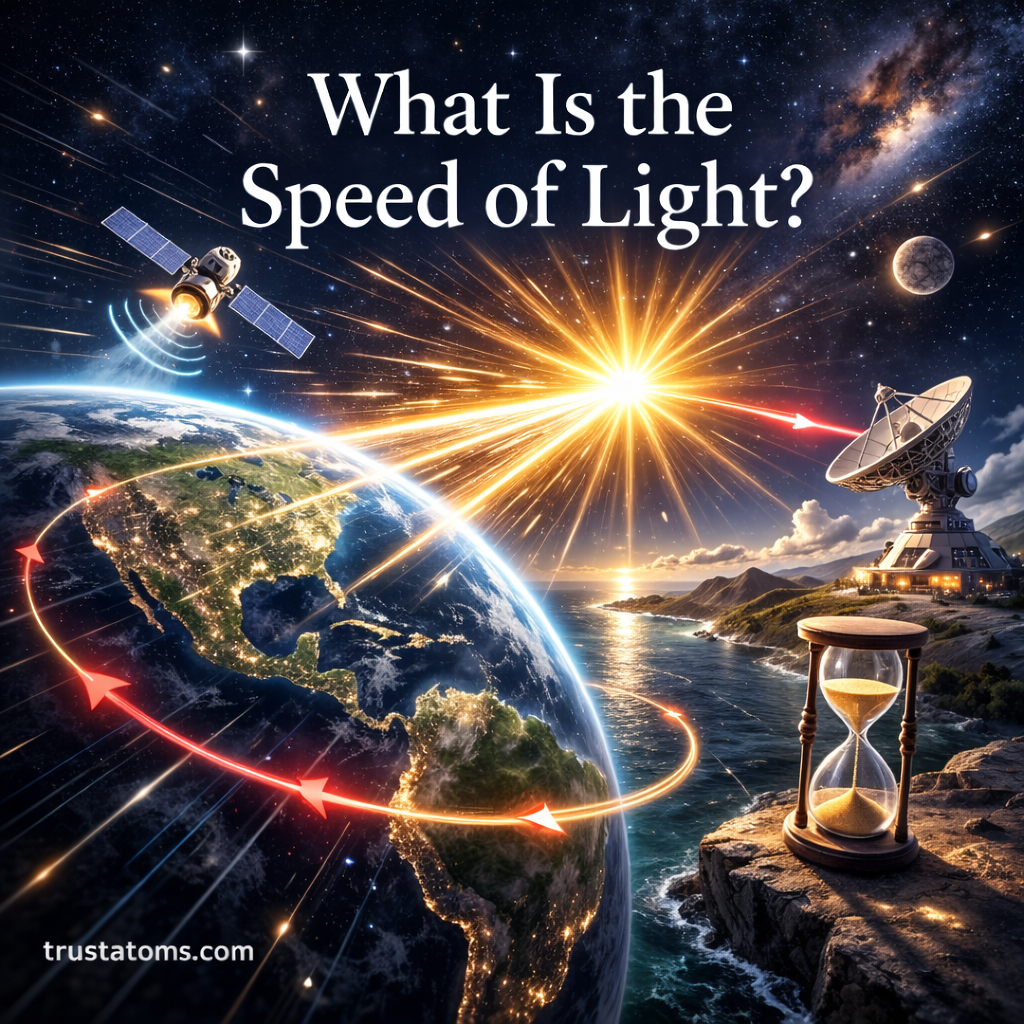
The speed of light is one of the most important constants in physics. It represents the maximum speed at which energy, information, and matter can travel in the universe.
In a vacuum, light travels at approximately:
299,792,458 meters per second
That’s about 300,000 kilometers per second or 186,282 miles per second.
To put that into perspective, light can travel around the Earth more than seven times in just one second.
What Is the Speed of Light in Simple Terms?
The speed of light is how fast light moves through empty space.
It is often represented by the letter “c” in physics.
What makes it extraordinary is this:
Nothing can travel faster than the speed of light in a vacuum.
This limit is a cornerstone of modern physics.
Why Is the Speed of Light So Important?
The speed of light plays a central role in:
- Special relativity
- General relativity
- Electromagnetism
- Cosmology
It connects space and time and defines the structure of the universe.
One of the most famous equations in science includes the speed of light:
E = mc²
This equation shows that mass can be converted into energy, with the speed of light squared acting as the conversion factor.
Does Light Always Travel at the Same Speed?
In a vacuum, yes.
The speed of light in empty space is constant and does not change.
However, light can slow down when traveling through materials like:
- Water
- Glass
- Air
This slowing happens because light interacts with atoms in the material. But even then, it never exceeds its vacuum speed.
How Was the Speed of Light Measured?
Scientists once believed light traveled instantaneously. Over time, experiments proved otherwise.
Early Observations
In the 17th century, astronomers observed delays in the motion of Jupiter’s moons, suggesting light had a finite speed.
Laboratory Measurements
Later experiments used rotating mirrors and precise timing methods to measure light’s speed more accurately.
Modern Definition
Today, the speed of light is defined exactly as:
299,792,458 meters per second
In fact, the meter itself is defined based on how far light travels in a fraction of a second.
Why Can’t Anything Go Faster Than Light?
According to special relativity:
- As an object moves faster, its energy increases.
- As it approaches the speed of light, its required energy grows dramatically.
- Reaching the speed of light would require infinite energy.
Because infinite energy is not physically attainable, nothing with mass can reach or exceed the speed of light.
The Speed of Light and Time
The speed of light is deeply connected to time.
When objects move close to the speed of light:
- Time slows down (time dilation)
- Length contracts
- Mass effectively increases
These effects are measurable and have been confirmed in particle accelerators and satellite systems.
The Speed of Light in Space and the Universe
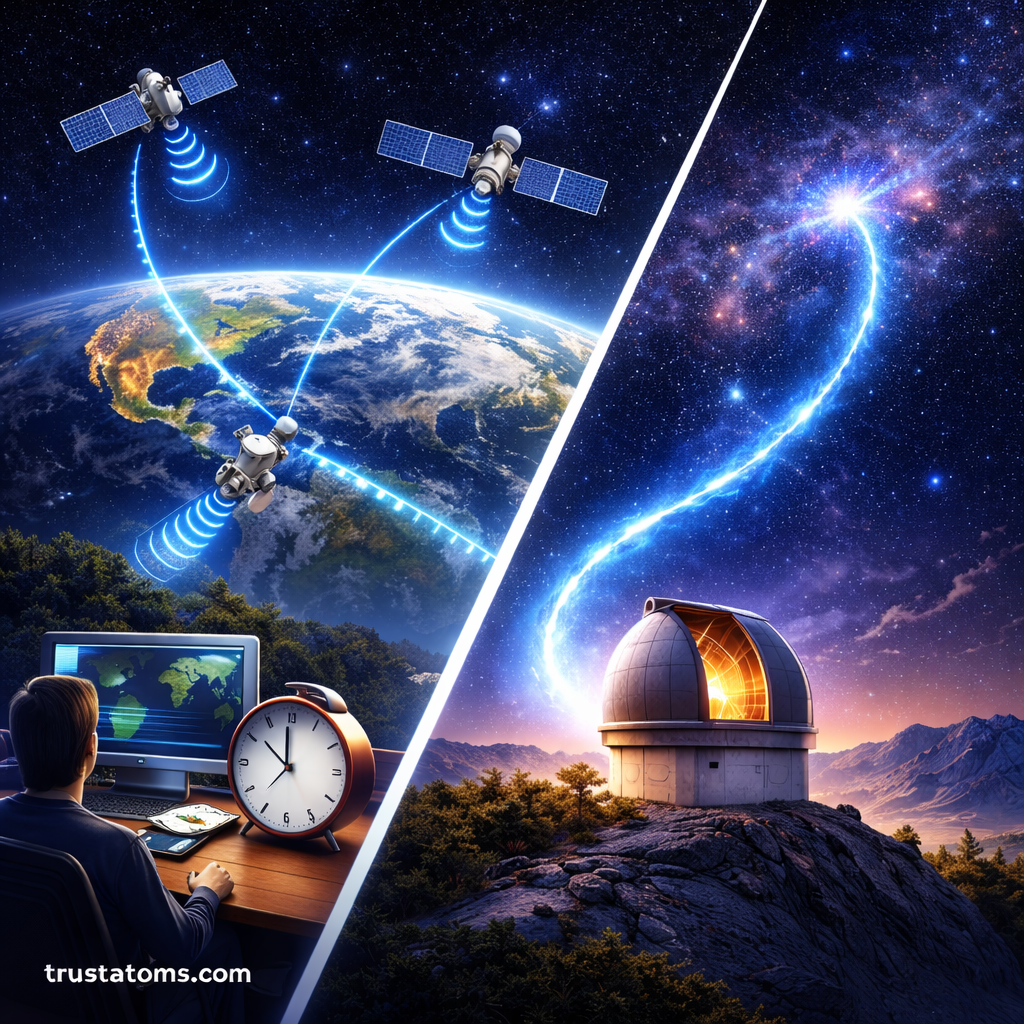
Because light has a finite speed, we see distant objects as they were in the past.
For example:
- The Sun’s light takes about 8 minutes to reach Earth.
- Light from distant stars can take years to arrive.
- Light from distant galaxies can take billions of years to reach us.
This means telescopes allow us to look back in time.
Light-Years Explained
A light-year is not a measure of time — it is a measure of distance.
One light-year equals the distance light travels in one year.
It equals about:
9.46 trillion kilometers
5.88 trillion miles
Astronomers use light-years to describe distances between stars and galaxies.
Practical Applications of the Speed of Light
The speed of light is not just theoretical — it affects everyday technology.
GPS Systems
Satellite communication depends on precise timing based on light-speed signals.
Fiber Optic Internet
Data travels as light pulses through optical cables.
Space Communication
Signals sent to spacecraft travel at the speed of light.
Even small delays matter when communicating across millions of kilometers.
Common Misconceptions
There are several misunderstandings about the speed of light.
It does not mean:
- Light is infinitely fast.
- Objects can casually “break” the speed limit.
- Science fiction faster-than-light travel is currently possible.
While some theoretical ideas explore exotic possibilities, no confirmed evidence shows anything exceeding light speed.
Why the Speed of Light Matters
The speed of light defines:
- The ultimate cosmic speed limit
- The structure of spacetime
- The relationship between mass and energy
- The scale of the observable universe
Without this constant, modern physics would not function as we know it.
It shapes everything from atomic behavior to galaxy formation.
Final Thoughts
The speed of light — approximately 299,792,458 meters per second — is one of the most fundamental constants in science.
It represents the maximum speed at which information and energy can travel in a vacuum. It connects space and time, limits motion in the universe, and forms the backbone of relativity.
From GPS navigation to understanding distant galaxies, the speed of light influences both everyday life and the deepest questions about the universe.
Understanding it is key to understanding modern physics itself.