Chemical reactions do more than transform substances. They also involve energy changes, often in the form of heat. The branch of chemistry that studies these energy changes is called thermochemistry.
Thermochemistry focuses on how heat is absorbed or released during chemical reactions and physical processes. Understanding these energy changes helps scientists explain reaction behavior, design industrial processes, and study natural systems ranging from metabolism to climate chemistry.
Definition of Thermochemistry
Thermochemistry is the branch of chemistry that studies the heat energy released or absorbed during chemical reactions and physical changes.
When substances react, energy stored in chemical bonds is either:
- Released into the surroundings
- Absorbed from the surroundings
Thermochemistry helps measure and predict these energy changes.
In simple terms, thermochemistry answers questions such as:
- Does a reaction release heat or absorb it?
- How much energy is involved?
- How does energy affect reaction direction and stability?
Heat and Energy in Chemical Reactions
Chemical reactions involve the breaking and forming of chemical bonds.
Two key energy processes occur:
- Breaking bonds requires energy
- Forming bonds releases energy
The overall heat change of a reaction depends on the balance between these two processes.
If more energy is released than absorbed, the reaction releases heat. If more energy is absorbed, the reaction takes in heat from its surroundings.
This balance determines the reaction’s thermochemical behavior.
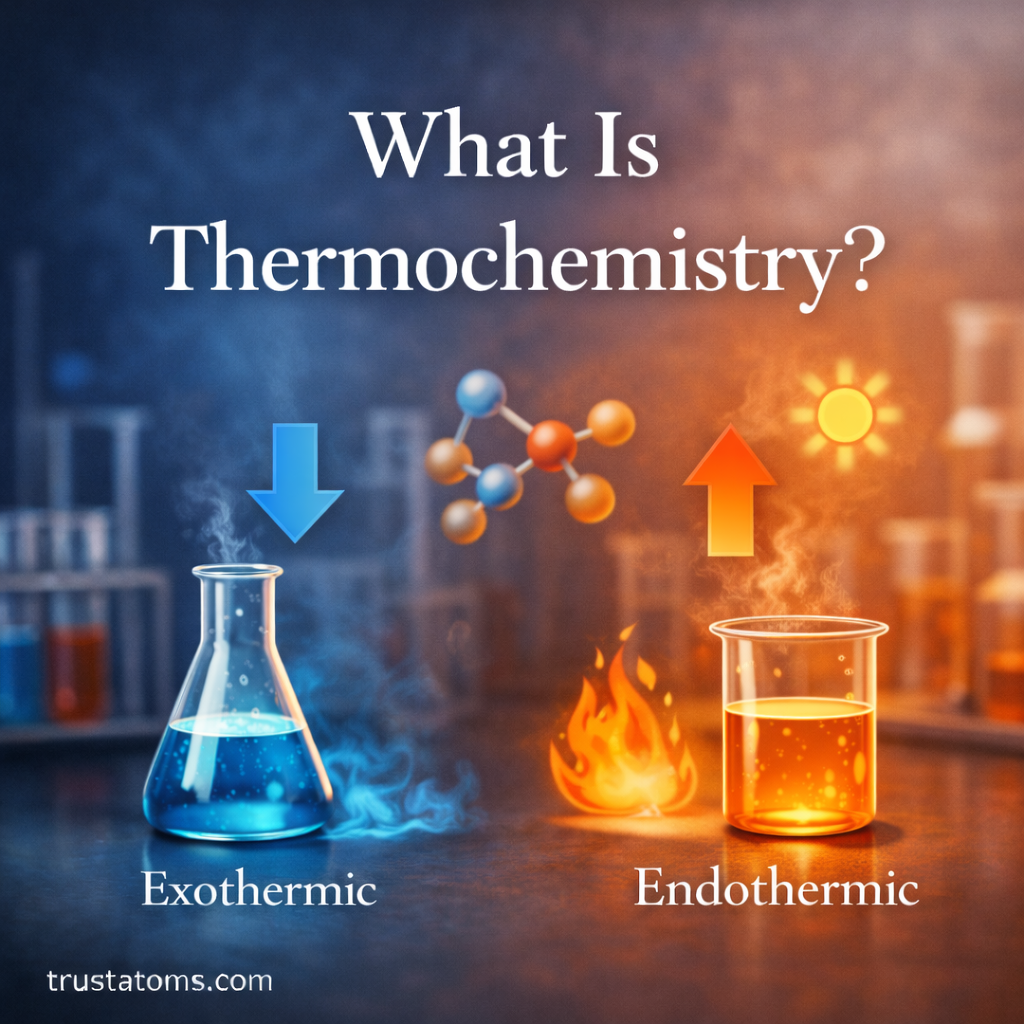
Exothermic Reactions
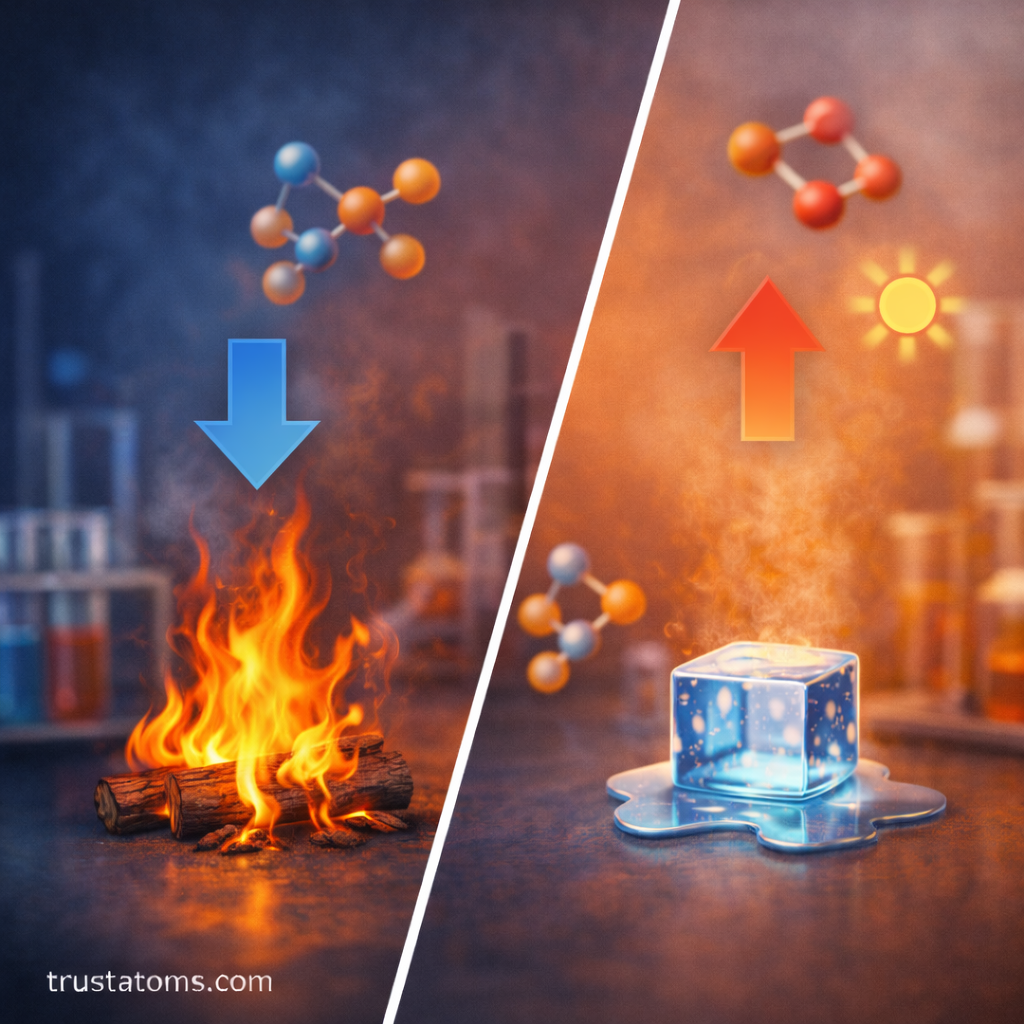
An exothermic reaction releases heat into the surrounding environment.
These reactions transfer energy outward, often causing the surroundings to warm up.
Characteristics of Exothermic Reactions
- Heat is released
- The surroundings become warmer
- Energy leaves the reacting system
Common Examples
Examples of exothermic reactions include:
- Combustion of fuels
- Burning wood
- Neutralization reactions between acids and bases
- Many metabolic reactions in living organisms
For example, when natural gas burns in a stove, the chemical reaction releases heat that can be used for cooking.
Endothermic Reactions
An endothermic reaction absorbs heat from the surroundings.
These reactions require an input of energy to occur.
Characteristics of Endothermic Reactions
- Heat is absorbed
- The surroundings become cooler
- Energy enters the reacting system
Common Examples
Endothermic reactions occur in processes such as:
- Photosynthesis in plants
- Melting ice
- Evaporation of water
- Certain chemical decompositions
For example, photosynthesis absorbs energy from sunlight to convert carbon dioxide and water into glucose and oxygen.
Enthalpy and Heat Change
Thermochemistry often uses a quantity called enthalpy, symbolized by H, to measure heat changes in reactions.
The change in enthalpy during a reaction is called enthalpy change, written as ΔH.
What Enthalpy Change Indicates
- Negative ΔH → Exothermic reaction (heat released)
- Positive ΔH → Endothermic reaction (heat absorbed)
Enthalpy change helps scientists quantify the energy involved in chemical processes.
Because most reactions occur at constant pressure, enthalpy is a practical way to track heat flow in chemistry.
Measuring Heat in Chemical Reactions
Scientists measure heat changes using a device called a calorimeter.
A calorimeter is designed to:
- Isolate a chemical reaction
- Measure temperature changes
- Calculate heat transfer
Basic Calorimetry Process
- A reaction occurs inside a controlled container.
- The temperature of the surrounding medium is recorded.
- The heat change is calculated from the temperature difference.
Calorimetry is widely used in chemistry laboratories to study reaction energetics.
Thermochemistry in Everyday Life
Thermochemical processes occur constantly in daily life.
Examples include:
- Burning gasoline in car engines
- Cooking food
- Battery operation
- Body metabolism
- Industrial fuel combustion
In each case, chemical reactions release or absorb energy that can be used for practical purposes.
Understanding thermochemistry helps engineers design efficient energy systems and helps scientists study environmental impacts.
Applications of Thermochemistry
Thermochemistry plays an important role across many scientific and industrial fields.
Industrial Chemistry
Industries use thermochemical data to:
- Design efficient chemical manufacturing processes
- Optimize fuel combustion
- Improve energy efficiency
Environmental Science
Thermochemistry helps scientists study:
- Atmospheric reactions
- Energy cycles in ecosystems
- Climate-related chemical processes
Biological Systems
Living organisms depend on thermochemical reactions for:
- Cellular respiration
- Metabolism
- Energy transfer within cells
These reactions allow organisms to convert chemical energy into usable biological energy.
Why Thermochemistry Is Important
Thermochemistry provides insight into the energy side of chemical reactions.
This knowledge allows scientists to:
- Predict whether reactions will release or absorb heat
- Understand how energy affects reaction stability
- Design safer chemical processes
- Improve industrial energy efficiency
By studying how energy moves during chemical reactions, thermochemistry connects chemistry with physics, biology, engineering, and environmental science.
Key Takeaways
Thermochemistry is the study of heat changes during chemical reactions and physical processes.
Important ideas include:
- Chemical reactions involve energy transfer
- Exothermic reactions release heat
- Endothermic reactions absorb heat
- Enthalpy (ΔH) measures heat change in reactions
- Calorimetry allows scientists to measure reaction heat
Thermochemistry helps explain how energy flows through chemical systems, making it a fundamental part of chemistry.