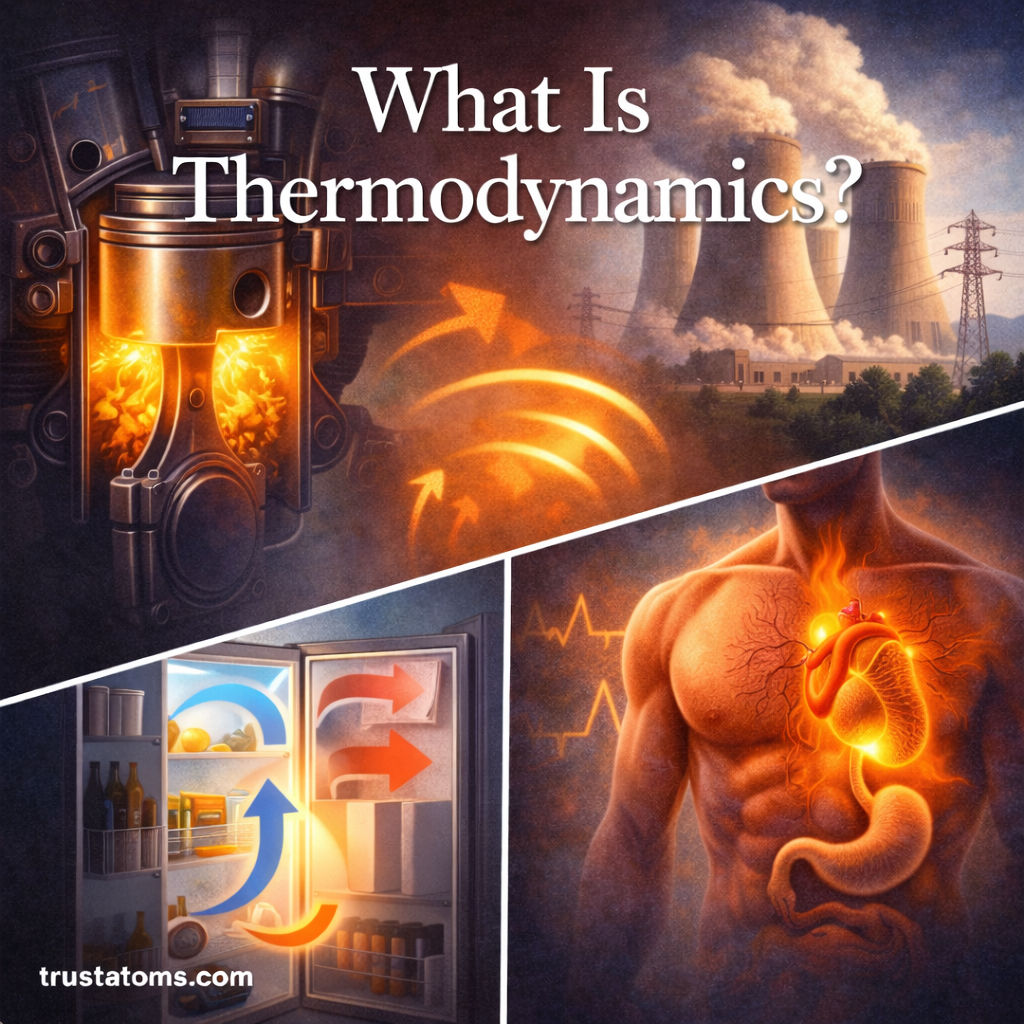
Thermodynamics is the branch of physics that studies heat, energy, temperature, and how they relate to work and matter.
In simple terms:
Thermodynamics explains how energy moves and transforms.
It helps us understand engines, refrigerators, power plants, the human body, and even the universe itself.
In this guide, you’ll learn:
- What thermodynamics is
- The four laws of thermodynamics
- Real-world examples
- Why it matters in science and engineering
What Is Thermodynamics in Simple Terms?
Thermodynamics studies how energy transfers between systems.
Energy can:
- Move from one object to another
- Change from one form to another
- Be stored within a system
For example:
- A stove transfers heat to a pan.
- A car engine converts heat into motion.
- Your body converts food into usable energy.
Thermodynamics provides the rules governing these processes.
Key Concepts in Thermodynamics
Before understanding the laws, it helps to know a few core ideas.
1. Energy
Energy is the ability to do work.
It exists in many forms:
- Thermal energy (heat)
- Kinetic energy (motion)
- Potential energy (stored energy)
- Chemical energy
- Electrical energy
2. Heat
Heat is energy transferred because of temperature difference.
Heat always flows naturally from:
Hot → Cold
3. Work
Work occurs when energy causes motion.
For example:
- Gas expanding inside an engine pushes a piston.
- Steam turns a turbine in a power plant.
4. System and Surroundings
In thermodynamics, we study a “system” (what we focus on) and everything outside it (the surroundings).
Examples of systems:
- A cup of coffee
- A car engine
- A living cell
- The atmosphere
The Four Laws of Thermodynamics
Thermodynamics is built on four fundamental laws.
Zeroth Law of Thermodynamics
If two systems are each in thermal equilibrium with a third system, they are in thermal equilibrium with each other.
In simpler terms:
If A and B have the same temperature as C, then A and B have the same temperature.
This law defines temperature.
It explains how thermometers work.
First Law of Thermodynamics
Energy cannot be created or destroyed — only transferred or transformed.
This is the law of conservation of energy.
Energy may change forms, such as:
- Heat → Motion
- Chemical → Electrical
- Electrical → Light
But the total amount of energy remains constant.
Example:
In a car engine:
- Fuel’s chemical energy becomes heat.
- Heat becomes mechanical motion.
- Some energy is lost as waste heat.
Second Law of Thermodynamics
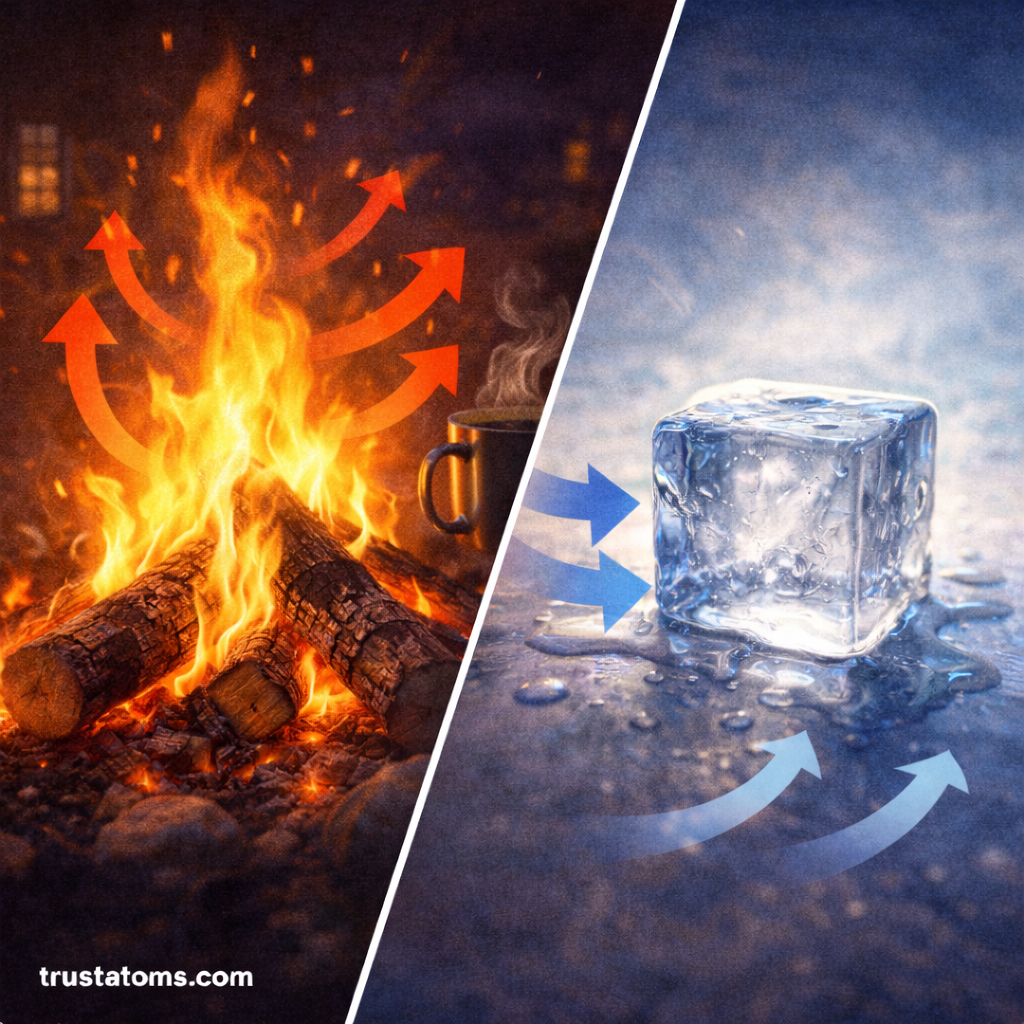
Energy transfers increase entropy (disorder).
This means:
- Heat flows naturally from hot to cold.
- No process is 100% efficient.
- Some energy always spreads out or becomes less useful.
Example:
A hot cup of coffee cools down.
It never spontaneously becomes hotter on its own.
The Second Law explains why:
- Perpetual motion machines are impossible.
- Engines always lose some energy.
- The universe tends toward greater disorder over time.
Third Law of Thermodynamics
As temperature approaches absolute zero, entropy approaches a minimum.
Absolute zero is the lowest possible temperature.
At this point:
- Molecular motion nearly stops.
- Disorder is minimized.
Absolute zero cannot be fully reached in practice.
Real-World Examples of Thermodynamics
Thermodynamics isn’t abstract — it’s everywhere.
1. Engines
Car engines convert fuel into motion using thermodynamic cycles.
2. Refrigerators and Air Conditioners
They remove heat from inside a space and release it outside.
Heat flows against its natural direction — but only because work (electricity) is applied.
3. Power Plants
Steam turbines convert thermal energy into electrical energy.
4. Human Metabolism
Your body follows thermodynamic principles:
- Food → Chemical energy
- Chemical energy → Motion + Heat
You constantly release heat to your surroundings.
Why Thermodynamics Matters
Thermodynamics helps us:
- Design efficient engines
- Build sustainable energy systems
- Understand climate systems
- Improve refrigeration and heating
- Study black holes and cosmology
It bridges physics, chemistry, engineering, and biology.
Common Misconceptions About Thermodynamics
Misconception 1: Energy Gets “Used Up”
Energy doesn’t disappear.
It transforms — often into less useful forms like dispersed heat.
Misconception 2: The Second Law Means Everything Is Falling Apart
The Second Law describes overall trends in disorder.
Local order can still increase (like life forming), as long as total entropy increases elsewhere.
Key Takeaways
- Thermodynamics studies heat, energy, and work.
- The First Law states energy is conserved.
- The Second Law introduces entropy and limits efficiency.
- The Third Law describes behavior near absolute zero.
- Thermodynamics governs engines, biology, and the universe.
It provides the foundational rules for how energy behaves.
Final Thoughts
Thermodynamics is one of the most powerful frameworks in physics.
It explains why engines work, why ice melts, why coffee cools, and why stars burn.
By understanding thermodynamics, we understand the limits and possibilities of energy itself.
From everyday appliances to the fate of the universe, thermodynamics sets the rules.