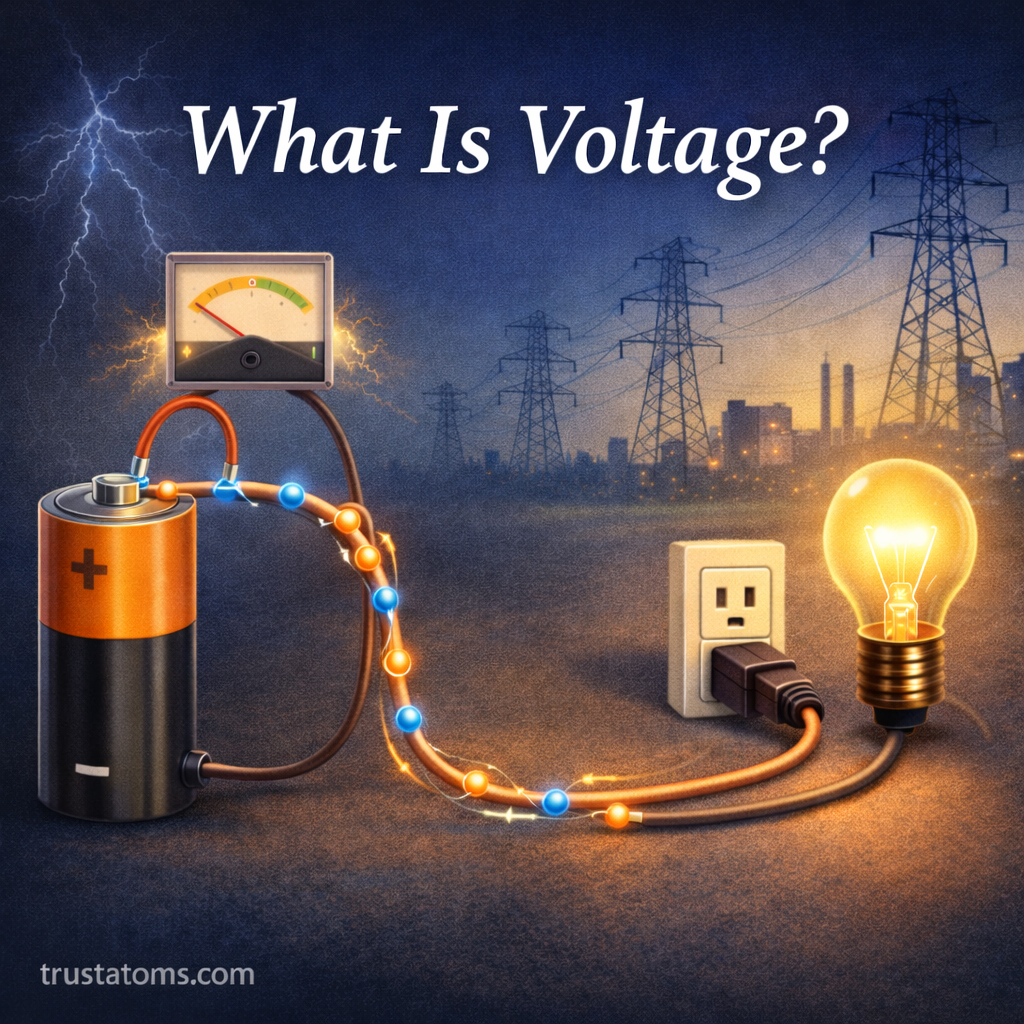
Voltage is one of the most important concepts in physics and electricity. It’s what makes electric current move, powers your devices, and allows energy to flow through circuits.
But what exactly is voltage?
In simple terms, voltage is the electrical “pressure” that pushes electric charge through a circuit.
Let’s explore what that really means and why it matters.
The Basic Definition of Voltage
Voltage is defined as:
The difference in electric potential between two points.
It tells us how much energy each unit of electric charge carries as it moves between those two points.
The standard unit of voltage is the volt (V), named after Italian physicist Alessandro Volta.
One volt means that one joule of energy is transferred per coulomb of charge.
What Does Voltage Actually Do?
Voltage does not flow.
Instead, it causes electric current to flow.
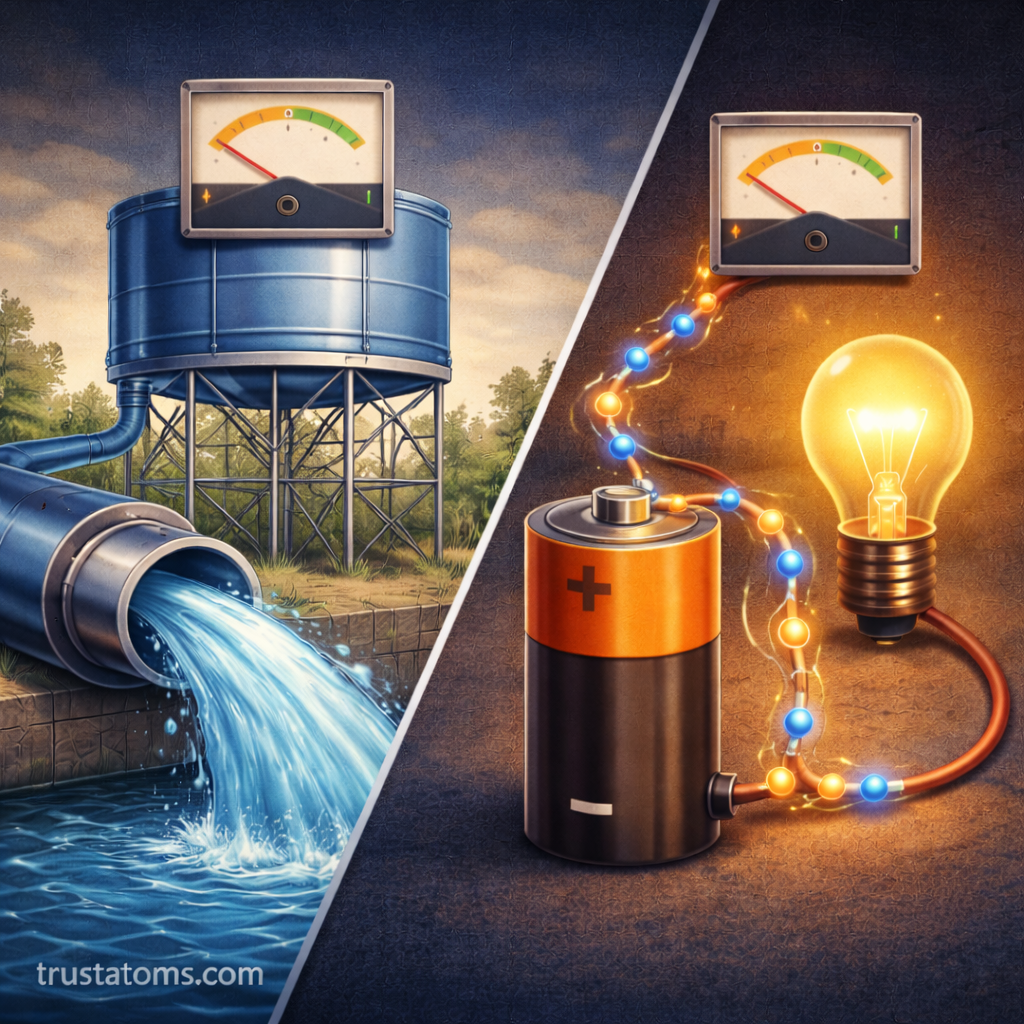
Think of it like water pressure in a pipe:
- Voltage = water pressure
- Current = water flow
- Resistance = pipe size or blockage
Higher pressure pushes more water.
Higher voltage pushes more electric charge.
Without voltage, electrons in a wire move randomly.
With voltage applied, they move in an organized direction — creating electric current.
How Voltage Is Created
Voltage is produced whenever there is a difference in electric potential energy between two points.
Common sources of voltage include:
- Batteries
- Power plants
- Solar panels
- Generators
For example, a battery creates voltage through chemical reactions inside it. These reactions separate positive and negative charges, creating a potential difference between its terminals.
When connected to a circuit, that difference pushes electrons through the wire.
The Formula for Voltage
Voltage can be defined mathematically as:
V = W / Q
Where:
- V = voltage (volts)
- W = energy (joules)
- Q = electric charge (coulombs)
This tells us that voltage measures how much energy each unit of charge carries.
You don’t need to memorize the formula to understand the concept — just remember:
Voltage = energy per charge.
Voltage and Electric Current
Voltage and current are closely related but not the same thing.
- Voltage is the push.
- Current is the flow.
They are connected by Ohm’s Law:
V = I × R
Where:
- V = voltage
- I = current
- R = resistance
From this relationship:
- Increasing voltage increases current (if resistance stays the same).
- Increasing resistance reduces current (if voltage stays the same).
This principle is fundamental in circuit design and electrical engineering.
Types of Voltage
There are two main types of voltage used in electrical systems.
Direct Voltage (DC Voltage)
Direct voltage remains constant over time.
Examples:
- Batteries (AA, AAA, car batteries)
- Phone chargers (internally converted to DC)
- Solar panels
In DC systems, the polarity does not change.
Alternating Voltage (AC Voltage)
Alternating voltage changes direction periodically.
Examples:
- Household wall outlets
- Electrical grids
- Large appliances
In the United States, household electricity alternates at 60 cycles per second (60 Hz).
AC voltage is efficient for transmitting power over long distances.
How Voltage Is Measured
Voltage is measured using a device called a voltmeter.
Important measurement rule:
- A voltmeter is connected in parallel with the component being measured.
Voltage levels vary widely:
- 1.5 volts → AA battery
- 9 volts → rectangular battery
- 120 volts → U.S. household outlets
- Thousands of volts → power transmission lines
Higher voltage does not automatically mean more danger — current and exposure matter too.
Why Voltage Matters
Voltage determines:
- How much energy devices receive
- Whether a circuit will operate properly
- How efficiently electricity can be transmitted
- The performance of motors, lights, and electronics
Too little voltage:
- Devices may not work correctly.
Too much voltage:
- Components can overheat or fail.
Engineers carefully design circuits to operate within specific voltage ranges.
Common Misconceptions About Voltage
Here are a few common misunderstandings:
“Voltage is electricity.”
Voltage is not electricity itself.
It is the force that drives electric current.
“Higher voltage always means more power.”
Power depends on both voltage and current.
Power formula:
P = V × I
A system can have high voltage but low current, or vice versa.
“Voltage moves through a wire.”
Voltage is a difference between two points — it does not “travel” like current does.
Simple Summary
Voltage is:
- The electric potential difference between two points
- Measured in volts
- Responsible for pushing electric charge
- Essential for powering circuits
- Closely related to current and resistance
Without voltage, electric current would not exist.
Final Thoughts
Voltage is one of the foundational ideas in physics and electrical science. It represents stored electrical energy and the force that drives current through a circuit.
Understanding voltage helps you better grasp:
- How batteries work
- Why appliances need specific power ratings
- How electricity travels from power plants to homes
- The relationship between energy, current, and resistance
Whether you’re studying physics or simply curious about how everyday devices operate, voltage is a concept worth mastering.