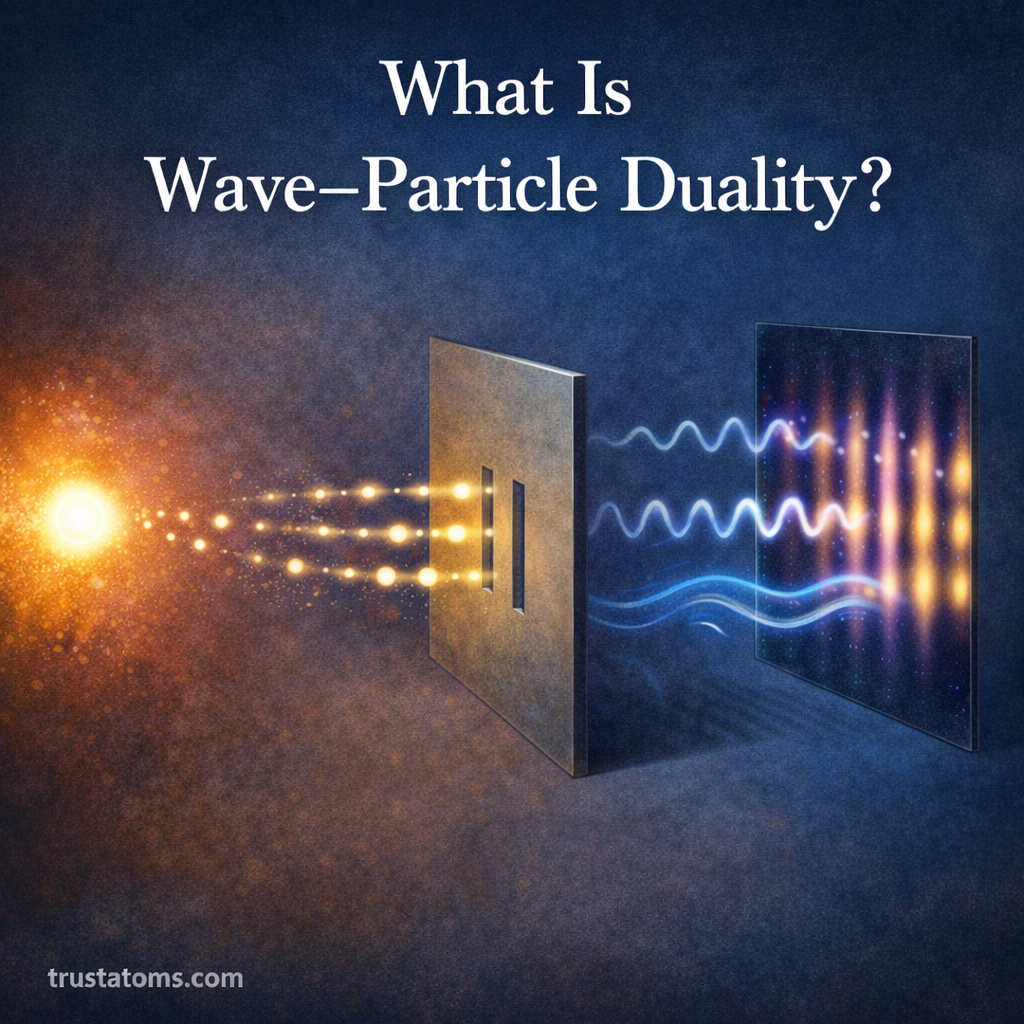
Wave–particle duality is a fundamental concept in quantum physics stating that light and matter can behave both like waves and like particles.
In everyday life, waves and particles seem completely different. Water waves spread out and interfere. Particles like baseballs move along clear paths. But at the atomic and subatomic scale, nature does not follow our everyday intuition.
Wave–particle duality shows that light and tiny particles such as electrons do not fit neatly into one category.
The Classical View: Waves vs. Particles
Before quantum physics, scientists believed waves and particles were separate.
Waves
Waves:
- Spread out over space
- Show interference and diffraction
- Carry energy without carrying matter across long distances
Examples include sound waves and water waves.
Particles
Particles:
- Have definite positions
- Travel along specific paths
- Collide like tiny solid objects
Examples include grains of sand or planets.
For centuries, light was debated. Was it a wave or a particle? The answer turned out to be: both.
Light as a Wave
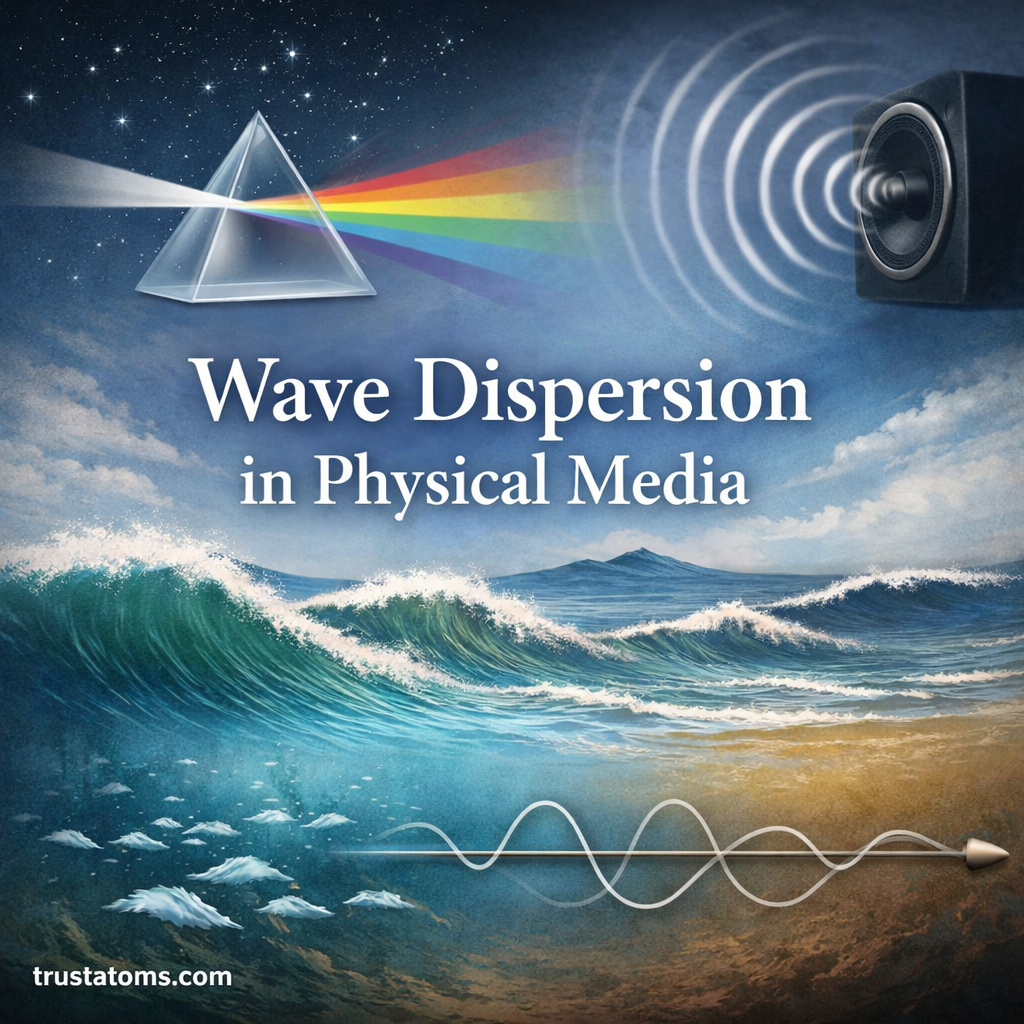
In the 1800s, experiments showed that light behaves like a wave.
The most famous evidence came from interference patterns. When light passes through two narrow slits, it creates a pattern of bright and dark bands on a screen.
This pattern only makes sense if light waves overlap and interfere with each other.
This supported the wave theory of light.
Light as a Particle
In the early 1900s, new experiments challenged the wave-only idea.
The photoelectric effect showed that light can knock electrons out of metal surfaces. But it did not behave like a smooth wave of energy.
Instead:
- Light delivered energy in tiny packets.
- Below a certain frequency, no electrons were released, no matter how intense the light was.
These energy packets are called photons.
This experiment demonstrated that light behaves like a stream of particles.
Matter as a Wave
Wave–particle duality does not apply only to light.
In 1924, physicist Louis de Broglie proposed that particles such as electrons should also have wave properties.
This idea was later confirmed by experiments showing that electrons can create interference patterns, just like light waves.
This means:
- Electrons can behave like particles when detected.
- Electrons can behave like waves when not directly observed.
Even atoms and small molecules show wave behavior under the right conditions.
The Double-Slit Experiment
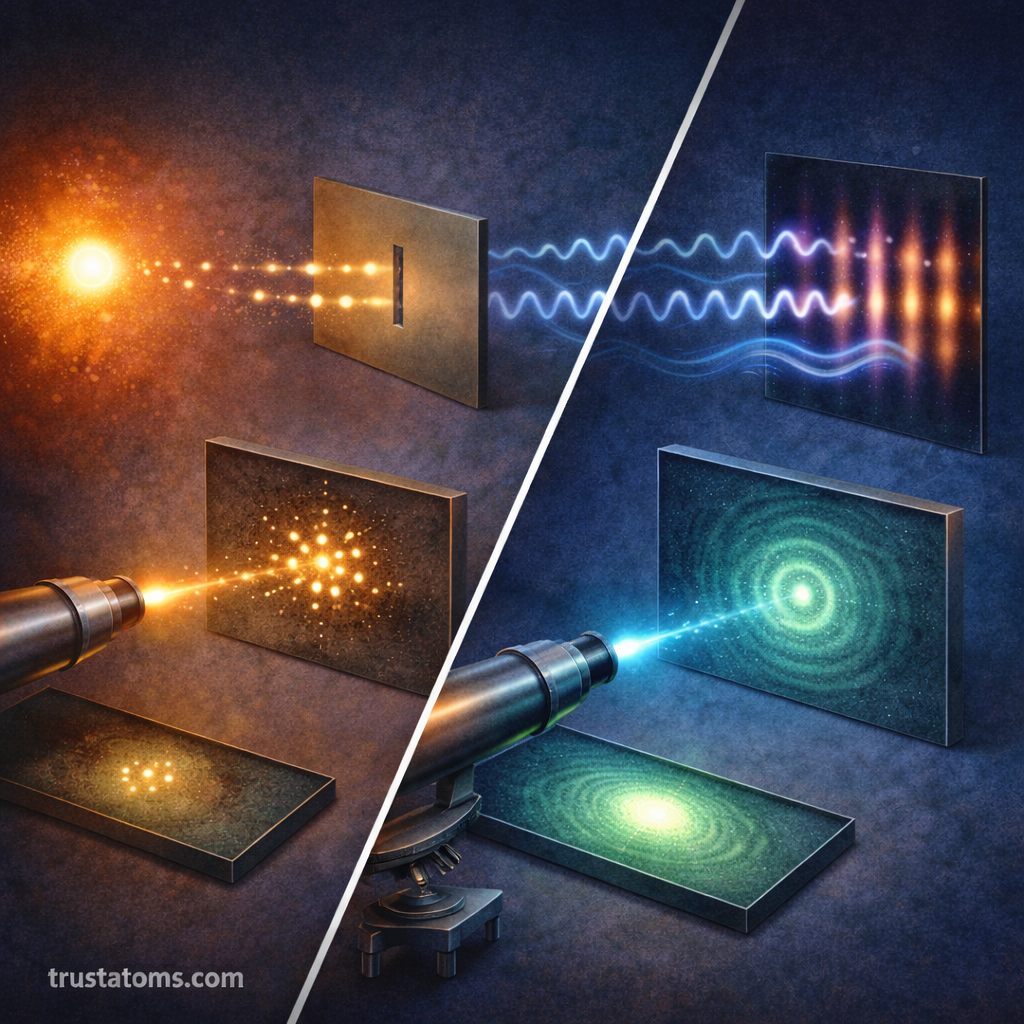
The double-slit experiment is one of the most famous demonstrations of wave–particle duality.
Here is what happens:
- Particles (like electrons) are fired at a barrier with two narrow slits.
- A screen behind the slits records where they land.
If electrons were only particles, we would expect two simple bands behind the slits.
Instead, an interference pattern appears — a pattern that only waves should create.
Even more surprising:
- When electrons are sent one at a time, the interference pattern still builds up over time.
- When scientists try to observe which slit the electron passes through, the interference pattern disappears.
This suggests that particles behave like waves until they are measured.
Why Wave–Particle Duality Matters
Wave–particle duality is not just a strange idea. It is central to modern physics.
It explains:
- How atoms are structured
- Why electrons exist in probability clouds rather than fixed orbits
- How lasers work
- How semiconductors function
Technologies based on quantum behavior include:
- Computers and smartphones
- MRI machines
- Solar panels
- Electron microscopes
Without understanding wave–particle duality, modern electronics would not exist.
The Role of Probability in Quantum Physics
Wave–particle duality is closely linked to probability.
In quantum mechanics:
- Particles are described by wave functions.
- The wave does not represent a physical ripple in space.
- Instead, it represents the probability of finding a particle in a certain location.
This means we cannot predict the exact position of a particle with certainty.
We can only calculate the likelihood of where it might be detected.
This probabilistic nature is one of the defining features of quantum physics.
Is It Really Both at the Same Time?
Wave–particle duality does not mean an object is half-wave and half-particle in a simple sense.
Instead:
- Sometimes it behaves like a wave.
- Sometimes it behaves like a particle.
- The behavior depends on how we measure it.
This idea challenges classical logic, but it consistently matches experimental results.
Quantum objects do not follow everyday rules. They follow quantum rules.
Key Takeaways
Wave–particle duality teaches us that:
- Light behaves as both a wave and a particle.
- Matter particles like electrons also have wave properties.
- The behavior depends on experimental conditions.
- Quantum mechanics describes reality using probabilities, not certainties.
This principle reshaped physics in the 20th century and continues to guide research in quantum computing, particle physics, and cosmology.
Wave–particle duality reminds us that nature is deeper and more surprising than our everyday experiences suggest.