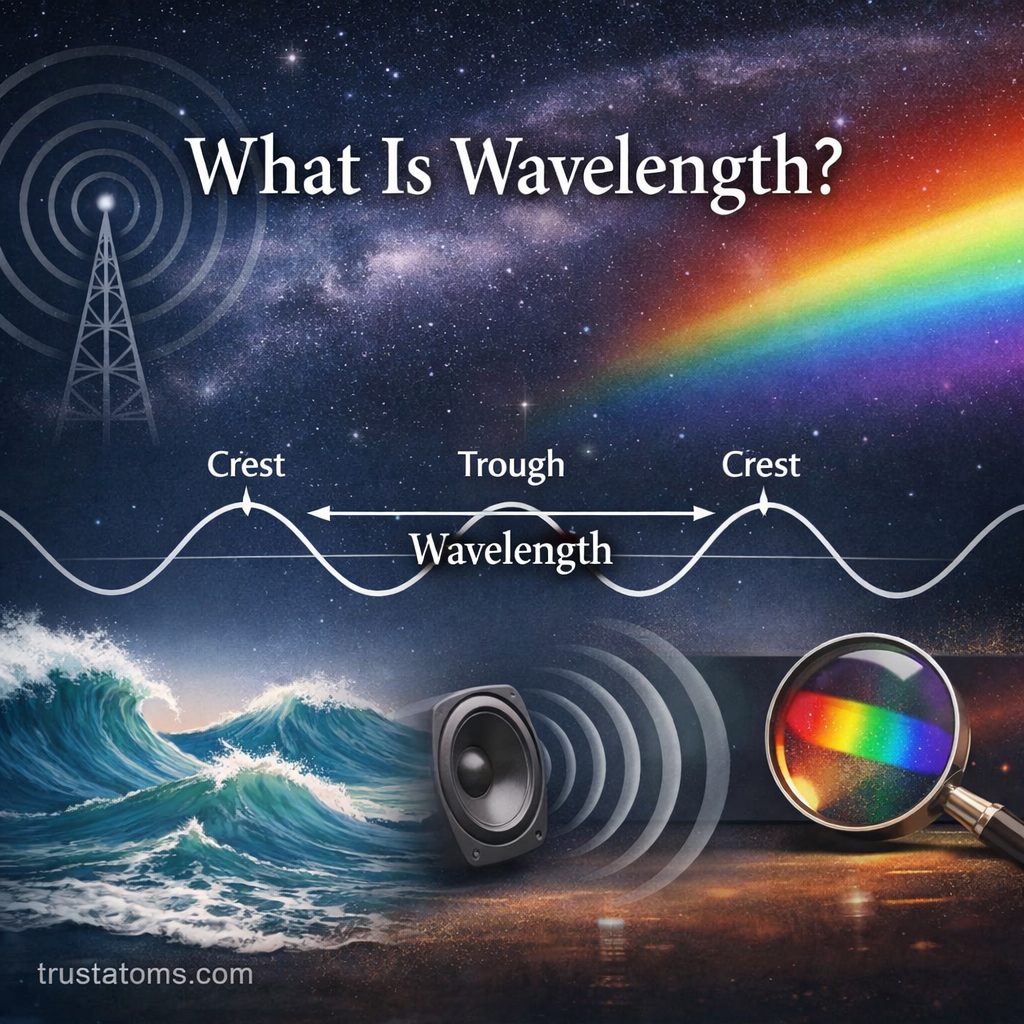
Wavelength is one of the most important concepts in physics because it helps us understand how waves behave — from light and sound to water and radio signals.
If you’ve ever seen ripples on water, heard music from a speaker, or noticed different colors of light, you’ve experienced wavelength in action.
In this guide, you’ll learn:
- What wavelength means
- How it’s measured
- How it relates to frequency
- Real-world examples
- Why it matters in science and technology
What Is Wavelength?
Wavelength is the distance between two identical points on a wave that are next to each other.
Most commonly, it’s measured from:
- Crest to crest (top of a wave)
- Trough to trough (bottom of a wave)
It represents the length of one complete wave cycle.
If a wave repeats over and over, the wavelength tells you how long each repeating section is.
How Wavelength Is Measured
Wavelength is usually represented by the Greek letter lambda (λ).
It is measured in meters (m), but depending on the type of wave, it can also be measured in:
- Centimeters (cm)
- Millimeters (mm)
- Nanometers (nm) — common for light
- Kilometers (km) — common for radio waves
For example:
- Visible light wavelengths are extremely small (hundreds of nanometers).
- Ocean waves can have wavelengths of several meters or more.
- Radio waves can stretch hundreds or even thousands of meters.
Wavelength and Frequency: What’s the Difference?
Wavelength and frequency are closely connected, but they describe different things.
- Wavelength = how long one wave cycle is
- Frequency = how many wave cycles pass a point per second
They have an inverse relationship:
- If wavelength increases, frequency decreases.
- If wavelength decreases, frequency increases.
For waves traveling at a constant speed (like light in a vacuum), this relationship stays balanced.
In simple terms:
Short wavelength → High frequency
Long wavelength → Low frequency
Real-Life Examples of Wavelength
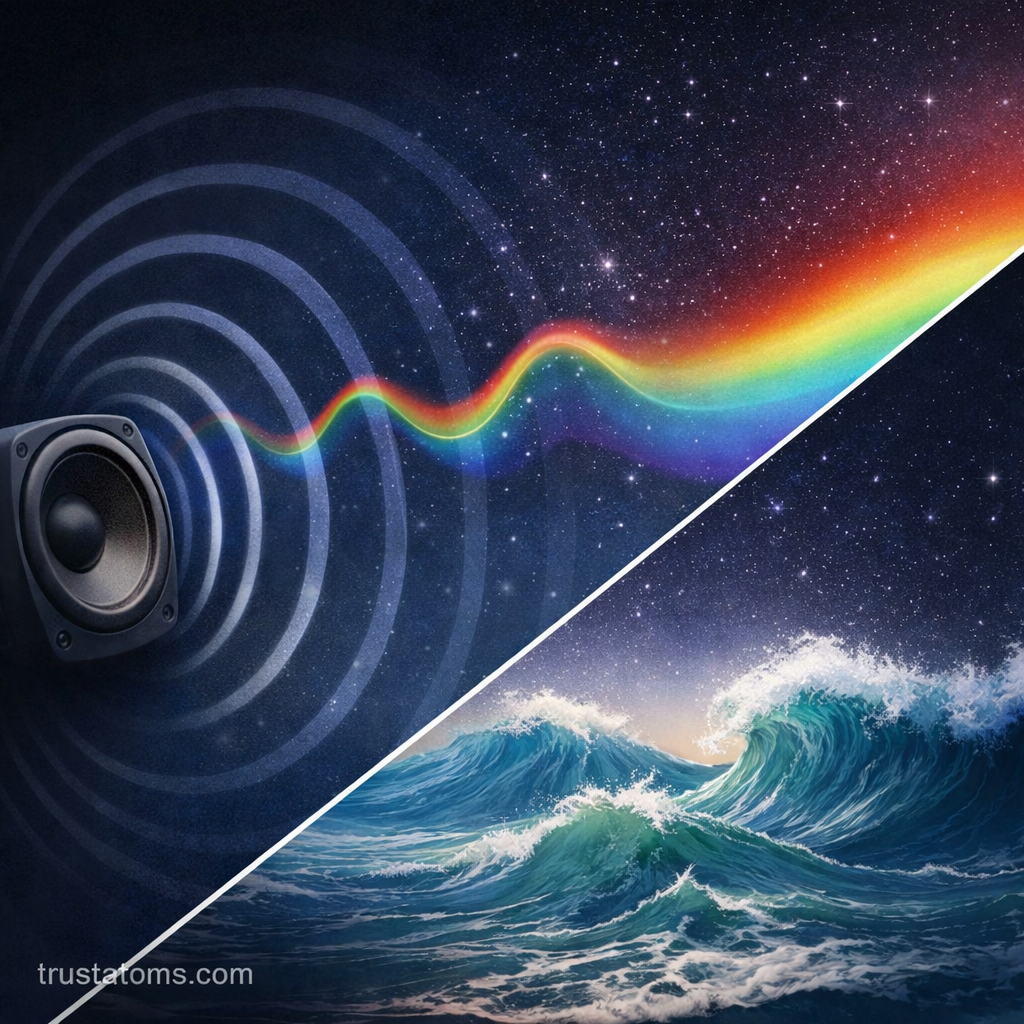
1. Water Waves
If you drop a rock into a pond, circular ripples form.
- The distance between ripple peaks is the wavelength.
- Larger spacing means a longer wavelength.
- Closer spacing means a shorter wavelength.
2. Sound Waves
Sound travels as waves through air.
- Low-pitched sounds (like a bass drum) have long wavelengths.
- High-pitched sounds (like a whistle) have short wavelengths.
That’s why deep sounds feel “spread out” compared to sharp, high sounds.
3. Light Waves and Color
Different colors of light have different wavelengths.
- Red light has a longer wavelength.
- Blue and violet light have shorter wavelengths.
The wavelength of light determines its color in the visible spectrum.
The Electromagnetic Spectrum and Wavelength
The electromagnetic spectrum includes all types of light waves, arranged by wavelength and frequency.
From longest wavelength to shortest:
- Radio waves
- Microwaves
- Infrared
- Visible light
- Ultraviolet
- X-rays
- Gamma rays
As wavelength decreases across this list, energy increases.
That’s why gamma rays are far more energetic than radio waves.
Why Wavelength Matters in Physics
Understanding wavelength helps scientists:
- Identify different types of light and radiation
- Design communication systems (radio, Wi-Fi, satellites)
- Study atoms and molecules
- Understand how energy travels
- Build technologies like lasers and medical imaging tools
Wavelength is a foundational concept in physics because nearly all forms of energy travel in waves.
How Wavelength Connects to Wave Speed
Wave speed depends on both wavelength and frequency.
If a wave travels faster:
- It can have a longer wavelength (if frequency stays constant).
- Or it can have a higher frequency (if wavelength stays constant).
In many cases, the speed of the wave is determined by the medium it travels through.
For example:
- Sound travels faster in solids than in air.
- Light slows down when it passes through water or glass.
Key Takeaways
- Wavelength is the distance between repeating points on a wave.
- It measures the length of one full wave cycle.
- It is commonly measured crest to crest or trough to trough.
- Wavelength and frequency are inversely related.
- It plays a major role in sound, light, water waves, and electromagnetic radiation.
Once you understand wavelength, you unlock a deeper understanding of how energy moves through the universe.