The work–energy theorem is one of the most powerful and practical ideas in classical physics. It connects two fundamental concepts—work and kinetic energy—into a single, elegant relationship that explains how forces change motion.
Whether you’re analyzing a rolling car, a falling object, or a machine in motion, the work–energy theorem provides a simpler alternative to using Newton’s laws step by step.
In this guide, we’ll break it down clearly and show how it applies to real mechanical systems.
What Is the Work–Energy Theorem?
The work–energy theorem states:
The net work done on an object equals the change in its kinetic energy.
In simple terms:
- If work is done on an object, its speed changes.
- If no net work is done, its kinetic energy remains constant.
- Positive work increases speed.
- Negative work (like friction) reduces speed.
This relationship allows us to analyze motion without tracking every force at every moment.
Understanding the Key Concepts
Before applying the theorem, let’s clarify its components.
Work in Physics
In physics, work occurs when:
- A force acts on an object
- The object moves
- The force has a component in the direction of motion
If you push a box across the floor, you do work on it.
If you push on a wall that doesn’t move, no work is done.
Kinetic Energy
Kinetic energy is the energy an object has because of its motion.
- Faster objects have more kinetic energy.
- Heavier objects have more kinetic energy (if moving at the same speed).
The key takeaway: changing speed means changing kinetic energy.
Why the Work–Energy Theorem Matters
Instead of analyzing motion using acceleration and time, the work–energy theorem allows you to:
- Compare starting and ending speeds directly
- Ignore intermediate motion details
- Solve problems more efficiently
This makes it especially useful in mechanical systems involving:
- Machines
- Vehicles
- Moving parts
- Energy transfers
Applying the Work–Energy Theorem in Mechanical Systems

Let’s look at how it works in real-world systems.
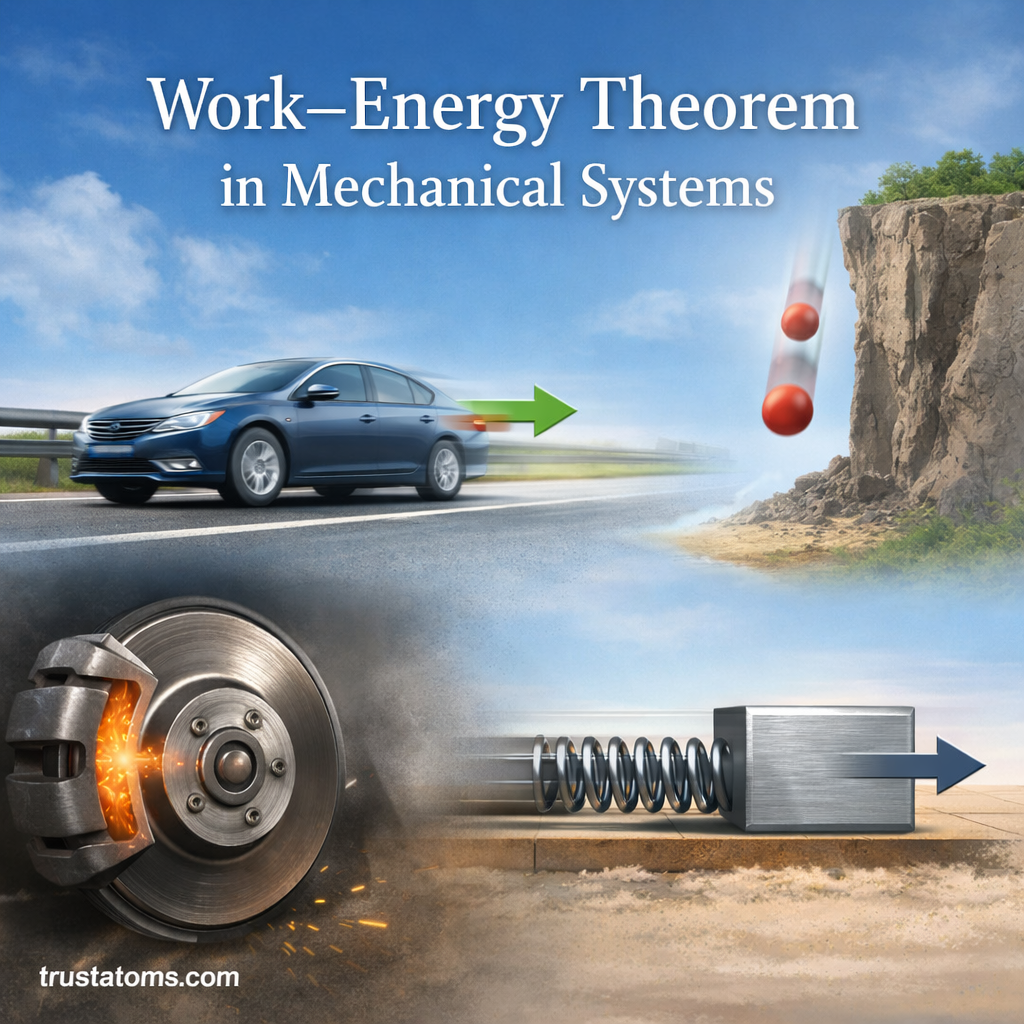
1. A Car Accelerating
When a car speeds up:
- The engine applies force to the wheels.
- The wheels apply force to the road.
- Work is done on the car.
- The car’s kinetic energy increases.
The greater the work done by the engine, the greater the increase in speed.
If friction and air resistance oppose motion, they do negative work, reducing the net work.
2. A Braking System
When brakes are applied:
- Friction forces act opposite the direction of motion.
- Negative work is done.
- Kinetic energy decreases.
- The car slows down.
The “lost” kinetic energy is converted into thermal energy in the brake pads.
3. A Falling Object
When an object falls:
- Gravity does work on it.
- The object speeds up.
- Its kinetic energy increases.
At the same time, gravitational potential energy decreases.
This demonstrates how the work–energy theorem connects directly to energy conservation principles.
4. Springs and Mechanical Devices
In systems with springs:
- A compressed spring does work on an object when released.
- That work becomes kinetic energy.
- The object moves faster.
This principle is used in:
- Mechanical clocks
- Suspension systems
- Launch mechanisms
Step-by-Step Method for Solving Problems
When using the work–energy theorem in physics problems:
- Identify the object or system.
- Determine all forces doing work.
- Calculate total (net) work.
- Compare initial and final kinetic energy.
- Solve for unknown speed, force, or displacement.
This approach often avoids complicated acceleration calculations.
Work by Multiple Forces
In real mechanical systems, several forces may act simultaneously:
- Applied force
- Friction
- Gravity
- Tension
- Normal force
Only forces that cause displacement in their direction do work.
The theorem uses net work, meaning:
- Add positive work
- Subtract negative work
- The total equals the change in kinetic energy
When the Work–Energy Theorem Is Most Useful
It is especially powerful when:
- Acceleration changes during motion
- Forces vary over distance
- Time is unknown or irrelevant
- You only care about initial and final speeds
Examples include:
- Roller coasters
- Vehicle crash analysis
- Industrial machinery
- Conveyor belt systems
Limitations and Assumptions
While extremely useful, the theorem assumes:
- Motion is analyzed in a consistent reference frame
- Energy transfers are accounted for properly
- The system boundaries are clearly defined
It does not replace Newton’s laws — it complements them.
Relationship to Conservation of Energy
The work–energy theorem is closely tied to conservation of energy.
If only conservative forces act (like gravity or ideal springs):
- Mechanical energy remains constant.
- Work simply shifts energy between forms.
If non-conservative forces act (like friction):
- Mechanical energy decreases.
- Energy transforms into heat or other forms.
The theorem helps quantify these changes clearly.
Key Takeaways
- The work–energy theorem links force and motion through energy.
- Net work equals the change in kinetic energy.
- Positive work increases speed.
- Negative work decreases speed.
- It simplifies complex motion problems.
- It is essential in analyzing real mechanical systems.
Understanding this theorem provides a powerful tool for solving practical physics problems efficiently and intuitively.
Final Thoughts
The work–energy theorem transforms how we approach mechanical motion. Instead of tracking acceleration moment by moment, we focus on energy transfer. This shift in perspective makes analyzing machines, vehicles, and moving systems far more straightforward.
In physics, energy often provides the cleanest path to understanding motion—and the work–energy theorem is one of the clearest bridges between force and movement.