The Earth’s atmosphere is a layered envelope of gases that surrounds the planet, protects life, and regulates climate. It plays a crucial role in everything from breathing and weather patterns to shielding us from harmful radiation.
Understanding the structure of the atmosphere helps explain how weather forms, how planes fly, and why conditions change as you move higher above the surface.
What Is the Atmosphere Made Of?
The atmosphere is composed primarily of gases, with the following approximate composition:
- Nitrogen (78%)
- Oxygen (21%)
- Argon (0.93%)
- Carbon dioxide (0.04%)
- Trace gases (neon, helium, methane, etc.)
It also contains variable amounts of water vapor, which is essential for weather and climate.
The Five Main Layers of the Atmosphere
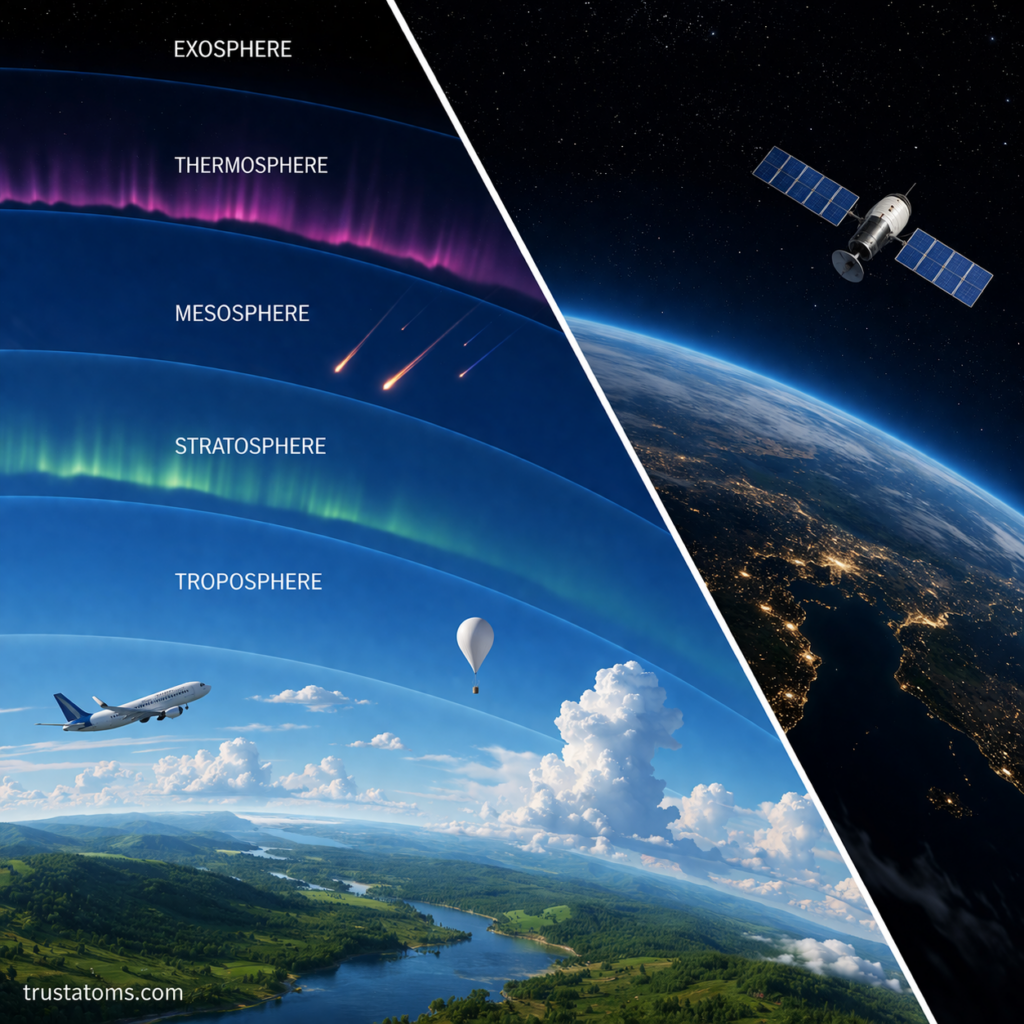
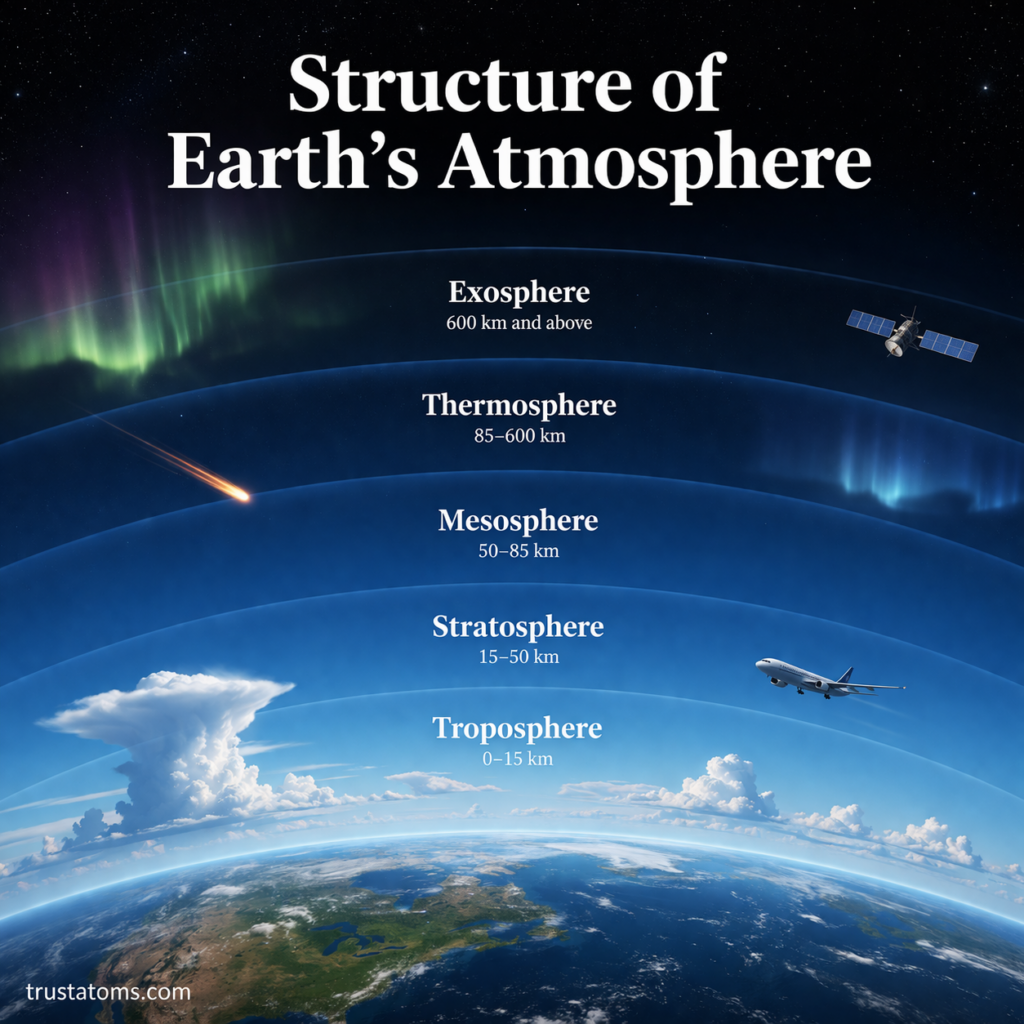
The atmosphere is divided into five main layers based on temperature changes with altitude. Each layer has unique characteristics and functions.
1. Troposphere
The troposphere is the lowest layer, where all weather occurs.
Key features:
- Extends from the surface to about 8–15 km (5–9 miles)
- Contains about 75% of the atmosphere’s mass
- Temperature decreases with altitude
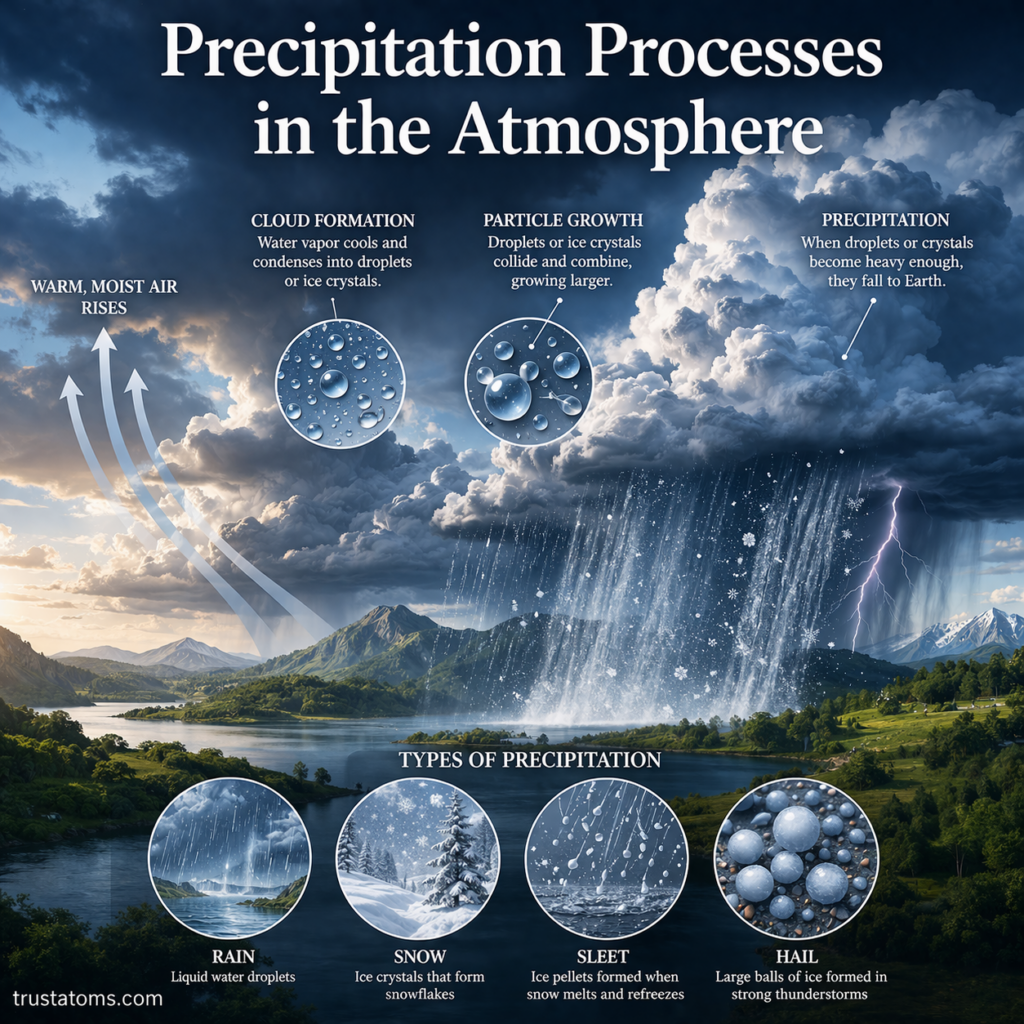
- Clouds, storms, and precipitation form here
Why it matters:
- Supports life and breathable air
- Drives weather systems and climate patterns
2. Stratosphere
The stratosphere lies above the troposphere and contains the ozone layer.
Key features:
- Extends from about 15 km to 50 km (9–31 miles)
- Temperature increases with altitude due to ozone absorbing solar radiation
- Stable air with little turbulence
Why it matters:
- The ozone layer protects life by absorbing harmful ultraviolet (UV) radiation
- Commercial jets often fly in the lower stratosphere for smoother travel
3. Mesosphere
The mesosphere is the middle layer where meteors burn up.
Key features:
- Extends from 50 km to 85 km (31–53 miles)
- Temperature decreases with altitude
- Coldest layer of the atmosphere
Why it matters:
- Protects Earth by disintegrating meteoroids before they reach the surface
4. Thermosphere
The thermosphere is a very thin layer with extremely high temperatures.
Key features:
- Extends from 85 km to about 600 km (53–373 miles)
- Temperature increases dramatically with altitude
- Contains ionized gases (ions)
Why it matters:
- Home to auroras (Northern and Southern Lights)
- Important for radio communication due to ionized particles
5. Exosphere
The exosphere is the outermost layer, gradually merging into space.
Key features:
- Extends from about 600 km to 10,000 km (373–6,200 miles)
- Extremely thin, with particles rarely colliding
- Contains hydrogen and helium
Why it matters:
- Transition zone between Earth’s atmosphere and outer space
- Satellites orbit within this region
How Temperature Defines Atmospheric Layers
The layers are defined primarily by how temperature changes with altitude:
- Troposphere: temperature decreases
- Stratosphere: temperature increases
- Mesosphere: temperature decreases
- Thermosphere: temperature increases
This alternating pattern is due to how different gases absorb solar energy at various altitudes.
Why the Atmosphere Is Essential for Life
The atmosphere is not just a collection of gases—it is a life-support system.
It provides:
- Oxygen for respiration
- Carbon dioxide for photosynthesis
- Protection from harmful solar radiation
- Insulation that keeps Earth warm enough for life
- A medium for weather and the water cycle
Without the atmosphere, Earth would be a cold, lifeless planet similar to the Moon.
Quick Summary of Atmospheric Layers
- Troposphere: weather and life-supporting air
- Stratosphere: ozone layer and UV protection
- Mesosphere: burns up meteors
- Thermosphere: auroras and radio communication
- Exosphere: boundary with space
Final Thoughts
The structure of Earth’s atmosphere reveals how delicately balanced our planet is. Each layer plays a specific role, from supporting life at the surface to protecting Earth from space hazards.
By understanding these layers, we gain insight into weather, climate, and even space exploration—making the atmosphere one of the most important systems on Earth.