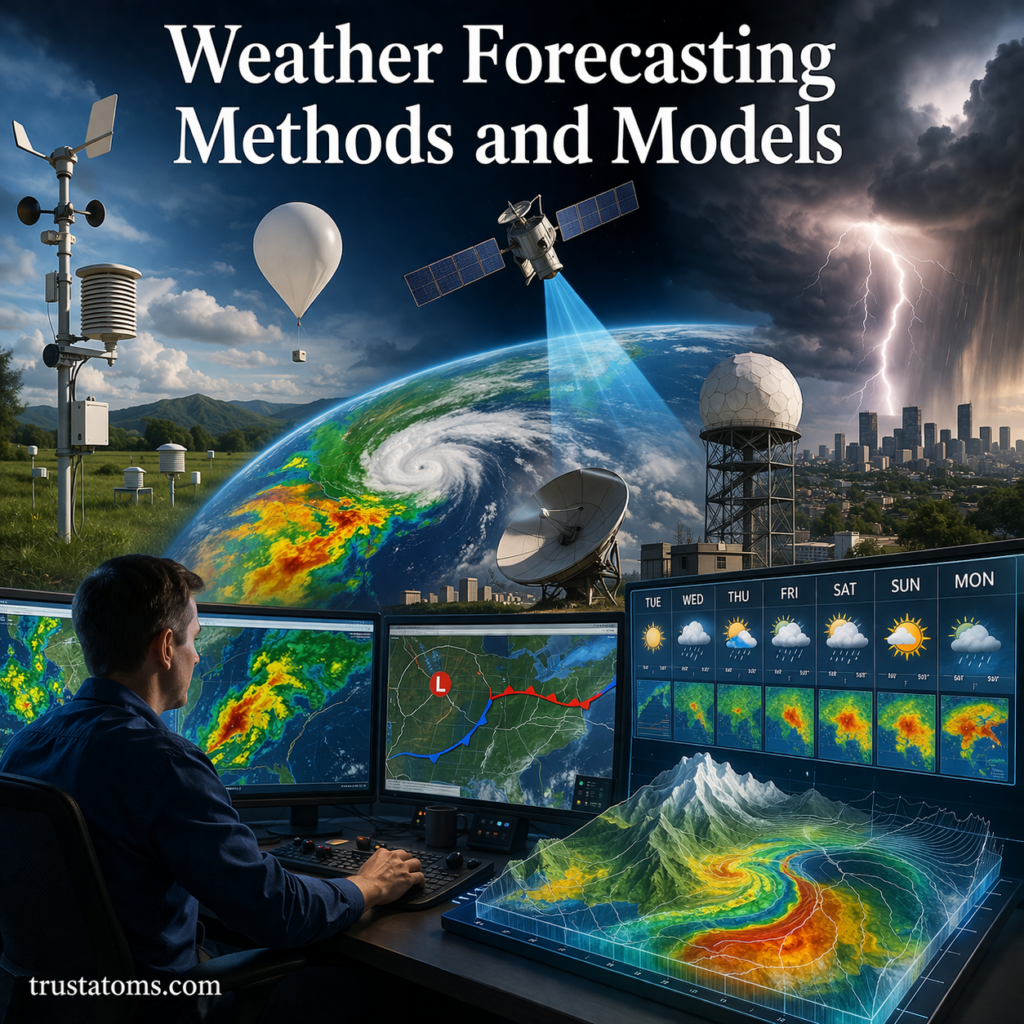
Weather forecasting is the science of predicting atmospheric conditions at a specific time and place. From daily temperature forecasts to severe storm warnings, modern forecasting combines observation, physics, and advanced computer models to provide accurate predictions.
Understanding how forecasts are made helps explain why they are sometimes highly accurate—and other times uncertain.
What Is Weather Forecasting?
Weather forecasting involves analyzing current atmospheric conditions and using scientific methods to predict future weather.
Meteorologists rely on:
- Observational data
- Physical laws of the atmosphere
- Mathematical models
- Historical patterns
These elements work together to produce forecasts ranging from hours to weeks ahead.
Key Components of Weather Forecasting
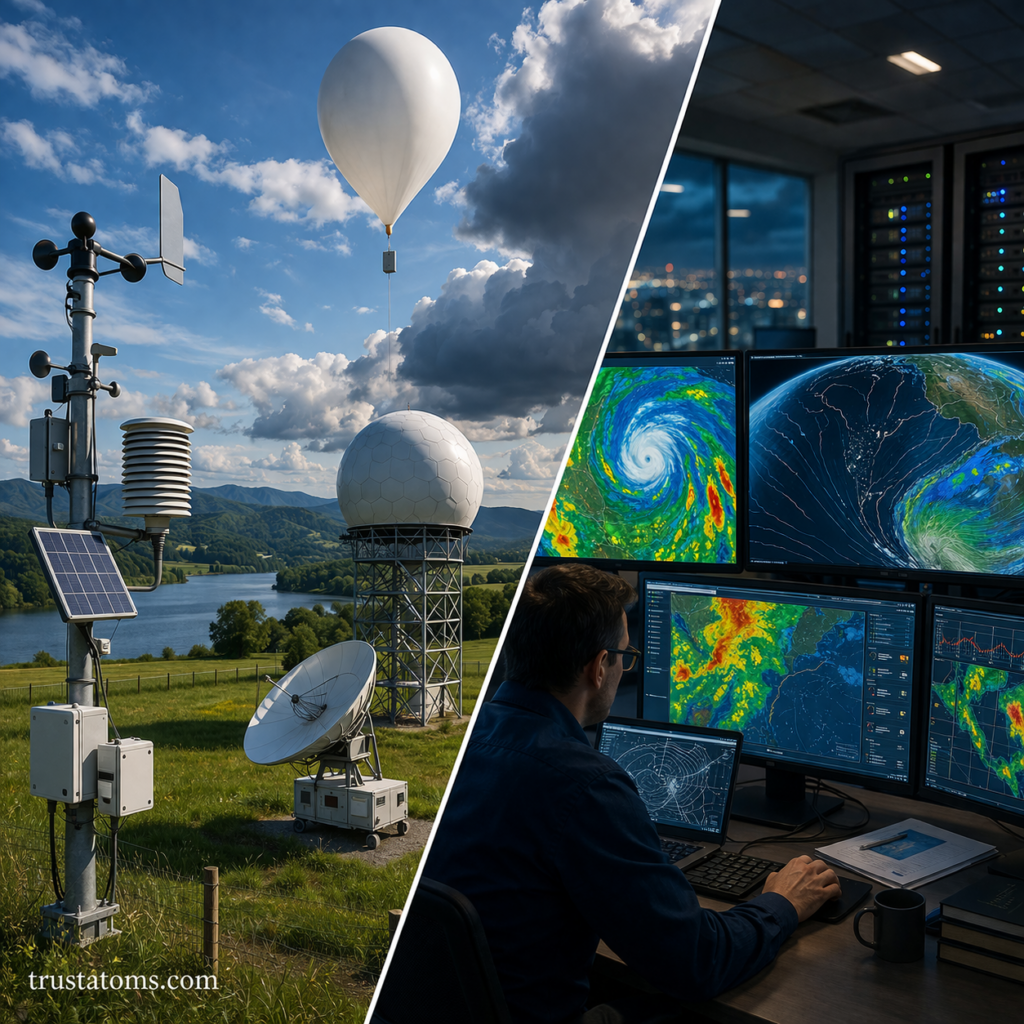
Accurate forecasting depends on collecting and interpreting large amounts of data.
1. Data Collection
Weather data comes from multiple sources:
- Weather stations (temperature, humidity, pressure, wind)
- Weather balloons (upper atmosphere conditions)
- Satellites (cloud cover, storms, global patterns)
- Radar systems (precipitation and storm movement)
- Ocean buoys (sea temperature and wave conditions)
2. Data Analysis
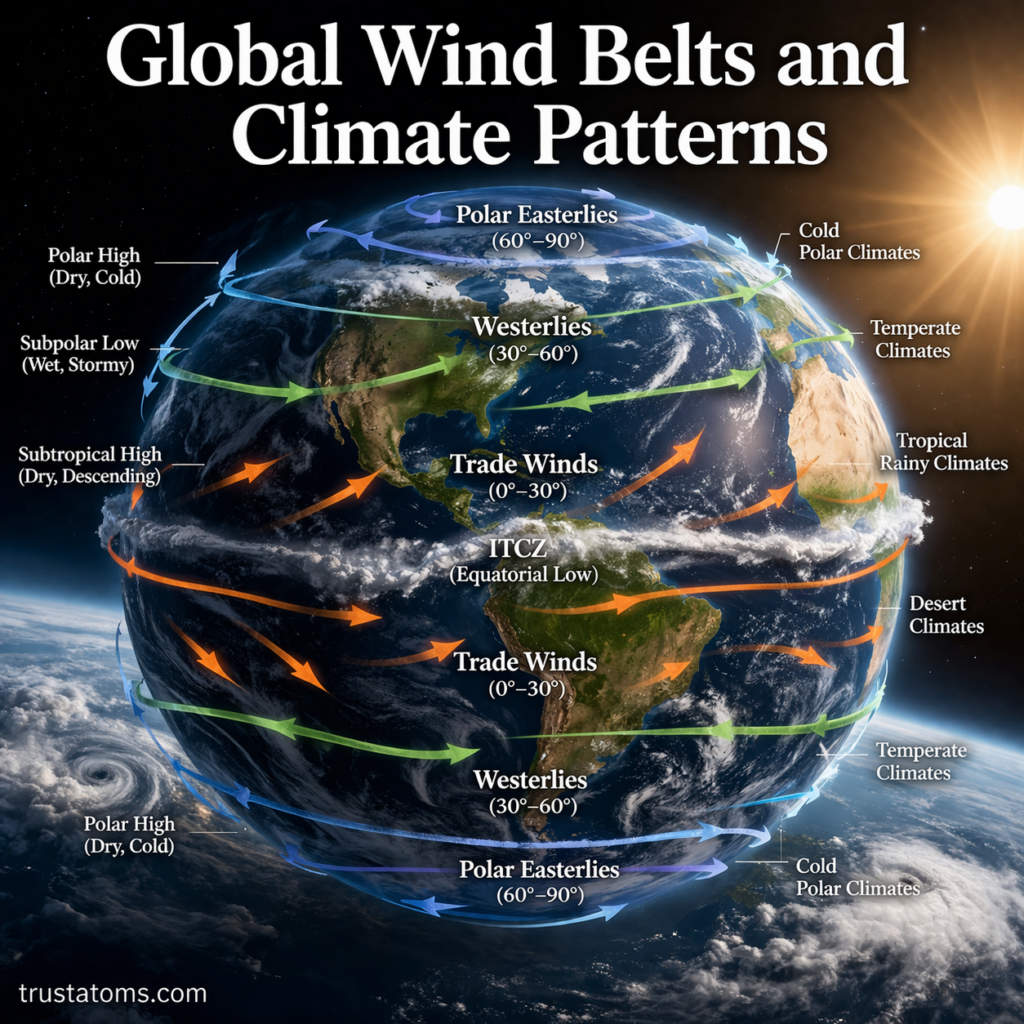
Meteorologists analyze patterns such as:
- Pressure systems
- Temperature gradients
- Wind direction and speed
- Moisture levels
This helps identify developing weather systems.
Forecasting Methods
There are several primary methods used in weather forecasting.
Persistence Method
- Assumes current conditions will continue
- Works best for short-term forecasts
- Example: A clear day is likely to remain clear
Climatology Method
- Uses historical weather averages
- Based on long-term patterns
- Example: Expecting warm weather in summer
Analog Method
- Compares current conditions to past similar situations
- Uses historical outcomes to predict future weather
Numerical Weather Prediction (NWP)
The most advanced forecasting method is Numerical Weather Prediction.
What Is NWP?
- Uses mathematical equations to simulate the atmosphere
- Runs on powerful supercomputers
- Processes massive amounts of data
These models calculate how temperature, pressure, wind, and moisture will change over time.
How It Works
- Collect global weather data
- Input data into computer models
- Apply physical laws of motion and thermodynamics
- Generate forecasts at different time intervals
Types of Weather Models
Different models are used depending on the forecast range and purpose.
Global Models
- Cover the entire Earth
- Provide long-range forecasts (days to weeks)
- Lower resolution but broad coverage
Regional Models
- Focus on specific areas
- Higher resolution and detail
- Better for short-term local forecasts
Ensemble Models
- Run multiple simulations with slightly different inputs
- Show a range of possible outcomes
- Help estimate forecast uncertainty
Forecast Time Ranges
Weather forecasts vary in accuracy depending on how far into the future they extend.
Short-Term Forecasts (0–3 days)
- Highly accurate
- Based on current observations and models
Medium-Term Forecasts (3–7 days)
- Moderate accuracy
- Increasing uncertainty
Long-Term Forecasts (7+ days)
- Lower accuracy
- Focus on general trends rather than exact conditions
Why Forecasts Are Not Always Perfect
Despite advanced technology, forecasting has limitations.
Sources of Uncertainty
- Incomplete or imperfect data
- Rapid atmospheric changes
- Small errors that grow over time
- Complexity of weather systems
This is why forecasts are often updated frequently.
Modern Technology in Forecasting
Advancements in technology have greatly improved forecasting accuracy.
Key Innovations
- High-resolution satellites
- Doppler radar systems
- Artificial intelligence and machine learning
- Faster supercomputers
These tools allow meteorologists to track storms, predict severe weather, and provide real-time updates.
Applications of Weather Forecasting
Weather forecasting impacts many areas of daily life.
1. Public Safety
- Severe weather warnings (storms, hurricanes, tornadoes)
- Evacuation planning
2. Transportation
- Aviation route planning
- Road safety during extreme weather
3. Agriculture
- Crop planning and irrigation
- Frost and drought predictions
4. Energy
- Predicting energy demand
- Managing renewable energy sources
Key Takeaways
- Weather forecasting combines observation, science, and technology
- Multiple methods are used, from simple patterns to complex models
- Numerical weather prediction is the most advanced approach
- Forecast accuracy decreases over longer time periods
- Technology continues to improve forecasting capabilities
Final Thoughts
Weather forecasting is a powerful blend of science and technology that helps us prepare for the future. While no forecast is perfect, modern methods and models provide increasingly accurate insights into atmospheric behavior.
As technology continues to evolve, forecasting will become even more precise—helping societies stay safer, more efficient, and better prepared for whatever the weather brings.