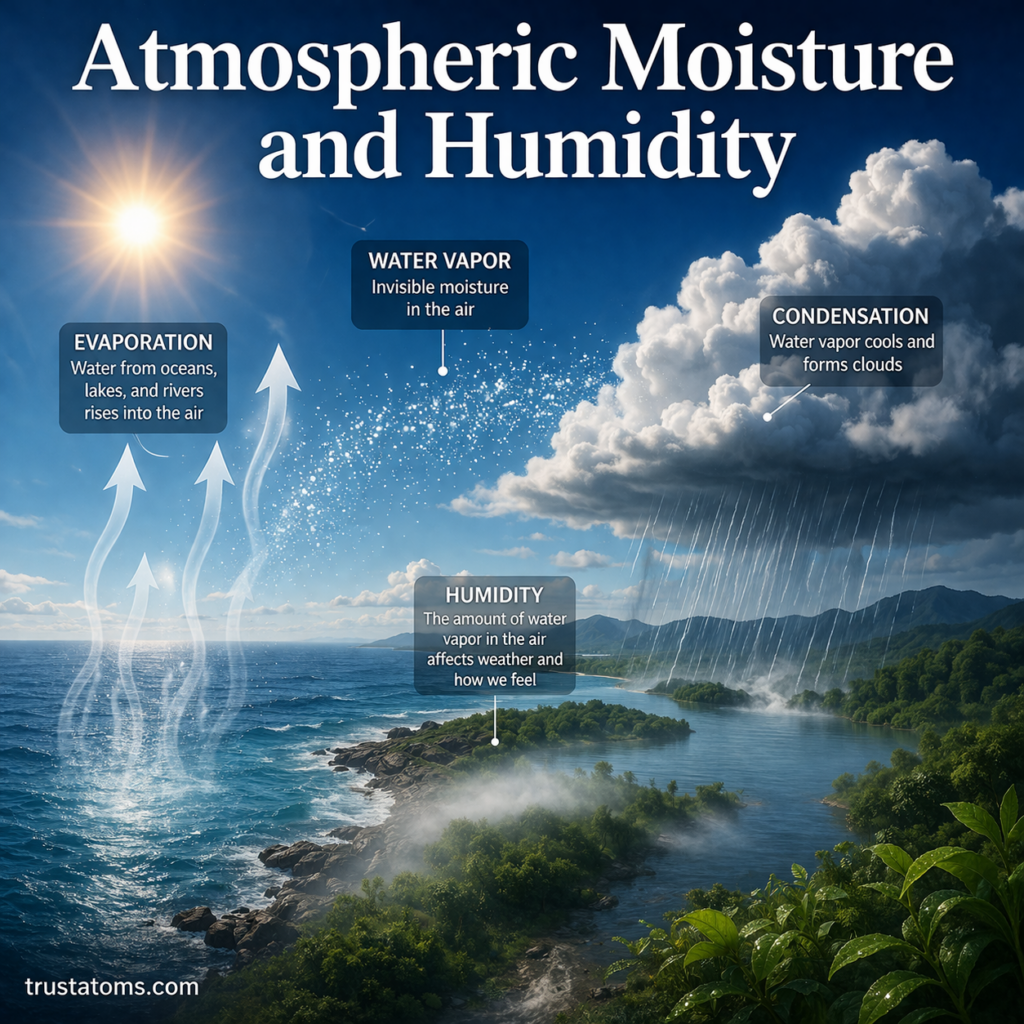
Atmospheric moisture plays a key role in weather, climate, and everyday comfort. Whether it’s a humid summer day or a dry winter morning, the amount of water vapor in the air directly affects how we feel and how the atmosphere behaves.
Understanding humidity helps explain everything from cloud formation to precipitation—and even why some days feel hotter than they actually are.
What Is Atmospheric Moisture?
Atmospheric moisture refers to the water vapor present in the air. Water exists in the atmosphere in three main forms:
- Gas (water vapor)
- Liquid (cloud droplets)
- Solid (ice crystals)
Among these, water vapor is the most important for humidity and weather processes.
Key Points
- Water vapor is invisible
- It varies widely depending on location and temperature
- Warm air can hold more moisture than cold air
What Is Humidity?
Humidity is a measure of how much water vapor is in the air. There are different ways to express humidity, but the most commonly used is relative humidity.
Types of Humidity
- Absolute Humidity
- The actual amount of water vapor in the air (grams per cubic meter)
- Relative Humidity
- The percentage of moisture in the air compared to the maximum it can hold at that temperature
- Specific Humidity
- The ratio of water vapor to the total air mass
Understanding Relative Humidity
Relative humidity (RH) is the most practical measurement because it reflects how “full” the air is with moisture.
How It Works
- 100% RH → Air is fully saturated
- 50% RH → Air holds half of its moisture capacity
- Low RH → Dry conditions
When RH reaches 100%, the air cannot hold additional moisture, and condensation begins.
The Role of Temperature
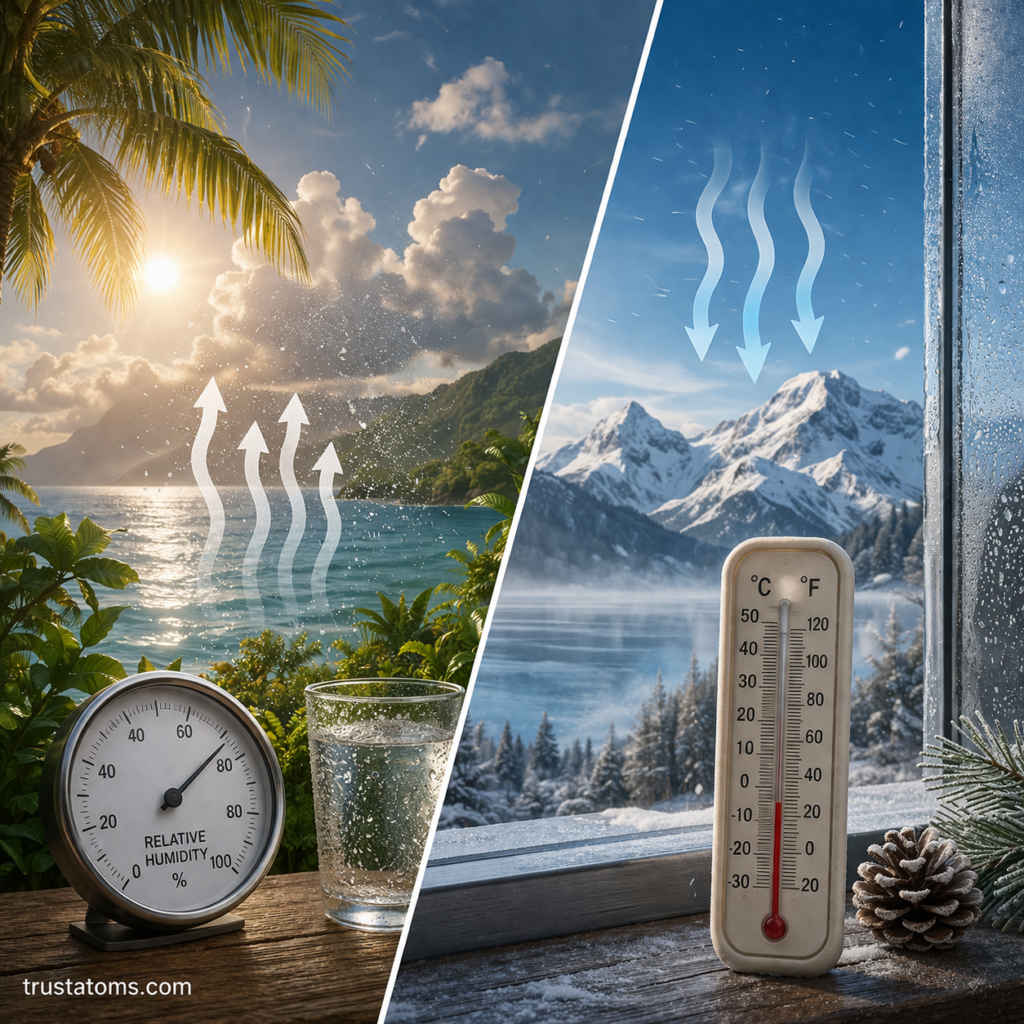
Temperature strongly influences how much moisture air can hold.
Key Relationship
- Warm air → Holds more water vapor
- Cold air → Holds less water vapor
This is why:
- Tropical regions are often humid
- Cold winter air tends to be dry
Example
On a hot day, air may hold large amounts of moisture without reaching saturation. But as temperatures drop (such as at night), the same air may reach saturation, leading to dew or fog.
How Moisture Enters the Atmosphere
Water vapor enters the atmosphere through several natural processes.
Main Sources
- Evaporation
- Water changes from liquid to vapor (oceans, lakes, rivers)
- Transpiration
- Plants release moisture into the air
- Sublimation
- Ice changes directly into water vapor
These processes are part of the water cycle, continuously adding moisture to the atmosphere.
Condensation and Cloud Formation
When air cools to its dew point temperature, it becomes saturated.
What Happens Next
- Water vapor condenses into tiny droplets
- Clouds form in the atmosphere
- Fog forms near the surface
Condensation requires tiny particles called condensation nuclei (like dust or salt).
Dew Point: A Key Indicator
The dew point is the temperature at which air becomes saturated and condensation begins.
Why It Matters
- Higher dew point → More moisture in the air
- Lower dew point → Drier air
Comfort Levels
- Below 50°F → Dry and comfortable
- 50–65°F → Moderately humid
- Above 65°F → Humid and uncomfortable
Dew point is often a better indicator of comfort than relative humidity.
How Humidity Affects Weather
Atmospheric moisture is essential for many weather processes.
Major Impacts
- Cloud formation
- Rain, snow, and storms
- Fog development
- Energy transfer in the atmosphere
High humidity can fuel strong storms, while low humidity often leads to clear skies.
How Humidity Affects Human Comfort
Humidity influences how we experience temperature.
High Humidity
- Reduces the body’s ability to cool through sweat
- Makes air feel warmer than actual temperature
- Can lead to heat stress
Low Humidity
- Causes dry skin and irritation
- Increases evaporation (cooling effect)
- Can make air feel cooler
Measuring Humidity
Humidity is measured using instruments called hygrometers.
Common Methods
- Electronic sensors
- Psychrometers (wet and dry bulb thermometers)
- Weather stations
These tools help meteorologists monitor atmospheric conditions and forecast weather.
Key Takeaways
- Atmospheric moisture refers to water vapor in the air
- Humidity measures how much moisture the air contains
- Relative humidity is the most commonly used metric
- Temperature plays a major role in moisture capacity
- Moisture enters the air through evaporation, transpiration, and sublimation
- Humidity affects weather patterns and human comfort
Final Thoughts
Atmospheric moisture and humidity are fundamental to understanding how the atmosphere works. From cloud formation to daily comfort, water vapor influences nearly every aspect of weather and climate.
By learning how humidity behaves, you gain a clearer picture of why the air feels the way it does—and how weather systems develop and change over time.