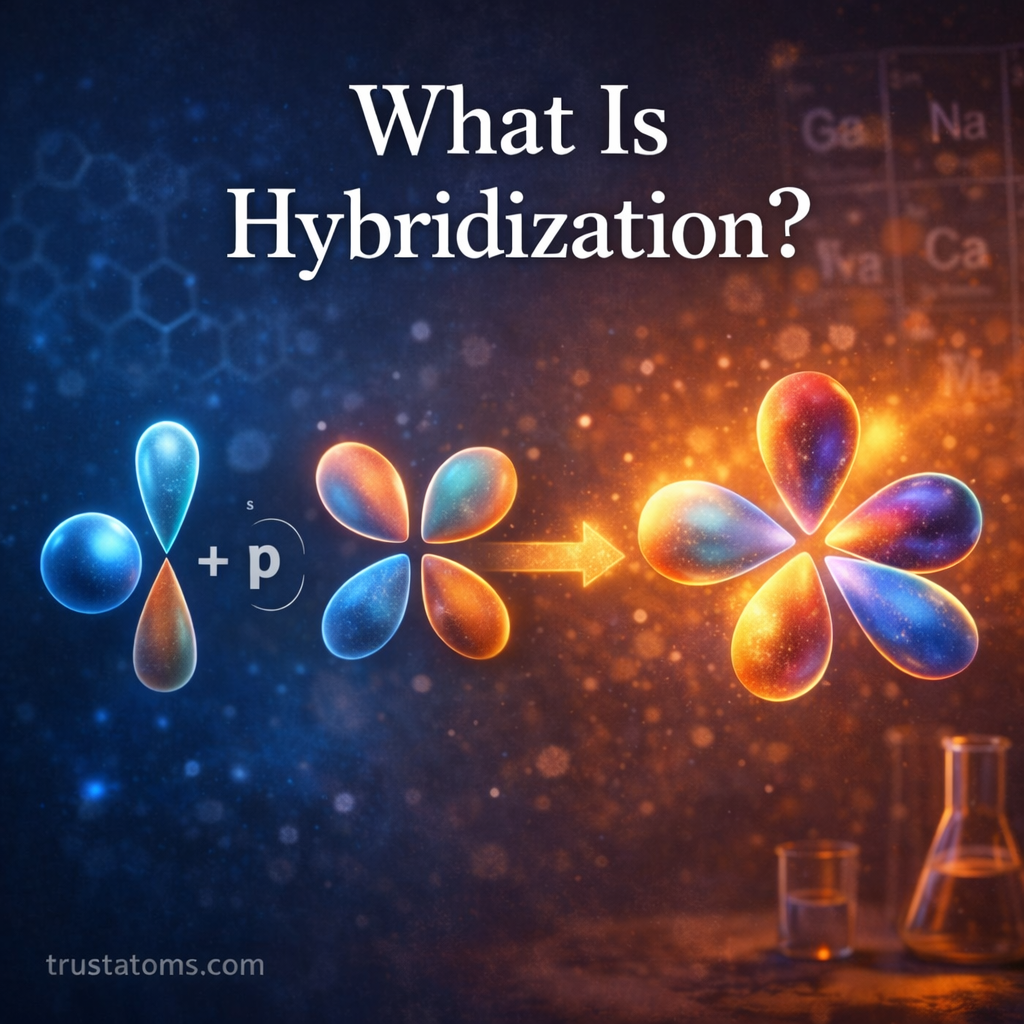
What Is Hybridization?

Illustration explaining hybridization in chemistry showing atomic orbitals combining to form hybrid orbitals with the title “What Is Hybridization?”
Diagram illustrating how atomic orbitals combine to form hybrid orbitals in chemistry. trustatoms.com.

Hybridization is a concept in chemistry that explains how atoms form chemical bonds by mixing their atomic orbitals. It helps scientists understand molecular shapes, bonding patterns, and how atoms share electrons to create stable molecules.

Without hybridization, many molecules would appear to break the basic rules of orbital theory. By combining orbitals into new hybrid orbitals, atoms can form bonds that match the shapes observed in real molecules.

Hybridization is especially important in organic chemistry, where carbon atoms frequently form multiple bonds and complex structures.

Continue reading “What Is Hybridization?”
What Is Ionization Energy?

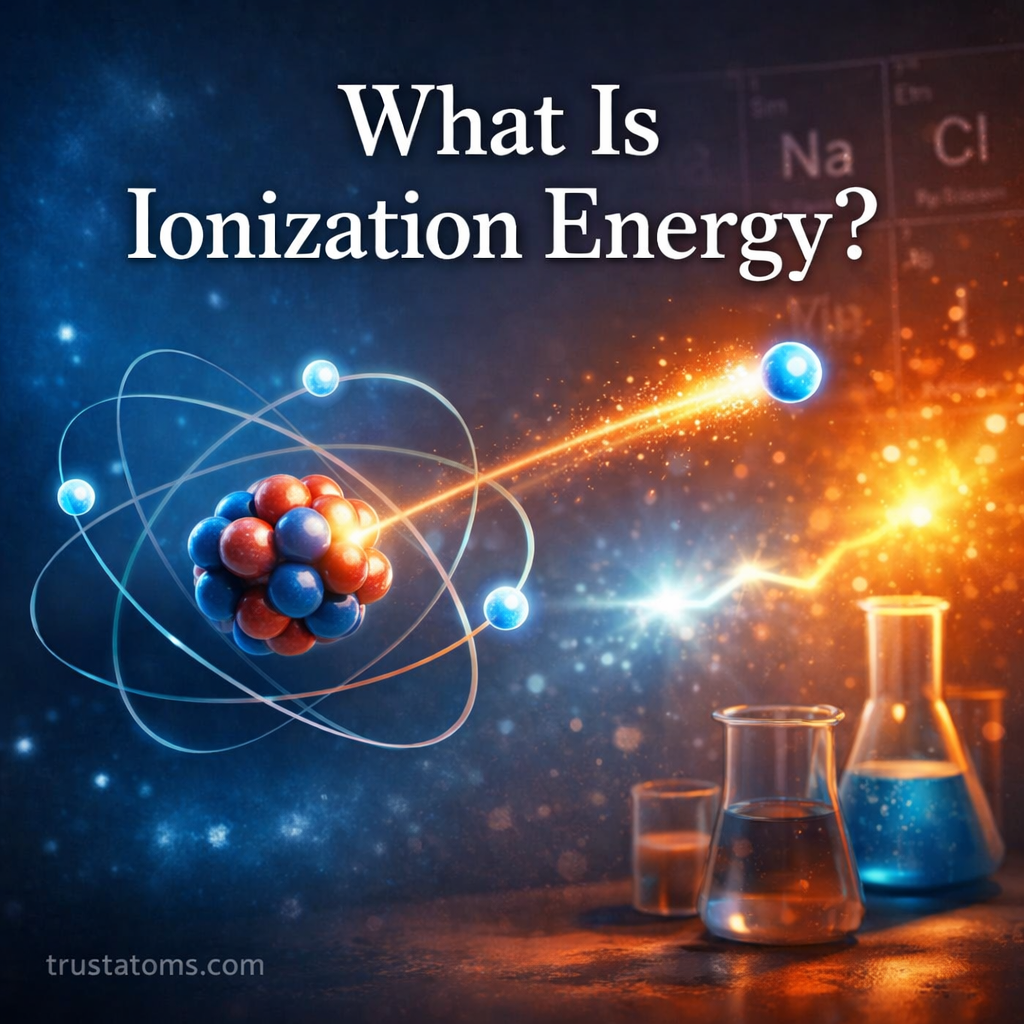
Illustration explaining ionization energy with an atom losing an electron and the title “What Is Ionization Energy?” displayed.
Illustration showing an electron being removed from an atom to demonstrate ionization energy. trustatoms.com

Ionization energy is one of the key concepts used to understand how atoms behave in chemistry. It explains how strongly an atom holds onto its electrons and helps scientists predict how elements will react with one another.

From chemical reactions to the formation of ions, ionization energy plays a major role in the structure and behavior of matter.

In simple terms, ionization energy tells us how much energy is required to remove an electron from an atom.

Continue reading “What Is Ionization Energy?”

What Is Electronegativity?

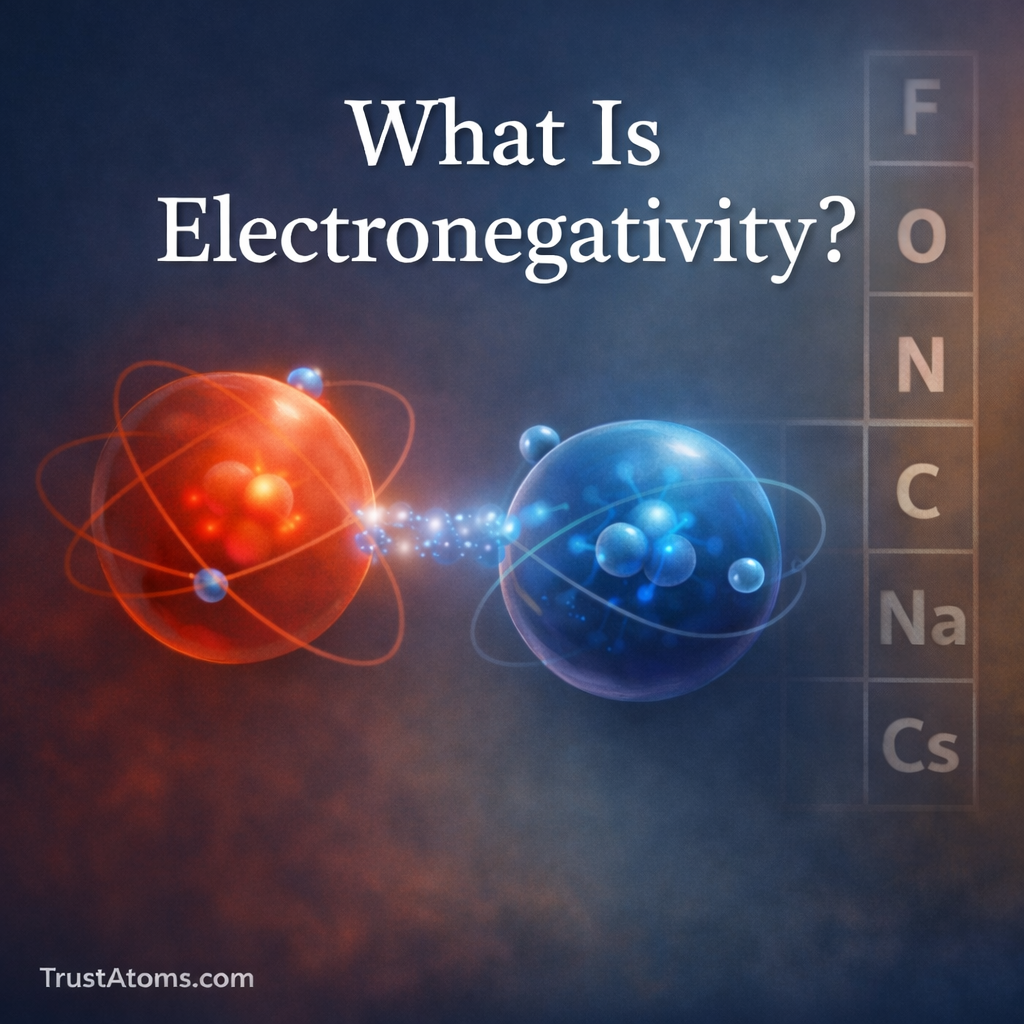
Simple illustration showing two atoms sharing electrons to explain electronegativity in chemistry.
Illustration demonstrating how atoms attract shared electrons in a chemical bond. trustatoms.com.

Electronegativity is one of the most important concepts in chemistry because it helps explain why atoms bond the way they do. It influences the formation of molecules, the behavior of chemical reactions, and the physical properties of substances.

In simple terms, electronegativity describes how strongly an atom attracts electrons when it forms a chemical bond. Some atoms pull electrons toward themselves very strongly, while others exert a weaker pull.

Understanding electronegativity allows chemists to predict how atoms interact, what types of bonds will form, and how molecules behave.

Continue reading “What Is Electronegativity?”

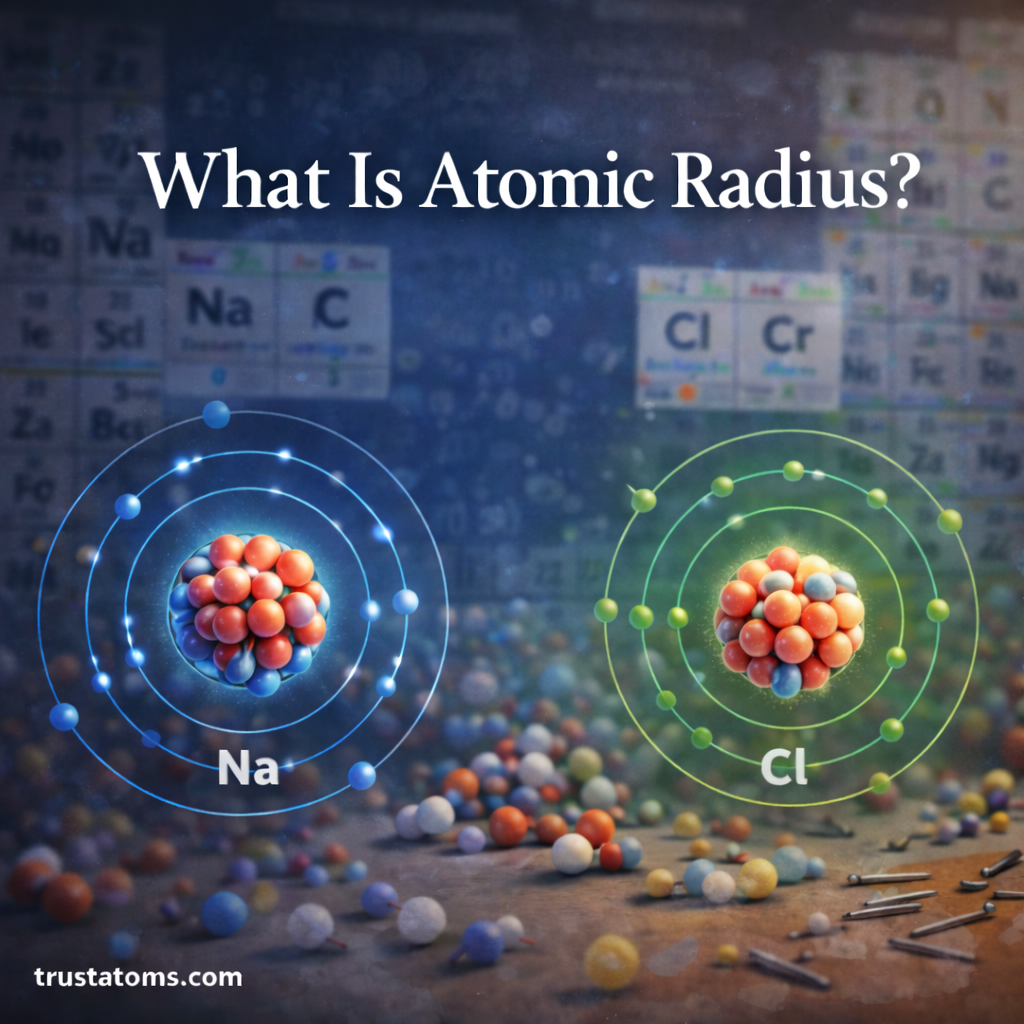
What Is Atomic Radius?

Illustration showing two atoms with visible electron shells representing the concept of atomic radius and atomic size in chemistry.
Illustration showing how atomic radius represents the size of an atom from its nucleus to its outer electron shell. trustatoms.com

Atomic radius is a fundamental concept in chemistry that describes the size of an atom. Although atoms are incredibly small and cannot be seen directly with ordinary microscopes, scientists can estimate how large they are by measuring the distance between atomic nuclei in bonded atoms.

Understanding atomic radius helps chemists explain patterns in the periodic table, predict chemical behavior, and understand how atoms interact with one another during chemical reactions.

Continue reading “What Is Atomic Radius?”

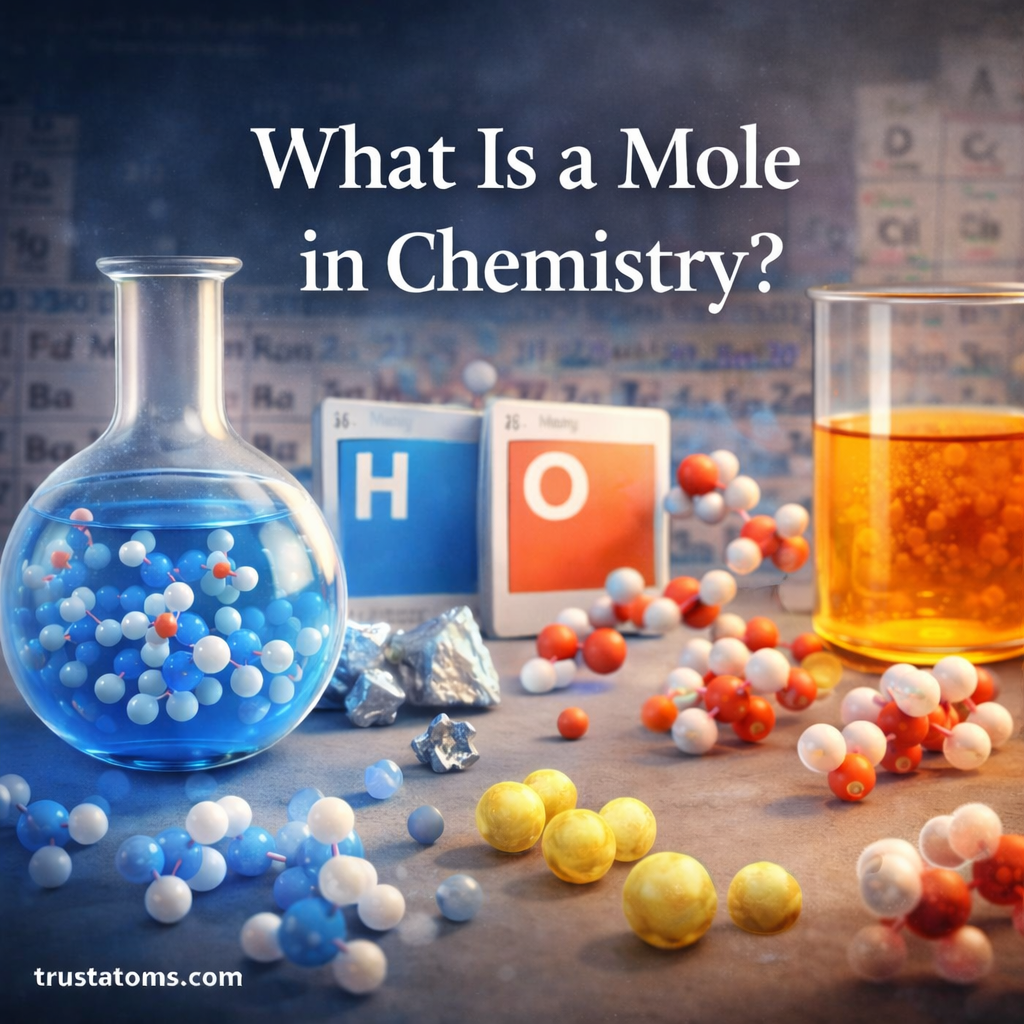
What Is a Mole in Chemistry?

Chemistry illustration showing laboratory glassware, molecular models, and element tiles representing the concept of a mole in chemistry.
Illustration representing how chemists measure extremely large numbers of atoms and molecules using the mole concept. trustatoms.com

In chemistry, the mole is a fundamental unit used to measure the amount of a substance. Rather than counting individual atoms or molecules one by one—which would be impossible due to their enormous numbers—scientists use the mole as a convenient way to measure large quantities of particles.

The mole allows chemists to connect the microscopic world of atoms and molecules with measurable quantities like mass and volume. Understanding this concept is essential for studying chemical reactions, formulas, and laboratory measurements.

Continue reading “What Is a Mole in Chemistry?”

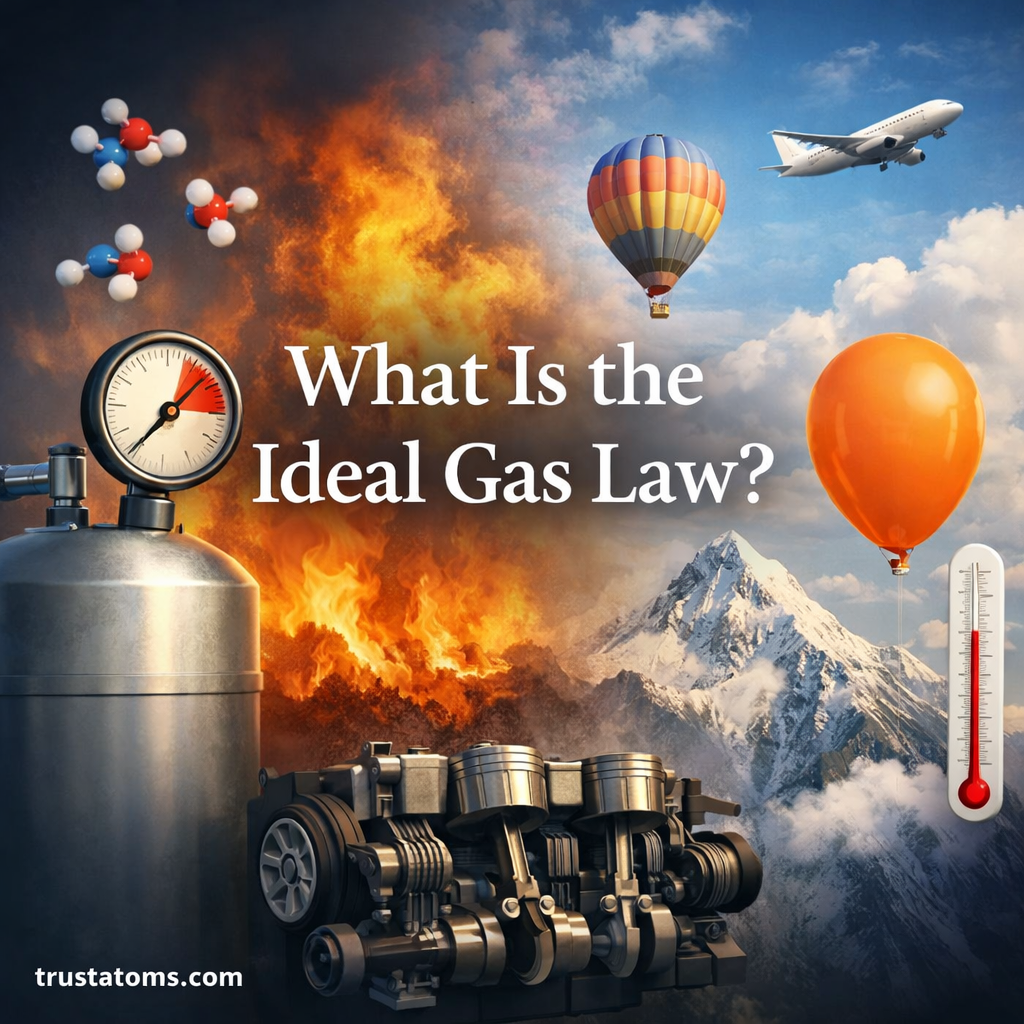
What Is the Ideal Gas Law?

Illustration explaining the Ideal Gas Law with gas container, balloon, molecules, and temperature changes representing gas behavior in chemistry.
Illustration representing how gases respond to changes in temperature, pressure, and volume. trustatoms.com

The Ideal Gas Law is one of the most important relationships in chemistry and physics. It explains how gases behave by linking four key properties: pressure, volume, temperature, and the number of gas particles.

By combining several earlier gas laws into a single equation, the Ideal Gas Law allows scientists to predict how gases will react when conditions change. It is widely used in chemistry, engineering, meteorology, and many everyday applications involving air and other gases.

Continue reading “What Is the Ideal Gas Law?”

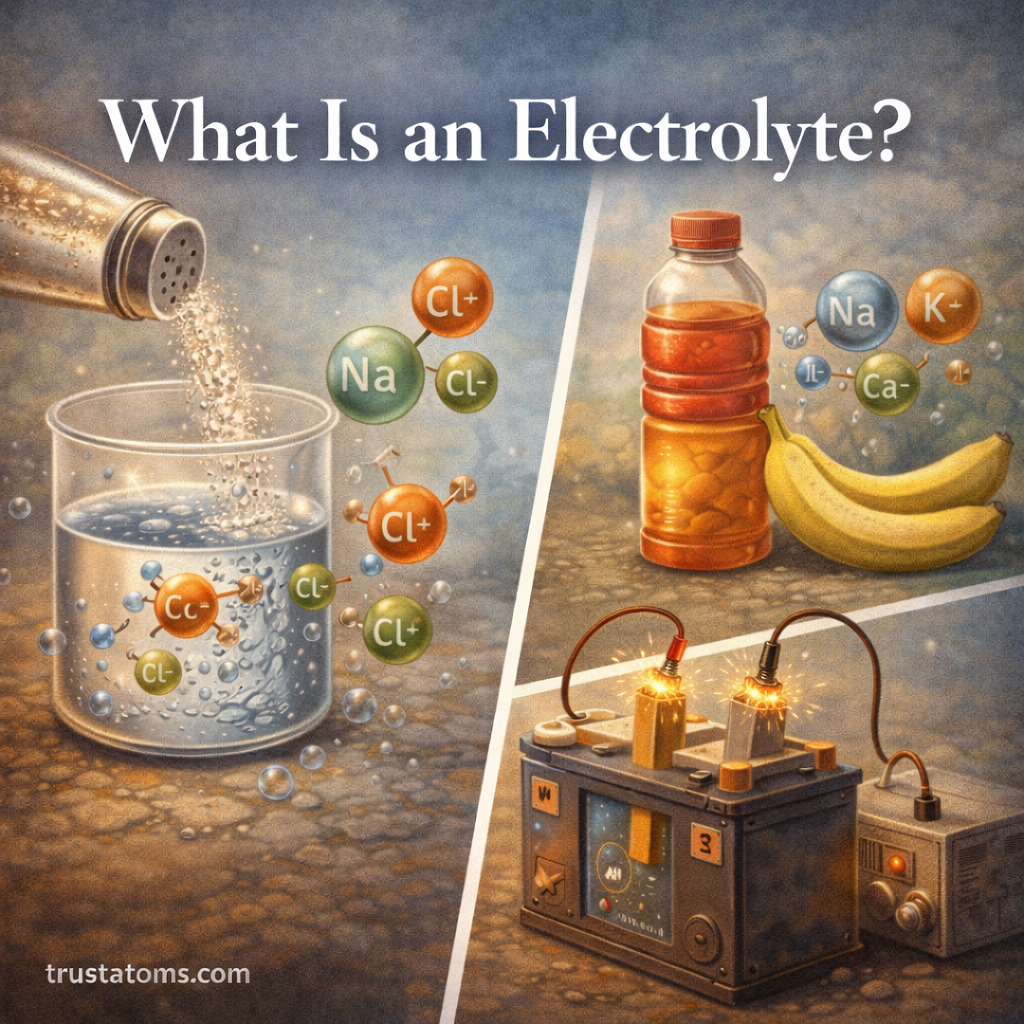
What Is an Electrolyte?

Illustration explaining electrolytes showing salt dissolving into ions in water, electrolyte drinks, and a battery conducting electricity.
Illustration showing how electrolytes dissolve into ions and allow electricity to move through solutions in chemistry and everyday systems. trustatoms.com

An electrolyte is a substance that produces ions when dissolved in water or melted, allowing it to conduct electricity. Electrolytes play an essential role in chemistry, biology, and many modern technologies because they enable the movement of electrical charge through liquids or solutions.

From powering batteries to supporting nerve signals in the human body, electrolytes are involved in many chemical and biological processes. Understanding how electrolytes work helps explain how energy flows through chemical systems and living organisms.

Continue reading “What Is an Electrolyte?”

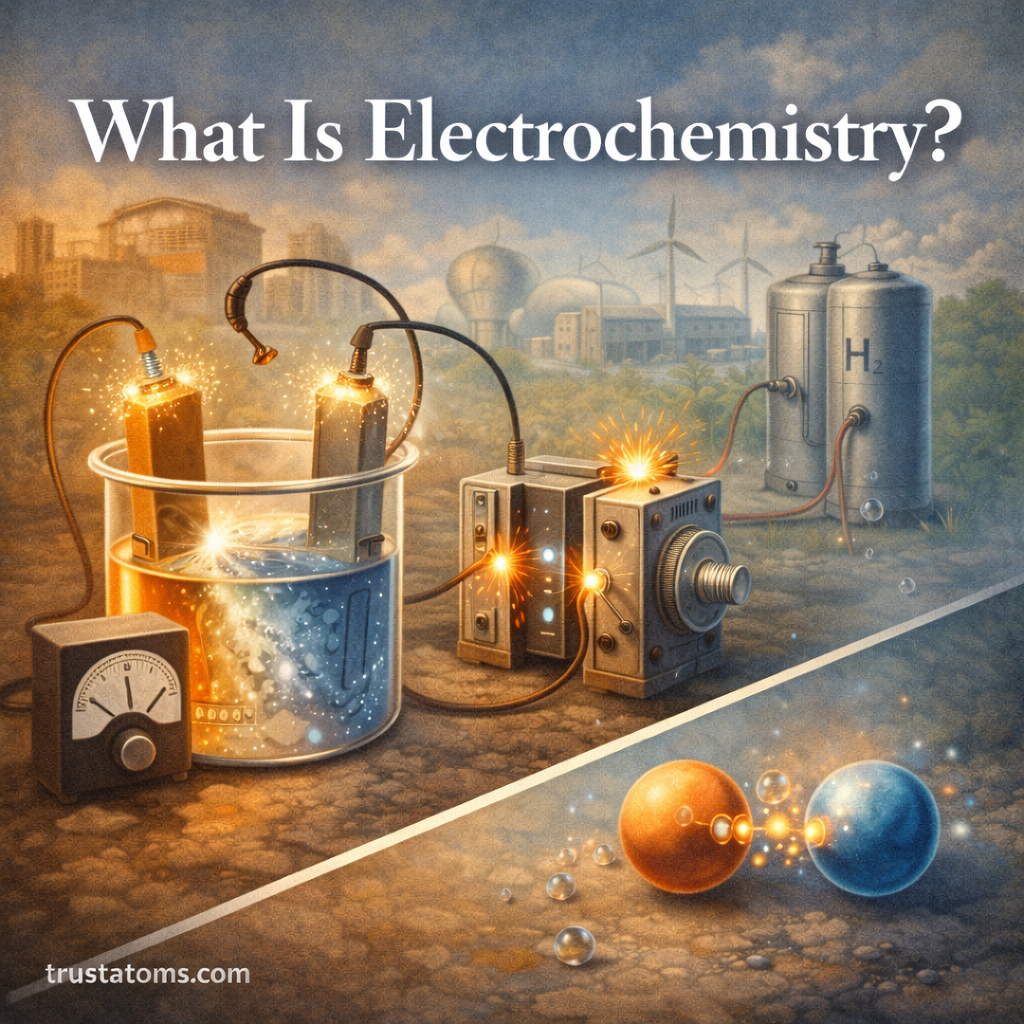
What Is Electrochemistry?

Illustration explaining electrochemistry with electrodes in a solution generating electricity and energy systems such as fuel cells and batteries.
Illustration showing how electrochemical reactions transfer electrons to generate electrical energy in batteries and fuel cells. trustatoms.com

Electrochemistry is the branch of chemistry that studies the relationship between chemical reactions and electricity. It focuses on how chemical reactions can produce electrical energy and how electrical energy can drive chemical reactions.

This field connects chemistry, physics, and engineering, and it plays an important role in modern technologies such as batteries, fuel cells, corrosion prevention, and electroplating.

Understanding electrochemistry helps scientists design energy systems, improve electronics, and develop new methods for storing and converting energy.

Continue reading “What Is Electrochemistry?”

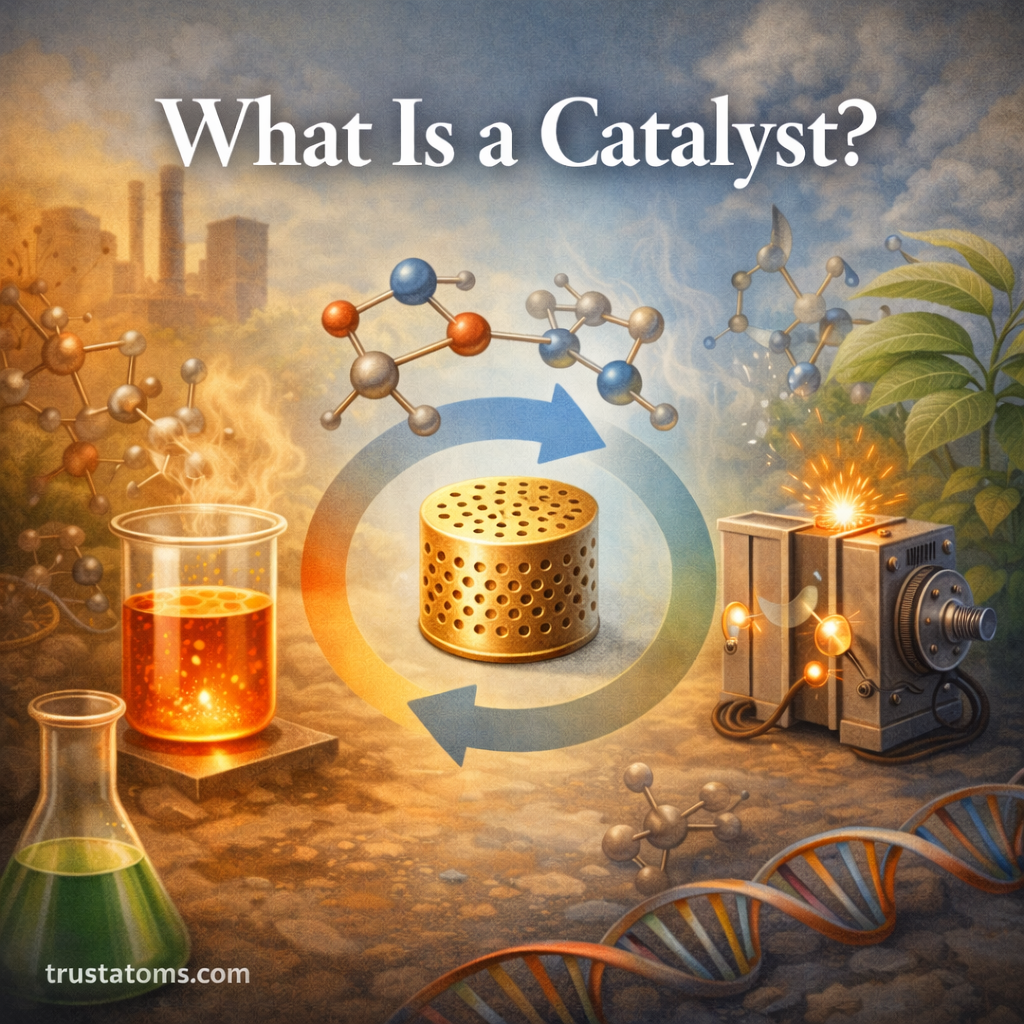
What Is a Catalyst?

Illustration explaining what a catalyst is in chemistry, showing a substance speeding up chemical reactions in laboratory, biological, and industrial settings.
Conceptual illustration showing how catalysts speed up chemical reactions in chemistry and industrial processes. trustatoms.com

A catalyst is a substance that speeds up a chemical reaction without being permanently consumed in the process. Catalysts are essential in chemistry because they make reactions occur faster or under milder conditions, often saving time, energy, and resources.

Many reactions that would normally take hours, days, or even years can occur almost instantly when a catalyst is present. Catalysts play a major role in industrial chemistry, environmental systems, and biological processes.

Continue reading “What Is a Catalyst?”

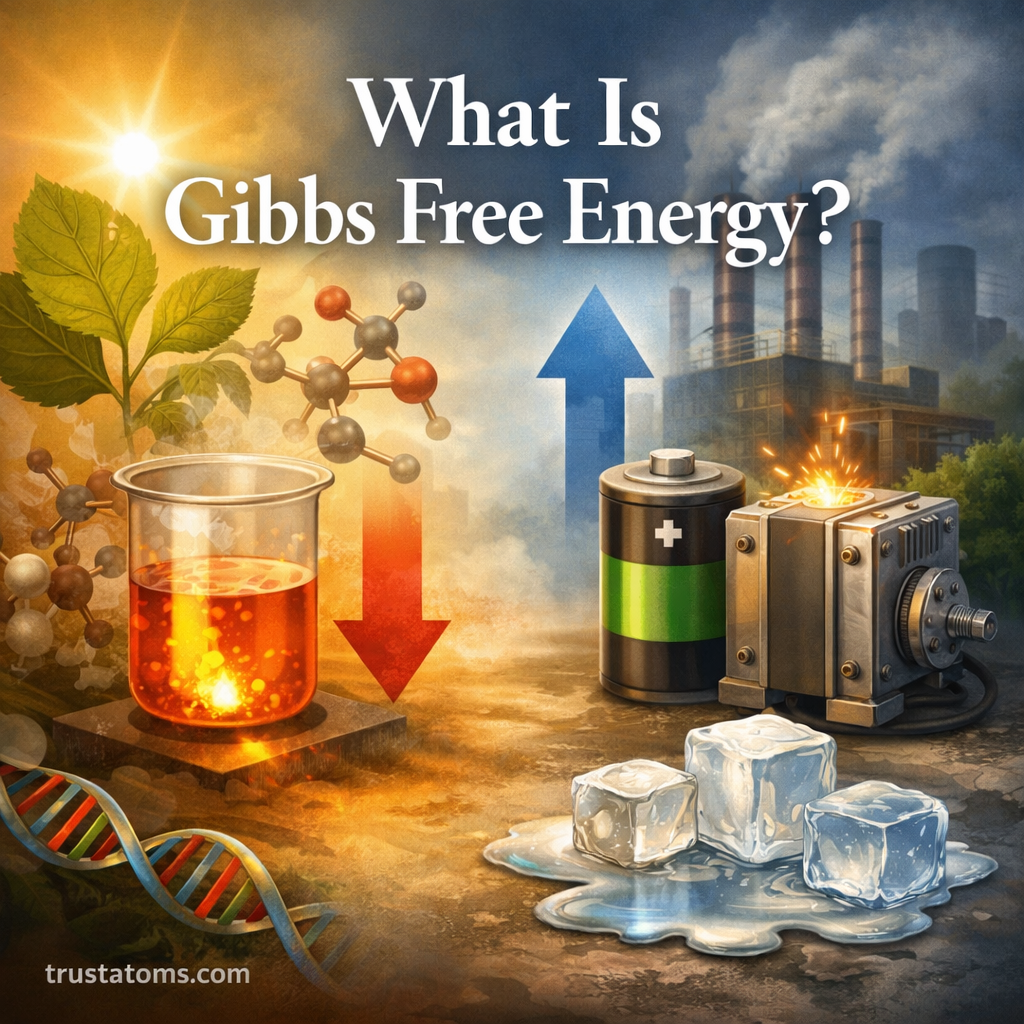
What Is Gibbs Free Energy?

Illustration explaining Gibbs Free Energy with chemical reaction energy concepts and industrial and biological examples.
Simple illustration showing how Gibbs Free Energy relates to chemical reactions and energy changes in chemistry. trustatoms.com

Gibbs Free Energy is one of the most important concepts in chemistry and thermodynamics. It helps scientists determine whether a chemical reaction will happen spontaneously under certain conditions. By combining ideas about energy, heat, and disorder, Gibbs Free Energy provides a powerful way to predict the direction and feasibility of chemical processes.

Chemists use this concept to analyze reactions in everything from biological systems and industrial manufacturing to environmental processes and energy storage technologies.

Continue reading “What Is Gibbs Free Energy?”