Population dynamics is the study of how and why populations change over time. In the study of biology and ecology, it focuses on patterns of population growth, decline, stability, and interactions within ecosystems.
A population is a group of individuals of the same species living in a particular area. Its size can increase when more individuals are born or arrive, and decrease when individuals die or leave. These changes affect everything from the number of fish in a lake to the survival of endangered wildlife.
Scientists study population dynamics to understand how organisms respond to food availability, predators, disease, competition, and environmental change. By measuring these influences, researchers can identify population trends and make better-informed conservation decisions.
What Are Population Dynamics?
Population dynamics describes changes in the size, structure, and distribution of a biological population over time. Researchers examine not only how many organisms exist but also their ages, locations, and chances of surviving and reproducing.
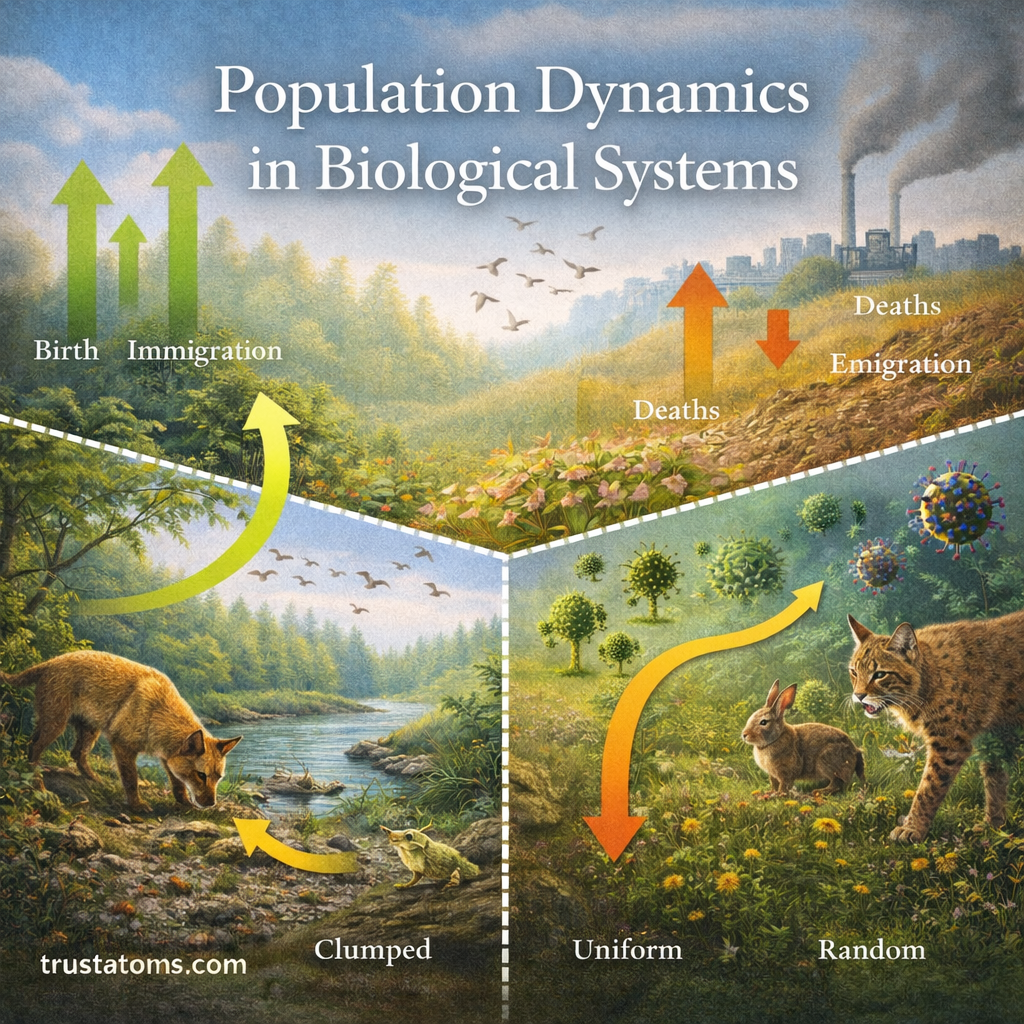
Four basic processes determine changes in population size:
- Births: New individuals enter the population through reproduction.
- Deaths: Individuals are removed from the population through mortality.
- Immigration: Individuals move into the population from another area.
- Emigration: Individuals leave the population for another area.
These processes can be summarized with a simple equation: population change = births + immigration − deaths − emigration. If the result is positive, the population increases. If it is negative, the population decreases.
Researchers use mathematical models to explore how these processes interact. Population Modeling in Ecology explains how scientists represent population changes and investigate possible future conditions.
How Scientists Measure Populations
Population size alone does not tell the entire story. Ecologists also examine density, distribution, and age structure to understand how a population functions.
Population Size and Density
Population size is the total number of individuals in a defined population. Population density measures how many individuals occupy a particular area or volume, such as deer per square kilometer or plankton per cubic meter of water.
Density matters because crowded populations may experience stronger competition for food, shelter, territory, and breeding opportunities. However, the effects depend on the species and available resources.
Population Distribution
Population distribution describes how individuals are arranged within their habitat. Ecologists recognize three common patterns:
- Clumped: Individuals gather in groups, as seen in fish schools and elephant herds.
- Uniform: Individuals are relatively evenly spaced, often because of territorial behavior or competition.
- Random: Individuals occur without a consistent spacing pattern, sometimes when seeds disperse independently across suitable habitat.
Age Structure and Reproduction
The proportions of young, reproductive-age, and older individuals can influence future population growth. A population containing many young individuals may have the potential to expand as they mature, while one with relatively few breeding individuals may face slower growth or decline.
What Factors Cause Populations to Change?

Population changes result from interactions between organisms and their environments. Some factors become stronger as populations grow denser, while others affect populations regardless of their size.
Food, Water, and Habitat
Organisms need resources to survive and reproduce. When food, water, shelter, or nesting sites become scarce, reproduction may decrease and mortality may increase. Resource shortages can also encourage individuals to move elsewhere.
Predation and Competition
Predators directly affect prey survival, while prey availability can influence predator reproduction and survival. Competition also limits access to resources, whether it occurs among members of the same species or between different species.
Disease and Environmental Disturbances
Infectious diseases may spread more readily when susceptible individuals encounter one another frequently. Droughts, floods, wildfires, and severe weather can also alter populations, sometimes causing sudden declines regardless of population density.
Exponential Growth vs. Logistic Growth
Ecologists use two basic mathematical models to describe population growth. Both simplify reality, but they help explain why some populations expand rapidly while others approach environmental limits.
| Feature | Exponential Growth | Logistic Growth |
|---|---|---|
| Growth pattern | J-shaped curve | S-shaped curve |
| Resources | Assumed unlimited | Become limiting |
| Growth rate | Increases with population size | Slows near carrying capacity |
| Long-term behavior | Continued expansion in the model | Approaches an environmental limit |
Exponential Growth
Exponential growth occurs when a population increases at a constant proportional rate under ideal conditions. As the population becomes larger, more individuals contribute to reproduction, producing increasingly large numerical gains.
In continuous-time models, exponential growth is represented by dN/dt = rN, where N is population size and r is the per-capita rate of increase. Real populations cannot maintain unrestricted growth indefinitely because resources and suitable habitat are finite.
Logistic Growth and Carrying Capacity
Logistic growth describes a population whose growth slows as it approaches environmental limits. This pattern occurs because ecosystems have a carrying capacity, the maximum population size an environment can support sustainably under particular conditions.
The logistic equation is dN/dt = rN(1 − N/K), where K represents carrying capacity. When N is much smaller than K, growth can be relatively rapid. As N approaches K, the model predicts that net growth slows toward zero.
Carrying capacity is not necessarily fixed. Changes in rainfall, habitat quality, food supplies, and other environmental conditions can raise or lower it. The relationship between resources and environmental carrying capacity helps explain why populations may fluctuate rather than settle permanently at one size.
Worked Example: Calculating Population Change
Imagine a hypothetical pond containing 200 frogs at the beginning of a year. During that year, researchers record 60 births, 35 deaths, 15 frogs arriving from nearby ponds, and 20 leaving.
The calculation follows three steps:
- Add births and immigration: 60 + 15 = 75 individuals gained.
- Add deaths and emigration: 35 + 20 = 55 individuals lost.
- Subtract losses from gains: 75 − 55 = 20 additional frogs.
The pond finishes the year with 220 frogs, representing a 10% increase from its starting population. This example assumes the counts are complete and that the population boundaries remain consistent.
Although the population increased, this calculation alone cannot tell researchers whether that growth will continue. They would also need information about food supplies, breeding habitat, disease, and survival rates.
Why Predator and Prey Populations Sometimes Cycle
Some populations rise and fall in recurring patterns. Snowshoe hares and Canada lynx provide a well-studied example of linked population fluctuations.
When hare numbers increase, more food becomes available to lynx. Lynx populations may subsequently increase, adding predation pressure on hares. As hare abundance falls, lynx may experience reduced food availability and eventually decline as well.
These cycles are not controlled by predation alone. Food quality, vegetation, weather, and other ecological conditions can influence their timing and intensity. Population cycles demonstrate why studying one species in isolation may produce an incomplete explanation.
How Human Activities Alter Population Dynamics
Human activities can change birth rates, survival, migration, and the resources available to organisms. Habitat fragmentation may isolate populations, while pollution or excessive harvesting can reduce survival and reproductive success.
Climate change can shift suitable habitats and seasonal breeding conditions. Introduced species may compete with native organisms, prey on them, or spread disease. Conversely, habitat restoration and carefully managed conservation programs can improve conditions for population recovery.
Using Population Dynamics in Wildlife Conservation
Conservation biologists track population size, reproductive success, survival, genetic diversity, and movement between habitats to evaluate extinction risks. Small, isolated populations may be especially vulnerable to environmental disturbances and reduced genetic diversity.
Population models help researchers compare possible outcomes under different management strategies, such as habitat protection, wildlife corridors, or harvesting limits. These predictions involve uncertainty, so repeated field observations are needed to test assumptions and adjust conservation plans.
Frequently Asked Questions
What is the difference between population dynamics and population growth?
Population growth describes an increase in the number of individuals. Population dynamics is broader: it examines increases, declines, stability, migration, age structure, and the ecological processes behind these changes.
Can a population exceed its carrying capacity?
Yes. Populations can temporarily exceed carrying capacity, particularly when reproduction continues before resource shortages affect survival. Such overshoots may be followed by declines, although the outcome depends on environmental conditions and species characteristics.
How do scientists estimate wild animal populations?
Methods include direct counts, camera traps, aerial surveys, sampling, and capture-mark-recapture studies. Researchers choose methods according to the species, habitat, and available resources, while accounting for animals that may go undetected.
Population dynamics explains how births, deaths, movement, and environmental pressures combine to change the number and distribution of organisms. Understanding these patterns helps scientists distinguish temporary fluctuations from longer-term declines and make more informed decisions about protecting species and habitats.
Sources: OpenStax, Biology 2e; Begon, Townsend, and Harper, Ecology: From Individuals to Ecosystems; U.S. Geological Survey.