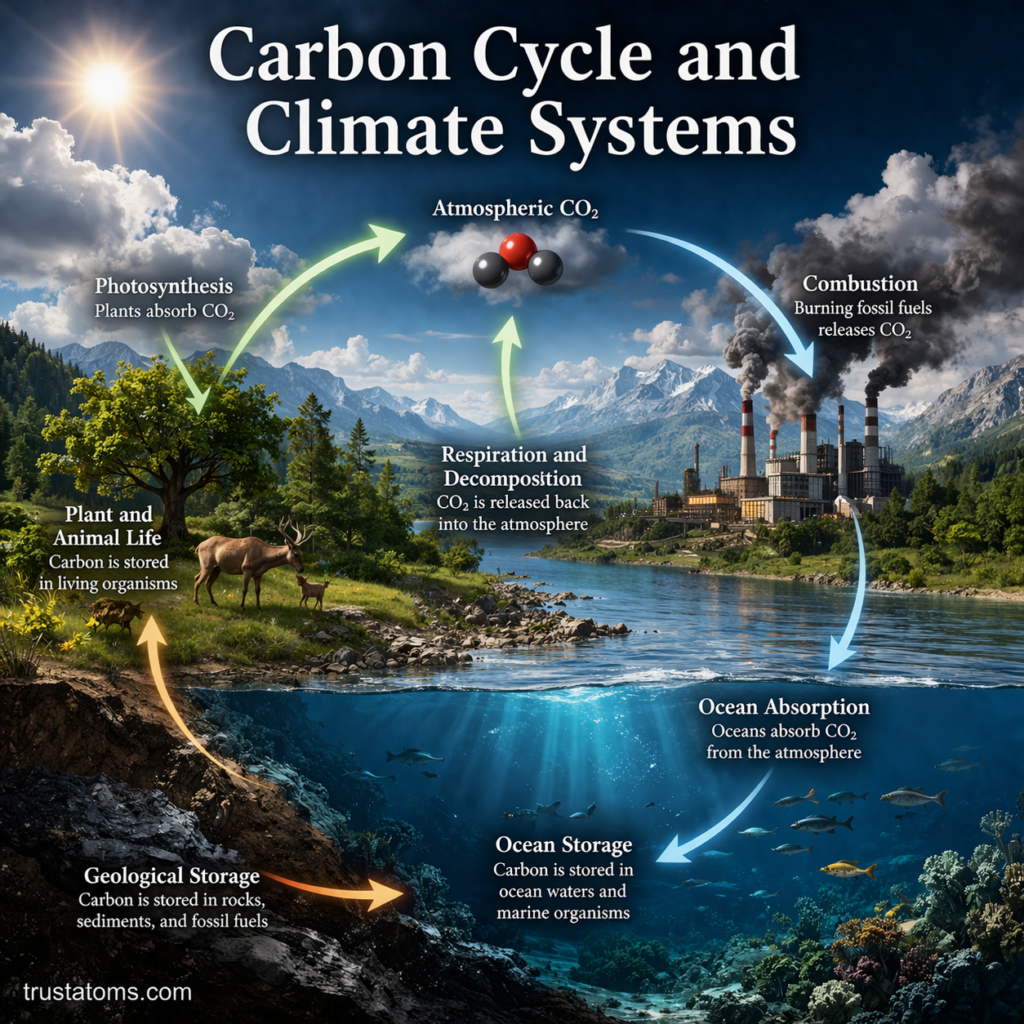
The carbon cycle is one of the most important processes on Earth. It describes how carbon moves between the atmosphere, oceans, land, and living organisms.
This continuous cycle plays a critical role in regulating Earth’s climate, supporting life, and influencing global temperature patterns.
What Is the Carbon Cycle?
The carbon cycle is the natural movement of carbon through different parts of the Earth system.
Carbon exists in multiple forms, including:
- Carbon dioxide (CO₂) in the atmosphere
- Organic carbon in plants and animals
- Dissolved carbon in oceans
- Carbon stored in rocks and fossil fuels
The cycle ensures that carbon is constantly reused and redistributed.
Major Components of the Carbon Cycle
Carbon moves through four main “spheres” of Earth:
Atmosphere
- Contains carbon mainly as carbon dioxide (CO₂)
- Acts as a central hub for carbon exchange
- Influences global temperature through greenhouse effects
Biosphere
- Includes all living organisms
- Plants absorb CO₂ during photosynthesis
- Animals release CO₂ through respiration
Hydrosphere
- Oceans store large amounts of carbon
- Carbon dissolves in seawater
- Marine organisms use carbon to build shells
Geosphere
- Stores carbon in rocks, sediments, and fossil fuels
- Holds the largest long-term carbon reserves
- Releases carbon through volcanic activity and human extraction
Key Processes in the Carbon Cycle
Several natural processes move carbon between these systems.
Photosynthesis
Plants absorb carbon dioxide and convert it into energy.
- Removes CO₂ from the atmosphere
- Stores carbon in plant tissues
Respiration
Living organisms release carbon dioxide back into the atmosphere.
- Occurs in plants, animals, and microbes
- Balances photosynthesis
Decomposition
When organisms die, decomposers break them down.
- Releases carbon into soil and atmosphere
- Transfers carbon to long-term storage
Ocean Absorption
Oceans absorb carbon dioxide from the atmosphere.
- Acts as a carbon sink
- Helps regulate atmospheric CO₂ levels
Combustion
Burning organic material releases stored carbon.
- Includes wildfires and fossil fuel burning
- Rapidly increases atmospheric CO₂
Short-Term vs Long-Term Carbon Cycle
The carbon cycle operates on different timescales.
Short-term cycle
- Occurs over days to years
- Includes photosynthesis, respiration, and ocean exchange
Long-term cycle
- Occurs over thousands to millions of years
- Involves rock formation, fossil fuels, and tectonic activity
Both cycles are essential for maintaining Earth’s balance.
Carbon Cycle and Climate Systems
The carbon cycle is closely linked to Earth’s climate system.
How carbon affects climate
- CO₂ is a greenhouse gas that traps heat
- Higher CO₂ levels lead to warming
- Lower CO₂ levels can lead to cooling
Feedback loops
The carbon cycle can amplify or reduce climate changes.
Examples:
- Warming → more CO₂ released from soil → further warming
- Increased plant growth → more CO₂ absorbed → cooling effect
These feedback loops make climate systems complex and dynamic.
Human Impact on the Carbon Cycle
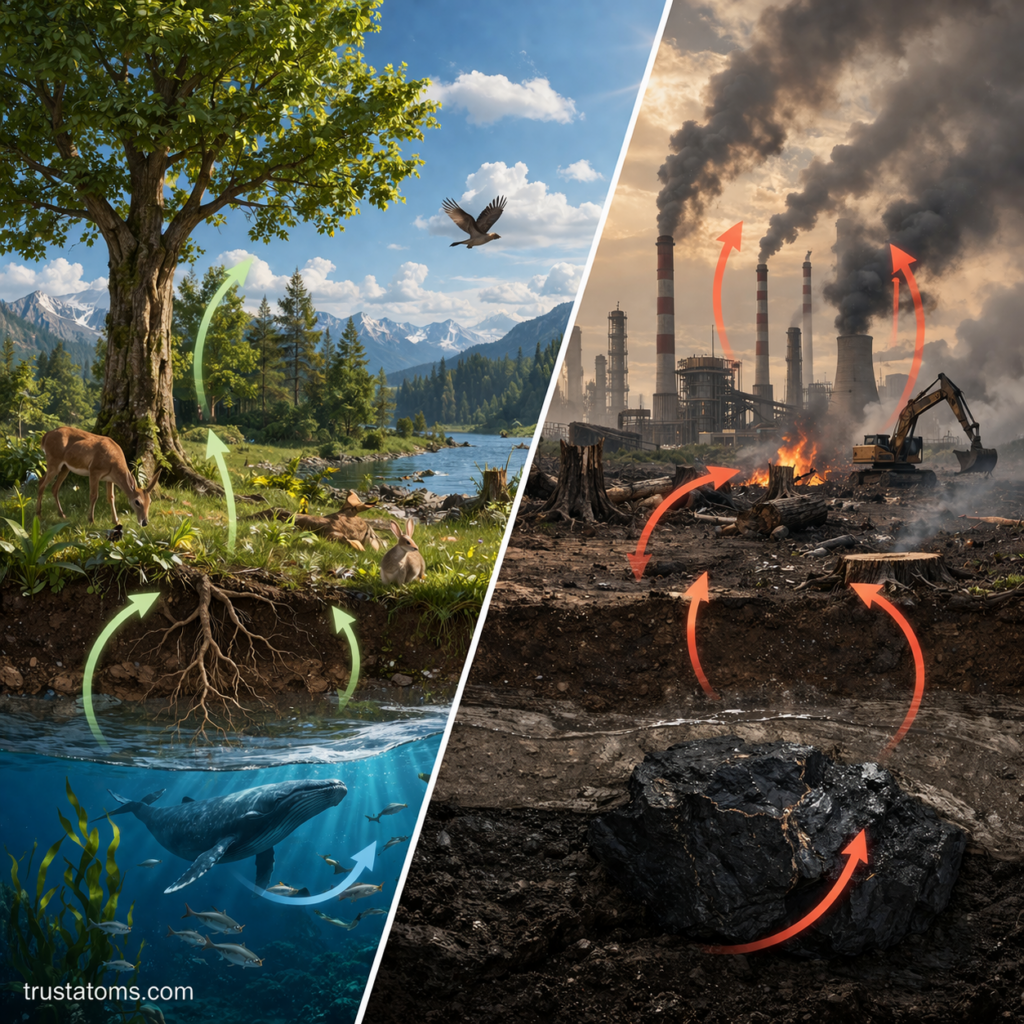
Human activity has significantly altered the natural carbon cycle.
Major sources of disruption
- Burning fossil fuels
- Deforestation
- Industrial processes
- Agriculture
What this causes
- Increased atmospheric CO₂
- Reduced carbon storage in forests
- Ocean acidification
These changes contribute directly to global climate change.
Carbon Sinks and Carbon Sources
Understanding carbon sinks and sources is key to climate science.
Carbon sinks
These absorb more carbon than they release:
- Forests
- Oceans
- Soil
Carbon sources
These release more carbon than they absorb:
- Fossil fuel combustion
- Deforestation
- Volcanic activity
Balancing sinks and sources is essential for climate stability.
Why the Carbon Cycle Matters
The carbon cycle is vital for both life and the environment.
Key importance
- Regulates Earth’s temperature
- Supports plant growth and food chains
- Maintains atmospheric balance
- Influences ocean chemistry
Without a stable carbon cycle, Earth’s climate would be unpredictable and less suitable for life.
The Carbon Cycle in Simple Terms
You can think of the carbon cycle like a recycling system:
- Carbon moves between air, water, land, and living things
- It is constantly reused and redistributed
- Balance keeps the system stable
When too much carbon stays in the atmosphere, the system becomes unbalanced.
Future of the Carbon Cycle
As human activity continues, the carbon cycle is changing.
Potential future trends
- Increased atmospheric CO₂ levels
- Reduced effectiveness of natural carbon sinks
- Stronger climate feedback loops
Understanding these changes is essential for developing solutions to climate challenges.
Final Thoughts
The carbon cycle is a foundational process that connects Earth’s systems. It regulates climate, supports ecosystems, and keeps the planet in balance.
However, human activities are disrupting this cycle at an unprecedented rate. By understanding how carbon moves through the Earth system, we can better address climate change and work toward a more sustainable future.