What Is an Endothermic Reaction?

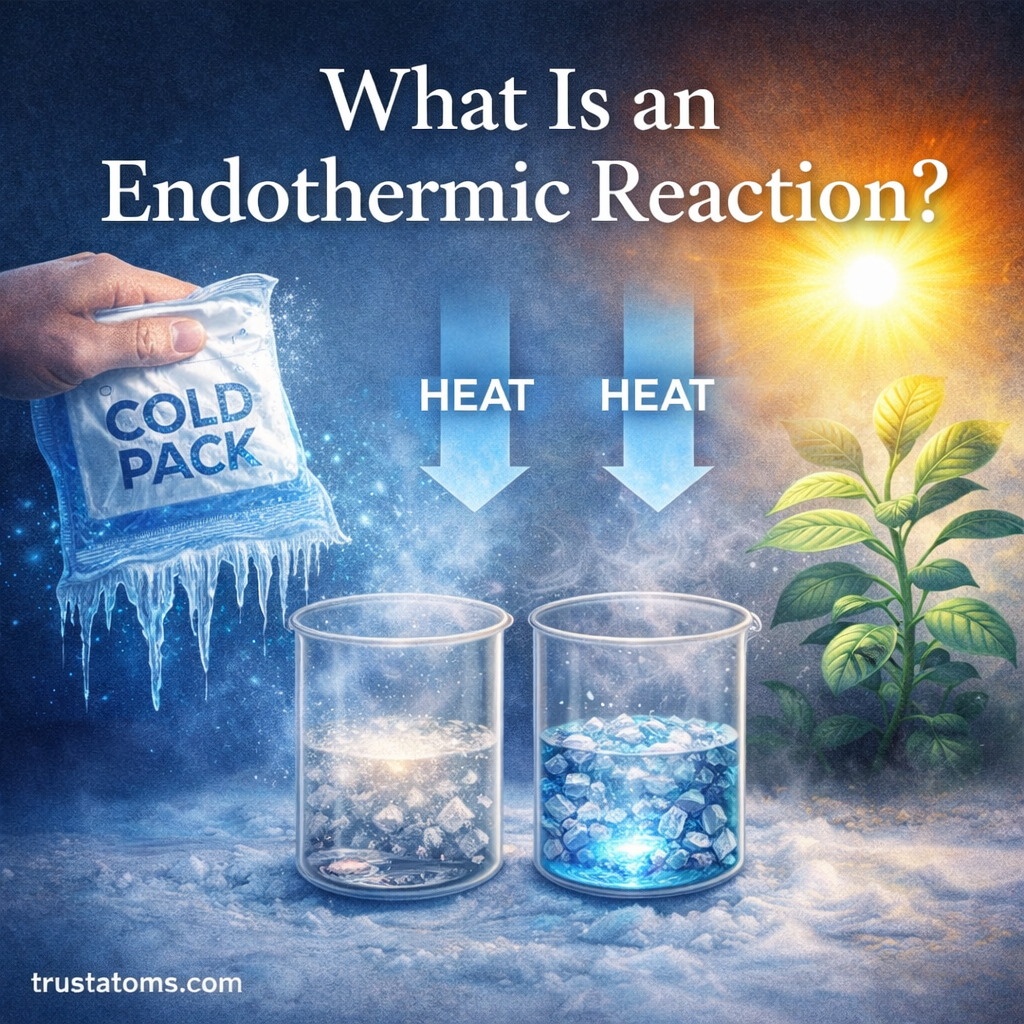
Illustration explaining an endothermic reaction, showing a cold pack, laboratory beakers absorbing heat, and a plant using sunlight for photosynthesis.
Conceptual illustration showing how endothermic reactions absorb heat energy from their surroundings. trustatoms.com.

An endothermic reaction is a chemical reaction that absorbs energy from its surroundings, usually in the form of heat. Instead of releasing heat like exothermic reactions, endothermic reactions require a continuous input of energy for the reaction to occur.

This energy absorption often causes the surrounding environment to feel cooler. Because of this, endothermic reactions are commonly used to demonstrate energy transfer in chemistry labs and natural processes.

Endothermic reactions play an important role in both nature and technology, helping power biological processes, environmental cycles, and industrial chemical production.

Continue reading “What Is an Endothermic Reaction?”
What Is an Exothermic Reaction?

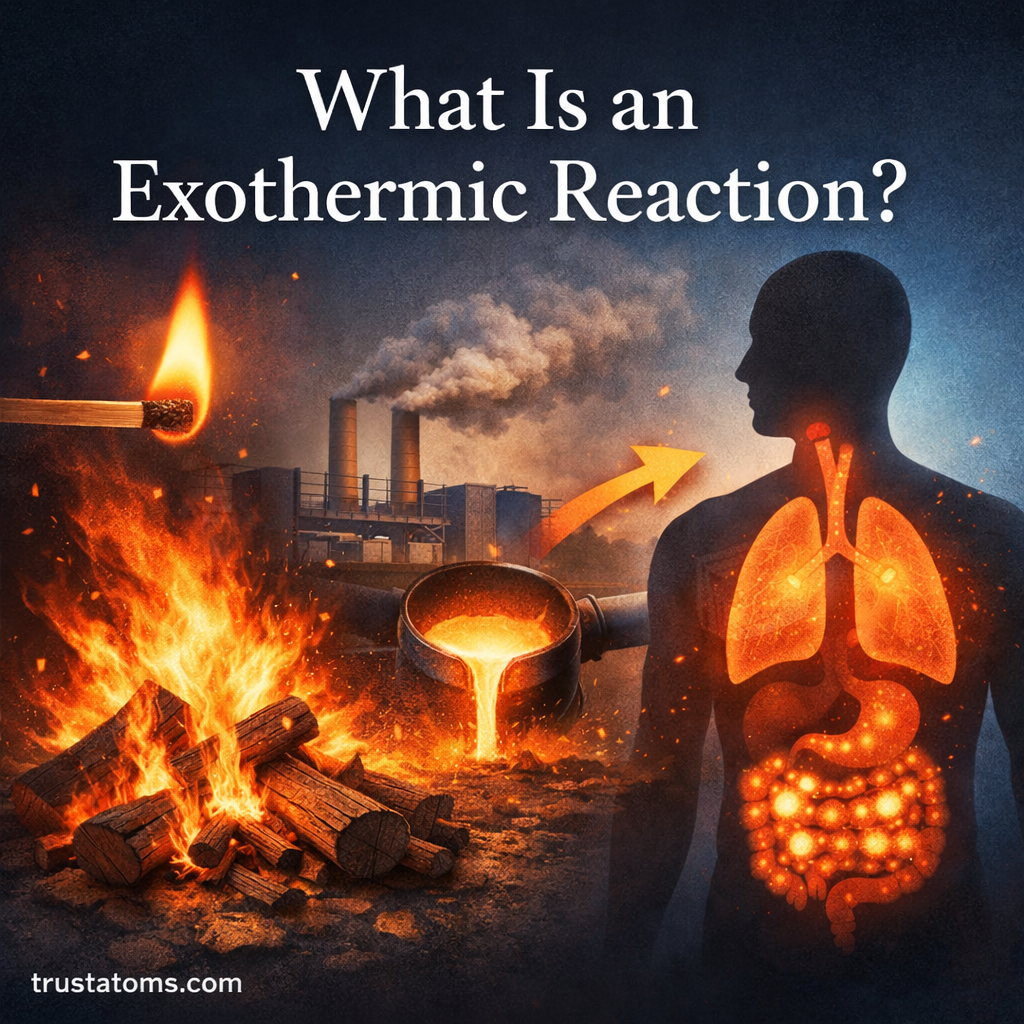
Illustration showing heat energy being released during an exothermic reaction, with examples like combustion, industrial heat processes, and biological energy release.
Conceptual illustration showing examples of exothermic reactions that release energy as heat. trustatoms.com

Exothermic reactions are chemical reactions that release energy into their surroundings, usually in the form of heat. These reactions are common in everyday life—from lighting a match to burning fuel in a car engine. In chemistry, understanding exothermic reactions helps explain how energy flows through chemical processes and why certain reactions occur spontaneously.

When an exothermic reaction takes place, the total energy released by forming new chemical bonds is greater than the energy required to break the original bonds in the reactants. The extra energy is released into the environment, often causing the surroundings to become warmer.

Continue reading “What Is an Exothermic Reaction?”

What Is a Precipitation Reaction?

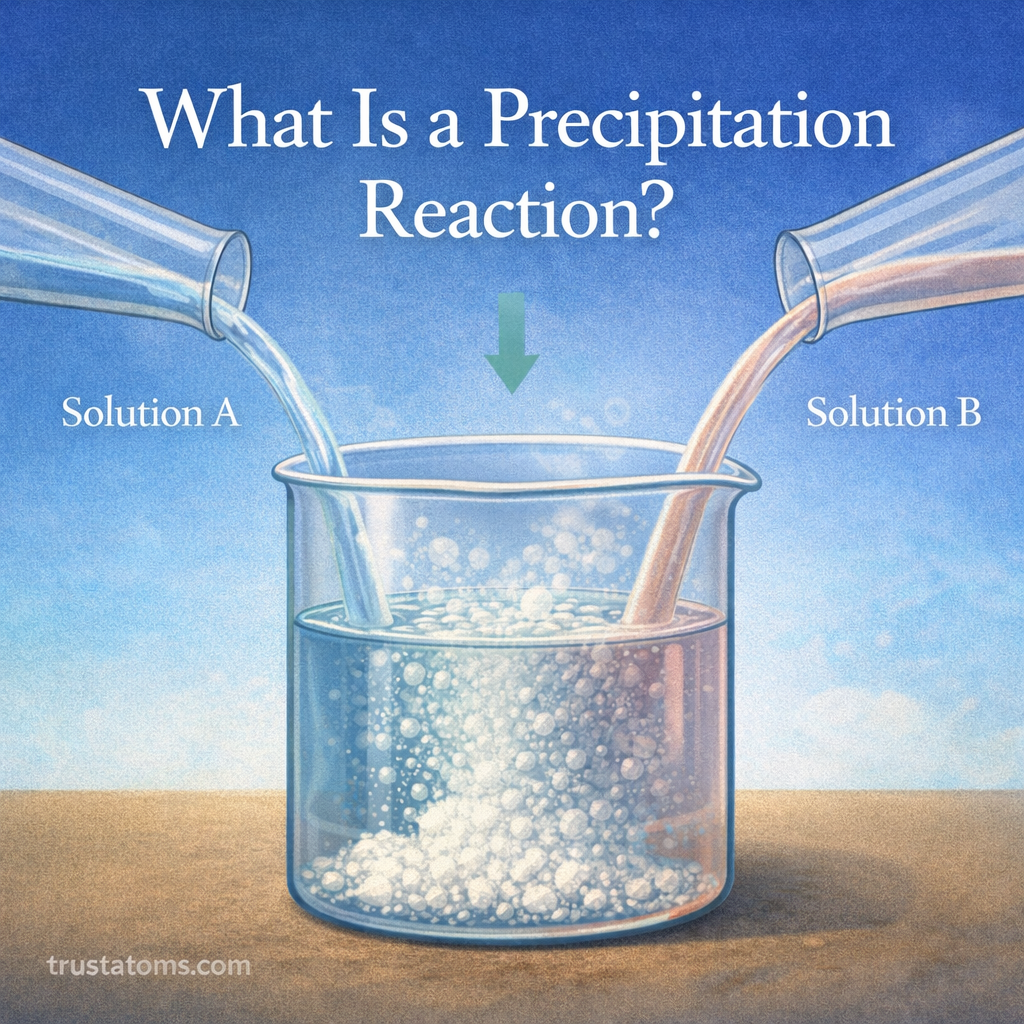
Illustration showing two liquid solutions mixing in a beaker to form a solid precipitate during a precipitation reaction.
Illustration demonstrating a precipitation reaction where two dissolved solutions combine to form a solid precipitate in the liquid. trustatoms.com.

A precipitation reaction is a type of chemical reaction in which two dissolved substances react to form a solid that separates from the solution. The solid that forms is called a precipitate.

These reactions commonly occur when two aqueous (water-based) solutions are mixed together and an insoluble compound forms. The solid particles appear cloudy at first and then settle at the bottom of the container.

Precipitation reactions are important in chemistry because they help scientists identify substances, remove impurities, and understand how compounds interact in solution.

Continue reading “What Is a Precipitation Reaction?”

What Is Solubility?

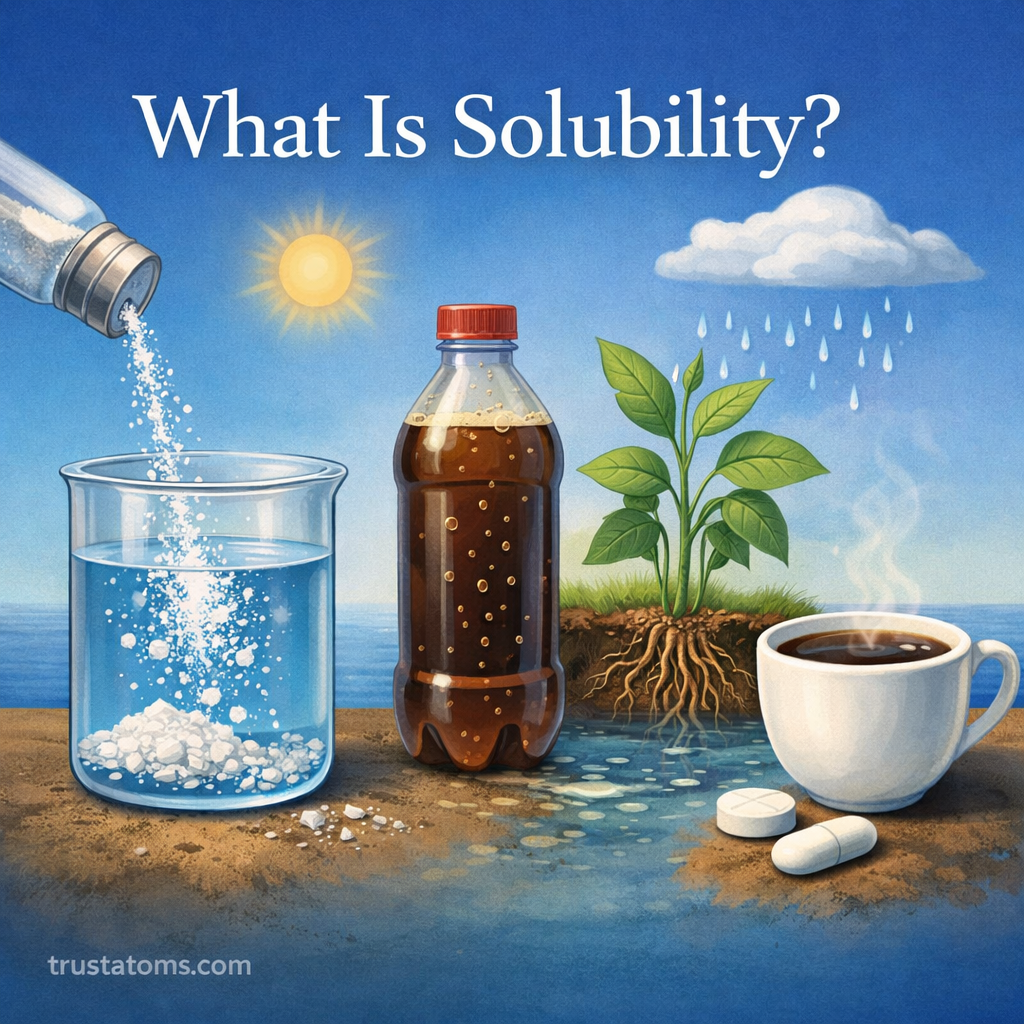
Illustration explaining solubility with salt dissolving in water, soda bubbles, plant roots in water, and a cup of coffee.
Simple illustration showing examples of solubility such as salt dissolving in water, carbonation in soda, and substances dissolving in everyday liquids. trustatoms.com.

Solubility is one of the most important concepts in chemistry because it explains how and why substances dissolve in liquids. From sugar dissolving in coffee to oxygen dissolving in water for fish to breathe, solubility helps scientists understand how different materials interact.

In simple terms, solubility describes the ability of a substance to dissolve in another substance, usually a liquid. Understanding solubility helps explain many natural processes, industrial applications, and everyday experiences.

Continue reading “What Is Solubility?”

What Is a Solution?

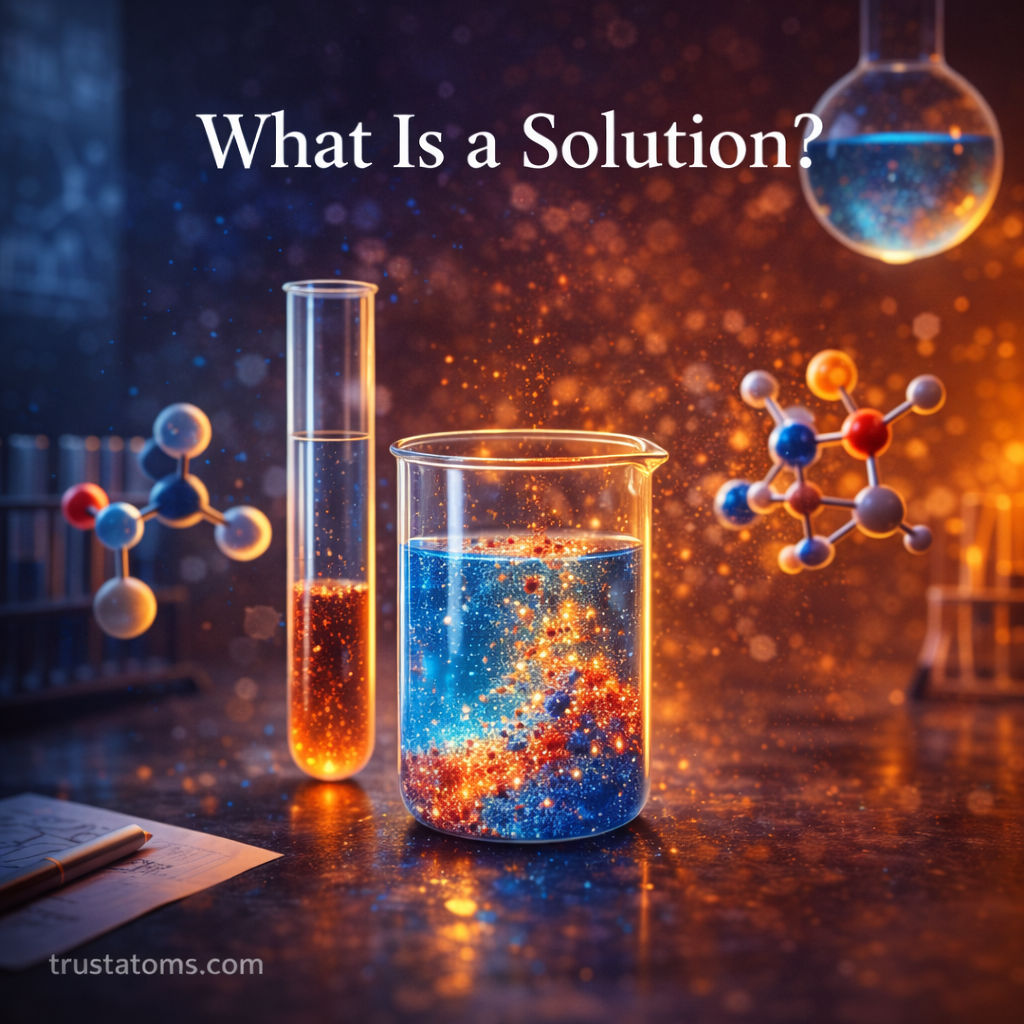
Illustration showing a solute dissolving into a liquid solvent inside laboratory glassware representing a chemical solution.
Illustration showing particles dissolving in a liquid to form a chemical solution. trustatoms.com.

In chemistry, a solution is a type of mixture where one substance dissolves evenly into another. The result is a uniform mixture in which the individual components cannot be easily distinguished.

Solutions are extremely common in everyday life. From saltwater and sugar in coffee to air and metal alloys, many substances around us exist as solutions.

Understanding solutions helps explain how substances mix, dissolve, and interact in chemical systems.

Continue reading “What Is a Solution?”

What Is Quantum Chemistry?

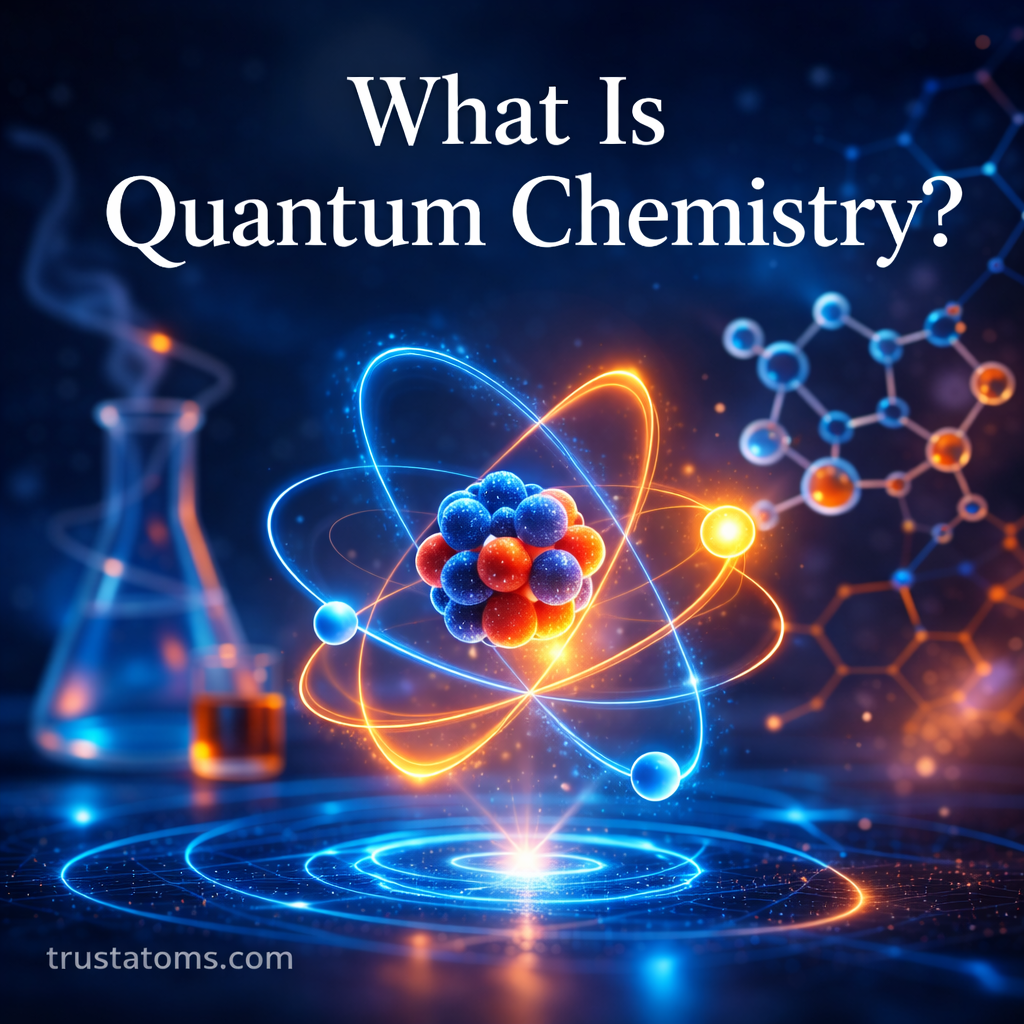
Illustration showing atomic and molecular structures representing quantum chemistry and electron behavior with the title “What Is Quantum Chemistry?”
Illustration representing how quantum mechanics explains electron behavior and molecular structure in quantum chemistry. trustatoms.com.

Quantum chemistry is the branch of chemistry that uses the principles of quantum mechanics to understand how atoms and molecules behave. It focuses on how electrons move, interact, and form chemical bonds at the smallest scales of matter.

Unlike classical chemistry, which often describes reactions and structures using simplified models, quantum chemistry explains chemical behavior using mathematical and physical laws that govern subatomic particles.

This field helps scientists understand why molecules form the shapes they do, how chemical reactions occur, and how energy moves through atomic systems.

Continue reading “What Is Quantum Chemistry?”

What Is an Orbital?

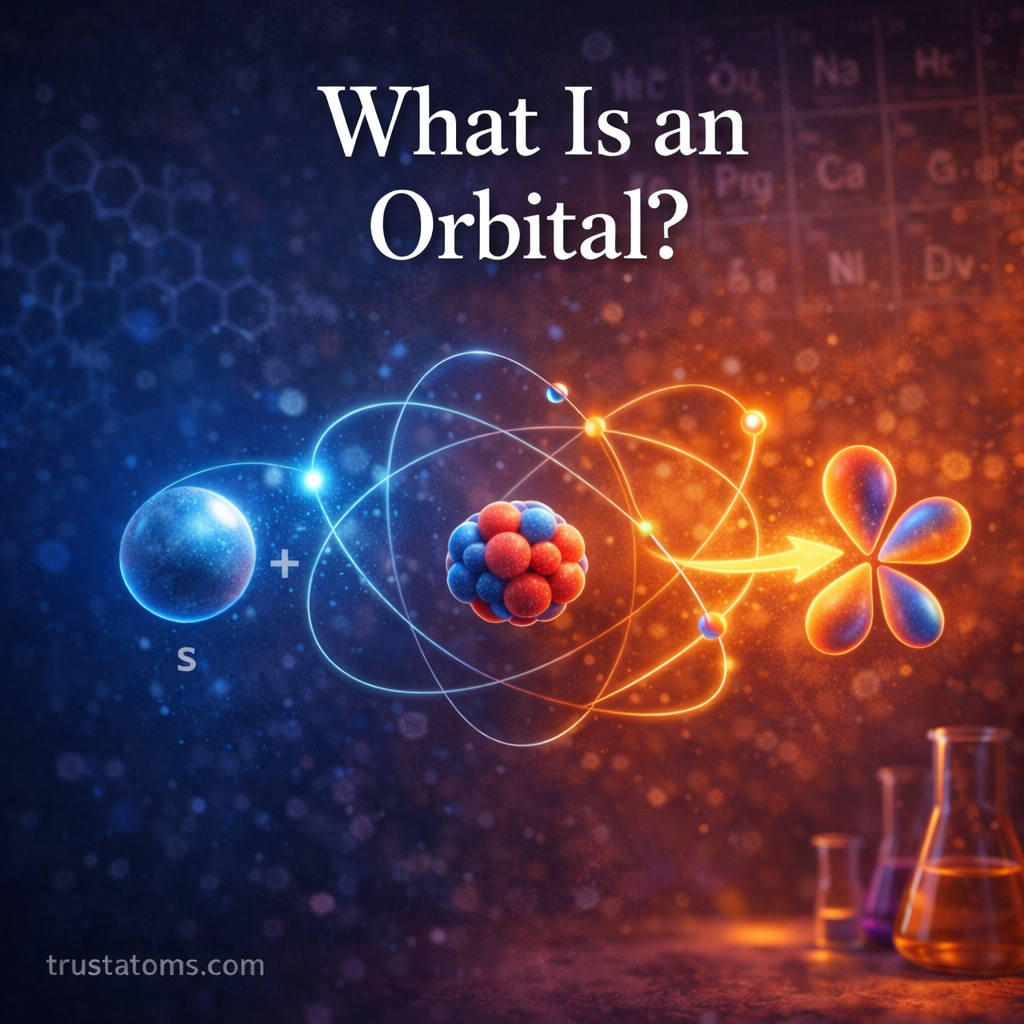
Illustration showing an atomic nucleus surrounded by electron probability regions to explain atomic orbitals with the title “What Is an Orbital?”
Illustration showing the electron probability region around an atomic nucleus to explain atomic orbitals. trustatoms.com.

In chemistry and physics, an orbital describes the region around an atom’s nucleus where an electron is most likely to be found. Orbitals are a fundamental part of atomic theory and help scientists understand how atoms bond, react, and form molecules.

Rather than moving in fixed circular paths, electrons exist in areas of probability called orbitals. These regions represent where electrons are most likely to appear at any given time.

Understanding orbitals helps explain the structure of atoms, the behavior of electrons, and the patterns seen in the periodic table.

Continue reading “What Is an Orbital?”

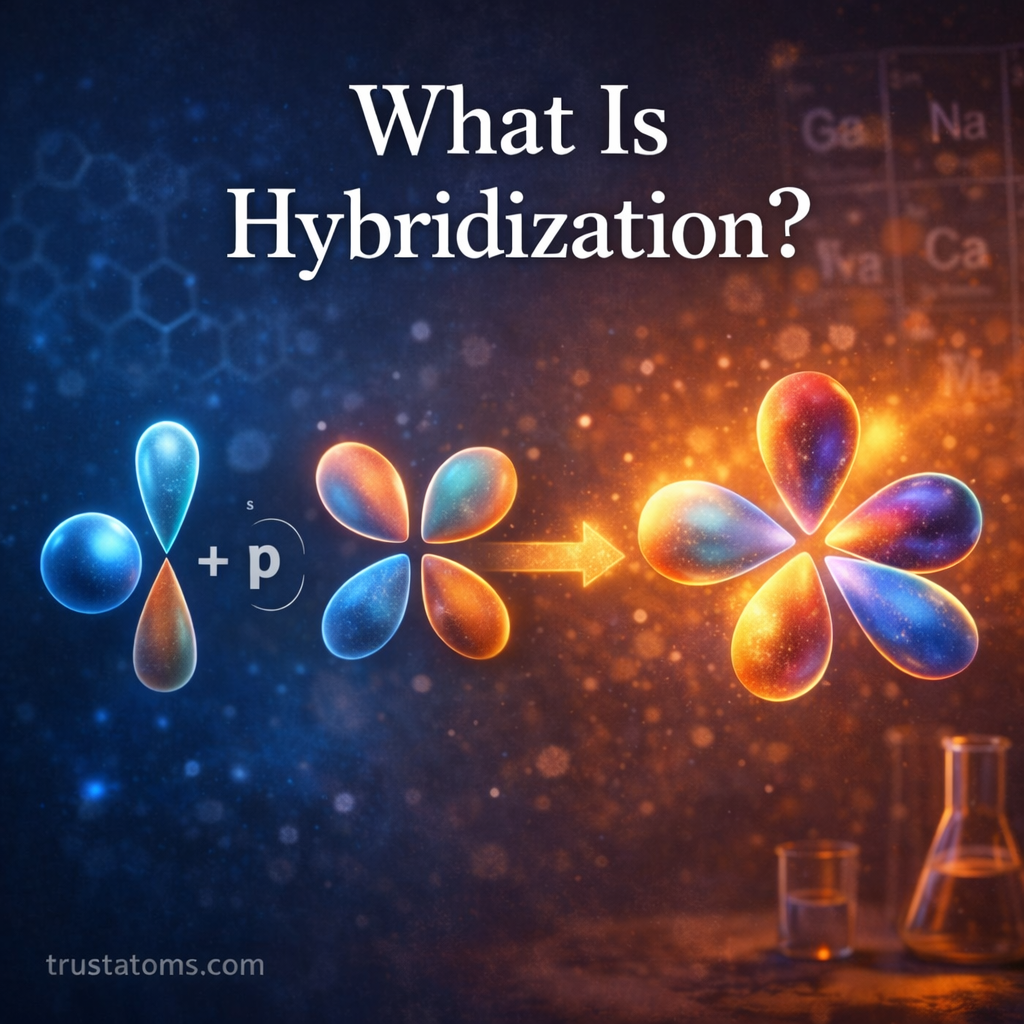
What Is Hybridization?

Illustration explaining hybridization in chemistry showing atomic orbitals combining to form hybrid orbitals with the title “What Is Hybridization?”
Diagram illustrating how atomic orbitals combine to form hybrid orbitals in chemistry. trustatoms.com.

Hybridization is a concept in chemistry that explains how atoms form chemical bonds by mixing their atomic orbitals. It helps scientists understand molecular shapes, bonding patterns, and how atoms share electrons to create stable molecules.

Without hybridization, many molecules would appear to break the basic rules of orbital theory. By combining orbitals into new hybrid orbitals, atoms can form bonds that match the shapes observed in real molecules.

Hybridization is especially important in organic chemistry, where carbon atoms frequently form multiple bonds and complex structures.

Continue reading “What Is Hybridization?”

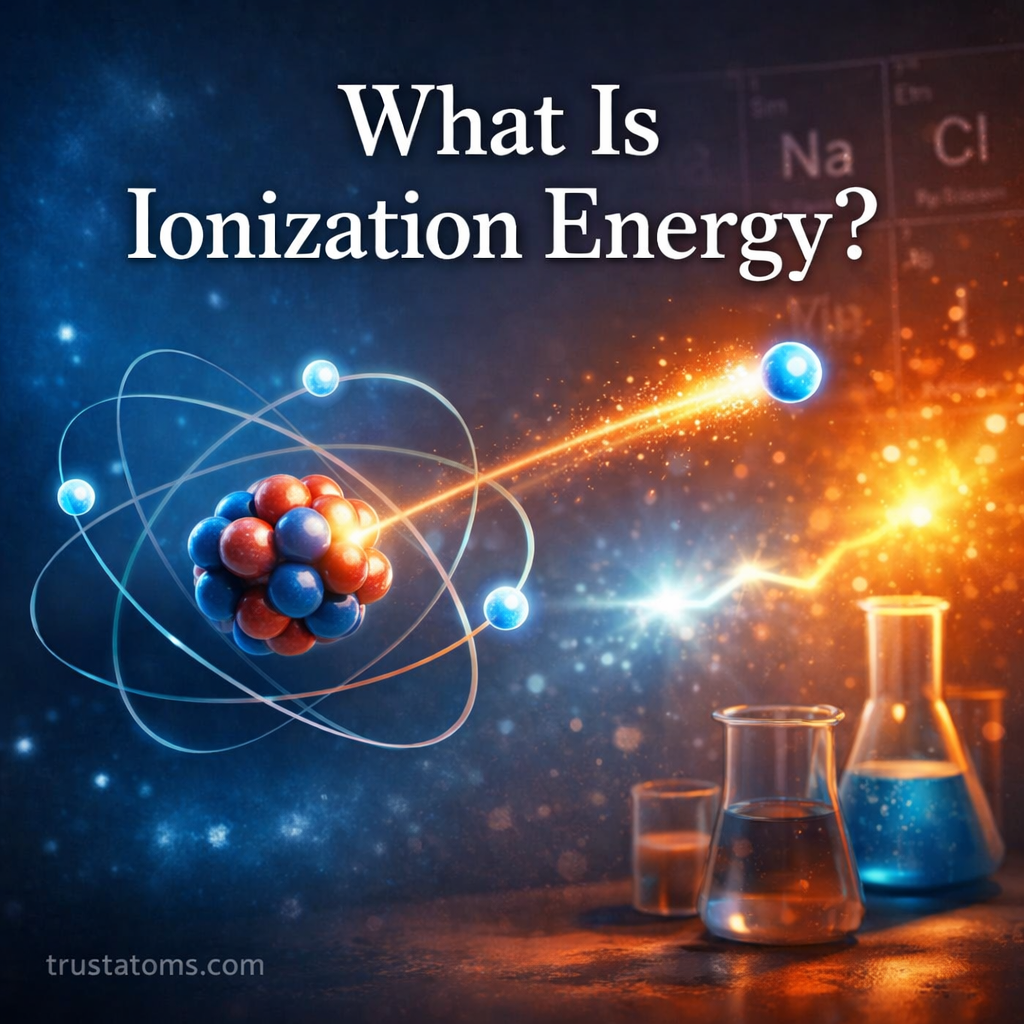
What Is Ionization Energy?

Illustration explaining ionization energy with an atom losing an electron and the title “What Is Ionization Energy?” displayed.
Illustration showing an electron being removed from an atom to demonstrate ionization energy. trustatoms.com

Ionization energy is one of the key concepts used to understand how atoms behave in chemistry. It explains how strongly an atom holds onto its electrons and helps scientists predict how elements will react with one another.

From chemical reactions to the formation of ions, ionization energy plays a major role in the structure and behavior of matter.

In simple terms, ionization energy tells us how much energy is required to remove an electron from an atom.

Continue reading “What Is Ionization Energy?”

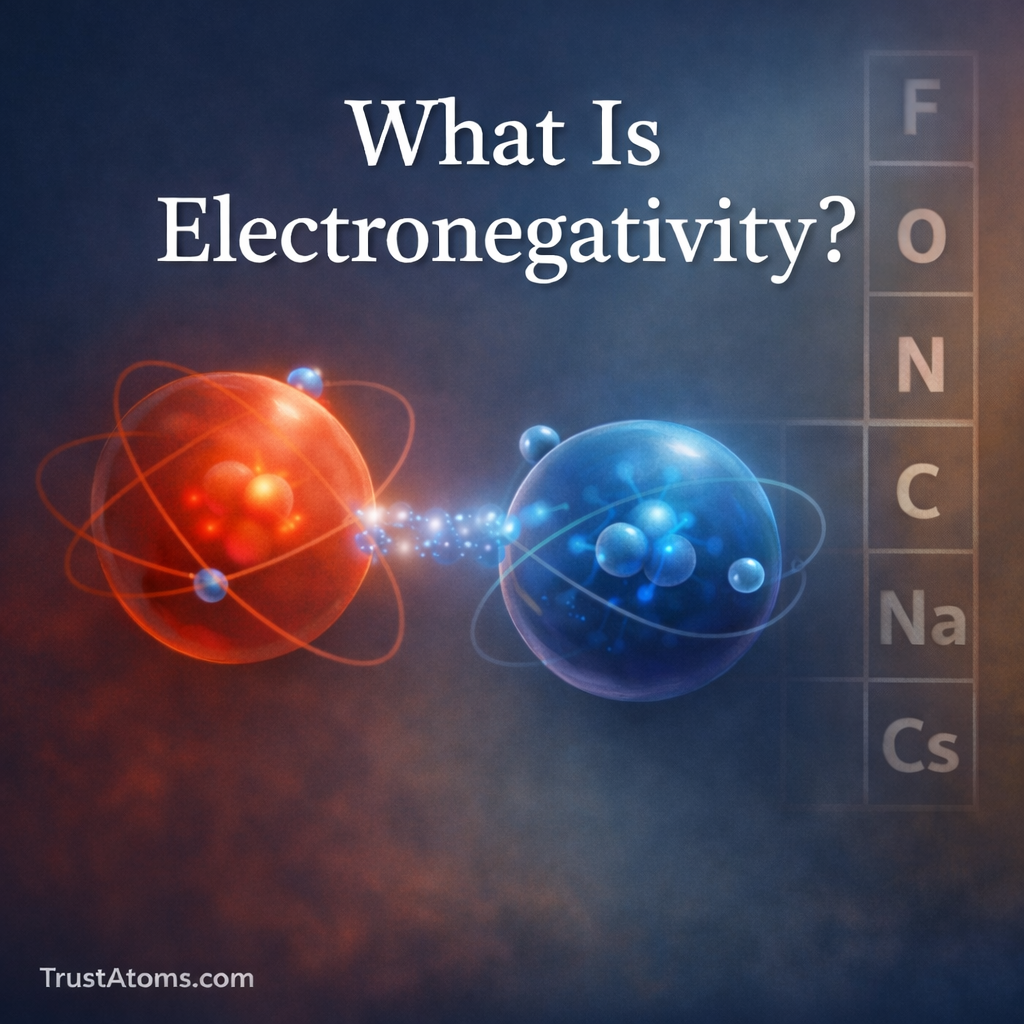
What Is Electronegativity?

Simple illustration showing two atoms sharing electrons to explain electronegativity in chemistry.
Illustration demonstrating how atoms attract shared electrons in a chemical bond. trustatoms.com.

Electronegativity is one of the most important concepts in chemistry because it helps explain why atoms bond the way they do. It influences the formation of molecules, the behavior of chemical reactions, and the physical properties of substances.

In simple terms, electronegativity describes how strongly an atom attracts electrons when it forms a chemical bond. Some atoms pull electrons toward themselves very strongly, while others exert a weaker pull.

Understanding electronegativity allows chemists to predict how atoms interact, what types of bonds will form, and how molecules behave.

Continue reading “What Is Electronegativity?”