What Is Le Chatelier’s Principle?

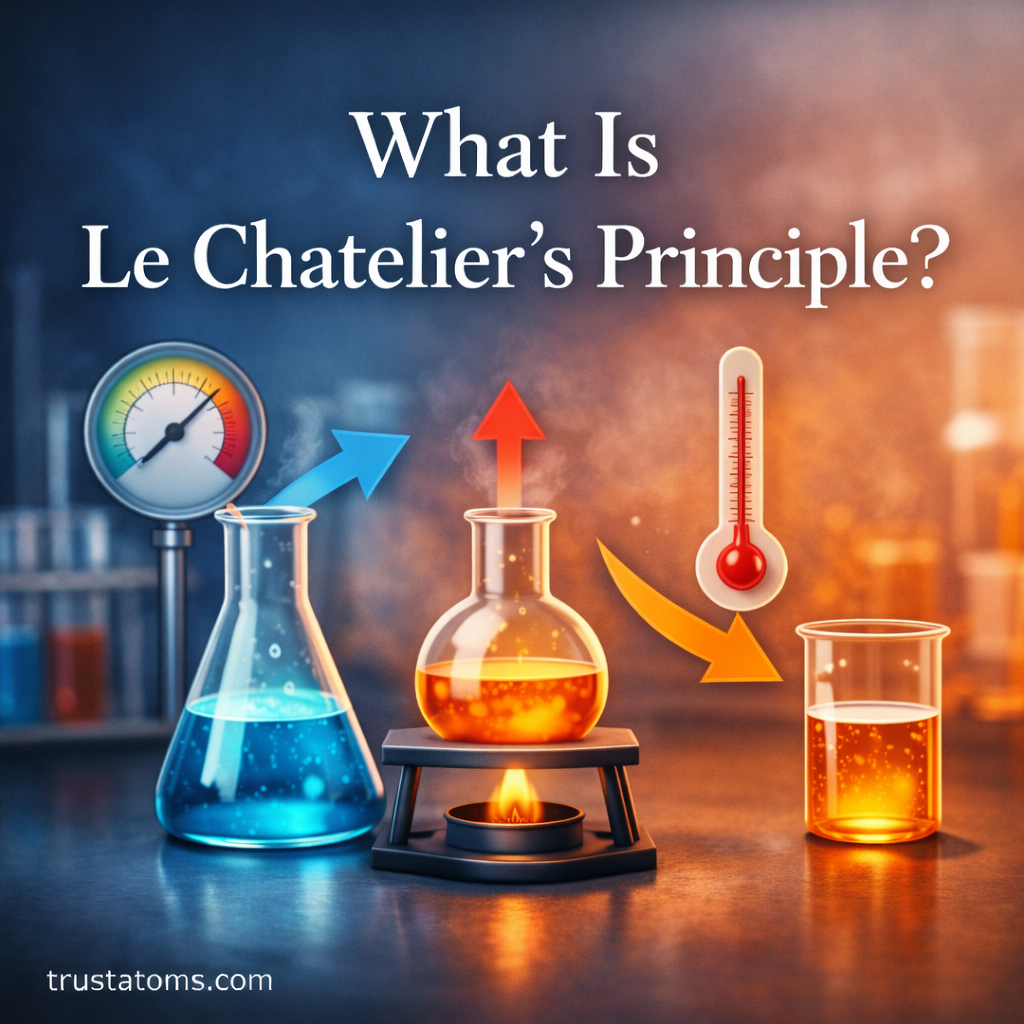
Illustration explaining Le Chatelier’s Principle with laboratory flasks, temperature and pressure indicators, and directional arrows showing equilibrium shifts.
Illustration demonstrating Le Chatelier’s Principle and how chemical equilibrium shifts when conditions such as temperature or pressure change. trustatoms.com.

Chemical reactions do not always stay in a fixed state. When conditions change, reactions often shift in response. Le Chatelier’s Principle explains how and why this happens.

In chemistry, many reactions exist in a state of chemical equilibrium, where the forward and reverse reactions occur at the same rate. When a change disturbs that equilibrium, the system adjusts in a way that helps restore balance. This predictable response is described by Le Chatelier’s Principle.

Understanding this principle helps scientists control reactions in laboratories, optimize industrial production, and better understand natural chemical processes.

Continue reading “What Is Le Chatelier’s Principle?”
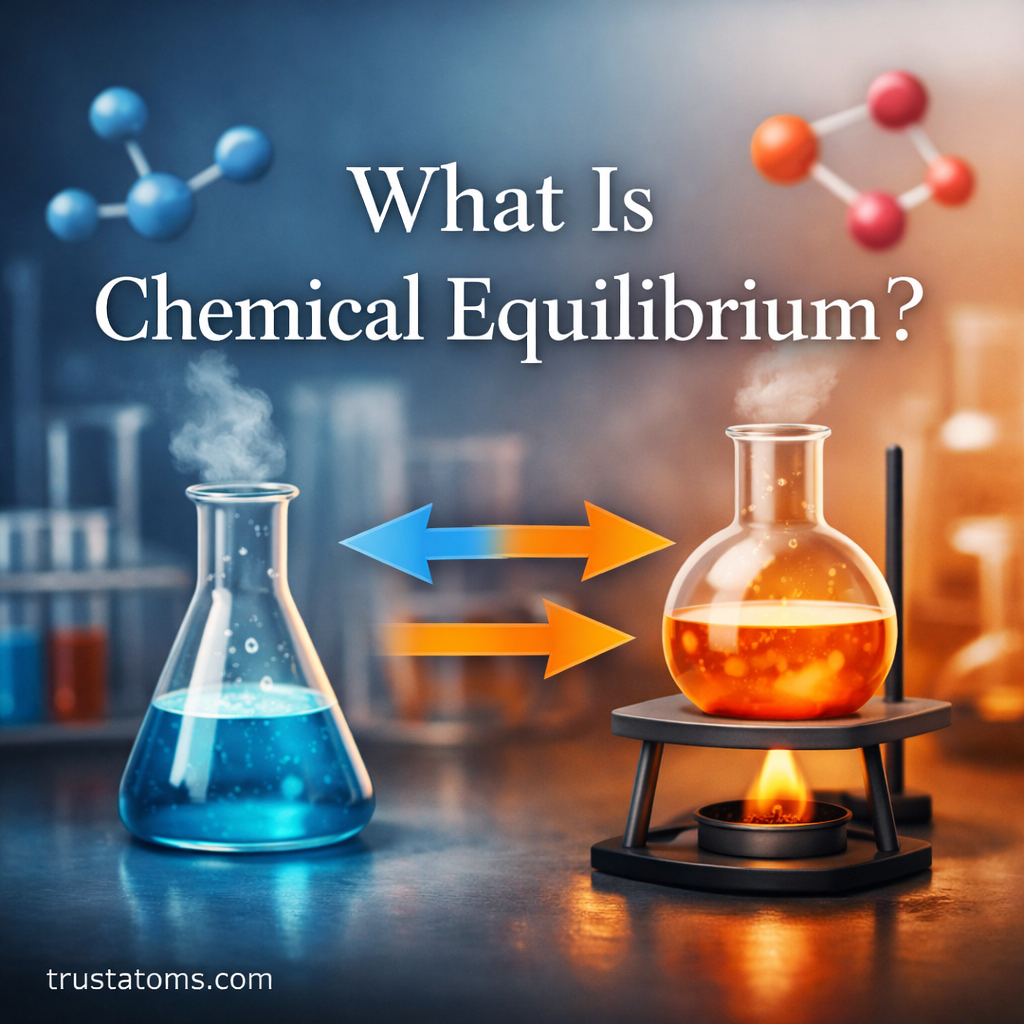
What Is Chemical Equilibrium?

Illustration explaining chemical equilibrium with two laboratory flasks and bidirectional arrows representing balance between reactions.
Illustration showing the concept of chemical equilibrium where reactions occur in both directions at equal rates. trustatoms.com.

Chemical reactions often seem straightforward: reactants combine, products form, and the reaction ends. However, many reactions behave differently. Instead of stopping completely, they continue in both directions at the same time. This dynamic balance is known as chemical equilibrium.

Understanding chemical equilibrium helps explain everything from industrial chemical production to biological processes in the human body. In chemistry, equilibrium describes a state where reactions appear to stop changing, even though molecular activity continues.

Continue reading “What Is Chemical Equilibrium?”

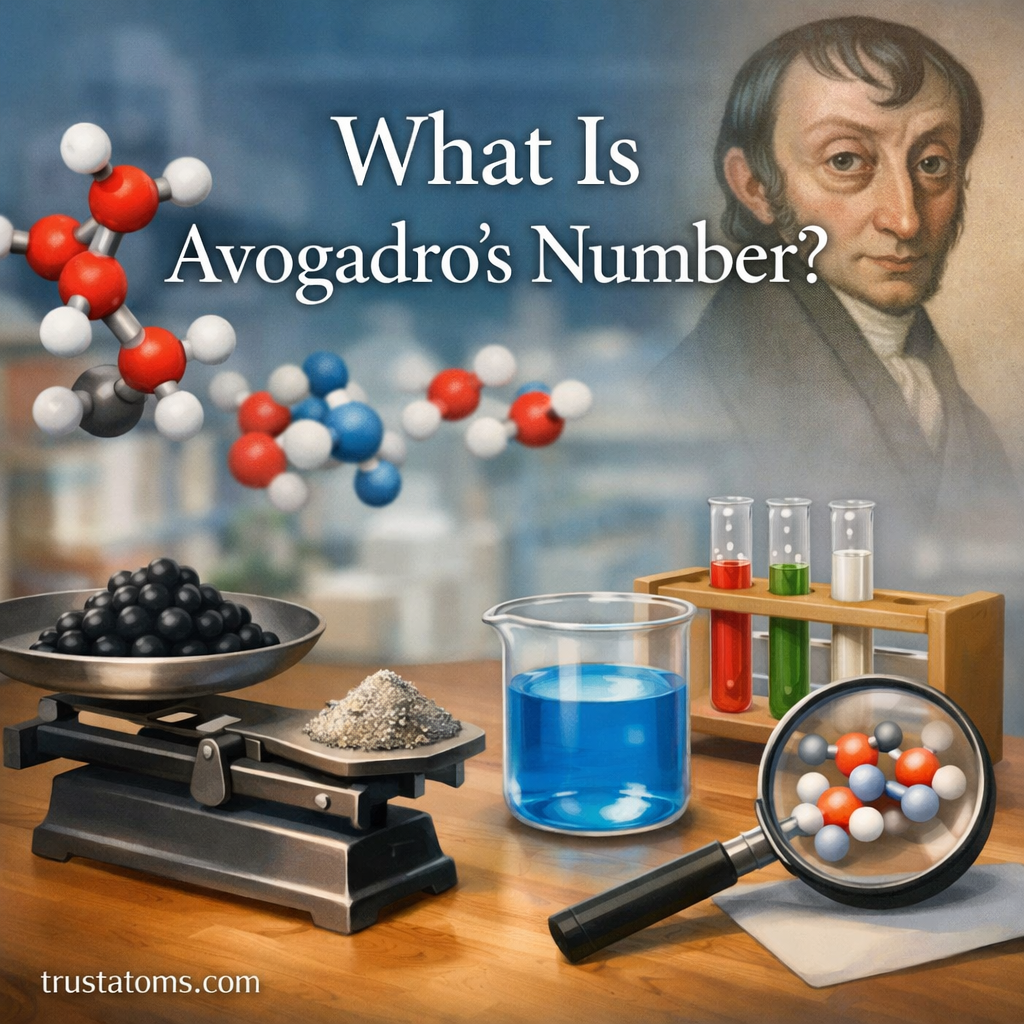
What Is Avogadro’s Number?

Illustrated chemistry diagram showing molecules, laboratory equipment, and conceptual particles representing Avogadro’s number.
Conceptual illustration explaining Avogadro’s number and the idea of counting particles such as atoms and molecules in chemistry. trustatoms.com

Avogadro’s number is one of the most important constants in chemistry. It connects the microscopic world of atoms and molecules with the measurable quantities scientists use in laboratories.

In simple terms, Avogadro’s number tells us how many particles—such as atoms, molecules, or ions—are present in one mole of a substance. This concept allows chemists to measure incredibly tiny particles using amounts we can weigh and observe.

Understanding Avogadro’s number is essential for topics like chemical reactions, molecular formulas, and stoichiometry.

Continue reading “What Is Avogadro’s Number?”

What Is an Isotope?

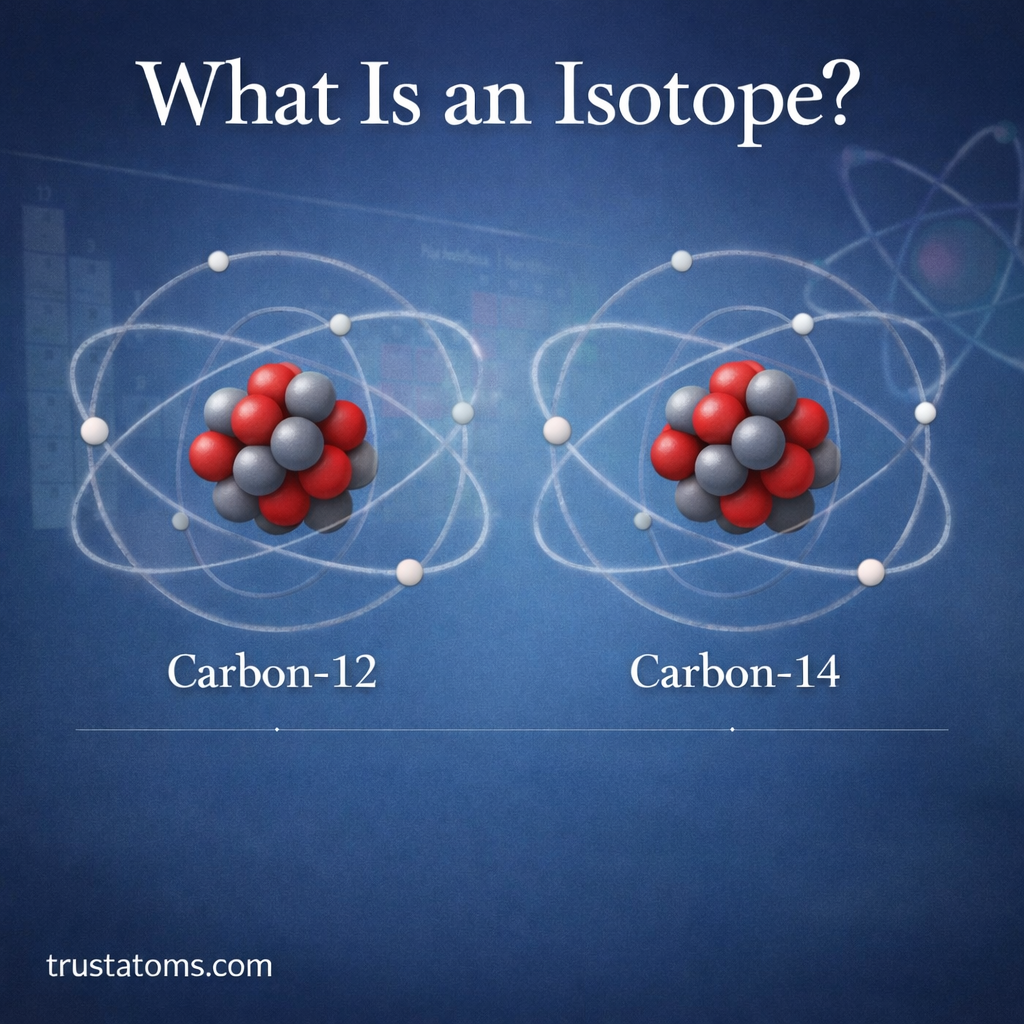
Simple educational diagram comparing Carbon-12 and Carbon-14 isotopes with labeled atomic nuclei and electron orbits.
Illustration showing two isotopes of carbon (Carbon-12 and Carbon-14) to demonstrate how isotopes have the same number of protons but different numbers of neutrons. trustatoms.com.

An isotope is a form of an element that has the same number of protons but a different number of neutrons in its atomic nucleus. Because isotopes belong to the same element, they share the same atomic number and similar chemical behavior, but they can differ in mass and physical properties.

Isotopes are important in many areas of science, including chemistry, physics, medicine, archaeology, and environmental research.

Continue reading “What Is an Isotope?”

What Is an Ion?

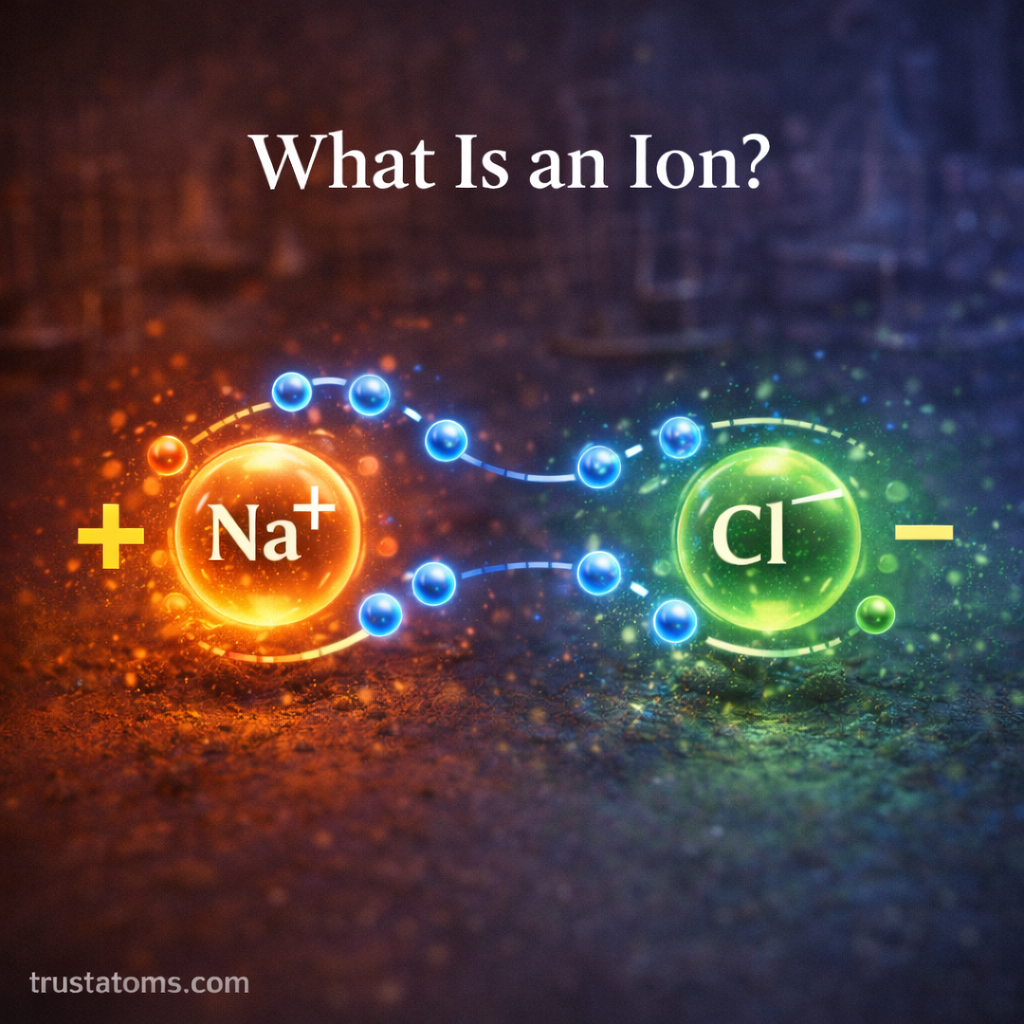
Illustration explaining ions with a positively charged sodium ion and a negatively charged chloride ion showing electron transfer.
Visual explanation of ions showing how atoms become positively or negatively charged by losing or gaining electrons. trustatoms.com

An ion is an atom or molecule that carries an electric charge because it has gained or lost one or more electrons. In normal conditions, atoms are electrically neutral, meaning they have equal numbers of protons and electrons. When that balance changes, the atom becomes an ion.

Ions play a critical role in chemistry, biology, and physics. They are involved in chemical reactions, electricity in batteries, nerve signals in the body, and the formation of many compounds found in nature.

Continue reading “What Is an Ion?”

Oxidation vs Reduction

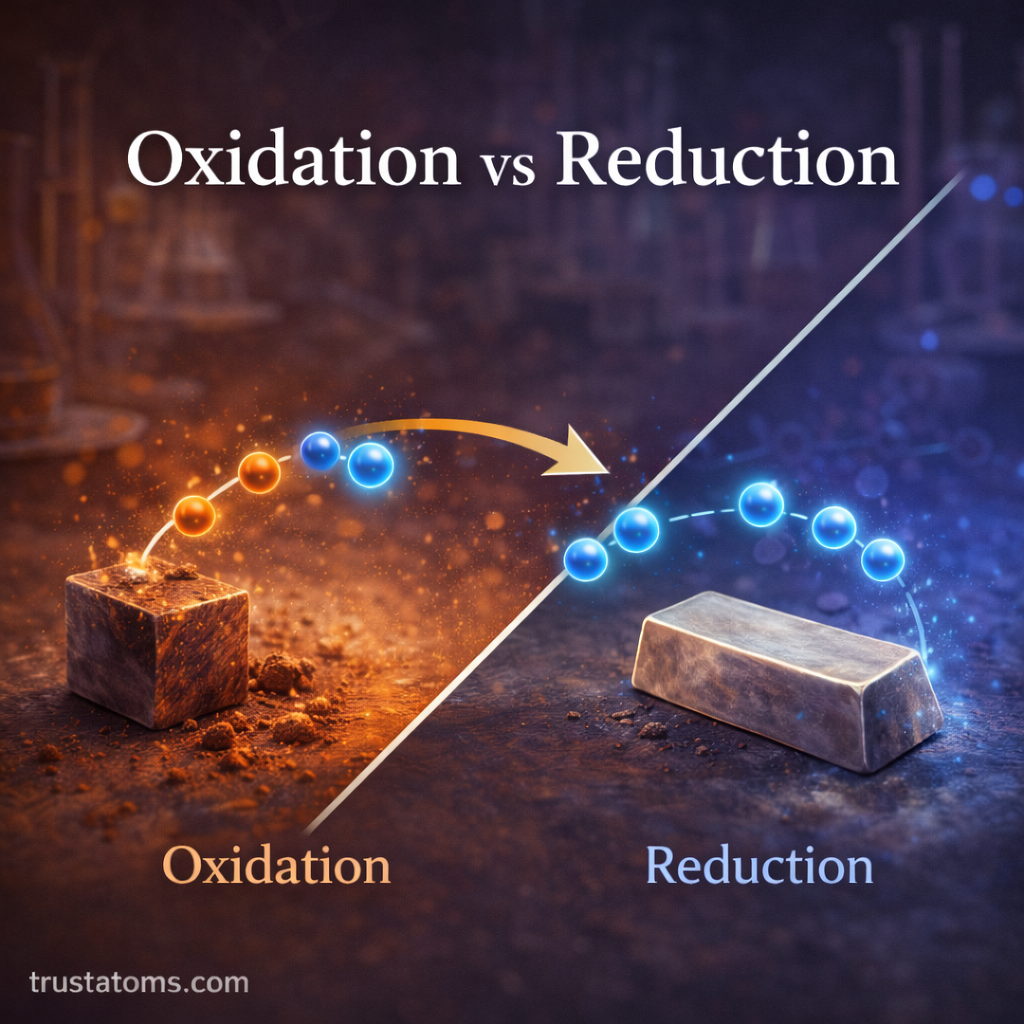
Diagonal split illustration comparing oxidation and reduction, showing electrons leaving a corroded metal on one side and moving toward a purified metal on the other.
Visual comparison of oxidation and reduction showing electron loss and electron gain in a redox reaction. trustatoms.com

Oxidation and reduction are two closely connected chemical processes that occur together in what are called redox reactions. These reactions involve the transfer of electrons between substances, allowing matter to change form and energy to be released or stored.

In simple terms:

  • Oxidation = loss of electrons
  • Reduction = gain of electrons

Understanding the difference between oxidation and reduction is essential for studying chemistry, biology, energy systems, and industrial processes.

Continue reading “Oxidation vs Reduction”

What Is Reduction?

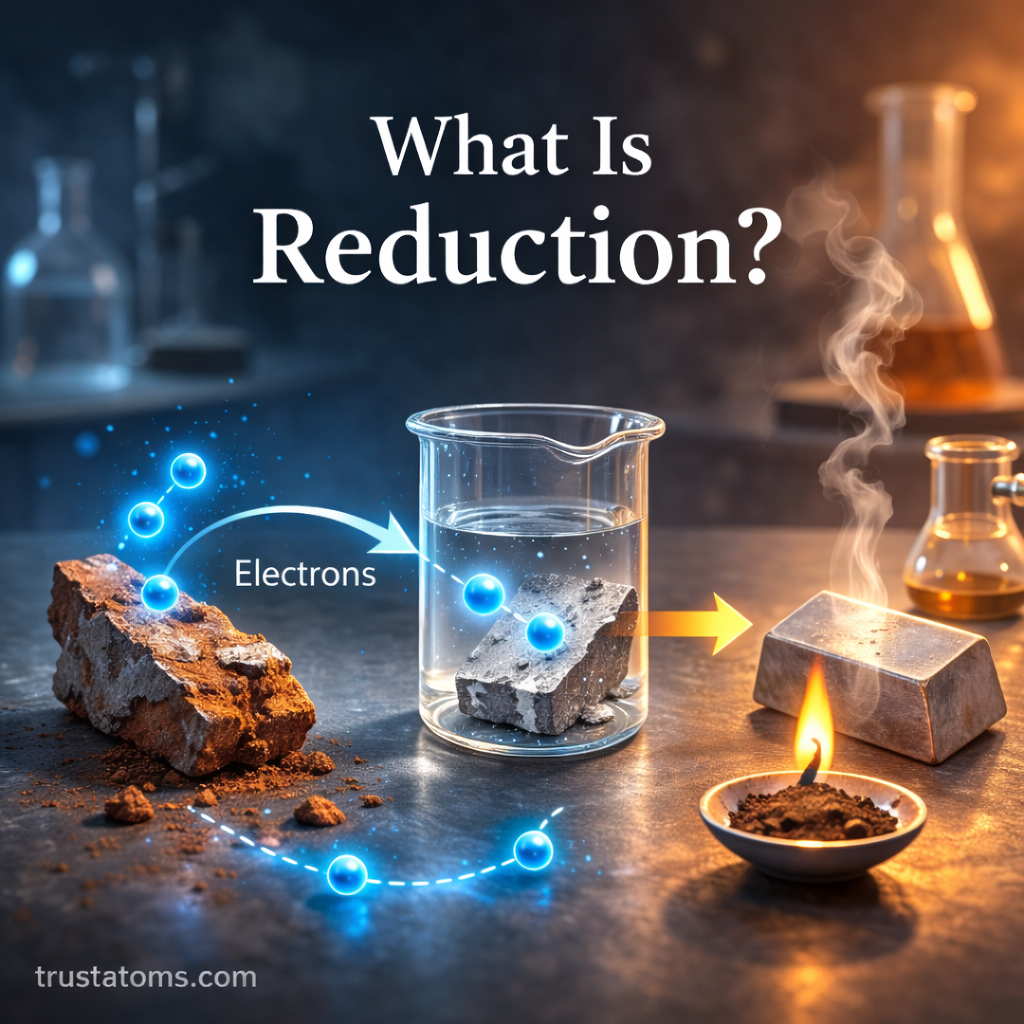
Educational illustration showing a metal ore gaining electrons and transforming into purified metal in solution, representing reduction in chemistry.
Conceptual illustration of reduction showing electron gain as metal ore converts into refined metal during a chemical reaction. trustatoms.com

Reduction is a fundamental chemical process in which a substance gains electrons during a reaction. It always occurs alongside oxidation in what chemists call a redox (reduction–oxidation) reaction.

In simple terms:

Reduction = gain of electrons.

Although reduction is often discussed together with oxidation, it has its own important role in chemistry, biology, energy systems, and industrial processes.

Continue reading “What Is Reduction?”

What Is Oxidation?

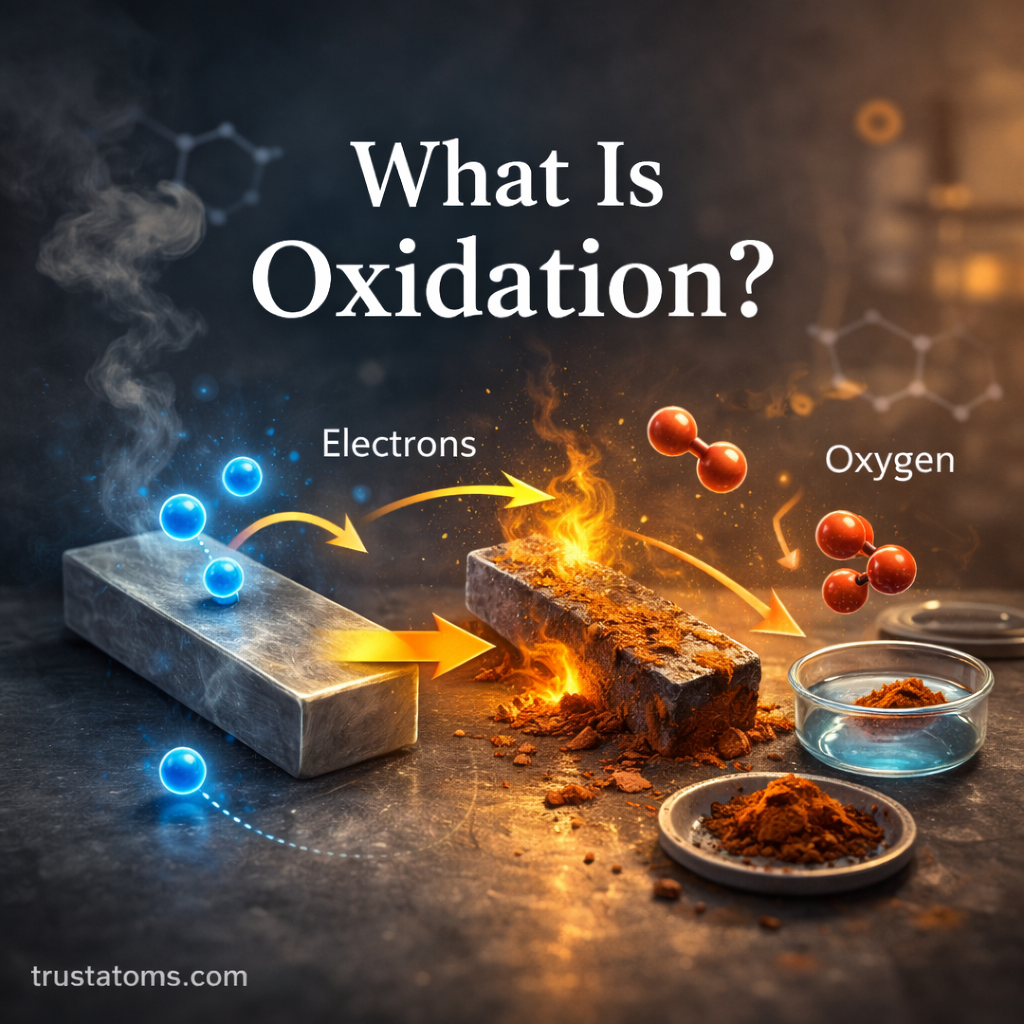
Contextual illustration showing a metal surface rusting, electron transfer between particles, and a burning candle to represent oxidation in chemistry.
Visual representation of oxidation showing electron loss, rust formation, and combustion in everyday chemical reactions. trustatoms.com

Oxidation is a fundamental chemical process in which a substance loses electrons during a reaction. It is one half of a broader type of reaction known as an oxidation-reduction (redox) reaction.

Although the word “oxidation” originally referred to reactions involving oxygen, modern chemistry defines it more precisely as electron loss, whether oxygen is involved or not.

Oxidation plays a critical role in everything from rust forming on metal to how your body produces energy.

Continue reading “What Is Oxidation?”

What Is Stoichiometry?

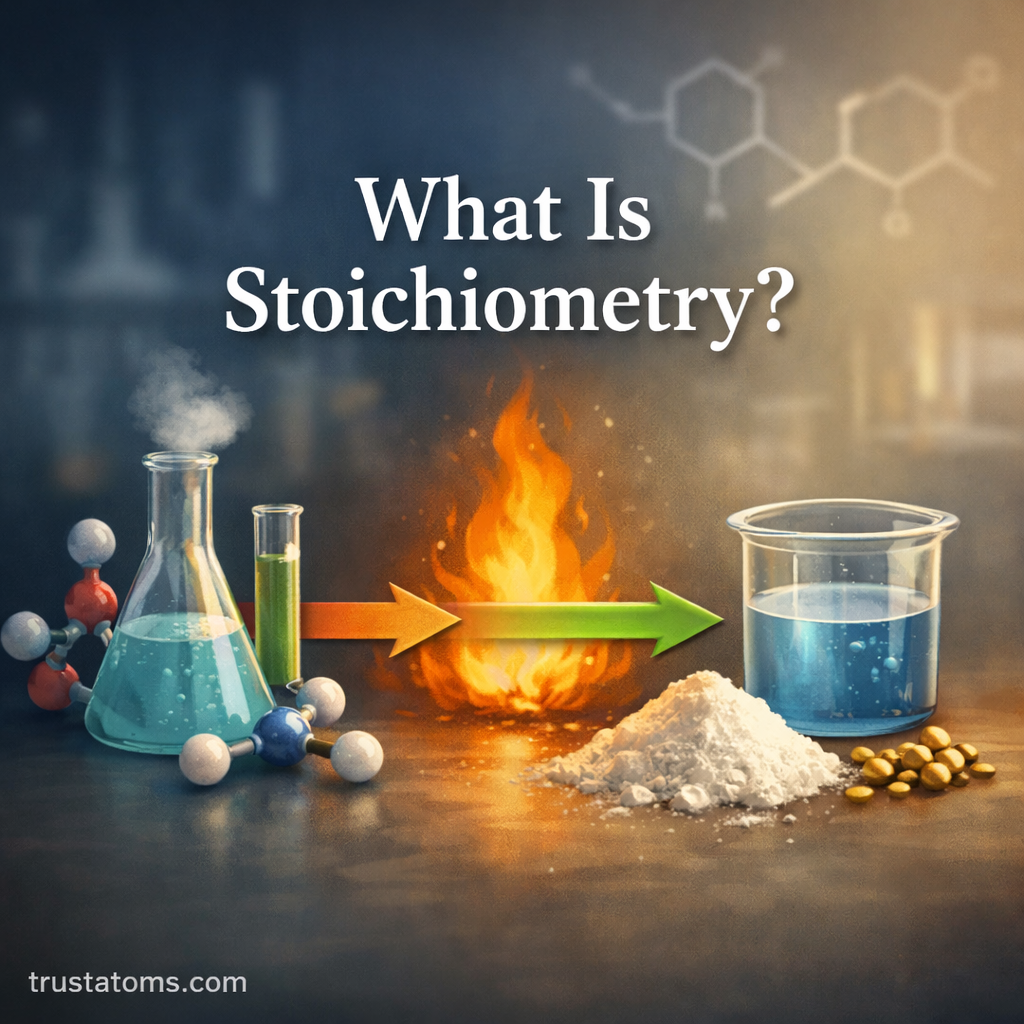
Simple contextual illustration explaining stoichiometry with laboratory glassware, reactants transforming into products, and the title “What Is Stoichiometry?” displayed above.
A simple visual explanation of stoichiometry showing reactants transforming into products in a balanced chemical reaction. trustatoms.com

Stoichiometry is the branch of chemistry that deals with quantitative relationships between substances in chemical reactions. In simple terms, it helps you calculate how much of a reactant is needed or how much product will be formed during a reaction.

If chemistry is the language of matter, stoichiometry is the math that keeps everything balanced.

Understanding stoichiometry allows scientists, engineers, pharmacists, and manufacturers to predict outcomes accurately, minimize waste, and design efficient chemical processes.

Continue reading “What Is Stoichiometry?”

What Is Molarity?

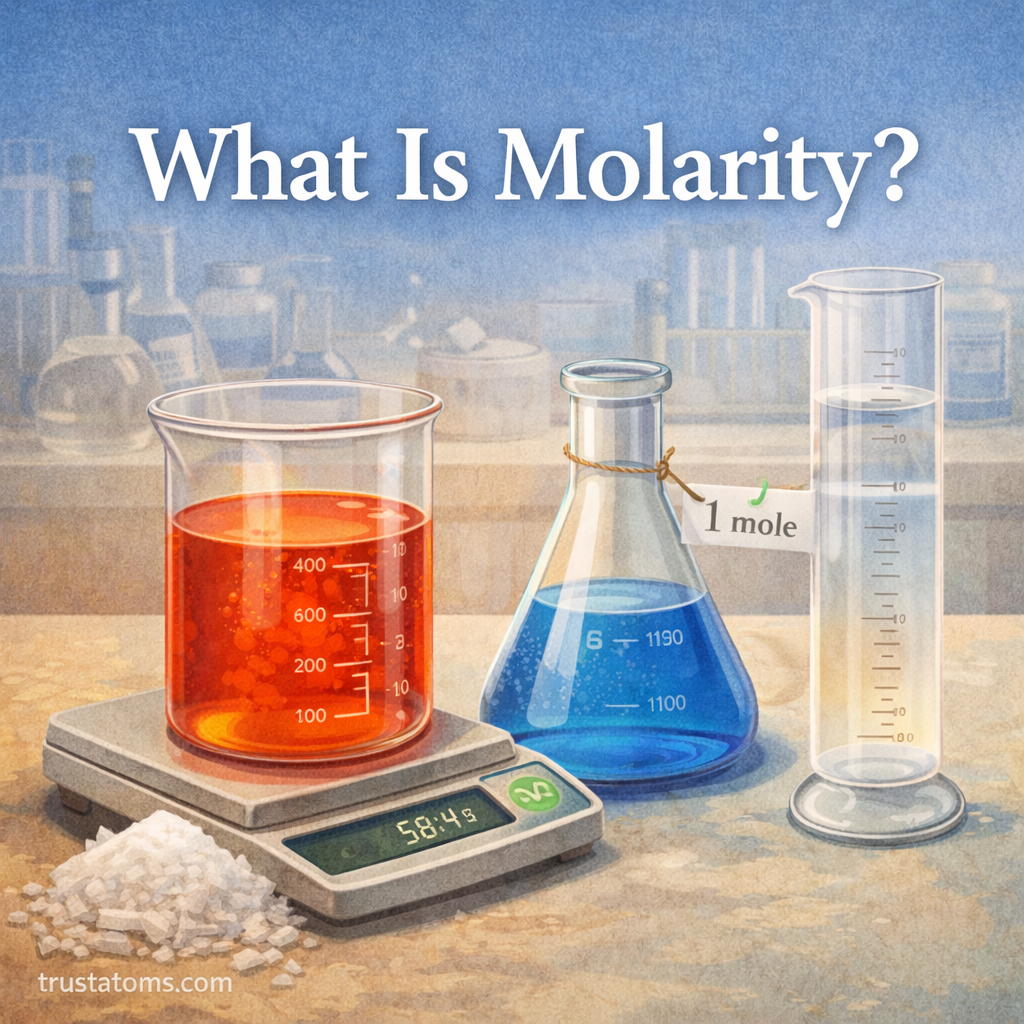
Laboratory illustration showing beakers and flasks with colored solutions to represent molarity and solution concentration.
A visual representation of molarity showing dissolved substances and solution volume in a lab setting. trustatoms.com

If you’ve ever mixed a sports drink, brewed coffee, or diluted a cleaning solution, you’ve adjusted concentration — even if you didn’t call it that.

In chemistry, one of the most common ways to measure concentration is molarity.

Molarity tells us how much of a substance is dissolved in a specific amount of liquid. It’s a precise and standardized way scientists describe the strength of a solution.

Let’s break it down clearly and step by step.

Continue reading “What Is Molarity?”