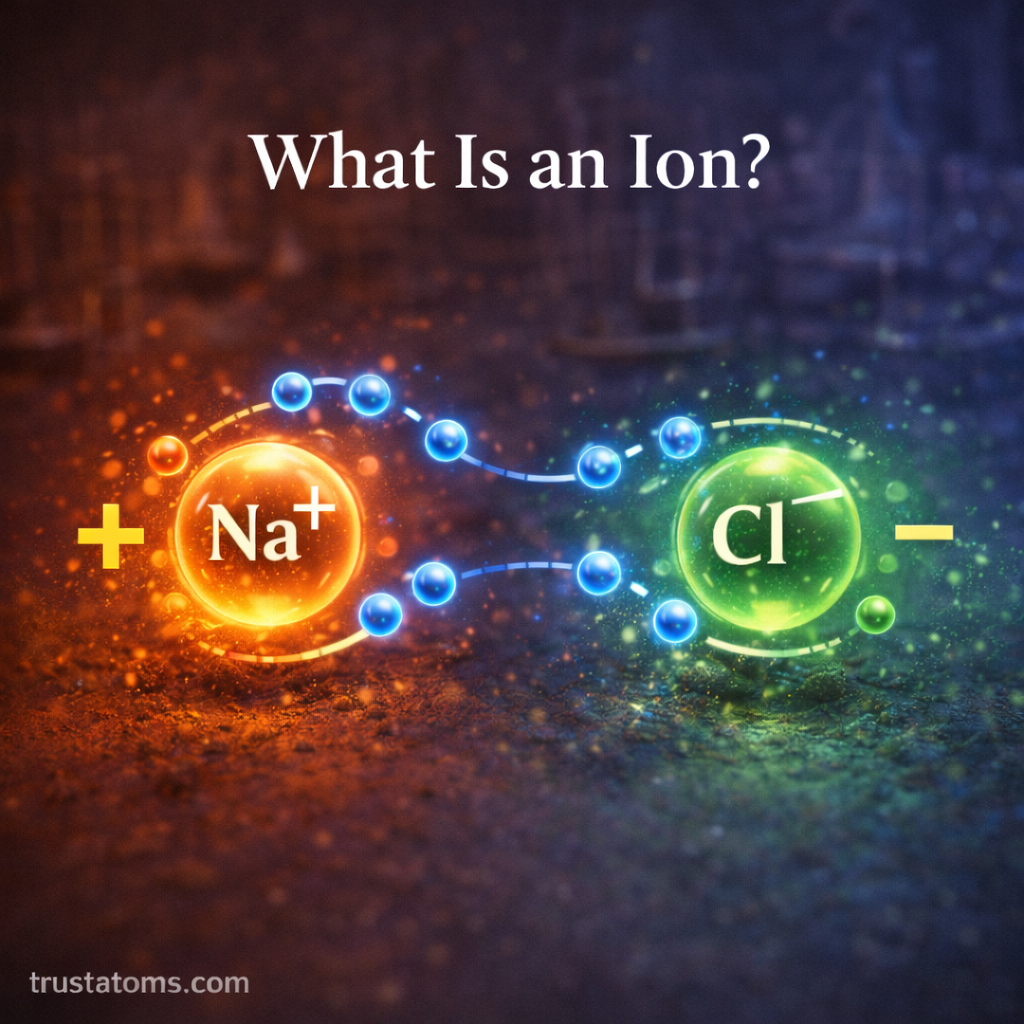
An ion is an atom or group of atoms that carries a net electric charge because its total number of electrons differs from its total number of protons. An ion is positively charged when it has fewer electrons than protons and negatively charged when it has more electrons than protons.
In simple terms, an ion is a charged particle. Ions help explain how table salt forms, why certain solutions conduct electricity, and how cells transmit electrical signals. They are a fundamental part of chemistry and chemical reactions, appearing in everything from minerals and seawater to batteries and biological fluids.
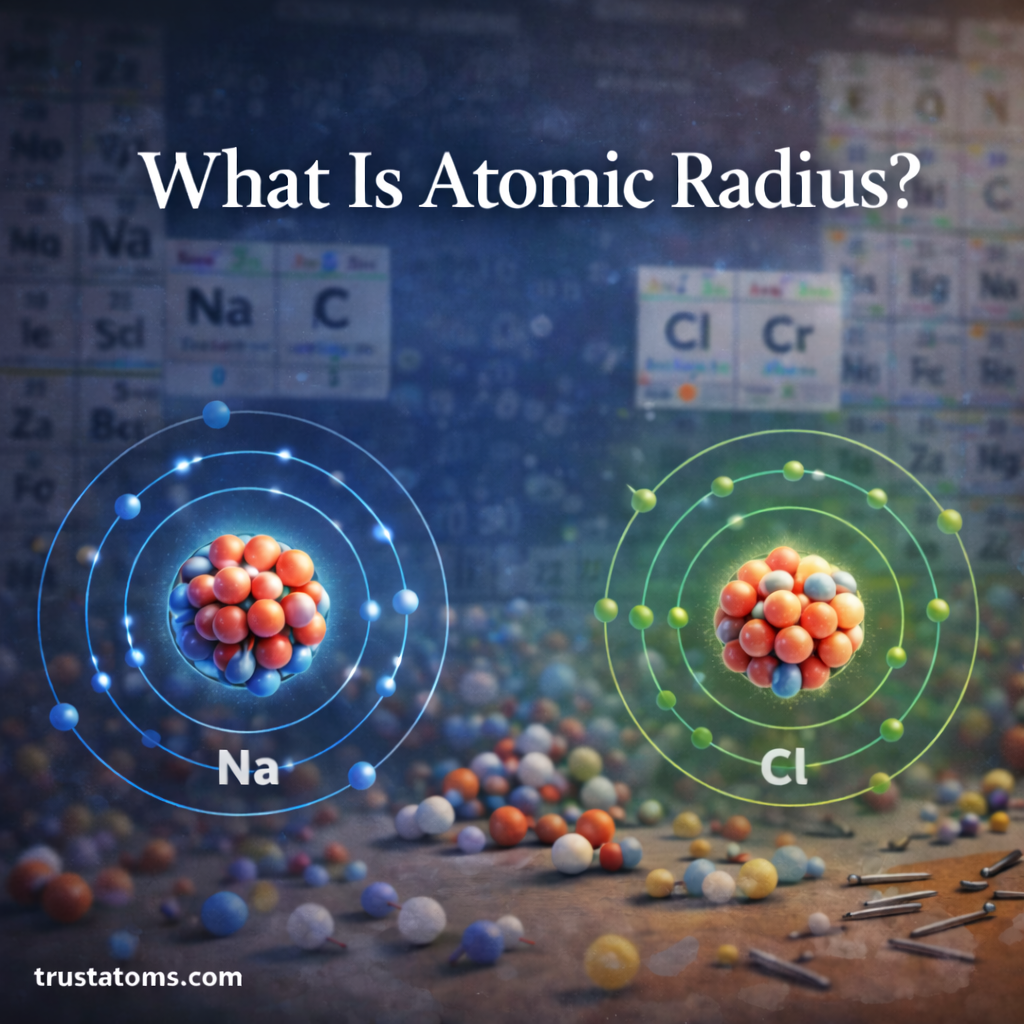
For example, a neutral sodium atom has 11 protons and 11 electrons. If it loses one electron, it becomes a sodium ion (Na⁺) with a positive charge of +1. A chlorine atom can gain an electron to become a negatively charged chloride ion (Cl⁻).
Ion Definition: What Makes a Particle Charged?
Atoms contain positively charged protons, negatively charged electrons, and usually electrically neutral neutrons. A neutral atom has equal numbers of protons and electrons, so their charges cancel. When that balance changes, the atom becomes an ion.
There are two main types of ions: cations, which have positive charges, and anions, which have negative charges. Ions can consist of a single atom or several bonded atoms carrying a combined net charge.
The electrons involved in ordinary ion formation are generally the outermost electrons. Understanding valence electrons and their behavior helps explain why sodium commonly forms Na⁺ while magnesium commonly forms Mg²⁺.
An ion’s actual charge should not be confused with its oxidation state in chemistry. Oxidation state is a formal electron-accounting value assigned using bonding rules; it does not always represent a measurable charge on an individual atom within a compound.
How Ions Form When Electrons Are Lost or Gained
Many ions form during chemical reactions involving electron transfer. When an atom loses electrons, its remaining positive charge exceeds its negative charge. When it gains electrons, its negative charge exceeds its positive charge.
For example, sodium can lose one electron according to the equation Na → Na⁺ + e⁻. Chlorine can gain an electron according to Cl + e⁻ → Cl⁻. These equations show electron loss and gain, not necessarily every step of a real chemical process.
Atoms do not always gain or lose electrons simply to obtain a full outer shell. The outcome of a reaction depends on the energy changes and stability of the entire chemical system. The octet rule is a useful introductory pattern for many main-group elements, but it has exceptions.
The Two Main Types of Ions: Cations and Anions
Cations: Positively Charged Ions
A cation is an ion with a positive net charge. A monatomic cation forms when an atom loses one or more electrons. Metals commonly form cations, although positive polyatomic ions also exist.
- Sodium ion (Na⁺): charge +1
- Potassium ion (K⁺): charge +1
- Calcium ion (Ca²⁺): charge +2
- Magnesium ion (Mg²⁺): charge +2
- Ammonium ion (NH₄⁺): charge +1
The superscript plus sign indicates positive charge. A number before the sign indicates the magnitude: Ca²⁺ has twice the positive charge of Na⁺.
Anions: Negatively Charged Ions
An anion has a negative net charge. Monatomic anions form when atoms gain electrons, while polyatomic anions contain multiple atoms with an overall negative charge.
- Chloride ion (Cl⁻): charge −1
- Fluoride ion (F⁻): charge −1
- Oxide ion (O²⁻): charge −2
- Nitrate ion (NO₃⁻): charge −1
- Sulfate ion (SO₄²⁻): charge −2
Both cations and anions can participate in chemical reactions, move through solutions, and interact through electrical attraction. Their opposite charges are particularly important in ionic substances.
Monatomic Ions vs. Polyatomic Ions
Ions can be classified according to the number of atoms they contain. A monatomic ion consists of one charged atom, while a polyatomic ion consists of two or more bonded atoms with an overall charge.
| Ion | Formula | Charge | Classification |
|---|---|---|---|
| Sodium | Na⁺ | +1 | Monatomic cation |
| Magnesium | Mg²⁺ | +2 | Monatomic cation |
| Chloride | Cl⁻ | −1 | Monatomic anion |
| Ammonium | NH₄⁺ | +1 | Polyatomic cation |
| Nitrate | NO₃⁻ | −1 | Polyatomic anion |
| Carbonate | CO₃²⁻ | −2 | Polyatomic anion |
| Phosphate | PO₄³⁻ | −3 | Polyatomic anion |
The atoms within a polyatomic ion are generally held together by covalent bonds. The group as a whole carries a charge and can interact with oppositely charged ions to form compounds. For example, ammonium (NH₄⁺) and nitrate (NO₃⁻) combine in a 1:1 ratio to form ammonium nitrate (NH₄NO₃).
Worked Example: Calculating an Ion’s Charge
The charge of a monatomic ion can be calculated from the number of protons and electrons. Each proton contributes one positive elementary charge, and each electron contributes one negative elementary charge.
The formula is: ion charge = number of protons − number of electrons, expressed in elementary charge units.
Consider a magnesium ion with 12 protons and 10 electrons.
- Count the protons: Magnesium has atomic number 12, so every magnesium atom or ion contains 12 protons.
- Count the electrons: A neutral magnesium atom has 12 electrons, but this ion has only 10.
- Subtract: 12 − 10 = +2.
- Write the symbol: Mg²⁺, indicating a magnesium ion with a positive charge of two elementary charge units.
Now consider a chloride ion with 17 protons and 18 electrons. Its charge is 17 − 18 = −1, so its symbol is Cl⁻. These examples show why losing electrons produces positive ions and gaining electrons produces negative ions.
How Ions Form Ionic Bonds
Ions are responsible for ionic bonding, a type of chemical bond formed by electrostatic attraction between oppositely charged ions.
In sodium chloride, sodium ions (Na⁺) and chloride ions (Cl⁻) attract one another. Rather than existing as isolated NaCl molecules in the solid, the ions form an extended three-dimensional crystal lattice.
An ionic compound such as sodium chloride has an overall neutral charge because the positive and negative charges balance. One Na⁺ ion balances one Cl⁻ ion, giving the formula NaCl.
Calcium chloride provides another example. A calcium ion has a charge of +2, while each chloride ion has a charge of −1. Two chloride ions are needed to balance one calcium ion, producing the formula CaCl₂.
This charge-balancing principle helps chemists predict the formulas of many ionic compounds. The actual structures and bonding can be more complex, particularly for compounds containing transition metals or polyatomic ions.
Where Ions Appear in Everyday Life
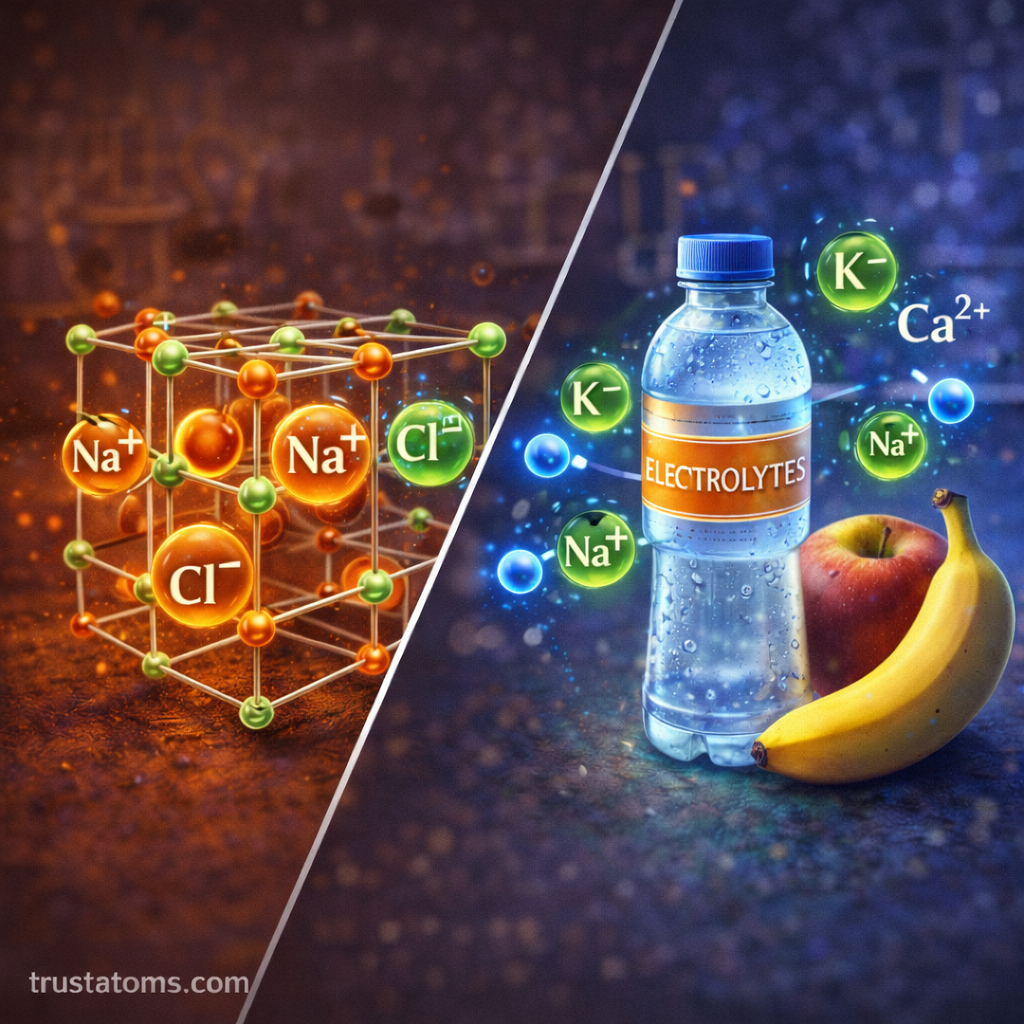
Ions are present in many ordinary materials and biological systems. Their ability to carry charge and interact with other particles explains their usefulness in solutions, electrical devices, and chemical processing.
Electrolytes in the Human Body
Sodium, potassium, calcium, magnesium, and chloride ions are electrolytes found in body fluids. They help maintain fluid balance, establish electrical differences across cell membranes, and support nerve signaling and muscle contraction.
For example, nerve cells use controlled movements of sodium and potassium ions across their membranes to generate electrical impulses. Electrolytes can be obtained through ordinary foods and drinks, and some sports drinks contain added electrolytes.
Batteries and Electrochemical Cells
Batteries use chemical reactions to separate and transfer charge. In a discharging battery, ions move through the electrolyte while electrons travel through the external circuit, allowing electrical energy to be delivered to a connected device.
Rechargeable lithium-ion batteries rely on the movement of lithium ions between electrode materials during charging and discharging. The electrons move through a separate external path.
Water Treatment and Softening
Hard water contains dissolved calcium and magnesium ions. Some water softeners use ion-exchange materials to replace these ions with sodium or potassium ions, reducing scale formation in pipes and appliances.
Why Some Ionic Solutions Conduct Electricity
Electrical conductivity requires charged particles that can move. In solid sodium chloride, ions are held in fixed positions within the crystal lattice, so the solid conducts electricity poorly under ordinary conditions.
When sodium chloride dissolves in water, its ions become dispersed and can move through the solution. The solution can then carry an electric current through the movement of both positive and negative ions.
Molten ionic compounds can also conduct electricity because their ions are mobile. Conductivity depends on factors such as ion concentration, charge, mobility, and temperature. Not every substance that dissolves in water produces ions: sugar, for example, dissolves mainly as neutral molecules and does not make water a strong conductor.
How to Read Ion Symbols and Charges
Chemists write an ion’s charge as a superscript after its chemical formula. A plus sign indicates positive charge, while a minus sign indicates negative charge. When the magnitude is greater than one, the number is written before the sign.
- Na⁺ means one positive elementary charge.
- Ca²⁺ means two positive elementary charges.
- Cl⁻ means one negative elementary charge.
- SO₄²⁻ means the sulfate group has an overall charge of −2.
Subscripts and superscripts serve different purposes. In SO₄²⁻, the subscript 4 means four oxygen atoms, while the superscript 2− represents the overall charge. Confusing these notations can lead to incorrect chemical formulas.
Ions vs. Neutral Atoms
The distinction between a neutral atom and a monatomic ion comes from the balance of protons and electrons. Both can belong to the same chemical element because the element’s identity depends on its number of protons.
| Property | Neutral atom | Monatomic ion |
|---|---|---|
| Net charge | Zero | Positive or negative |
| Protons and electrons | Equal numbers | Unequal numbers |
| Electron arrangement | Neutral configuration | Changed by electron gain or loss |
| Example | Na | Na⁺ |
Changing an atom’s electron count does not change its atomic number. A sodium ion is still sodium because it retains 11 protons, even though its charge and chemical behavior differ from those of a neutral sodium atom.
Common Misconceptions About Ions
Positive Ions Have Gained Protons
Ordinary positive ion formation involves losing electrons, not gaining protons. The nucleus generally remains unchanged, so the element retains its identity.
All Ions Contain Only One Atom
Some ions contain several bonded atoms. Ammonium (NH₄⁺), nitrate (NO₃⁻), and sulfate (SO₄²⁻) are examples of polyatomic ions with overall electrical charges.
Ionic Compounds Contain Only Positive Ions
Ordinary ionic compounds contain both positive and negative ions in proportions that produce an overall neutral substance. Sodium chloride contains Na⁺ and Cl⁻ ions, not just sodium ions.
Ions Can Conduct Electricity Only in Water
Ions can transport charge in many liquids, including molten salts and nonaqueous electrolytes. Their mobility, rather than the presence of water alone, determines whether they can contribute to electrical conduction.
Frequently Asked Questions
What is an ion in simple terms?
An ion is an atom or group of atoms with a positive or negative electrical charge. It has an unequal balance of protons and electrons, commonly resulting from electron gain or loss.
What is the difference between a cation and an anion?
A cation carries a positive charge, while an anion carries a negative charge. Na⁺ is a cation, and Cl⁻ is an anion. Their opposite charges allow them to attract each other.
How do you determine the charge of an ion?
For a monatomic ion, subtract the number of electrons from the number of protons. An atom with 12 protons and 10 electrons has a charge of +2, while one with 17 protons and 18 electrons has a charge of −1.
Is sodium chloride an ion?
Sodium chloride (NaCl) is an ionic compound, not a single ion. It consists of sodium cations (Na⁺) and chloride anions (Cl⁻) arranged in an electrically neutral crystal lattice when solid.
Why are ions important in the human body?
Ions such as sodium, potassium, calcium, and chloride help regulate fluid balance, nerve impulses, muscle contraction, and other cellular processes. Their movement across cell membranes supports electrical signaling in living tissues.
An ion is defined by its net electrical charge, which results from an imbalance between protons and electrons. Recognizing the difference between cations, anions, and polyatomic ions makes it easier to understand chemical formulas, ionic bonding, and electrical conductivity. These same principles explain how familiar substances such as table salt, battery electrolytes, and dissolved minerals behave.
Sources: OpenStax, Chemistry 2e; Theodore L. Brown, H. Eugene LeMay, Bruce E. Bursten, Catherine J. Murphy, Patrick M. Woodward, and Matthew W. Stoltzfus, Chemistry: The Central Science; International Union of Pure and Applied Chemistry (IUPAC), Compendium of Chemical Terminology (Gold Book).