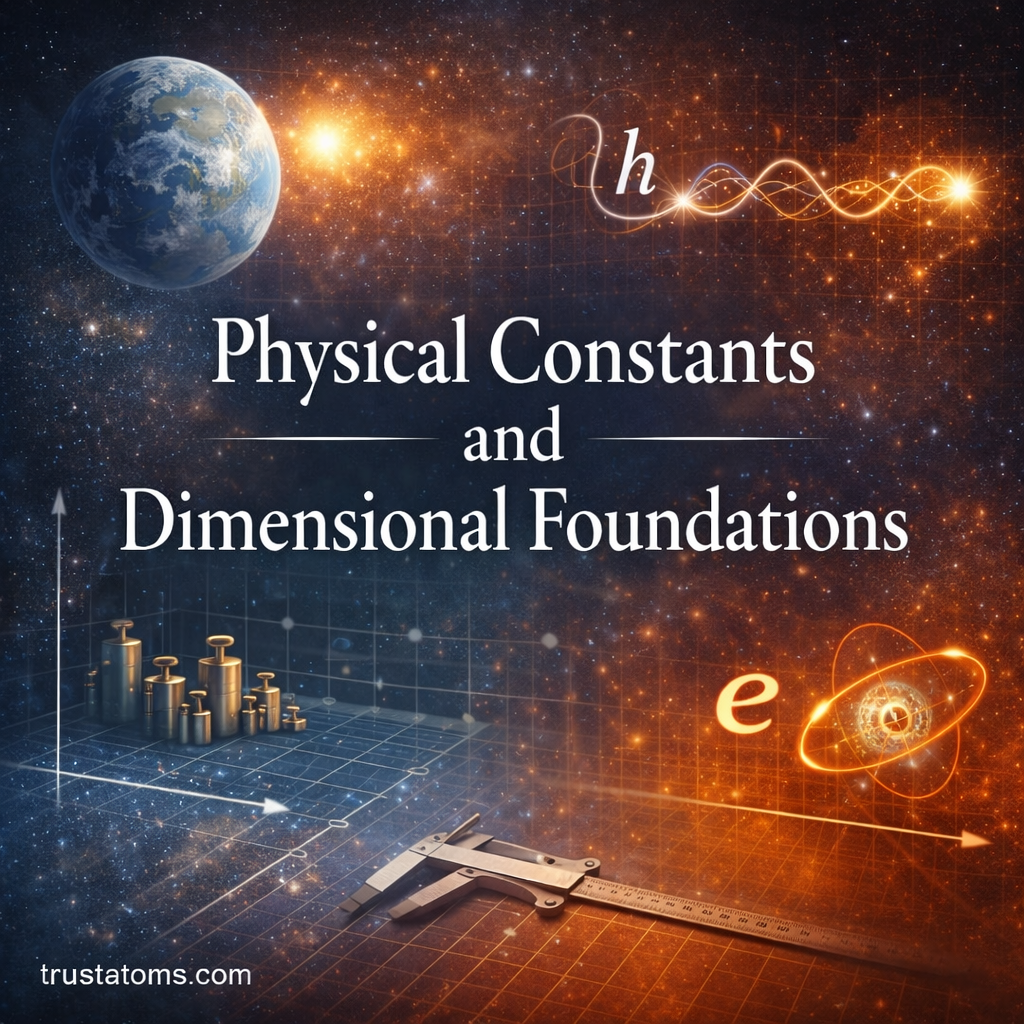
Every equation in physics rests on a deeper foundation — physical constants and dimensional structure.
From gravity to electromagnetism, from quantum mechanics to cosmology, the laws of nature depend on fixed quantities that do not change across space or time. These are called physical constants.
But constants alone are not enough. They only make sense within a dimensional framework — a system that defines how quantities like length, time, mass, and charge relate to one another.
In this guide, we’ll explore:
- What physical constants are
- Why dimensions matter
- The structure of fundamental units
- How constants shape the laws of physics
- Why dimensional analysis is a powerful scientific tool