What Is Mechanical Advantage?

Illustration showing examples of mechanical advantage including a pulley lifting a heavy block, a lever on a fulcrum, a car jack raising a vehicle, and a screw being driven into wood with the title “What Is Mechanical Advantage?” and trustatoms.com watermark.
Everyday examples of mechanical advantage in action, including levers, pulleys, jacks, and screws. trustatoms.com

Mechanical advantage is a key concept in physics that explains how machines make work easier.

From simple tools like levers and pulleys to complex machines like cranes and hydraulic lifts, mechanical advantage helps us lift heavier objects, move loads more efficiently, and apply force more effectively.

In simple terms, mechanical advantage describes how much a machine multiplies your input force.

Let’s break it down clearly.

Continue reading “What Is Mechanical Advantage?”


What Is Hooke’s Law?

Illustration showing a stretched spring, weighing scale, car suspension system, and mechanical watch components with the title “What Is Hooke’s Law?” and trustatoms.com watermark.
Everyday examples of Hooke’s Law in action, including springs, suspension systems, and precision mechanical devices. trustatoms.com

Hooke’s Law is one of the foundational principles in physics. It explains how springs and other elastic materials stretch or compress when a force is applied.

If you’ve ever pulled on a rubber band or compressed a spring, you’ve seen Hooke’s Law in action.

In simple terms, Hooke’s Law states that the extension of an elastic object is directly proportional to the force applied — as long as the elastic limit is not exceeded.

Let’s break that down clearly and step by step.

Continue reading “What Is Hooke’s Law?”

What Is Elasticity?

Illustration showing examples of elasticity including a stretched rubber band, bending bridge, spring, diving board, and paper clip with the title “What Is Elasticity?” and trustatoms.com watermark.
Visual examples of elasticity in physics, including stretching, bending, and returning to original shape. trustatoms.com

Elasticity is one of the most important ideas in physics. It explains why a rubber band stretches and returns to its shape, why bridges bend slightly under traffic, and how materials respond when forces act on them.

In simple terms, elasticity describes a material’s ability to return to its original shape after being stretched, compressed, or bent.

Understanding elasticity helps engineers design buildings, athletes choose equipment, and scientists predict how materials behave under stress.

Continue reading “What Is Elasticity?”

What Is Archimedes’ Principle?

Illustration showing a ship floating in water, a rock submerged, a wooden block floating, and a hot air balloon rising, titled “What Is Archimedes’ Principle?” with trustatoms.com watermark.
Conceptual illustration of Archimedes’ Principle showing displaced water, floating objects, and upward buoyant force in fluids. trustatoms.com

Archimedes’ Principle is a fundamental law of physics that explains why objects float or sink in fluids.

It states:

An object submerged in a fluid experiences an upward force equal to the weight of the fluid it displaces.

This simple idea explains everything from ships floating on water to hot air balloons rising in the sky.

Archimedes’ Principle is one of the most important concepts in fluid mechanics.

Continue reading “What Is Archimedes’ Principle?”

What Is Buoyancy?

Illustration showing a cargo ship floating, a scuba diver underwater, and a hot air balloon rising, titled “What Is Buoyancy?” with trustatoms.com watermark.
Conceptual illustration of buoyancy showing floating ships, neutral buoyancy underwater, and rising hot air balloons. trustatoms.com

Buoyancy is the upward force that a fluid exerts on an object placed in it.

This force is what allows boats to float, balloons to rise, and swimmers to stay above water.

Whenever an object is partially or completely submerged in a liquid or gas, buoyancy acts against gravity. Whether the object floats, sinks, or stays suspended depends on the balance between buoyant force and weight.

Continue reading “What Is Buoyancy?”

What Is Density?

Illustration showing a wooden block floating, a metal cube sinking, a hot air balloon rising, and Earth compared with a gas giant, titled “What Is Density?” with trustatoms.com watermark.
Conceptual illustration of density showing floating and sinking objects, rising hot air, and planetary density comparison. trustatoms.com

Density is a physical property that describes how much mass is contained within a given volume.

In simple terms, density tells us how tightly matter is packed together.

Some materials feel heavy for their size, while others feel light. That difference is density.

Understanding density helps explain why objects float or sink, how planets are structured, and how materials behave in science and engineering.

Continue reading “What Is Density?”

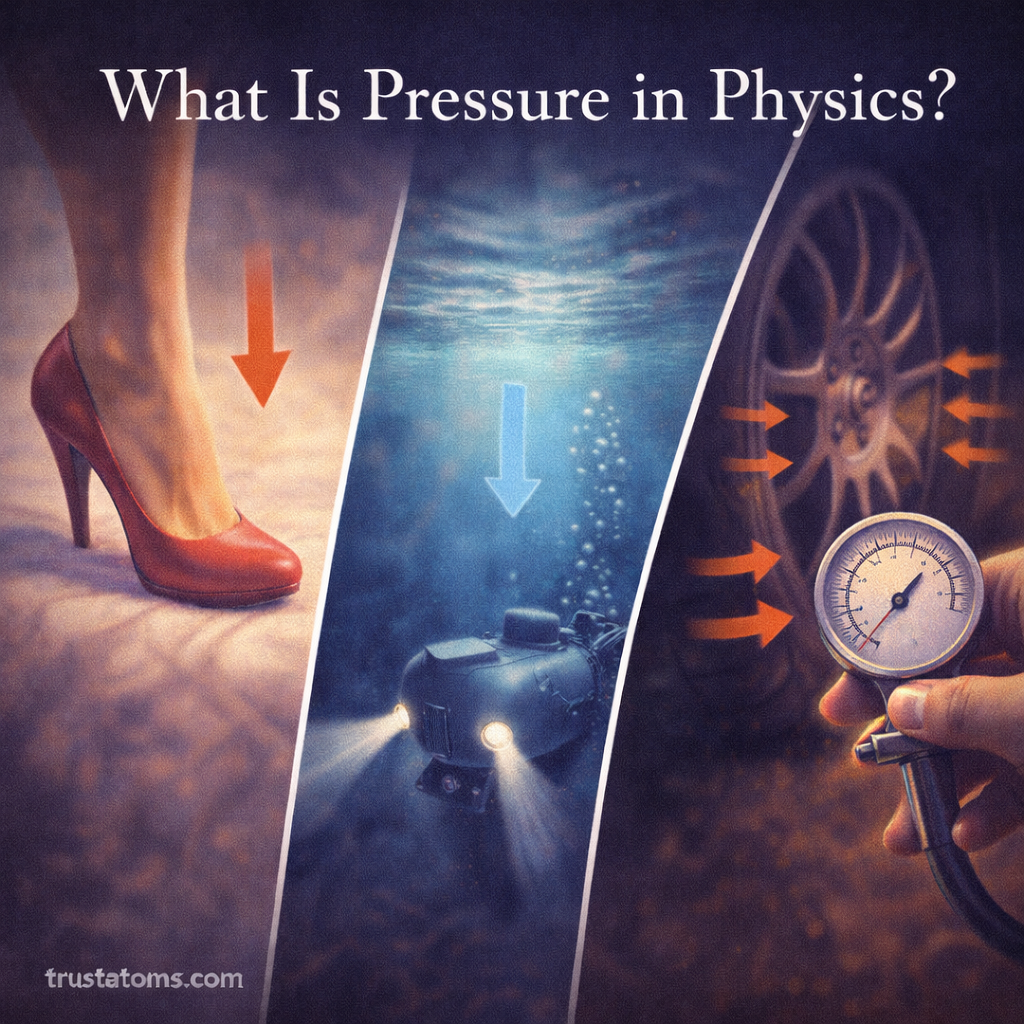
What Is Pressure in Physics?

Illustration showing a high heel applying force to the ground, a deep-sea submersible underwater, and a tire pressure gauge measuring air pressure, titled “What Is Pressure in Physics?” with trustatoms.com watermark.
Conceptual illustration of pressure in physics showing force over area, underwater depth pressure, and tire air pressure measurement. trustatoms.com

Pressure in physics is the amount of force applied over a given area.

In simple terms, pressure tells us how concentrated a force is. The same force applied over a small area produces more pressure than when spread over a large area.

Pressure plays a crucial role in fluid dynamics, weather systems, engineering, and even everyday experiences like walking in snow or using a knife.

Continue reading “What Is Pressure in Physics?”

What Is Bernoulli’s Principle?

Illustration showing airflow over an airplane wing, fluid moving through a narrow pipe, and a spray bottle demonstrating Bernoulli’s Principle, with trustatoms.com watermark.
Conceptual illustration of Bernoulli’s Principle showing airplane lift, pressure changes in a pipe, and spray bottle fluid flow. trustatoms.com

Bernoulli’s Principle is a fundamental concept in fluid dynamics that explains the relationship between a fluid’s speed and its pressure.

In simple terms, it states:

When a fluid moves faster, its pressure decreases.

This principle helps explain how airplanes fly, how spray bottles work, and why wind can lift roofs during storms.

It is one of the most important ideas in physics for understanding the motion of liquids and gases.

Continue reading “What Is Bernoulli’s Principle?”

What Is Fluid Dynamics?

Illustration showing an airplane with airflow lines, a swirling hurricane, and water ripples demonstrating fluid motion, titled “What Is Fluid Dynamics?” with trustatoms.com watermark.
Conceptual illustration of fluid dynamics showing airflow over an airplane, hurricane rotation, and water ripple motion. trustatoms.com

Fluid dynamics is the branch of physics that studies how liquids and gases move.

It explains how water flows through pipes, how air moves around airplane wings, how blood circulates in the body, and even how weather systems form.

Anytime a liquid or gas is in motion, fluid dynamics helps describe and predict its behavior.

Continue reading “What Is Fluid Dynamics?”

What Is Plasma?

Illustration of glowing ionized plasma with lightning, magnetic field lines, and solar activity, titled “What Is Plasma?” with trustatoms.com watermark.
Conceptual illustration of plasma as an ionized state of matter, showing charged particles, lightning, and solar plasma activity. trustatoms.com

Plasma is often called the fourth state of matter. While most people are familiar with solids, liquids, and gases, plasma is just as important — and far more common in the universe.

Plasma forms when a gas becomes so energized that its atoms lose electrons. This creates a mixture of positively charged ions and free electrons.

Unlike ordinary gases, plasma conducts electricity and responds strongly to magnetic fields.

Continue reading “What Is Plasma?”