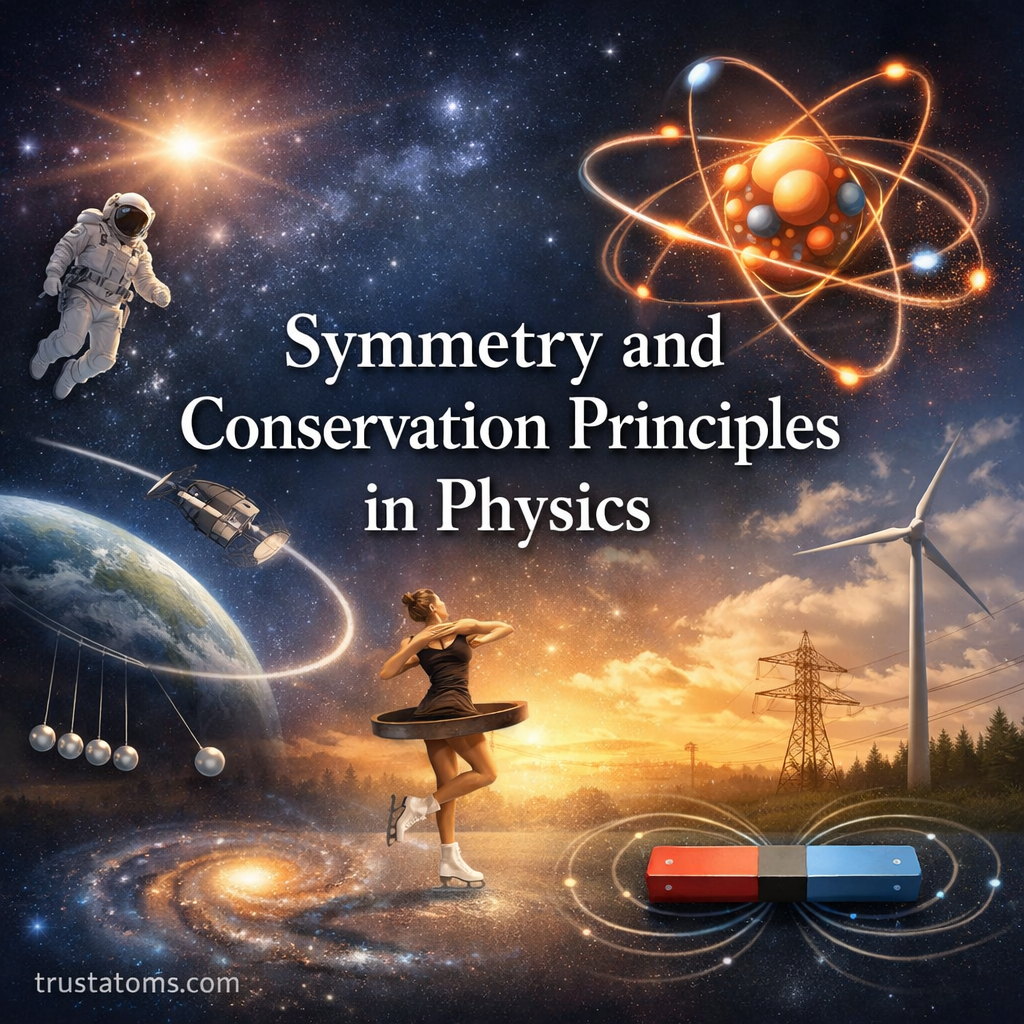
Symmetry and Conservation Principles in Physics

Illustrated diagram showing symmetry concepts in physics including rotation, orbit, and balanced forces representing conservation principles.
Conceptual illustration representing symmetry and conservation principles in physics. trustatoms.com

Symmetry is one of the most powerful ideas in physics. It doesn’t just describe beauty or balance — it explains why certain physical quantities never change.

From the conservation of energy to the conservation of momentum, many of the universe’s most important laws exist because nature has built-in symmetries. In this article, we’ll break down what symmetry means in physics, how it leads directly to conservation laws, and why this connection is one of the deepest insights in modern science.

Continue reading “Symmetry and Conservation Principles in Physics”
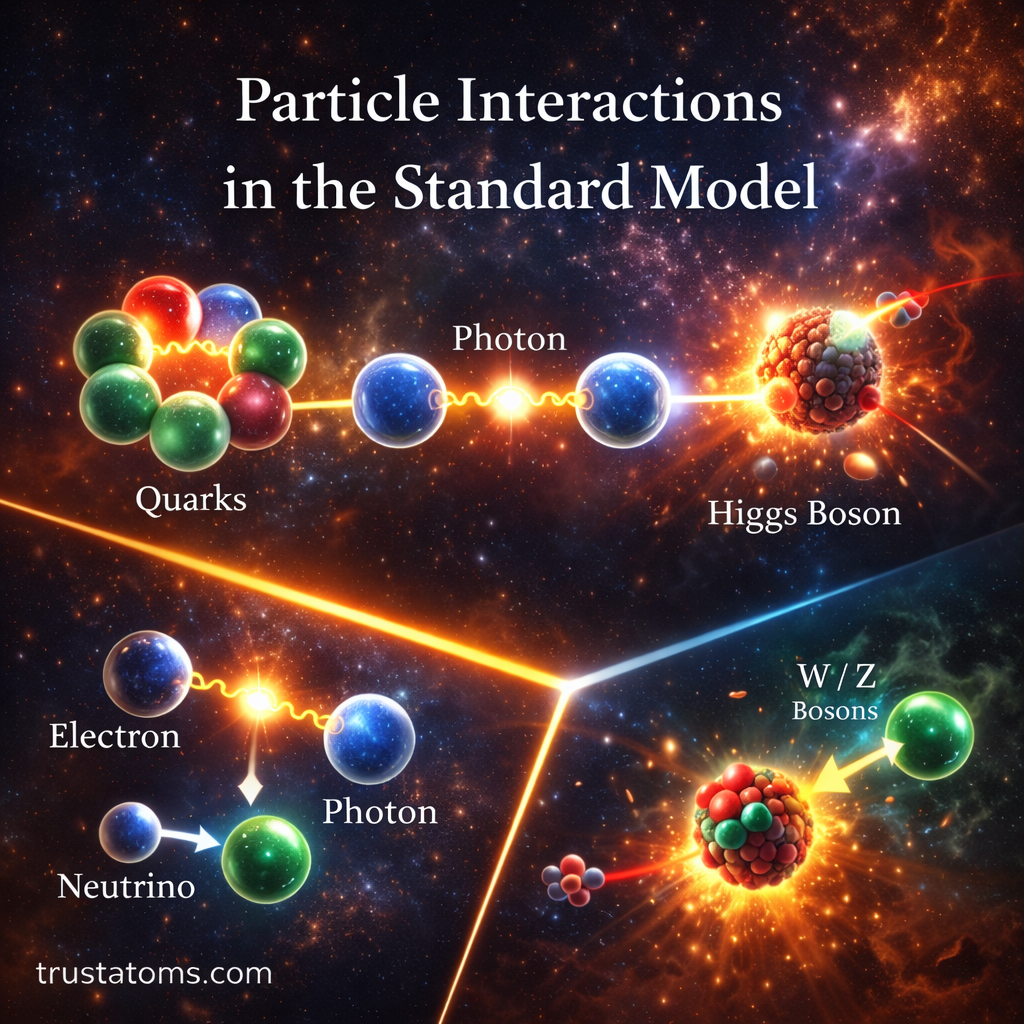
Particle Interactions in the Standard Model

Illustration of particle interactions in the Standard Model showing quarks, photons, Higgs boson, W and Z bosons, and neutrino exchanges with title overlay and trustatoms.com watermark.
Conceptual illustration of particle interactions in the Standard Model highlighting force carriers and fundamental particles. trustatoms.com

What is everything made of?

Modern physics answers this question through the Standard Model — the most successful theory ever developed to describe fundamental particles and their interactions.

The Standard Model explains:

  • What matter is made of
  • How particles interact
  • Which forces govern the universe at small scales

In this guide, we’ll explore particle interactions in the Standard Model, how forces are transmitted, and why this framework remains central to modern physics.

Continue reading “Particle Interactions in the Standard Model”

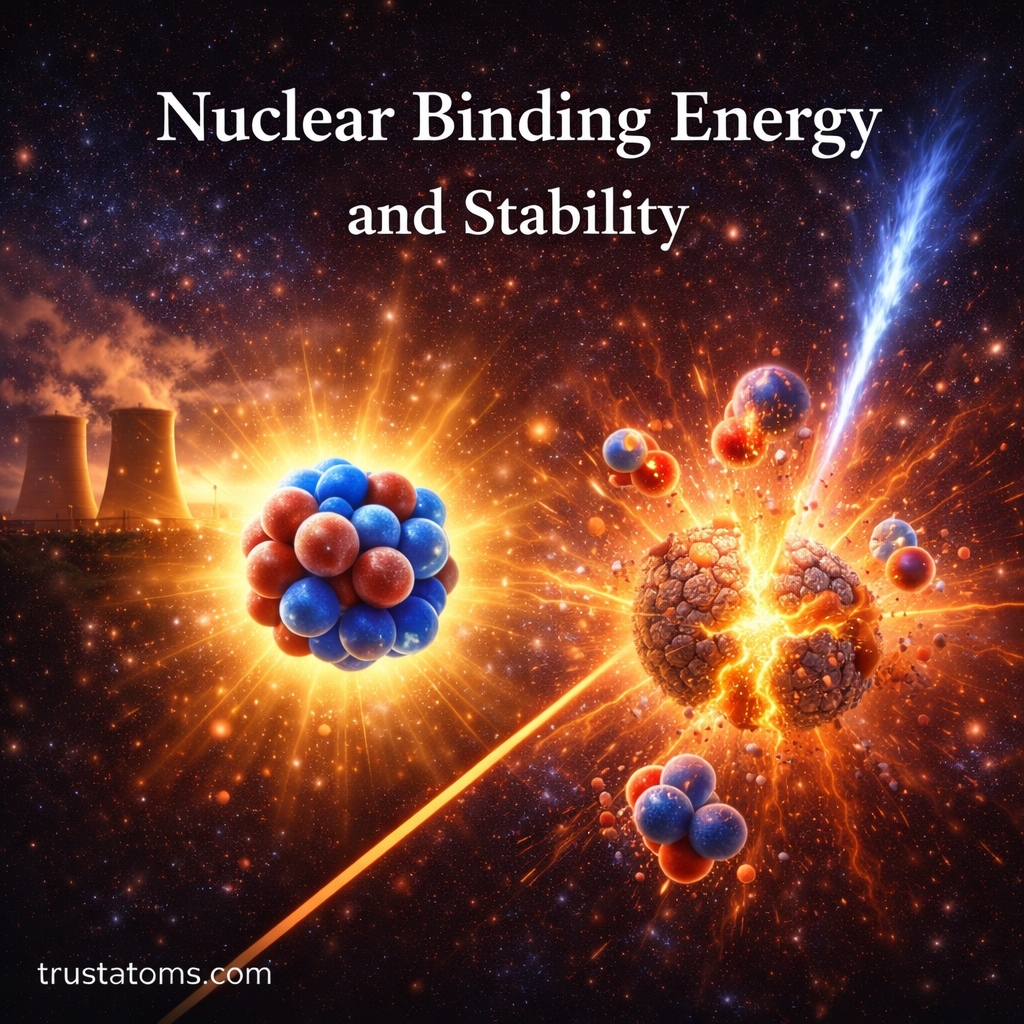
Nuclear Binding Energy and Stability

Illustration of nuclear binding energy and stability showing a stable atomic nucleus, an unstable splitting nucleus, and a nuclear power plant in the background with title overlay and trustatoms.com watermark.
Conceptual illustration of nuclear binding energy highlighting stable and unstable nuclei and real-world nuclear energy production. trustatoms.com

Why do some atomic nuclei remain stable for billions of years while others decay in seconds?

The answer lies in nuclear binding energy.

Nuclear binding energy explains:

  • Why energy is released in nuclear reactions
  • Why some isotopes are stable
  • Why stars can shine for billions of years
  • Why nuclear fission and fusion produce enormous energy

Understanding binding energy is essential for nuclear physics, astrophysics, and modern energy science.

Continue reading “Nuclear Binding Energy and Stability”

Mass–Energy Equivalence in Modern Physics

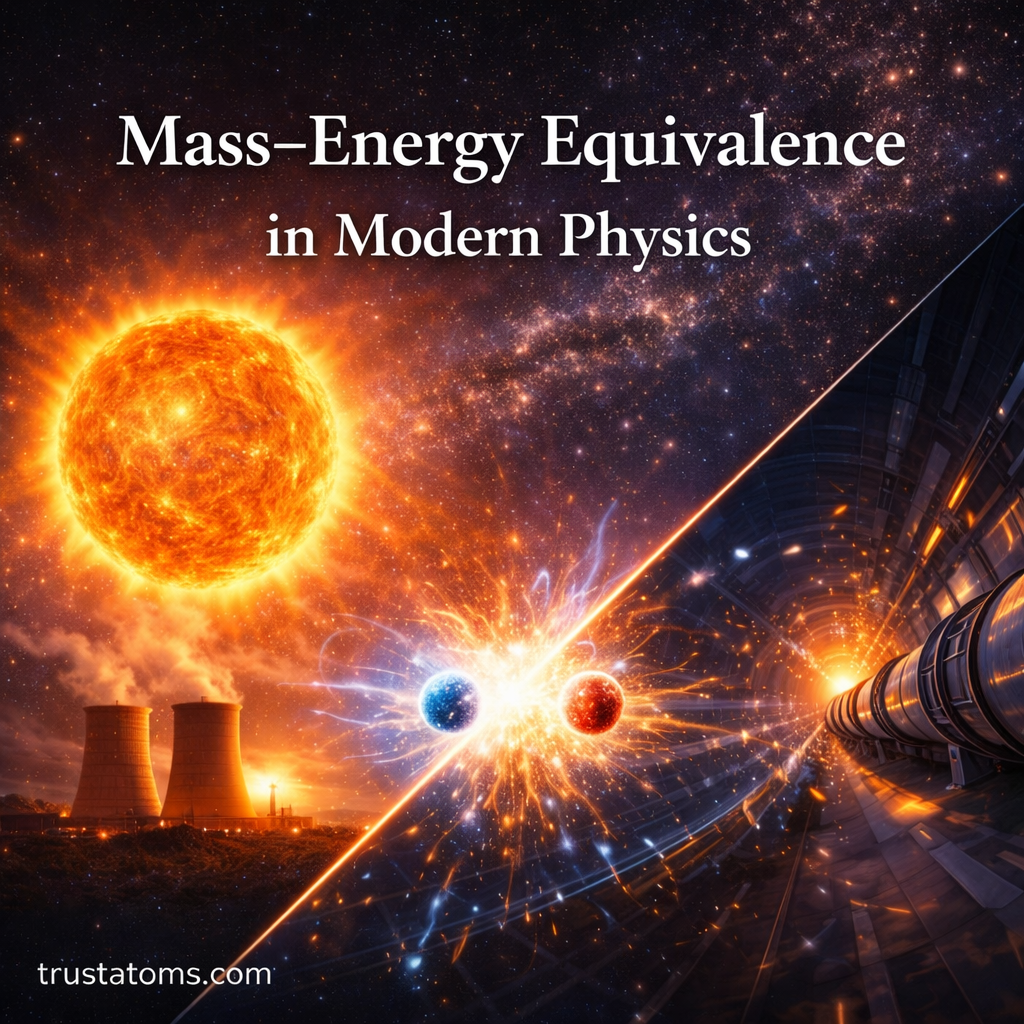
Illustration of mass–energy equivalence in modern physics showing the Sun, nuclear power plant, and particle collision inside an accelerator with title overlay and trustatoms.com watermark.
Conceptual illustration of mass–energy equivalence highlighting stellar fusion, nuclear energy, and particle collisions. trustatoms.com

Few equations in science are as famous as:

E = mc²

This simple relationship changed physics forever.

Mass–energy equivalence reveals that mass is not separate from energy. Instead, mass is a highly concentrated form of energy. This insight reshaped our understanding of nuclear reactions, particle physics, cosmology, and even the origin of the universe.

In this guide, we’ll explore what mass–energy equivalence means, where it comes from, and why it remains foundational in modern physics.

Continue reading “Mass–Energy Equivalence in Modern Physics”

Spacetime Curvature in General Relativity

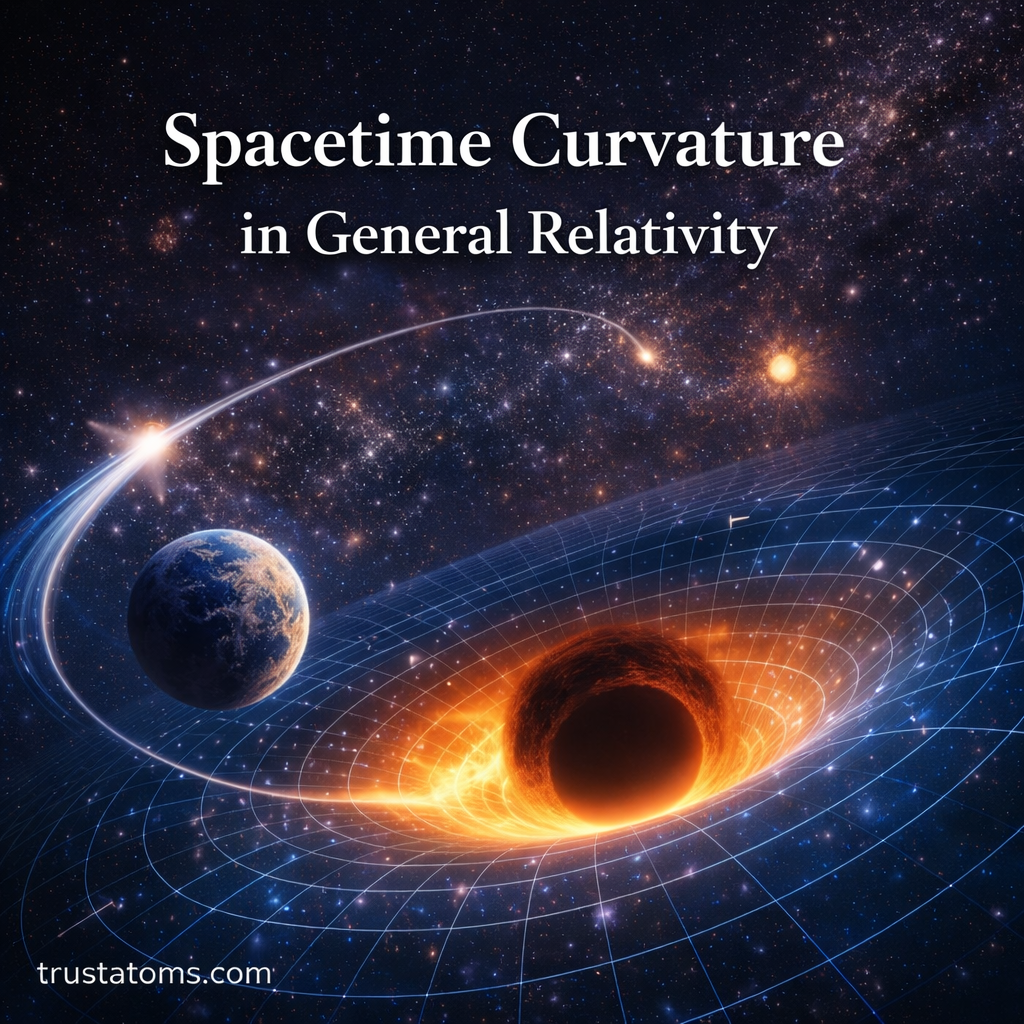
Illustration of spacetime curvature in general relativity showing a warped spacetime grid around a black hole with light bending and title overlay, trustatoms.com watermark in corner.
Conceptual illustration of spacetime curvature around a massive object demonstrating gravitational bending of light and warped geometry. trustatoms.com

Gravity feels simple.

Drop a ball, and it falls. Planets orbit the Sun. The Moon circles Earth.

For centuries, gravity was described as a force pulling objects together. But in the early 20th century, Albert Einstein transformed our understanding completely. In his theory of general relativity, gravity is not a force — it is the curvature of spacetime itself.

This article explains what spacetime curvature is, how it works, and why it is one of the most profound ideas in modern physics.

Continue reading “Spacetime Curvature in General Relativity”

Relativistic Momentum in High-Velocity Systems

Illustration of relativistic momentum in high-velocity systems showing a particle accelerator, space background, and high-speed motion effects with title overlay and trustatoms.com watermark.
Conceptual illustration of relativistic momentum in high-velocity systems with particle acceleration and cosmic motion imagery. trustatoms.com

When objects move at everyday speeds, classical physics works beautifully. But as velocities approach the speed of light, Newton’s equations begin to break down. In these extreme conditions — inside particle accelerators, near black holes, or in cosmic ray interactions — we must use relativistic momentum.

Relativistic momentum explains how motion behaves when speeds are a significant fraction of the speed of light. It reshapes our understanding of mass, energy, and motion in high-velocity systems.

This guide breaks it down clearly and step-by-step.

Continue reading “Relativistic Momentum in High-Velocity Systems”

Schrödinger Wave Functions in Bound Systems

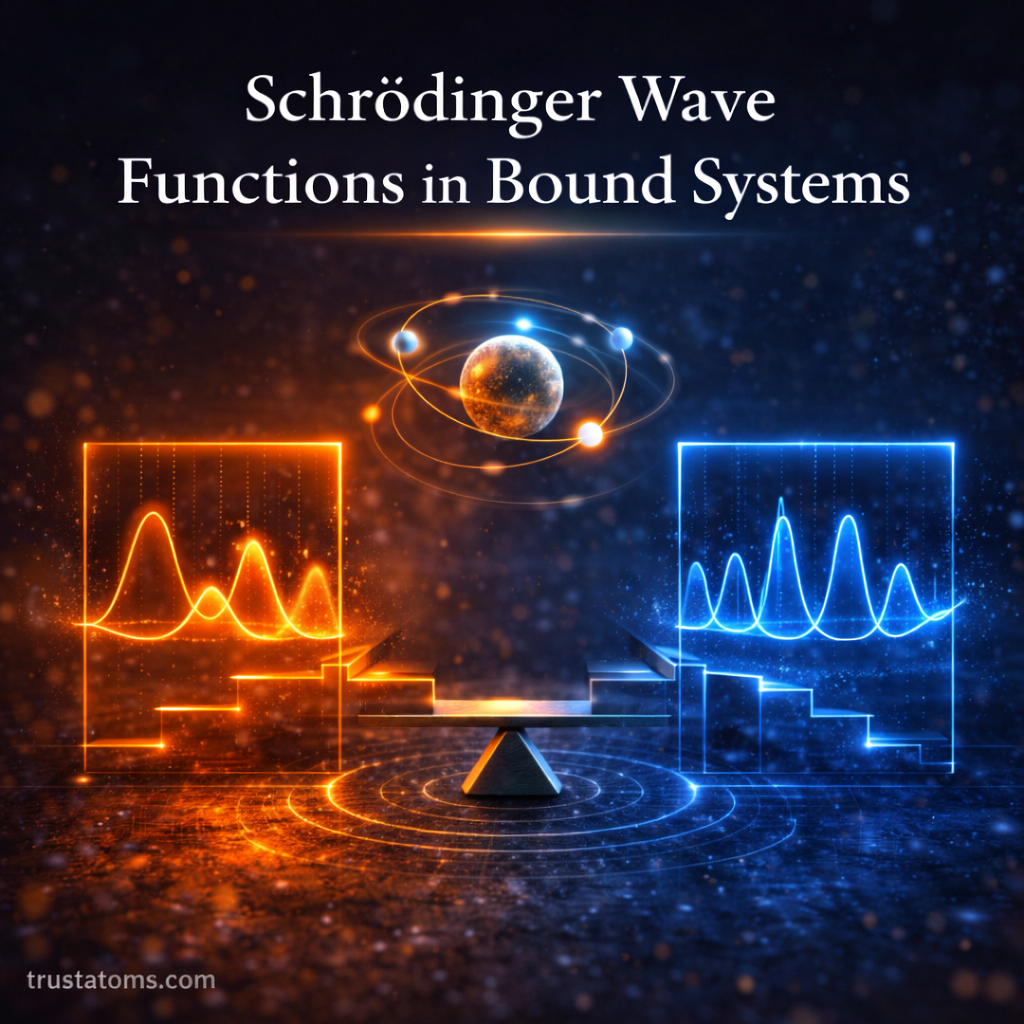
Schrödinger wave functions in bound systems illustration showing atomic orbitals and quantized energy levels in a quantum physics visualization.
Illustration representing Schrödinger wave functions and quantized bound states in an atomic system. trustatoms.com

In quantum mechanics, particles such as electrons do not orbit atoms the way planets orbit the Sun. Instead, their behavior is described by wave functions — mathematical objects that encode probabilities.

When a particle is confined to a specific region of space, such as inside an atom or a quantum well, it forms what physicists call a bound system.

In this article, we’ll explore how Schrödinger wave functions describe bound systems, why energy becomes quantized, and how this explains atomic structure and modern technology.

Continue reading “Schrödinger Wave Functions in Bound Systems”

Heisenberg Uncertainty Principle in Quantum Theory

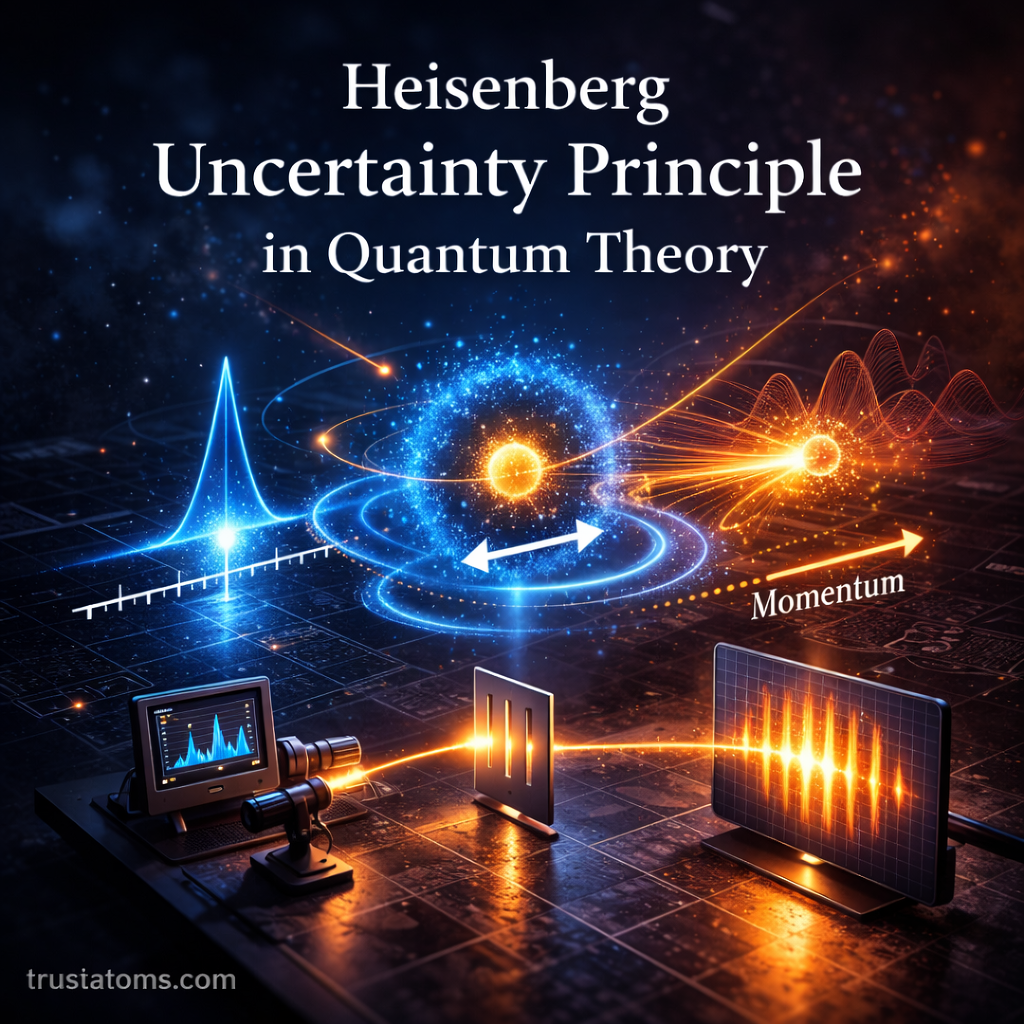
Heisenberg Uncertainty Principle illustration showing position and momentum trade-off in a quantum physics visualization.
Illustration representing the Heisenberg Uncertainty Principle and the trade-off between position and momentum in quantum theory. trustatoms.com

The Heisenberg Uncertainty Principle is one of the most profound discoveries in quantum physics. It reveals a surprising truth about the microscopic world:

There are fundamental limits to how precisely certain pairs of physical properties can be known at the same time.

This is not due to poor measurement tools or human error. It is built into the structure of reality itself.

In this guide, we’ll explore what the Heisenberg Uncertainty Principle means, why it exists, and how it shapes modern quantum theory.

Continue reading “Heisenberg Uncertainty Principle in Quantum Theory”

Quantum States and Probability Amplitudes

Quantum states and probability amplitudes illustration showing wave-like patterns, particles, and probability clouds in a quantum physics scene.
Illustration representing quantum states and probability amplitudes with wave interference and particle probability clouds. trustatoms.com

Quantum mechanics describes the behavior of matter and energy at the smallest scales — atoms, electrons, photons, and other subatomic particles.

Unlike classical physics, which predicts exact outcomes, quantum physics works with probabilities. At the heart of this framework are two key ideas:

  • Quantum states
  • Probability amplitudes

In this guide, we’ll break down what these concepts mean, how they relate to measurements, and why they are essential to understanding modern physics.

Continue reading “Quantum States and Probability Amplitudes”

Semiconductor Behavior in Electronic Materials

Semiconductor behavior illustration showing a microchip with p-type and n-type regions on a circuit board.
Illustration of semiconductor behavior showing p-type and n-type regions within a microchip on a circuit board. trustatoms.com

Semiconductors are the foundation of modern technology. From smartphones and computers to solar panels and advanced medical devices, semiconductor materials make electronic control possible.

But what exactly is semiconductor behavior? How can a material sometimes conduct electricity and sometimes resist it?

In this guide, we’ll explore the physics behind semiconductor behavior, how electrons move in these materials, and why semiconductors are essential in electronic systems.

Continue reading “Semiconductor Behavior in Electronic Materials”