Entropic Forces in Statistical Mechanics

Illustration showing polymer elasticity and osmotic motion representing entropic forces in statistical mechanics.
Conceptual illustration of entropic forces in statistical mechanics, including polymer recoil and osmotic behavior. trustatoms.com

Forces usually bring to mind pushes and pulls caused by fields — gravity, electromagnetism, or mechanical contact.

But in statistical mechanics, some forces arise for a completely different reason.

They are not driven by energy minimization alone, but by entropy maximization.

These are called entropic forces.

Entropic forces play a central role in:

  • Polymer elasticity
  • Osmosis
  • Colloidal interactions
  • Biological molecular motion
  • Emergent gravity theories

Understanding entropic forces helps explain how large-scale behavior emerges from microscopic randomness.

Continue reading “Entropic Forces in Statistical Mechanics”


Electromagnetic Wave Propagation in Media

Illustration showing electromagnetic waves refracting through glass and propagating through different media like air and water.
Conceptual diagram of electromagnetic wave propagation through different media including refraction and transmission effects. trustatoms.com

Electromagnetic waves — including radio waves, microwaves, visible light, X-rays, and gamma rays — are fundamental carriers of energy and information. In a vacuum, they travel at the speed of light.

But most real-world applications involve waves moving through materials, not empty space.

When electromagnetic waves enter a medium like air, water, glass, or fiber optic cable, their behavior changes. They can slow down, bend, reflect, weaken, or even get absorbed.

Understanding electromagnetic wave propagation in media is essential for telecommunications, optics, materials science, and modern engineering.

Continue reading “Electromagnetic Wave Propagation in Media”

Relativistic Time and Length Contraction

Illustration showing time dilation and length contraction with a moving spacecraft and clock in a spacetime grid background.
Conceptual illustration of relativistic time dilation and length contraction in special relativity. trustatoms.com

Space and time are not fixed backdrops to the universe. According to Einstein’s theory of relativity, they are flexible and depend on motion.

Two of the most surprising consequences of this theory are:

  • Time dilation (moving clocks run slower)
  • Length contraction (moving objects shrink along the direction of motion)

These effects only become noticeable at speeds close to the speed of light, but they have been experimentally confirmed many times. Understanding them reshapes how we think about motion, distance, and even reality itself.

Continue reading “Relativistic Time and Length Contraction”

Spin and Angular Momentum in Quantum Systems

Illustration showing atomic orbital motion and particle spin representing spin and angular momentum in quantum systems.
Conceptual illustration of spin and angular momentum in quantum systems. trustatoms.com

Quantum mechanics reveals a world that behaves very differently from everyday physics. Among its most fascinating concepts are spin and angular momentum — properties that shape atomic structure, chemistry, magnetism, and even modern technologies like MRI and quantum computing.

In classical physics, angular momentum describes how objects rotate. But in quantum systems, angular momentum is quantized, and spin does not mean what you might expect. This article breaks down both ideas clearly and shows how they connect to real physical phenomena.

Continue reading “Spin and Angular Momentum in Quantum Systems”

Quantum Tunneling in Potential Barriers

Illustration of quantum tunneling in potential barriers showing a particle wave passing through an energy barrier in a quantum system.
Conceptual illustration of quantum tunneling in potential barriers, depicting wave behavior and probability transmission in quantum mechanics. trustatoms.com

Quantum tunneling is one of the most fascinating and counterintuitive phenomena in physics. In classical mechanics, a particle must have enough energy to overcome a barrier. If it does not, it simply reflects back.

In quantum mechanics, that rule no longer strictly applies.

Particles described by wave functions can pass through potential barriers—even when they do not have enough classical energy to climb over them. This phenomenon is known as quantum tunneling.

Quantum tunneling is not just theoretical. It plays a crucial role in nuclear physics, semiconductor devices, and even the fusion reactions powering the Sun.

Continue reading “Quantum Tunneling in Potential Barriers”

Energy Density in Field Theories

Illustration of energy density in field theories showing electromagnetic waves, gravitational curvature around a massive object, and quantum field fluctuations in space.
Conceptual illustration of energy density in field theories highlighting electromagnetic fields, spacetime curvature, and quantum fluctuations. trustatoms.com

Energy is one of the most fundamental concepts in physics. In classical mechanics, we often talk about the energy of objects—kinetic energy, potential energy, thermal energy.

But in field theories, energy is not just stored in objects.

It is distributed continuously throughout space.

Energy density describes how much energy exists per unit volume within a field. This concept is central to electromagnetism, general relativity, quantum field theory, and modern cosmology.

Understanding energy density helps physicists describe how fields carry, store, and transfer energy across the universe.

Continue reading “Energy Density in Field Theories”

Experimental Uncertainty in Measurement

Illustration of experimental uncertainty in measurement showing precision gauge, digital scale, statistical confidence curve, and laboratory microscope experiment.
Conceptual illustration of experimental uncertainty in measurement highlighting precision instruments, statistical confidence, and laboratory analysis. trustatoms.com

No measurement in physics is perfectly exact.

No matter how advanced the instrument or how careful the observer, every experimental result carries some degree of uncertainty. Understanding and quantifying that uncertainty is essential to scientific accuracy, credibility, and progress.

Experimental uncertainty is not a mistake. It is a natural and measurable part of observation.

In physics, acknowledging uncertainty strengthens conclusions rather than weakening them.

Continue reading “Experimental Uncertainty in Measurement”

Scaling Laws in Physical Systems

Illustration of scaling laws in physical systems showing an elephant, skyscraper, planet Earth, wind turbine, ship, and natural forces representing size-dependent physical behavior.
Conceptual illustration of scaling laws in physical systems highlighting how size influences mechanics, gravity, fluid dynamics, and energy systems. trustatoms.com

Scaling laws describe how physical quantities change when the size of a system changes. They reveal powerful patterns in nature—showing how length, area, volume, force, and energy relate across different scales.

From tiny atoms to massive galaxies, scaling principles help physicists understand how systems behave when dimensions grow larger or smaller. These laws are foundational in physics, engineering, biology, and even cosmology.

Understanding scaling laws allows scientists to predict how changes in size affect performance, stability, and energy requirements.

Continue reading “Scaling Laws in Physical Systems”

Dimensional Analysis in Physical Quantities

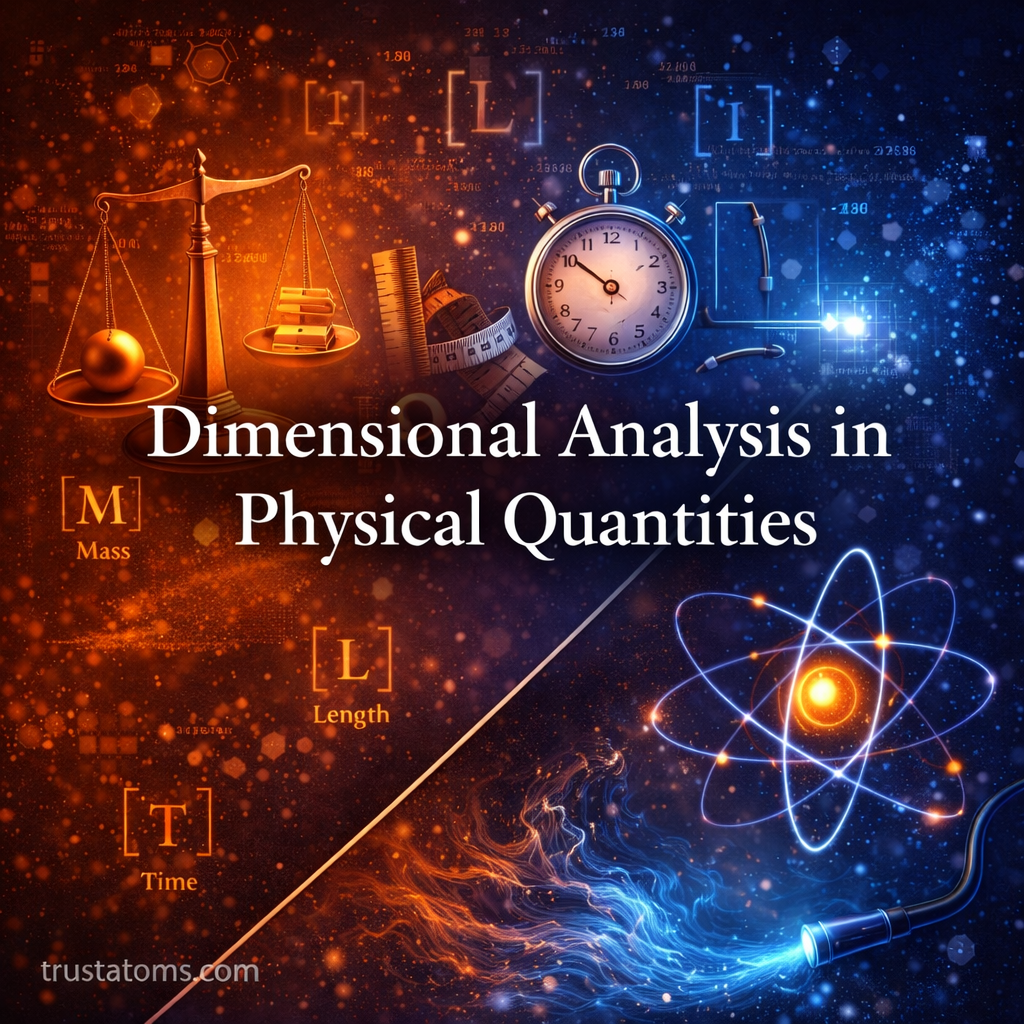
Illustration representing dimensional analysis in physical quantities with mass scale, ruler, stopwatch, atomic structure, and fundamental measurement symbols.
Conceptual illustration of dimensional analysis in physical quantities highlighting mass, length, time, and fundamental measurement principles. trustatoms.com

Dimensional analysis is one of the most powerful and practical tools in physics. It allows scientists and engineers to check equations, derive relationships, simplify problems, and even predict physical behavior—without solving complex mathematics.

At its core, dimensional analysis ensures that physical equations make sense.

If the dimensions do not match, the equation cannot be correct.

Continue reading “Dimensional Analysis in Physical Quantities”

Mathematical Modeling in Physical Systems

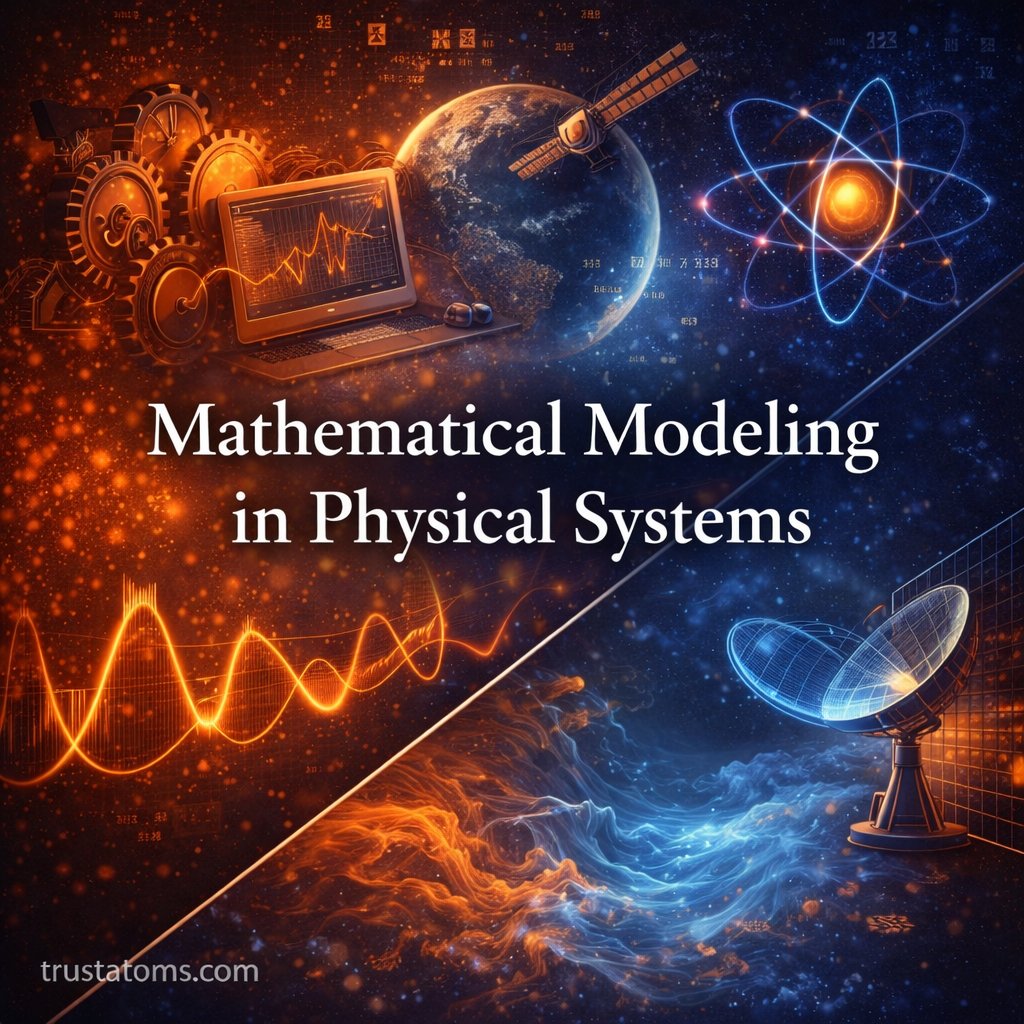
Illustration representing mathematical modeling in physical systems with mechanical gears, satellite orbit, atomic structure, wave patterns, and simulation graphics.
Conceptual illustration of mathematical modeling in physical systems, highlighting mechanics, orbital motion, wave behavior, and computational simulation. trustatoms.com

Mathematical modeling is one of the most powerful tools in physics. It allows scientists to describe, predict, and understand physical systems using equations, logical structures, and computational simulations.

From planetary motion to quantum particles, mathematical models translate physical laws into forms that can be analyzed and tested. Without modeling, modern science and engineering would not exist in their current form.

In applied and theoretical physics alike, modeling connects observation to prediction.

Continue reading “Mathematical Modeling in Physical Systems”