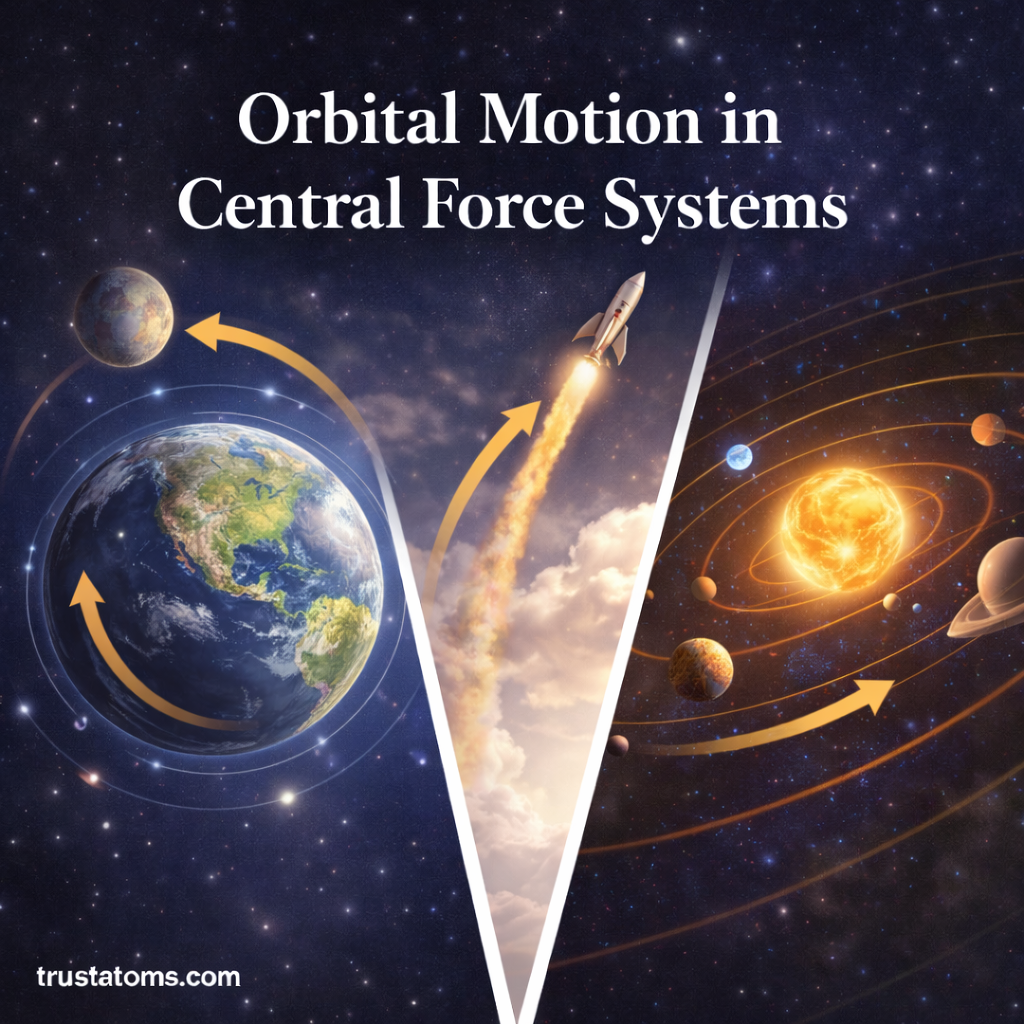
Orbital Motion in Central Force Systems

Illustration showing Earth orbiting in space, a rocket launching outward, and planets orbiting the Sun to represent orbital motion in central force systems.
Examples of orbital motion in central force systems, including Earth–Moon interaction, rocket escape, and planetary orbits. trustatoms.com

Orbital motion is one of the most fascinating phenomena in physics. From satellites circling Earth to planets orbiting the Sun, these motions are governed by a powerful principle: central forces.

Understanding orbital motion in central force systems helps explain planetary systems, space travel, atomic models, and gravitational interactions across the universe.

In this guide, we’ll explore how central forces create stable orbits and what determines the motion of objects in space.

Continue reading “Orbital Motion in Central Force Systems”
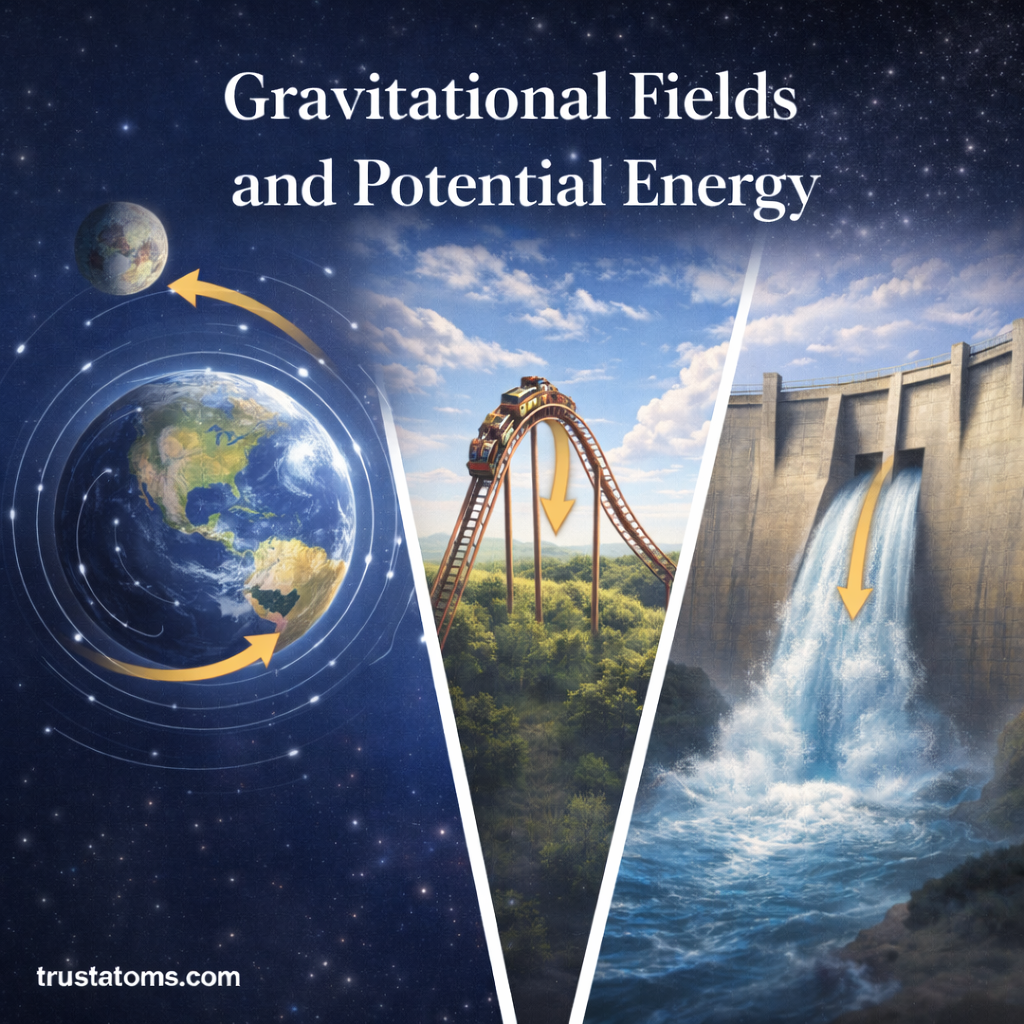
Gravitational Fields and Potential Energy

Illustration showing Earth and Moon gravitational interaction, a roller coaster at height, and a dam releasing water to represent gravitational fields and potential energy.
Examples of gravitational fields and potential energy in space, roller coaster motion, and hydroelectric systems. trustatoms.com

Gravity is one of the most familiar forces in everyday life. It keeps our feet on the ground, governs planetary motion, and shapes the structure of the universe. But behind this familiar force lies a powerful concept in physics: gravitational fields and gravitational potential energy.

Understanding how gravitational fields work — and how they store energy — is essential for studying mechanics, astronomy, engineering, and space science.

Continue reading “Gravitational Fields and Potential Energy”

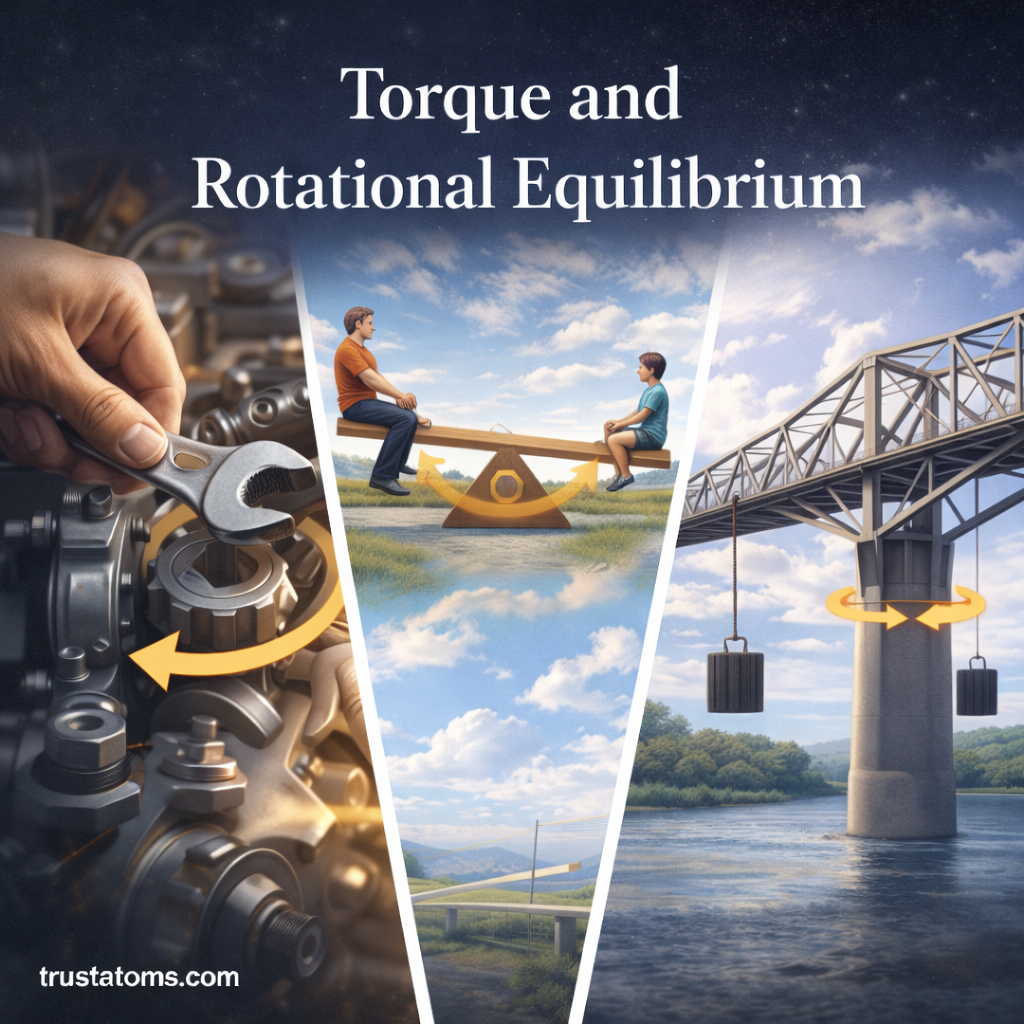
Torque and Rotational Equilibrium

Illustration showing a wrench applying torque, a balanced seesaw, and a bridge structure demonstrating rotational equilibrium in mechanical systems.
Real-world examples of torque and rotational equilibrium, including tools, levers, and structural balance. trustatoms.com

Torque is the rotational equivalent of force. Just as force causes linear acceleration, torque causes rotational motion. Understanding torque and rotational equilibrium is essential for analyzing levers, bridges, engines, and nearly every mechanical system involving rotation.

In this guide, we’ll break down what torque is, how it works, and how objects remain balanced when rotational forces cancel out.

Continue reading “Torque and Rotational Equilibrium”

Angular Acceleration in Rotational Motion

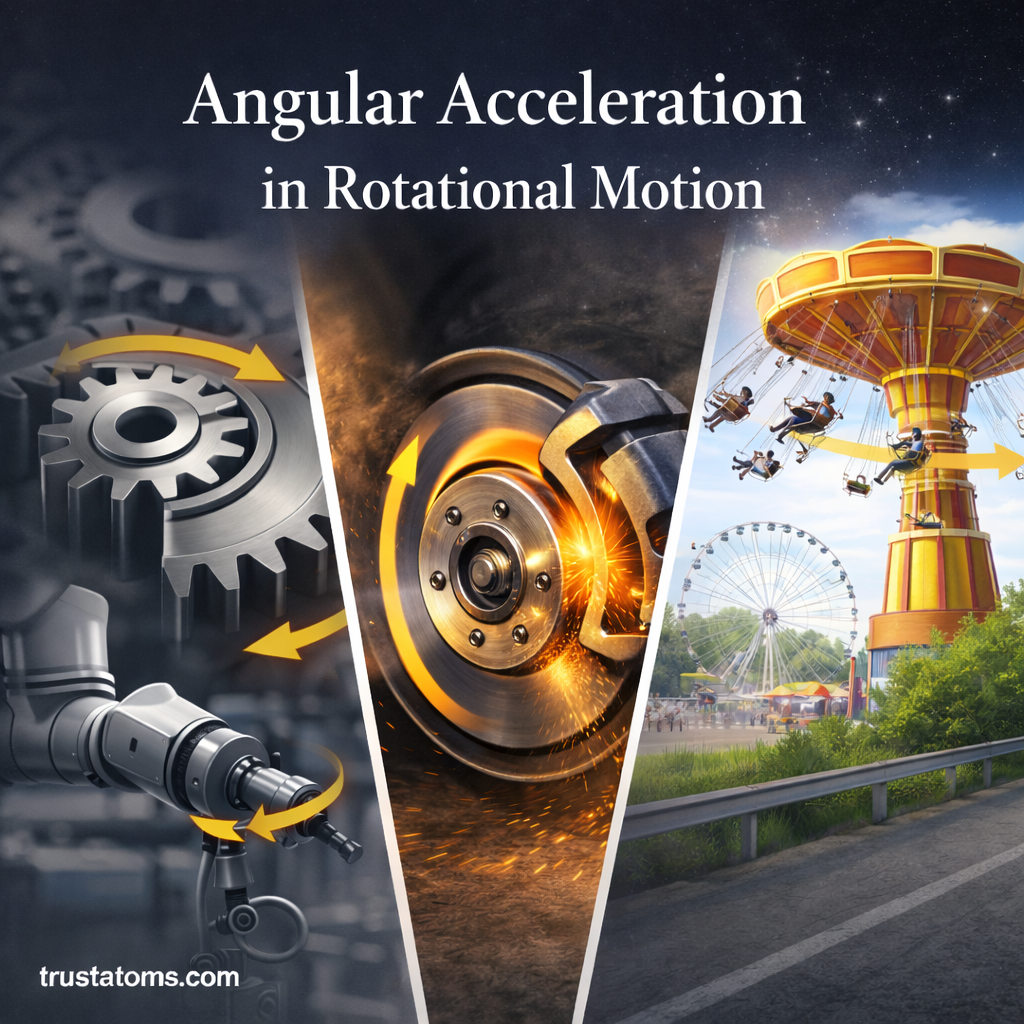
Illustration showing rotating gears, a braking system slowing down, and an amusement ride accelerating to represent angular acceleration in rotational motion.
Real-world examples of angular acceleration in rotating systems, including gears, braking mechanisms, and amusement rides. trustatoms.com

Angular acceleration is one of the core concepts in rotational physics. It describes how quickly a rotating object changes its angular velocity over time.

From car wheels speeding up at a traffic light to turbines gradually slowing down after shutdown, angular acceleration plays a central role in understanding how rotating systems behave.

In this guide, we’ll break down angular acceleration clearly, connect it to linear motion, and explore how it applies in real mechanical systems.

Continue reading “Angular Acceleration in Rotational Motion”

Rotational Kinematics in Rigid Bodies

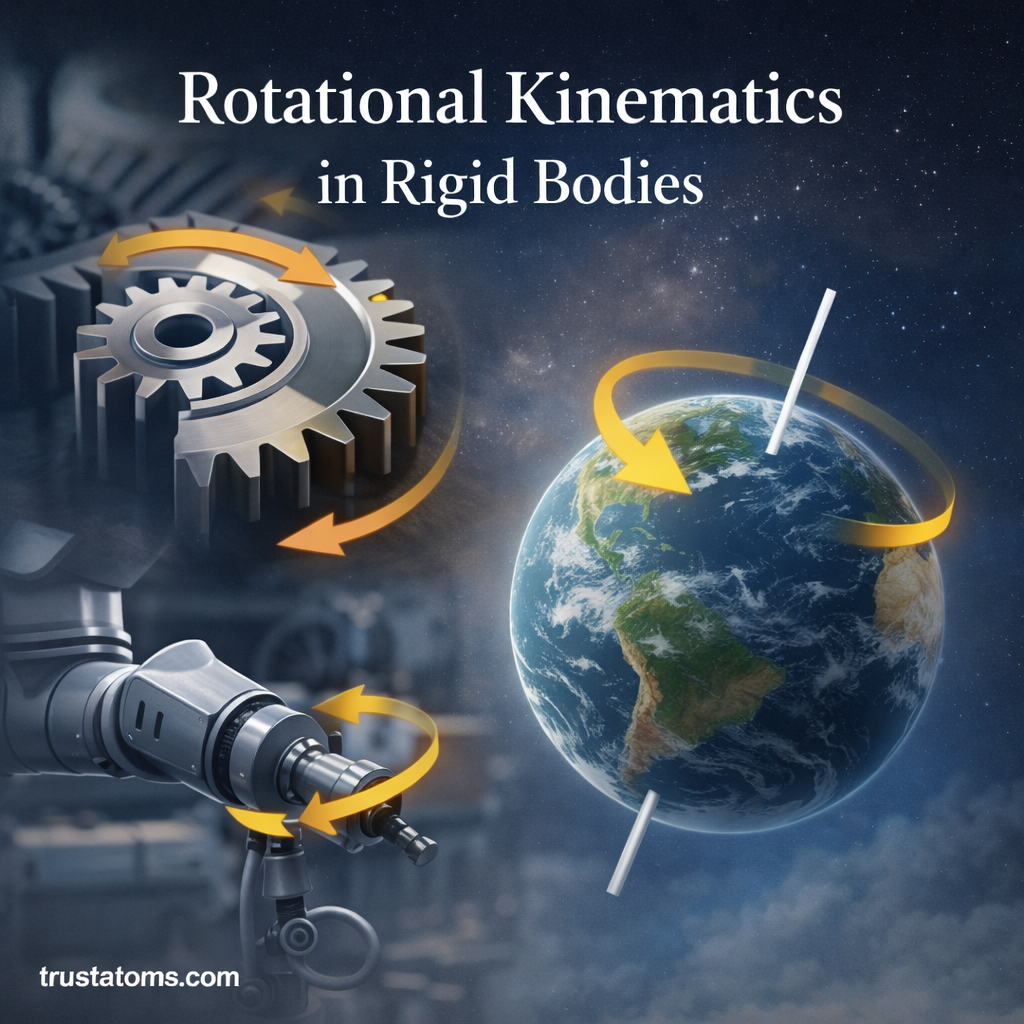
Illustration showing rotating gears, a robotic arm joint, and Earth spinning to represent rotational kinematics in rigid bodies.
Examples of rotational motion in rigid bodies including gears, robotic systems, and planetary rotation. trustatoms.com

Rotational motion is everywhere — from spinning wheels and rotating gears to planets orbiting stars. While linear motion describes objects moving in straight lines, rotational kinematics focuses on how rigid bodies rotate around an axis.

Understanding rotational kinematics in rigid bodies is essential in physics, engineering, robotics, aerospace, and mechanical system design. In this guide, we’ll break it down clearly and connect it to real-world systems.

Continue reading “Rotational Kinematics in Rigid Bodies”

Work–Energy Theorem in Mechanical Systems

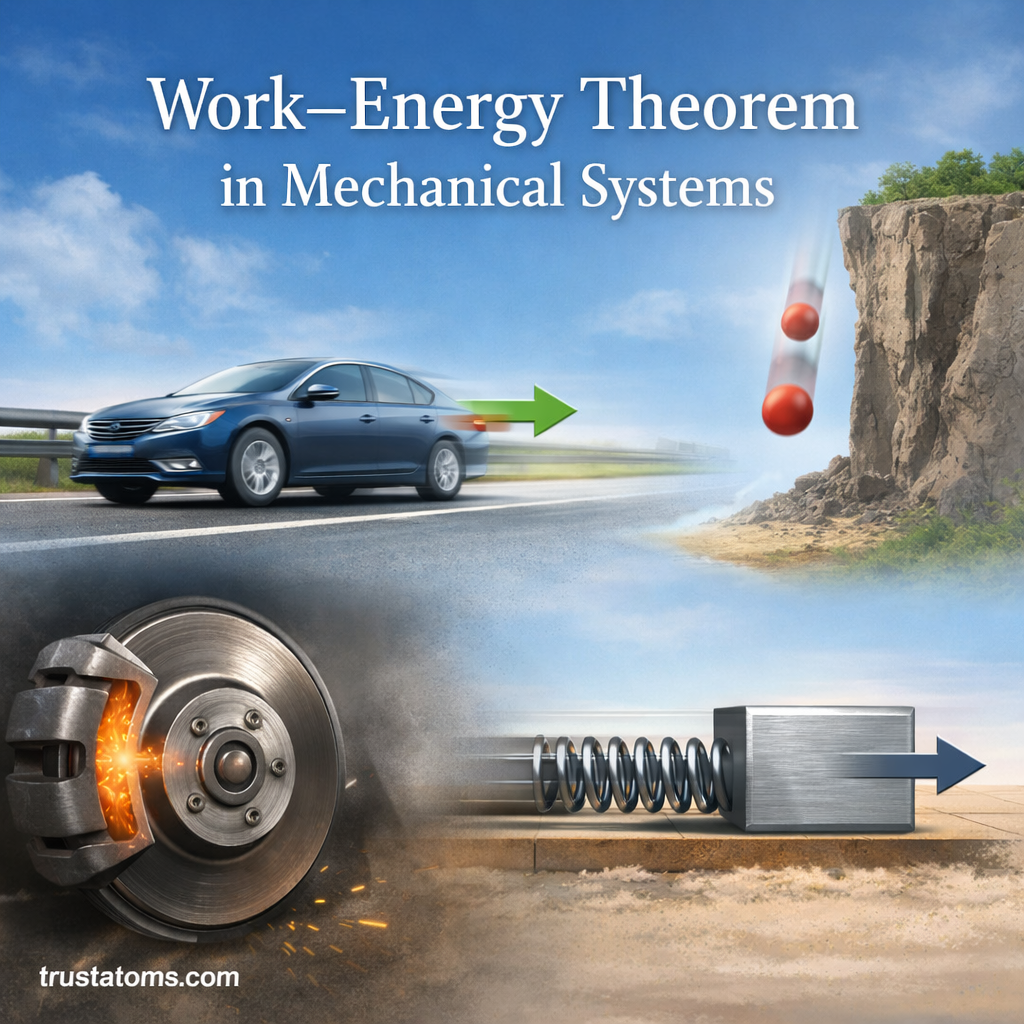
Contextual illustration showing car acceleration, braking system, falling object, and spring system representing the Work–Energy Theorem in mechanical systems.
Illustration showing real-world examples of the Work–Energy Theorem in mechanical systems. trustatoms.com

The work–energy theorem is one of the most powerful and practical ideas in classical physics. It connects two fundamental concepts—work and kinetic energy—into a single, elegant relationship that explains how forces change motion.

Whether you’re analyzing a rolling car, a falling object, or a machine in motion, the work–energy theorem provides a simpler alternative to using Newton’s laws step by step.

In this guide, we’ll break it down clearly and show how it applies to real mechanical systems.

Continue reading “Work–Energy Theorem in Mechanical Systems”

Conservation Laws in Isolated Systems

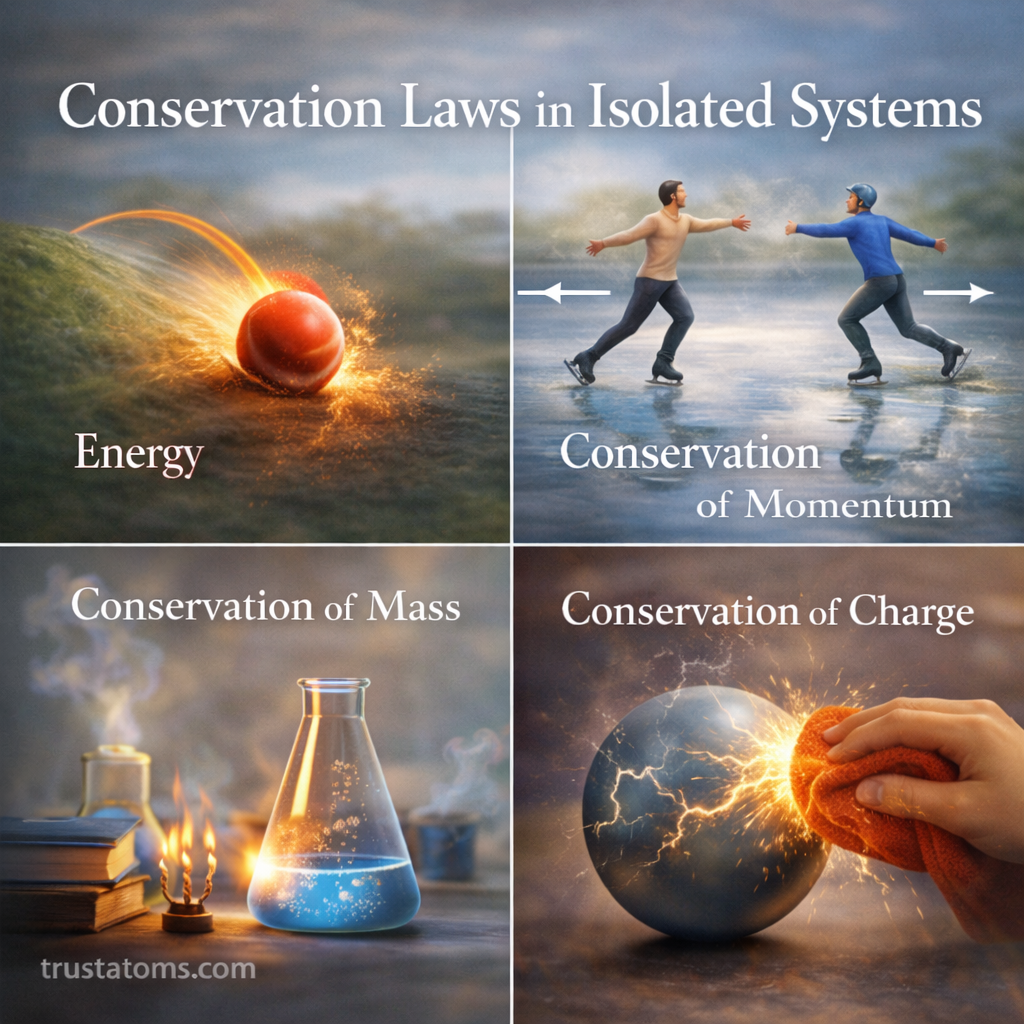
Illustration showing conservation laws in isolated systems including energy, momentum, mass, and electric charge examples, trustatoms.com.
Conservation laws in isolated systems illustrated through energy, momentum, mass, and charge examples. trustatoms.com.

Why does the total momentum of colliding billiard balls remain constant?
Why can energy change form but never simply disappear?

The answer lies in one of the most powerful ideas in physics: conservation laws.

Conservation laws explain what stays constant in nature — even when everything else seems to change. In this guide, we’ll break down what conservation laws are, what an isolated system means, and why these principles are foundational to physics.

Continue reading “Conservation Laws in Isolated Systems”

Impulse and Momentum Transfer in Collisions

Illustration showing impulse and momentum transfer in collisions with a car crash, the barrel end of a baseball bat hitting a baseball, and two spheres colliding, trustatoms.com.
Impulse and momentum transfer illustrated through real-world collision examples. trustatoms.com.

Collisions are everywhere — from a baseball hitting a bat to cars braking suddenly at a red light. Behind each impact lies a powerful physics principle: impulse and momentum transfer.

Understanding how momentum changes during a collision explains why airbags save lives, why athletes “follow through,” and why softer materials reduce injury. In this guide, we’ll break down impulse and momentum in a clear, practical way — without heavy math.

Continue reading “Impulse and Momentum Transfer in Collisions”

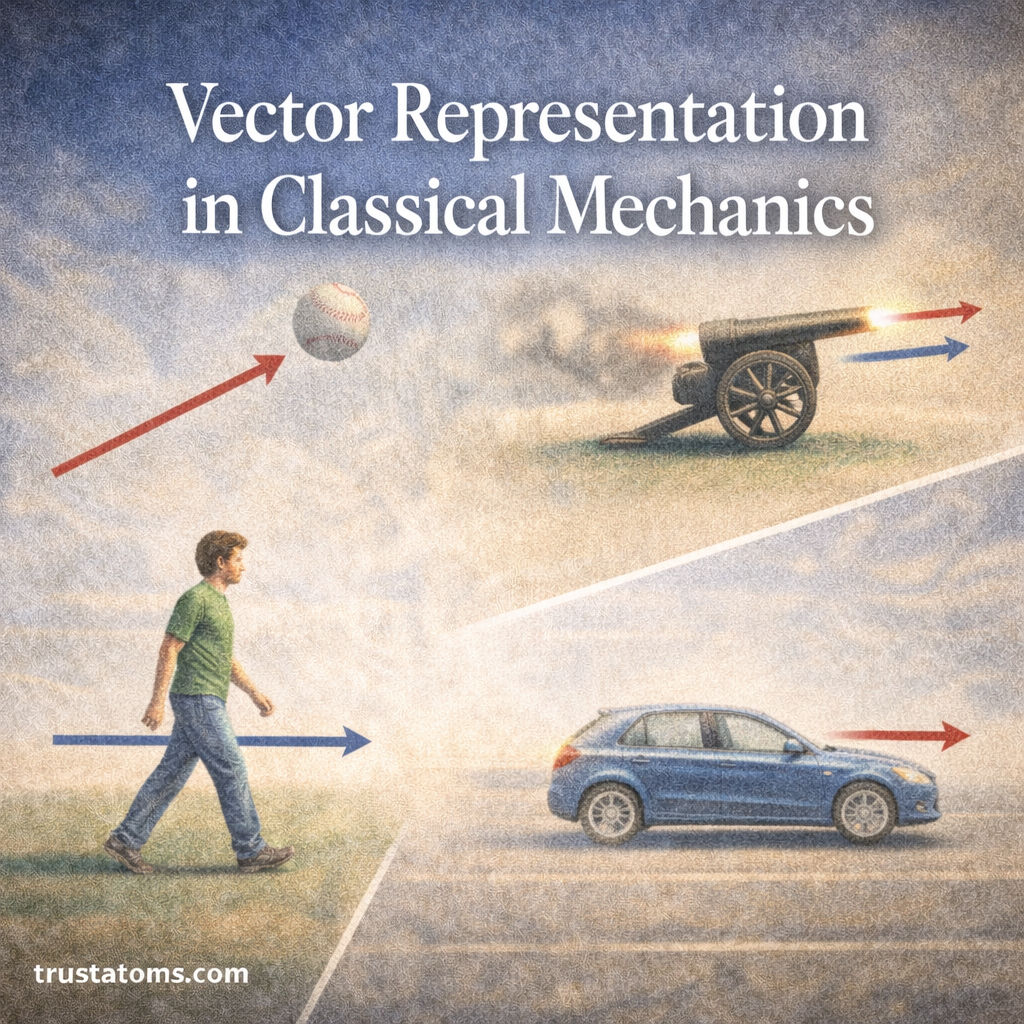
Vector Representation in Classical Mechanics

Illustration showing examples of vector representation in classical mechanics, including a moving baseball, a cannon firing, a walking person, and a car in motion with directional arrows, titled “Vector Representation in Classical Mechanics” and trustatoms.com watermark.
Examples of motion and force represented as vectors in classical mechanics. trustatoms.com

In classical mechanics, many physical quantities are not just about “how much” but also about “which direction.” That’s where vectors come in.

Vector representation allows physicists to describe motion, forces, and fields accurately by including both magnitude and direction. Without vectors, understanding real-world motion—from projectiles to planetary orbits—would be incomplete.

Let’s explore how vectors work and why they are essential in classical mechanics.

Continue reading “Vector Representation in Classical Mechanics”

Inertial and Non-Inertial Reference Frames

Split illustration showing a person observing a moving car from outside and a driver inside an accelerating car, representing inertial and non-inertial reference frames, with trustatoms.com watermark.
Visual comparison of inertial and non-inertial reference frames from an outside observer and an accelerating vehicle perspective. trustatoms.com

Understanding motion in physics requires more than just measuring speed and distance. It also depends on where you are observing from. That viewpoint is called a reference frame.

Two important types of reference frames are inertial reference frames and non-inertial reference frames. These concepts help explain why forces sometimes appear to act on objects—even when nothing seems to be pushing or pulling them.

Let’s break this down clearly and step by step.

Continue reading “Inertial and Non-Inertial Reference Frames”