Boundary Conditions in Wave Equations

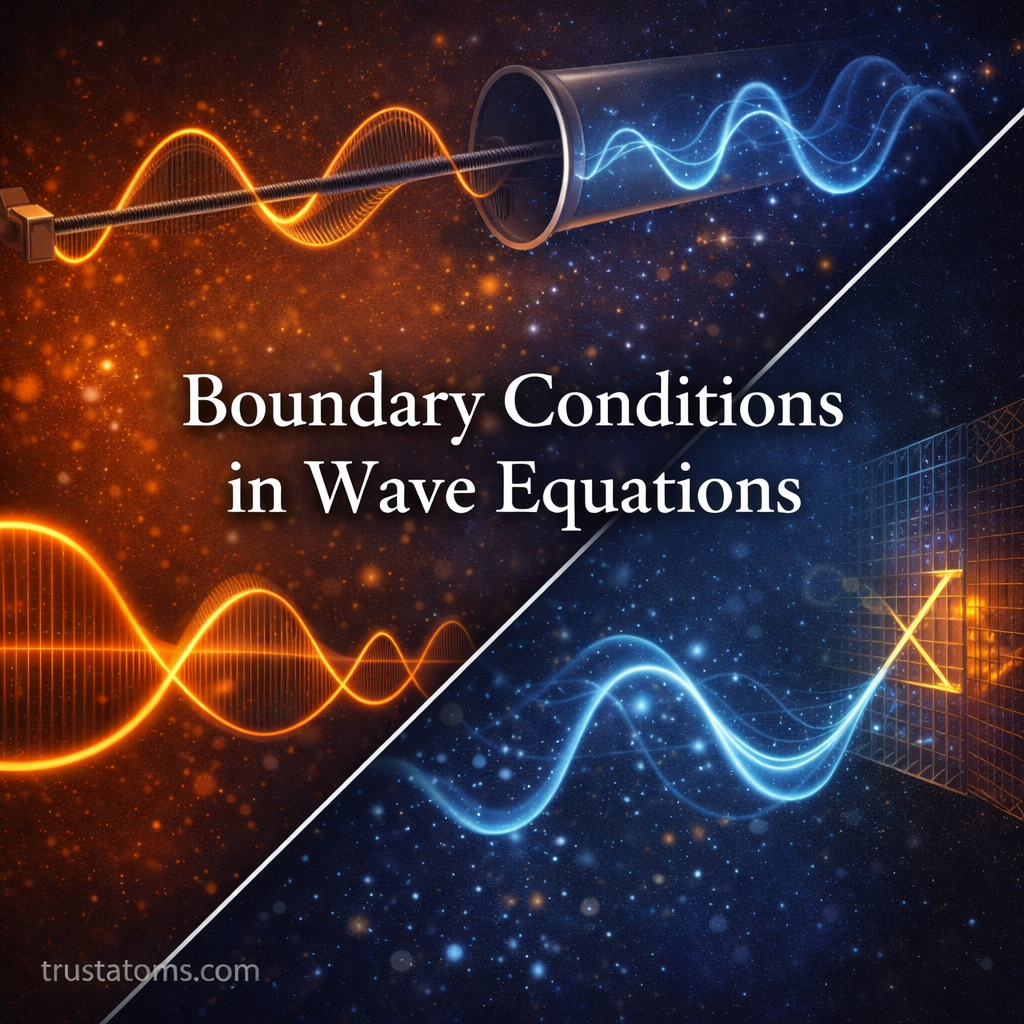
Illustration of boundary conditions in wave equations showing standing waves on a fixed string, sound waves in an open pipe, and wave reflection at a surface.
Conceptual illustration of boundary conditions in wave equations demonstrating fixed, free, and reflective wave behavior. trustatoms.com

Wave equations describe how vibrations, oscillations, and disturbances move through space and time. From sound traveling through air to light propagating in space, wave behavior is governed by precise mathematical relationships.

But solving a wave equation is only part of the story.

To determine the actual physical behavior of a system, we must also specify boundary conditions. These conditions define what happens at the edges of the system and ultimately determine which wave patterns are allowed.

In physics, boundary conditions transform general equations into meaningful, real-world solutions.

Continue reading “Boundary Conditions in Wave Equations”
Complex Systems in Applied Physics

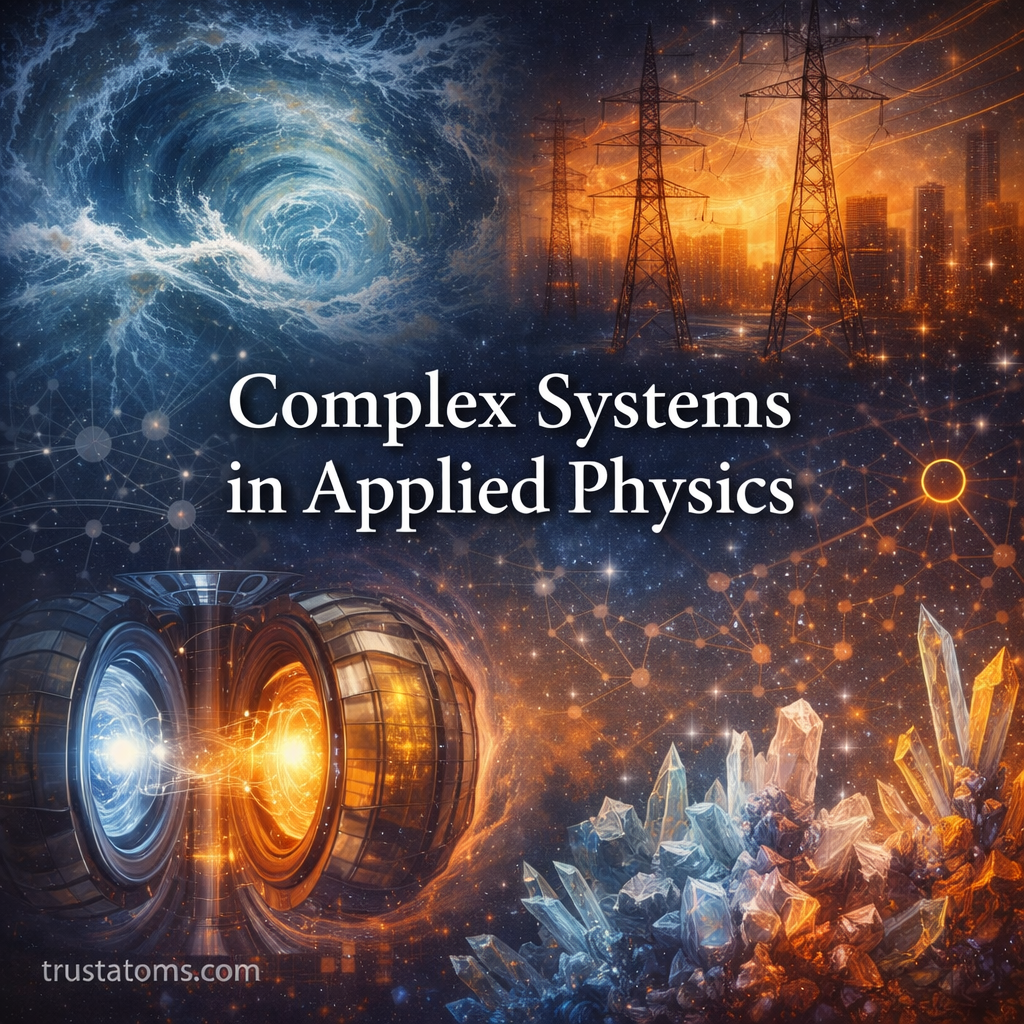
Illustration of complex systems in applied physics showing turbulence, power grid networks, plasma confinement, and crystal formation interconnected in a dynamic composition.
Conceptual illustration representing complex systems in applied physics, including turbulence, energy grids, plasma dynamics, and material structures. trustatoms.com

Complex systems are everywhere in applied physics—from turbulent air flowing over an aircraft wing to electrical grids powering entire cities. Unlike simple systems that can be described with a few equations and predictable outcomes, complex systems involve many interacting parts whose collective behavior produces surprising, emergent patterns.

Understanding complex systems is essential for solving real-world engineering and scientific challenges. In applied physics, it bridges theory and practical problem-solving across energy, materials, climate, medicine, and technology.

Continue reading “Complex Systems in Applied Physics”

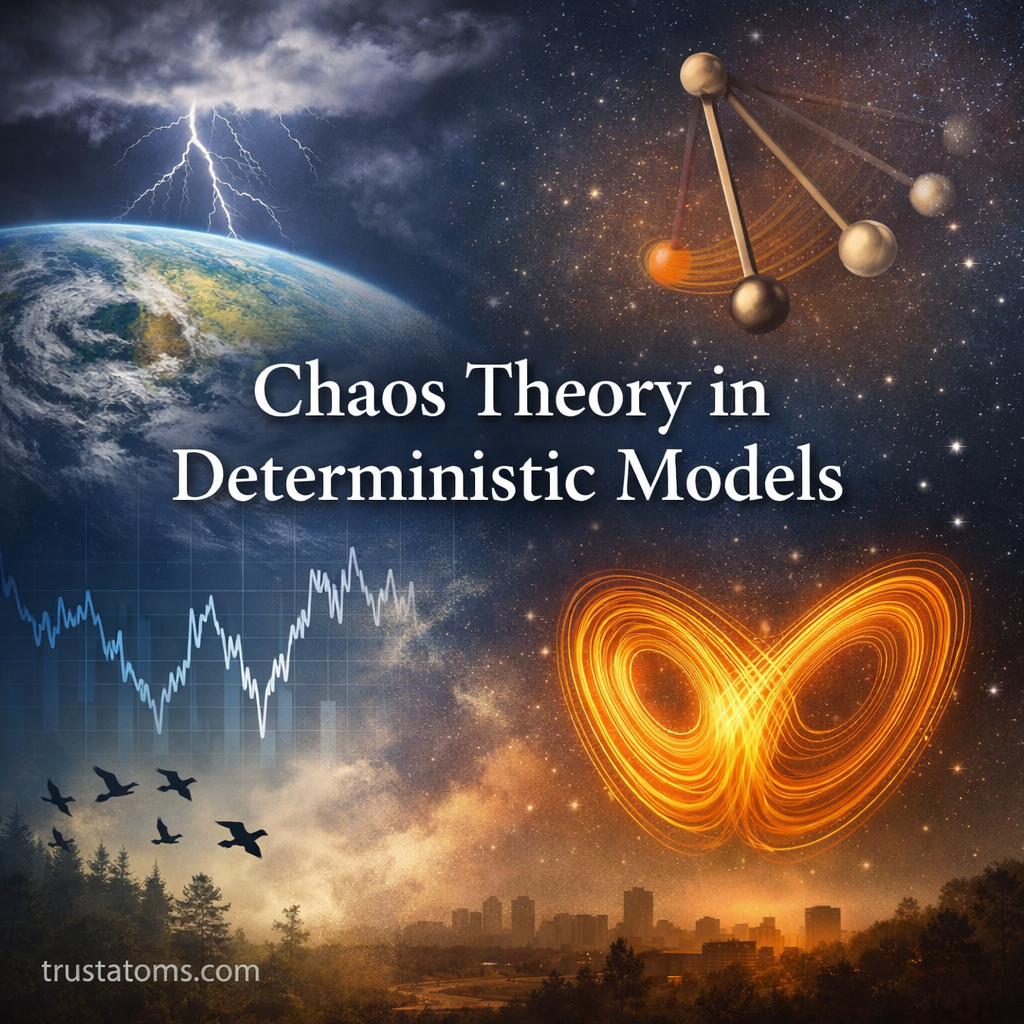
Chaos Theory in Deterministic Models

Illustration representing chaos theory in deterministic models with a double pendulum, strange attractor pattern, Earth’s atmosphere, and nonlinear system visualization.
Conceptual illustration of chaos theory in deterministic models showing nonlinear dynamics and sensitive dependence on initial conditions. trustatoms.com

Chaos theory explores how systems governed by clear, fixed rules can still produce unpredictable and highly complex behavior. At first glance, that sounds contradictory. If something is deterministic—meaning its future is completely determined by its current state—shouldn’t it be predictable?

Surprisingly, the answer is no.

From weather systems to planetary motion, deterministic models can generate outcomes that look random, even though they follow strict physical laws. Understanding this paradox is the foundation of chaos theory.

Continue reading “Chaos Theory in Deterministic Models”

Nonlinear Dynamics in Mechanical Systems

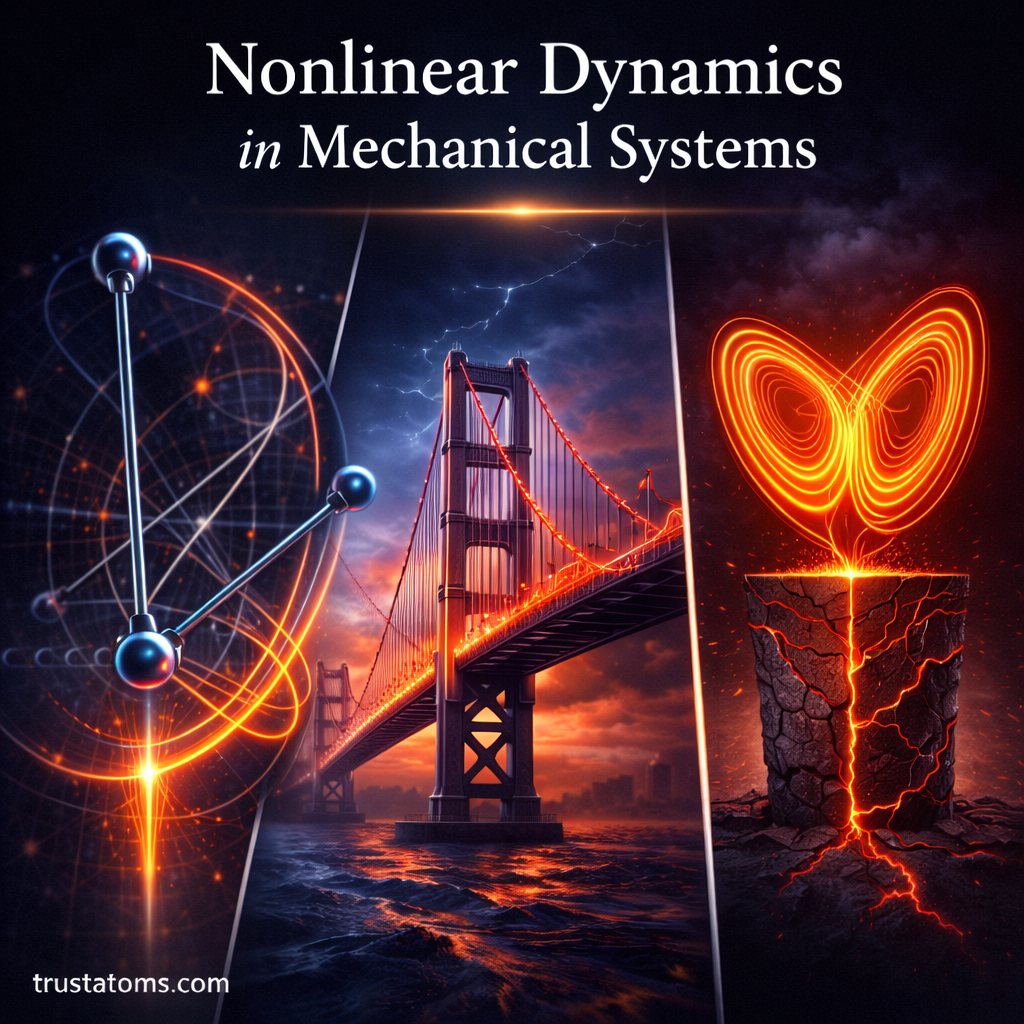
Illustration showing nonlinear dynamics in mechanical systems including a chaotic double pendulum, vibrating suspension bridge, and strange attractor pattern.
Conceptual visualization of nonlinear behavior in mechanical systems, including chaos, structural instability, and complex motion patterns. trustatoms.com

Most introductory physics problems assume something comforting:

Small inputs produce small outputs.

Push a pendulum gently, and it swings gently. Stretch a spring slightly, and it responds proportionally.

But many real-world mechanical systems do not behave this way.

When forces, motion, or energy interactions stop following simple proportional rules, we enter the world of nonlinear dynamics — a field that explains complex motion, chaos, instability, and surprising behavior in mechanical systems.

In this guide, we’ll explore what nonlinear dynamics means, how it differs from linear motion, and why it matters in engineering and physics.

Continue reading “Nonlinear Dynamics in Mechanical Systems”

Laser Emission in Quantum Systems

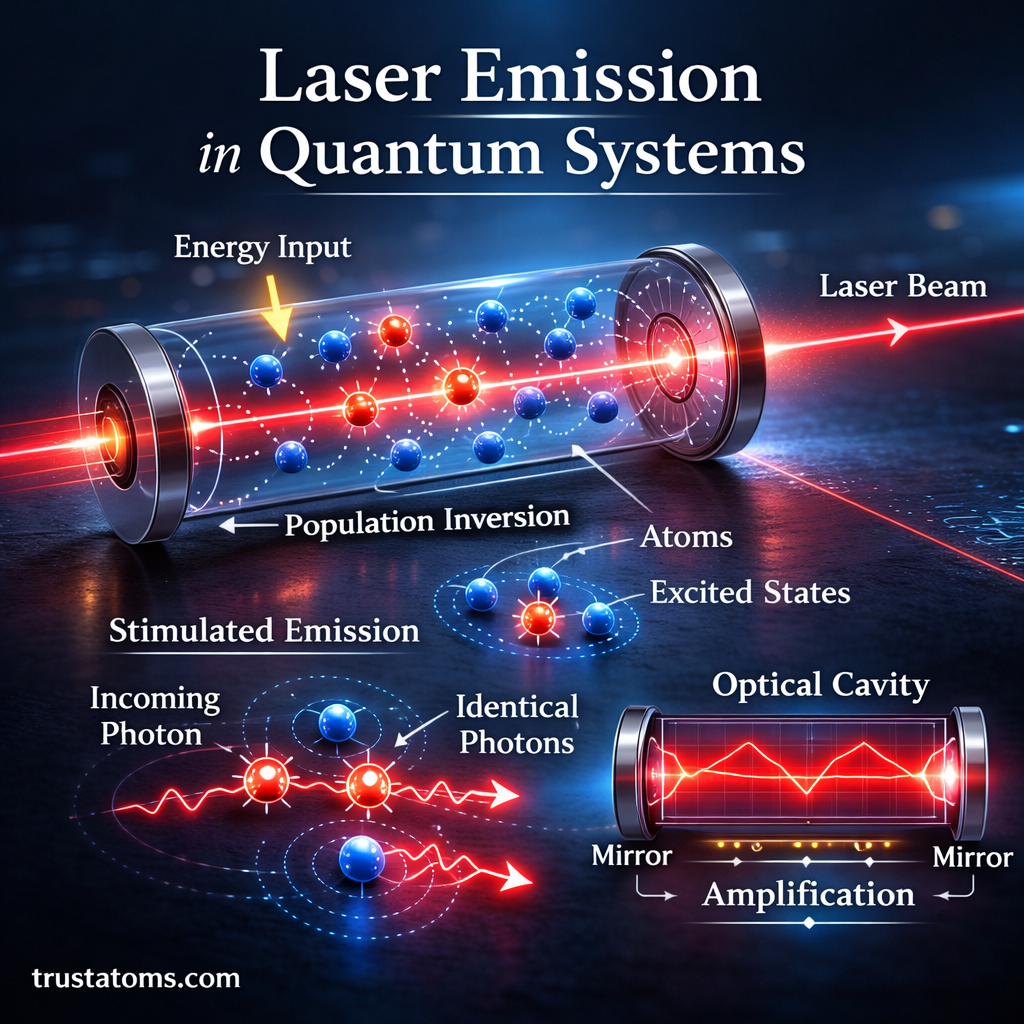
Scientific illustration of laser emission in a quantum system showing stimulated emission inside an optical cavity with a coherent laser beam.
Diagram illustrating stimulated emission, population inversion, and laser amplification inside a quantum optical cavity. trustatoms.com

Lasers are everywhere — in barcode scanners, fiber-optic communication, medical devices, manufacturing tools, and scientific research labs.

But behind every laser beam is a deeply quantum process.

Laser emission is not just bright light. It is a controlled release of energy from atoms and molecules governed by the rules of quantum mechanics. Understanding how lasers work requires exploring how electrons behave inside atoms — and how light itself can trigger more light.

In this guide, we’ll break down laser emission in quantum systems in clear, step-by-step terms.

Continue reading “Laser Emission in Quantum Systems”

Diffraction Patterns in Wave Optics

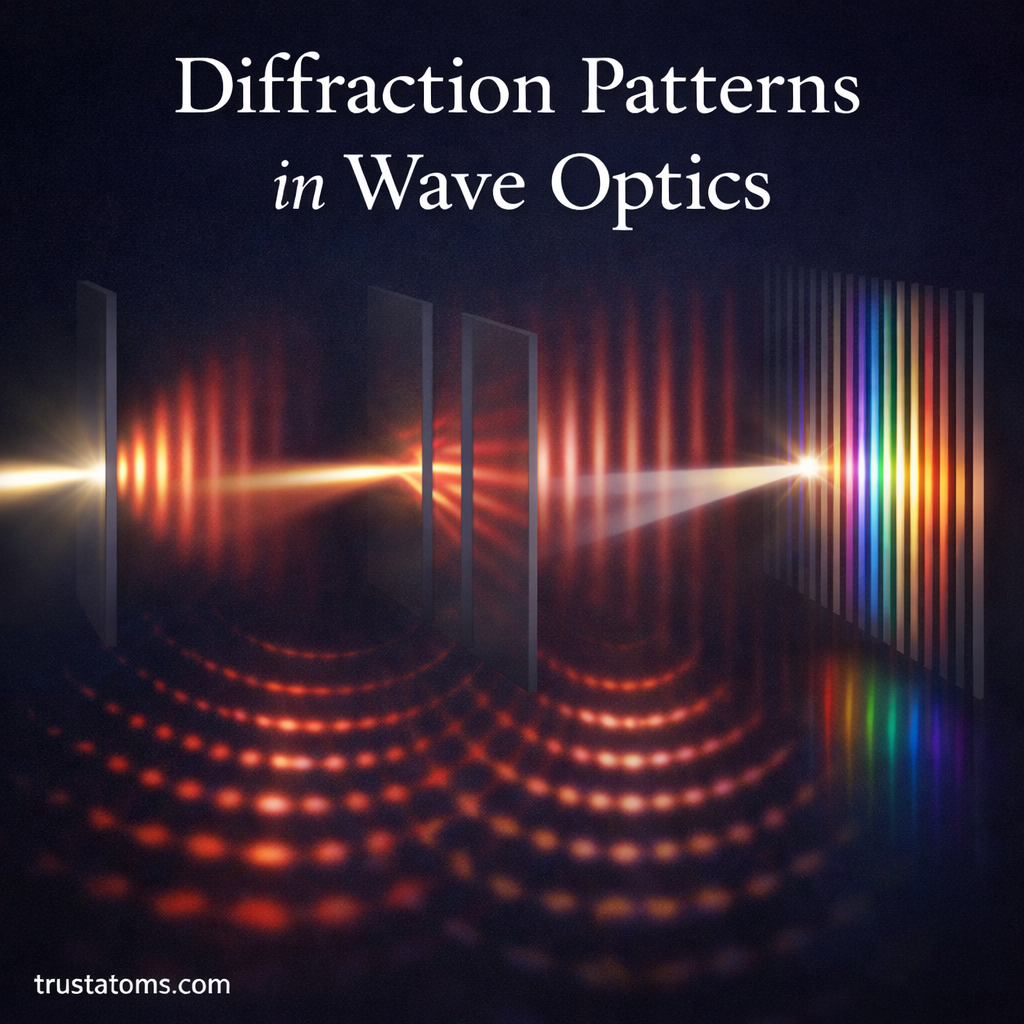
Illustration showing single-slit and double-slit diffraction patterns with light spreading and forming bright and dark fringes in wave optics.
Visualization of diffraction patterns formed when light passes through narrow slits and gratings. trustatoms.com

Light doesn’t always travel in perfectly straight lines.

When it encounters a narrow opening or passes by an edge, it spreads out. This spreading behavior is called diffraction, and the patterns it creates are known as diffraction patterns.

Diffraction is one of the clearest demonstrations that light behaves as a wave. It plays a central role in wave optics and helps explain phenomena seen in laboratories, telescopes, microscopes, and even everyday life.

In this guide, we’ll explore what diffraction patterns are, why they form, the types of diffraction, and how they’re used in science and technology.

Continue reading “Diffraction Patterns in Wave Optics”

Optical Refraction in Transparent Media

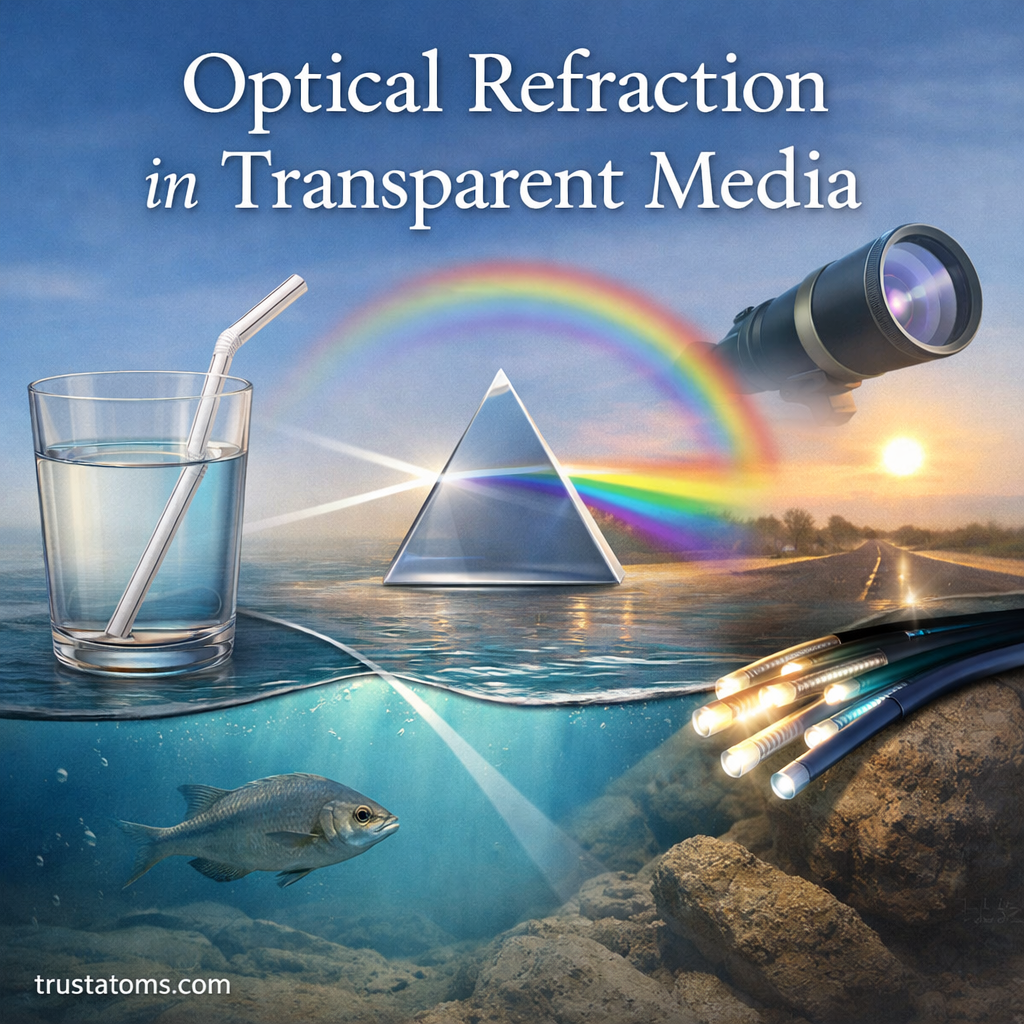
Optical refraction illustration showing light bending as it passes through water and a prism in transparent media with title overlay.
Illustration demonstrating how light bends when passing through transparent materials such as water and glass. trustatoms.com

Light appears simple — it lets us see. But when light passes through water, glass, or air, it doesn’t just travel straight. It bends. This bending of light is called optical refraction, and it’s one of the most important principles in physics.

From eyeglasses and microscopes to rainbows and fiber-optic cables, refraction plays a central role in how we understand and use light.

In this guide, we’ll break down what optical refraction is, why it happens, how to calculate it, and where it shows up in everyday life.

Continue reading “Optical Refraction in Transparent Media”

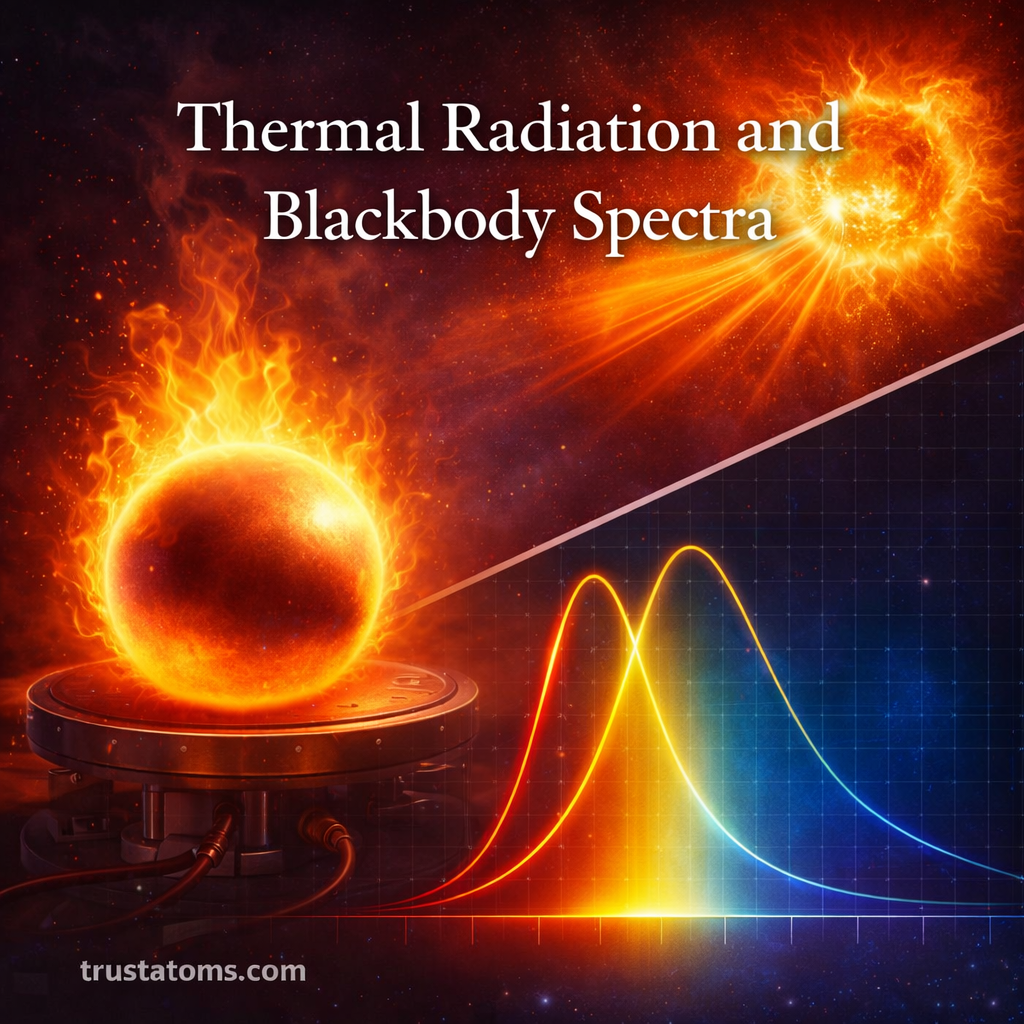
Thermal Radiation and Blackbody Spectra

Educational illustration showing a glowing heated sphere, the Sun emitting radiation, and a colorful blackbody spectrum curve representing thermal radiation intensity at different temperatures.
Objects emit thermal radiation based on temperature, producing characteristic blackbody spectra across wavelengths. trustatoms.com.

Every object around you is emitting radiation.

From a glowing stove burner to your own body, all matter with temperature above absolute zero releases electromagnetic energy. This emission is known as thermal radiation, and its behavior is described by the concept of a blackbody spectrum.

Understanding thermal radiation and blackbody spectra is fundamental in physics, astronomy, climate science, and modern technology.

In this guide, we’ll explore what thermal radiation is, what makes a perfect blackbody, and how temperature determines the color and intensity of emitted light.

Continue reading “Thermal Radiation and Blackbody Spectra”

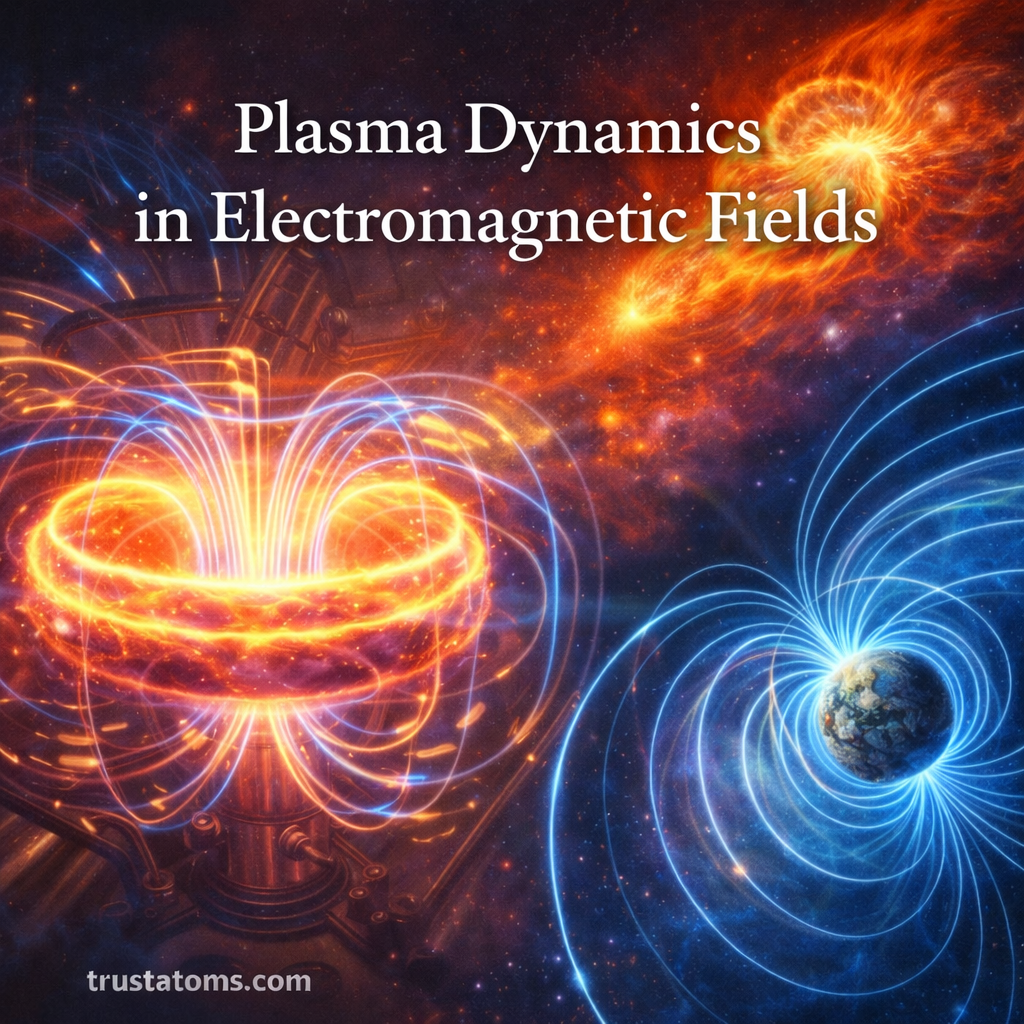
Plasma Dynamics in Electromagnetic Fields

Educational illustration showing plasma confined in a fusion reactor and solar plasma interacting with Earth’s magnetic field, representing plasma dynamics in electromagnetic fields.
Plasma motion is shaped by electric and magnetic fields, from fusion reactors to solar wind interacting with Earth’s magnetosphere. trustatoms.com.

Plasma is often called the fourth state of matter.

It makes up stars, solar flares, lightning, neon lights, and much of the visible universe. But unlike solids, liquids, and gases, plasma behaves very differently — especially when exposed to electric and magnetic fields.

Understanding plasma dynamics in electromagnetic fields is essential in astrophysics, fusion research, space science, and advanced engineering.

In this guide, we’ll explore how plasma forms, how it responds to electric and magnetic forces, and why its motion is so complex and powerful.

Continue reading “Plasma Dynamics in Electromagnetic Fields”

Viscosity and Shear Stress in Fluids

Educational split illustration showing honey flowing slowly, water pouring quickly, and blood moving through a vessel to demonstrate viscosity and shear stress in fluids.
Higher viscosity fluids resist motion more strongly, creating greater shear stress between moving layers. trustatoms.com.

Why does honey flow more slowly than water?
Why does oil behave differently at cold temperatures?
Why do some fluids resist motion while others move freely?

The answer lies in viscosity and shear stress — two core concepts in fluid mechanics that explain how fluids resist deformation and motion.

In this guide, we’ll break down what viscosity is, how shear stress works, the relationship between them, and why these ideas matter in physics, engineering, and everyday life.

Continue reading “Viscosity and Shear Stress in Fluids”