What Is the Schrödinger Equation?

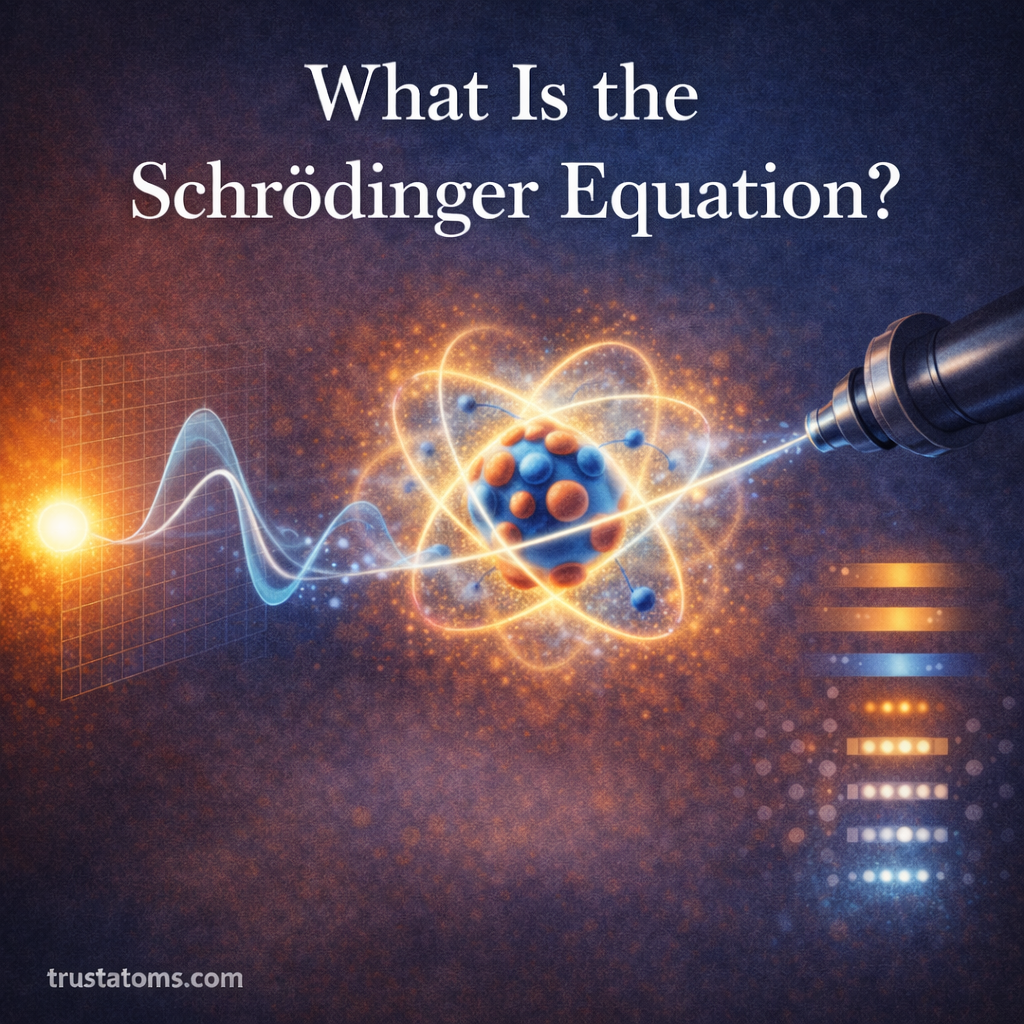
Illustration of an atom surrounded by a glowing probability cloud and wave pattern representing the Schrödinger equation, with the title “What Is the Schrödinger Equation?” and trustatoms.com watermark.
Conceptual illustration showing atomic probability clouds and wave behavior representing the Schrödinger equation in quantum mechanics. trustatoms.com

The Schrödinger equation is one of the most important equations in quantum mechanics. It describes how quantum systems — such as electrons, atoms, and molecules — behave over time.

In simple terms, the Schrödinger equation tells us how the wave function of a particle evolves. The wave function contains all the measurable information about a quantum system.

Just as Newton’s laws describe motion in classical physics, the Schrödinger equation describes motion at the atomic and subatomic scale.

Continue reading “What Is the Schrödinger Equation?”
What Is Wave–Particle Duality?

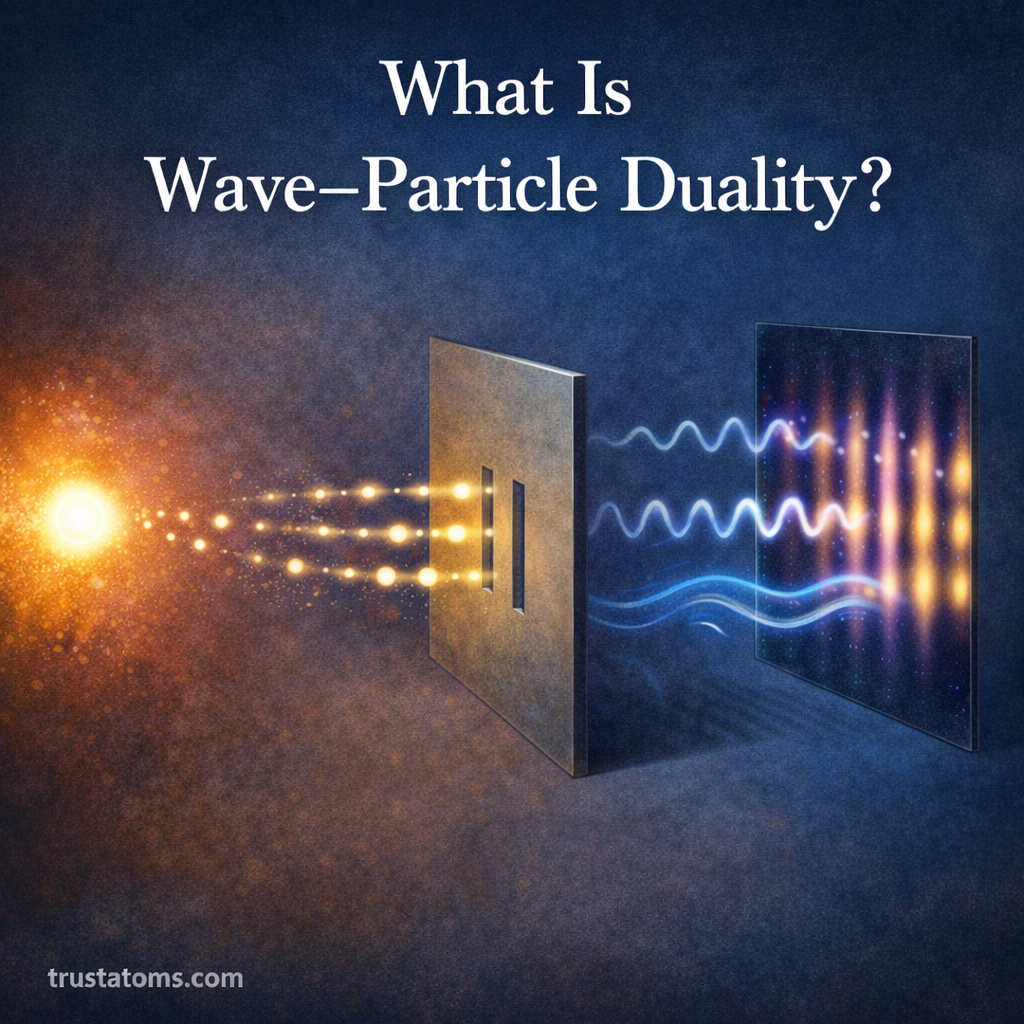
Illustration of the double-slit experiment showing particles passing through slits and forming a wave interference pattern with the title “What Is Wave–Particle Duality?” and trustatoms.com watermark.
Conceptual illustration of wave–particle duality showing particle paths and wave interference behavior in a double-slit experiment. trustatoms.com

Wave–particle duality is a fundamental concept in quantum physics stating that light and matter can behave both like waves and like particles.

In everyday life, waves and particles seem completely different. Water waves spread out and interfere. Particles like baseballs move along clear paths. But at the atomic and subatomic scale, nature does not follow our everyday intuition.

Wave–particle duality shows that light and tiny particles such as electrons do not fit neatly into one category.

Continue reading “What Is Wave–Particle Duality?”

What Is Radioactive Decay?

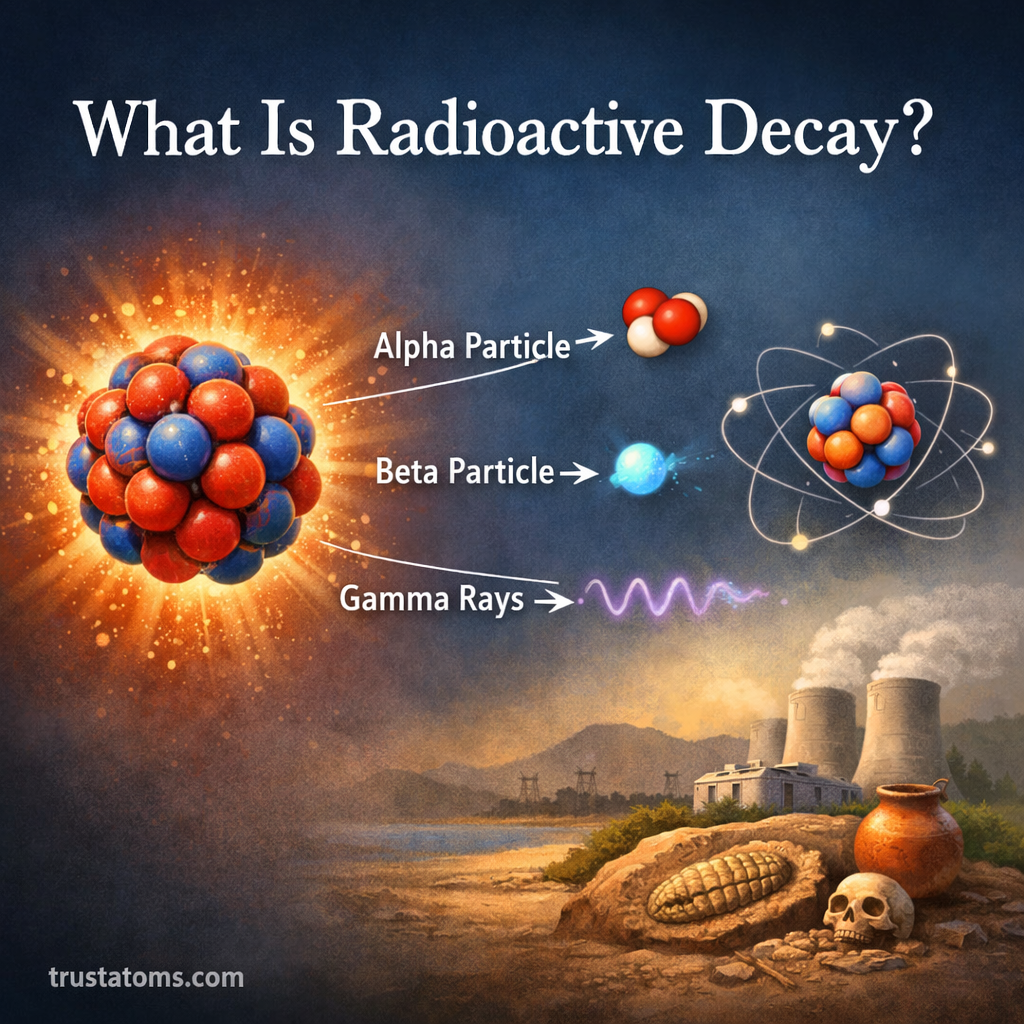
Contextual illustration showing an unstable atomic nucleus emitting alpha, beta, and gamma radiation with the title “What Is Radioactive Decay?” and trustatoms.com watermark.
Illustration explaining how unstable atomic nuclei release alpha, beta, and gamma radiation during radioactive decay. trustatoms.com

Radioactive decay is a natural process where an unstable atomic nucleus releases energy by emitting radiation. Over time, this process transforms the original atom into a different element or a more stable form of the same element.

Radioactive decay happens spontaneously. It does not require heat, pressure, or chemical reactions. It is driven entirely by the internal structure of the atom’s nucleus.

Understanding radioactive decay is essential in physics, nuclear energy, medicine, geology, and even archaeology.

Continue reading “What Is Radioactive Decay?”

What Is Nuclear Energy?

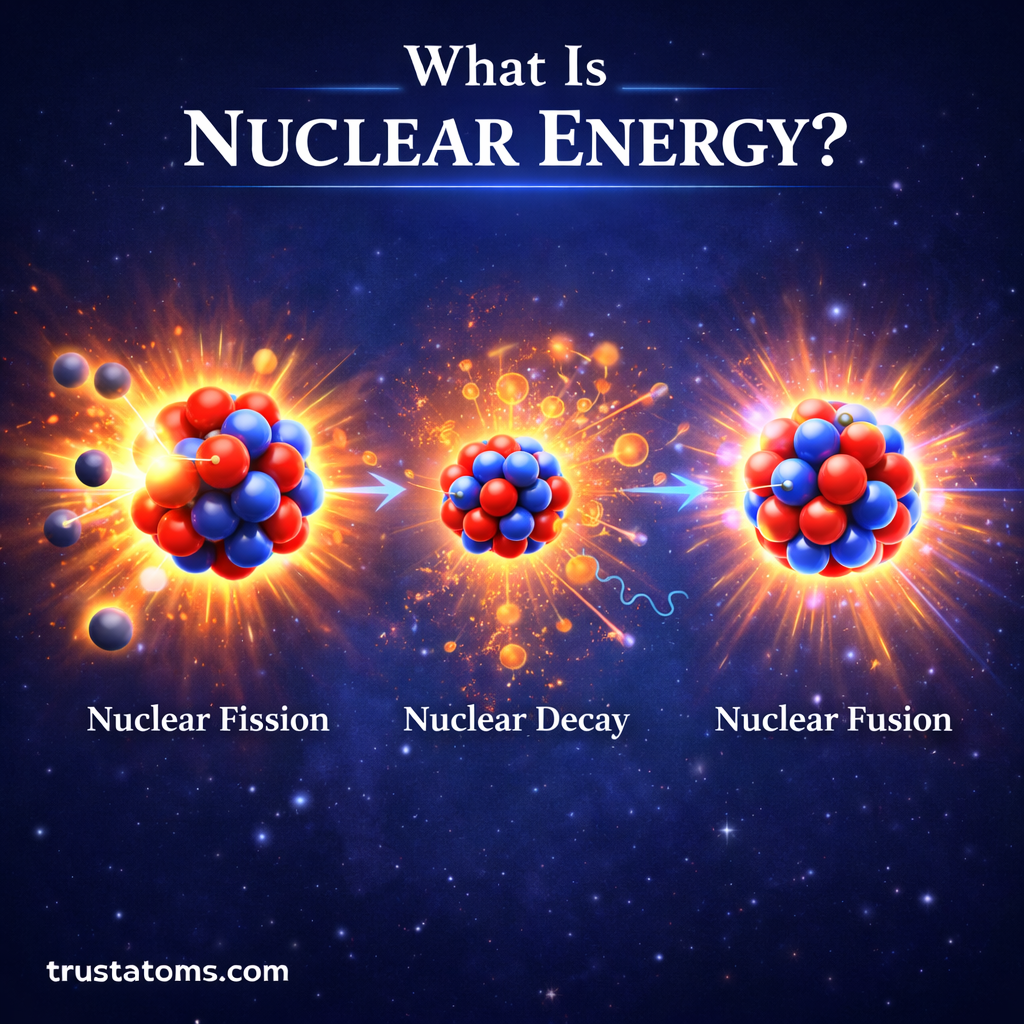
Illustration showing nuclear fission, radioactive decay, and nuclear fusion processes with atomic nuclei releasing energy.
Visual overview of nuclear energy through fission, decay, and fusion processes. trustatoms.com

Nuclear energy is the energy stored in the nucleus of an atom. It is released when atomic nuclei change through processes such as fission, fusion, or radioactive decay.

Unlike chemical energy — which comes from electron interactions — nuclear energy comes from changes inside the atom’s core. Because the nucleus holds enormous binding energy, even small changes can release massive amounts of power.

Nuclear energy plays a major role in electricity generation, medicine, and scientific research.

Continue reading “What Is Nuclear Energy?”

What Is Atomic Structure?

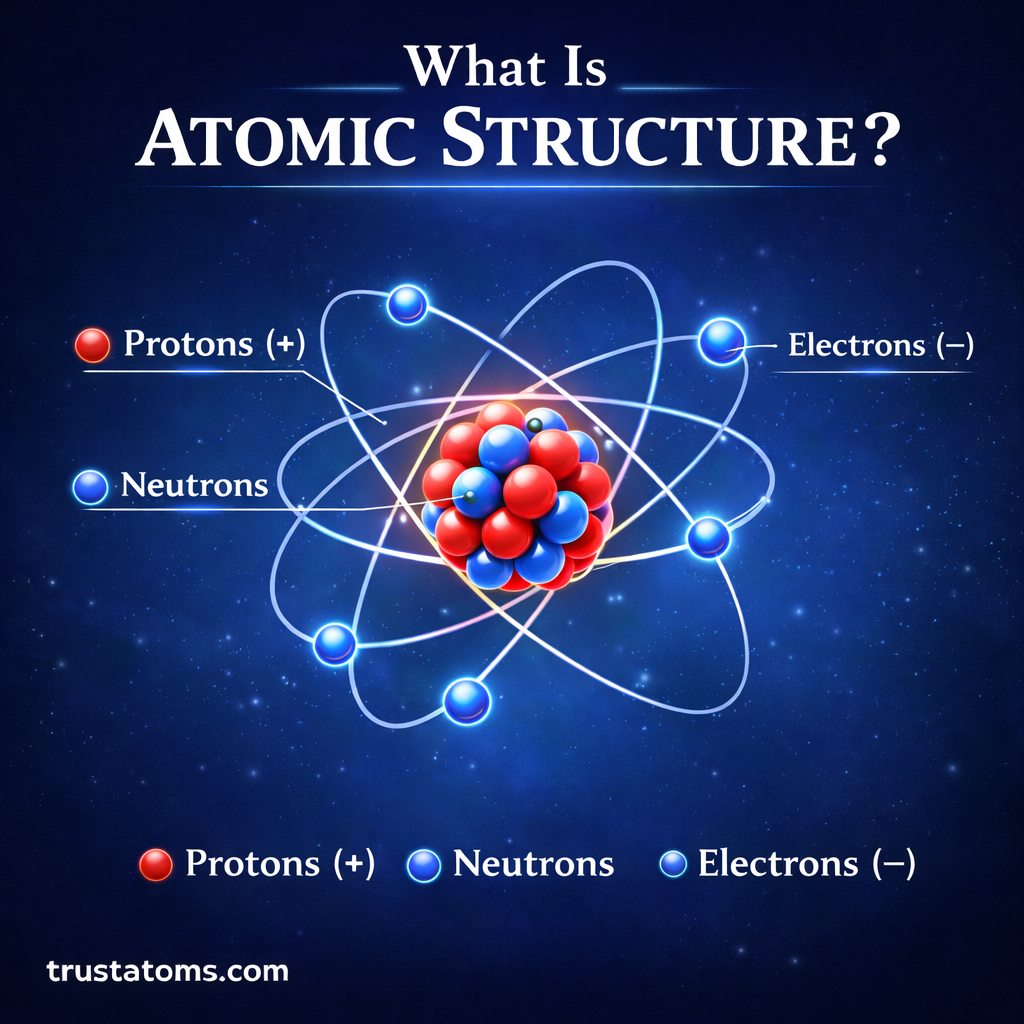
Simple atomic structure diagram showing a nucleus with protons and neutrons and electrons orbiting around it on a dark blue background.
Simple diagram illustrating the basic structure of an atom with protons, neutrons, and electrons. trustatoms.com

Atomic structure refers to the arrangement of particles inside an atom. It explains how protons, neutrons, and electrons are organized and how they determine the properties of elements.

Everything around you — air, water, metals, living organisms — is made of atoms. Understanding atomic structure is key to understanding chemistry, electricity, radiation, and even modern technology.

Atomic structure forms one of the foundations of physics.

Continue reading “What Is Atomic Structure?”

What Is the Speed of Light?

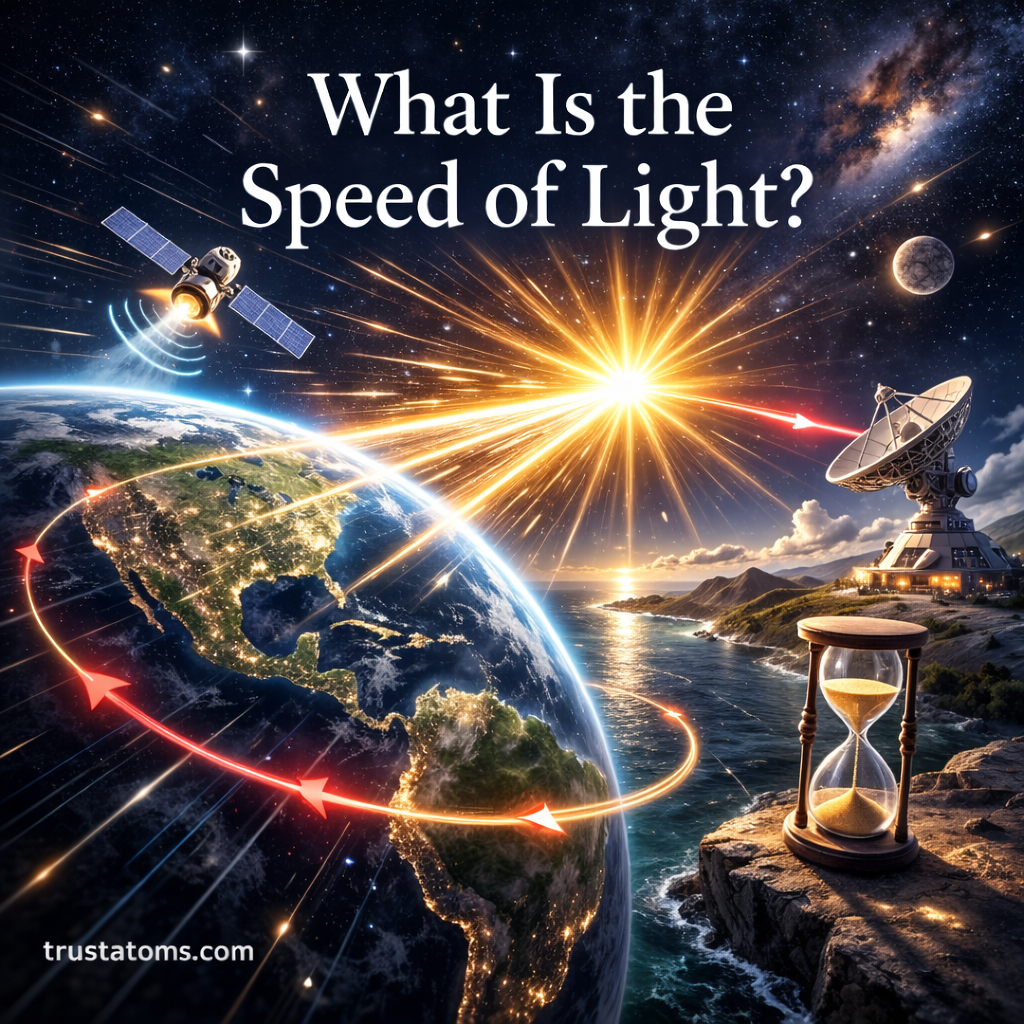
Illustration showing a bright beam of light traveling through space past Earth, satellites, and a radio telescope representing the speed of light.
Conceptual visualization of the speed of light traveling through space and connecting Earth with distant objects. trustatoms.com

The speed of light is one of the most important constants in physics. It represents the maximum speed at which energy, information, and matter can travel in the universe.

In a vacuum, light travels at approximately:

299,792,458 meters per second

That’s about 300,000 kilometers per second or 186,282 miles per second.

To put that into perspective, light can travel around the Earth more than seven times in just one second.

Continue reading “What Is the Speed of Light?”

What Is Time Dilation?

Illustration showing a fast-moving rocket, clocks ticking at different rates, an astronaut, and curved spacetime around Earth representing time dilation.
Conceptual visualization of time dilation caused by high speed and gravity. trustatoms.com

Time dilation is a phenomenon in physics where time passes at different rates depending on speed or gravity.

In everyday life, time feels constant. A second is always a second. But according to modern physics, time is not absolute. Under certain conditions — especially at very high speeds or near massive objects — time can slow down.

Time dilation is a key prediction of relativity and has been confirmed through experiments.

Continue reading “What Is Time Dilation?”

What Is Relativity?

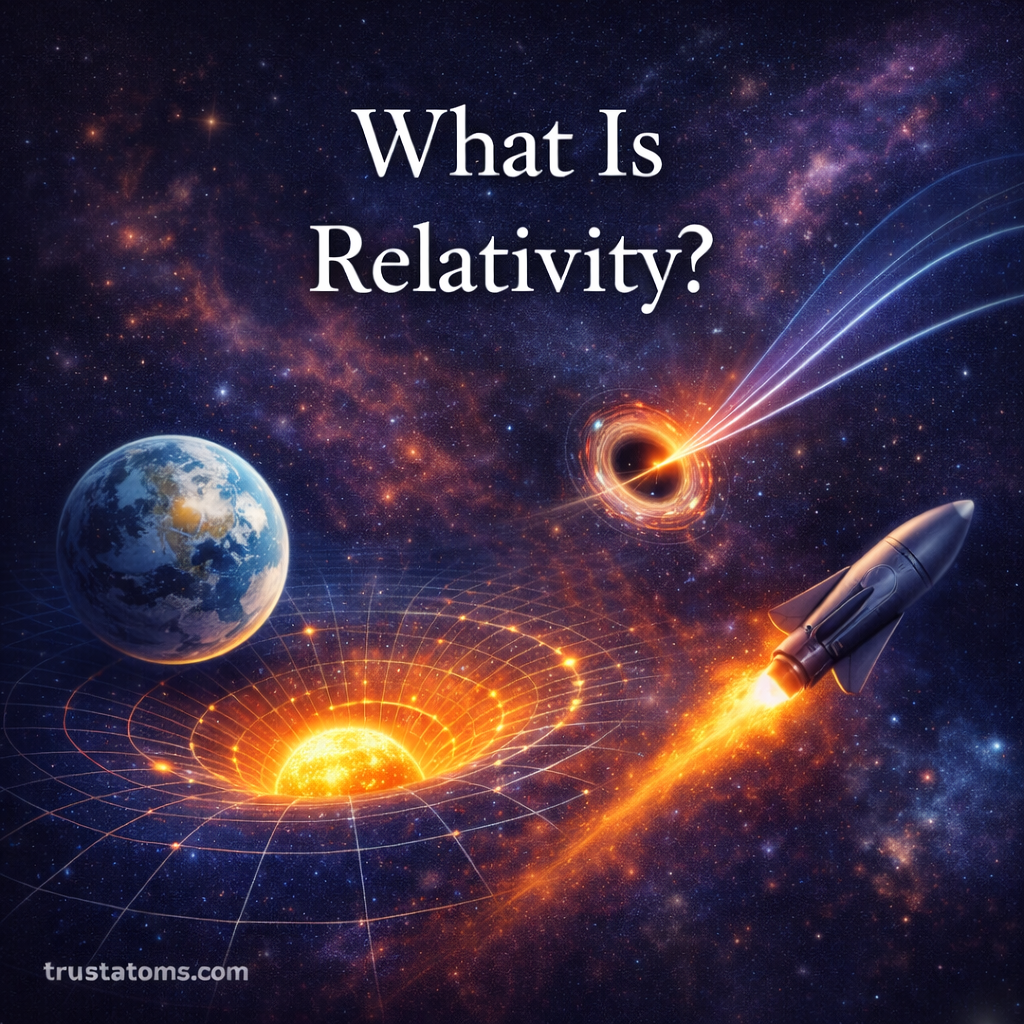
Illustration of spacetime curvature around a massive object with Earth, a rocket, and a black hole representing relativity in physics.
Visual representation of relativity showing spacetime curvature, gravity, and motion in space. trustatoms.com

Relativity is a theory in physics that explains how space, time, gravity, and motion are connected. Developed in the early 20th century, it transformed our understanding of the universe.

Relativity shows that time is not universal, space can curve, and gravity is not simply a force pulling objects together — it is the result of spacetime bending.

There are two main parts of relativity:

  1. Special Relativity
  2. General Relativity

Together, they describe how the universe behaves at very high speeds and in strong gravitational fields.

Continue reading “What Is Relativity?”

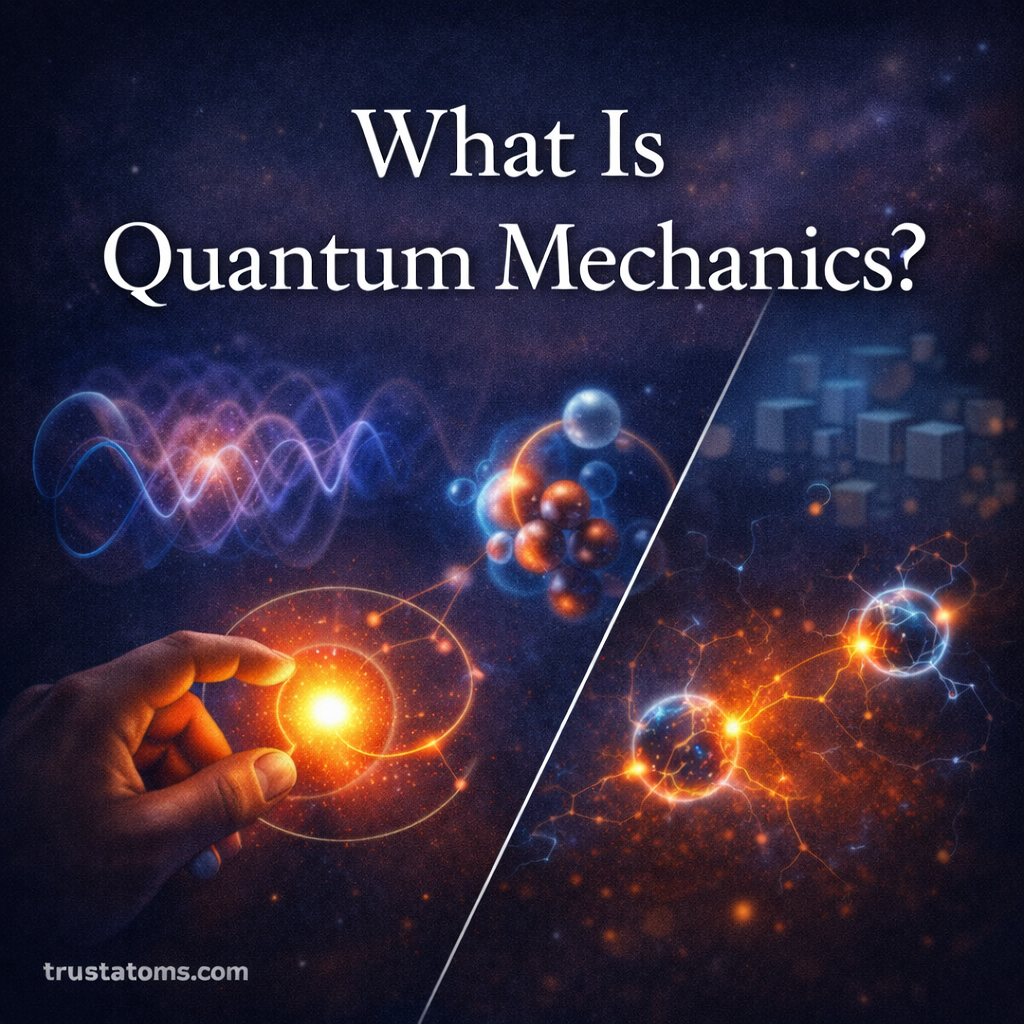
What Is Quantum Mechanics?

Illustration representing quantum mechanics with glowing particles, wave patterns, atomic structures, and entangled particles in a space-like background.
Conceptual visualization of quantum mechanics showing wave–particle duality and entanglement. trustatoms.com

Quantum mechanics is the branch of physics that explains how matter and energy behave at the smallest scales — atoms, electrons, photons, and other subatomic particles.

While classical physics describes everyday objects like cars and planets, quantum mechanics governs the strange and fascinating world of the microscopic.

It is one of the most successful scientific theories ever developed, forming the foundation of modern electronics, chemistry, and even emerging technologies like quantum computing.

Continue reading “What Is Quantum Mechanics?”

What Is Inductance?

Illustration of a copper coil generating a magnetic field alongside a transformer and wireless charging pad representing inductance in physics.
Visual explanation of inductance showing magnetic fields created by a coil and real-world applications. trustatoms.com

Inductance is a fundamental concept in physics that explains how electrical energy can be stored in a magnetic field. It plays a central role in circuits, power systems, motors, transformers, and wireless charging technologies.

In simple terms, inductance describes how a conductor resists changes in electric current by generating a magnetic field.

This guide explains what inductance is, how it works, the formula behind it, and why it matters in real-world applications.

Continue reading “What Is Inductance?”