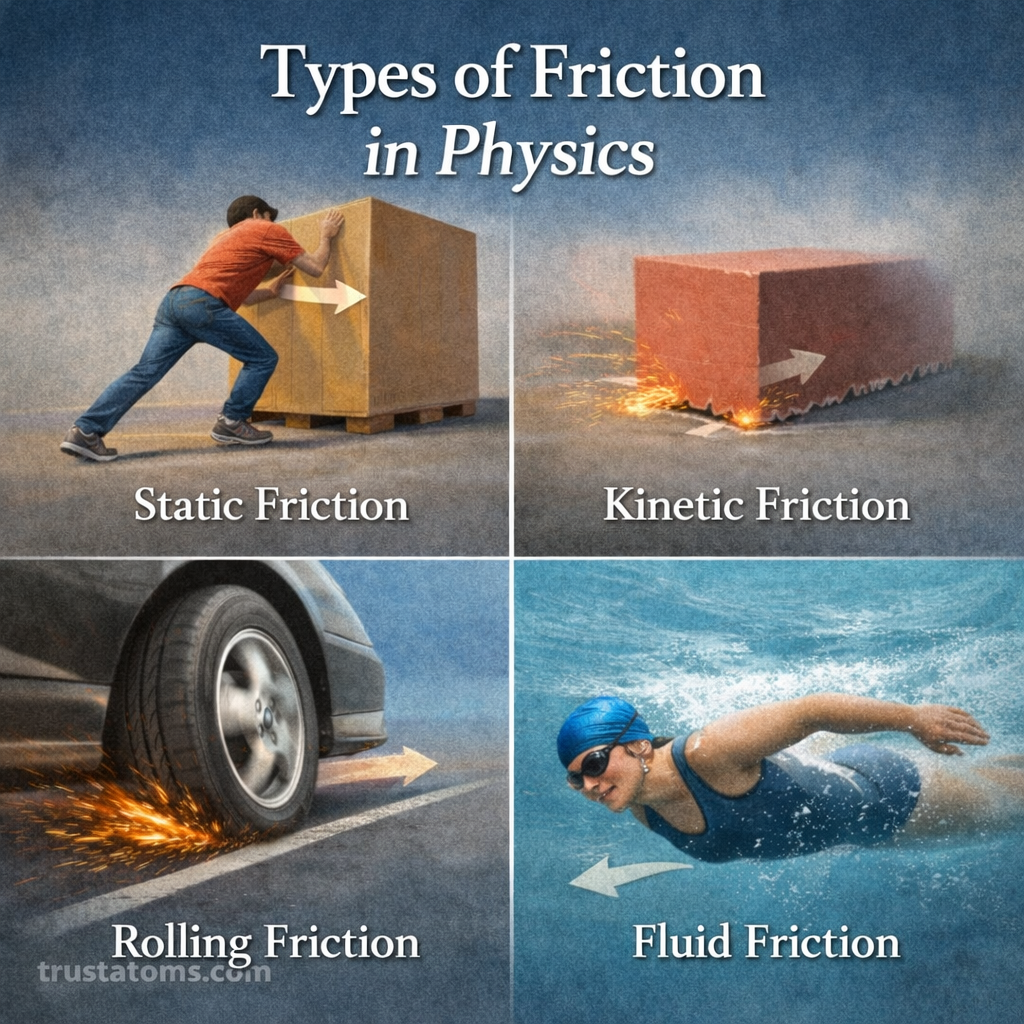
Types of Friction in Physics

Educational illustration showing static friction, kinetic friction, rolling friction, and fluid friction with real-world examples and the title “Types of Friction in Physics,” including trustatoms.com watermark.
Visual overview of the four main types of friction in physics. trustatoms.com

Friction is one of the most important forces in physics. It affects how we walk, drive, write, and even how machines operate.

But friction is not just one single force — it comes in different forms depending on how objects interact.

In this guide, you’ll learn:

  • The main types of friction
  • How each type works
  • Real-world examples
  • How they compare to one another
  • Why understanding friction matters
Continue reading “Types of Friction in Physics”

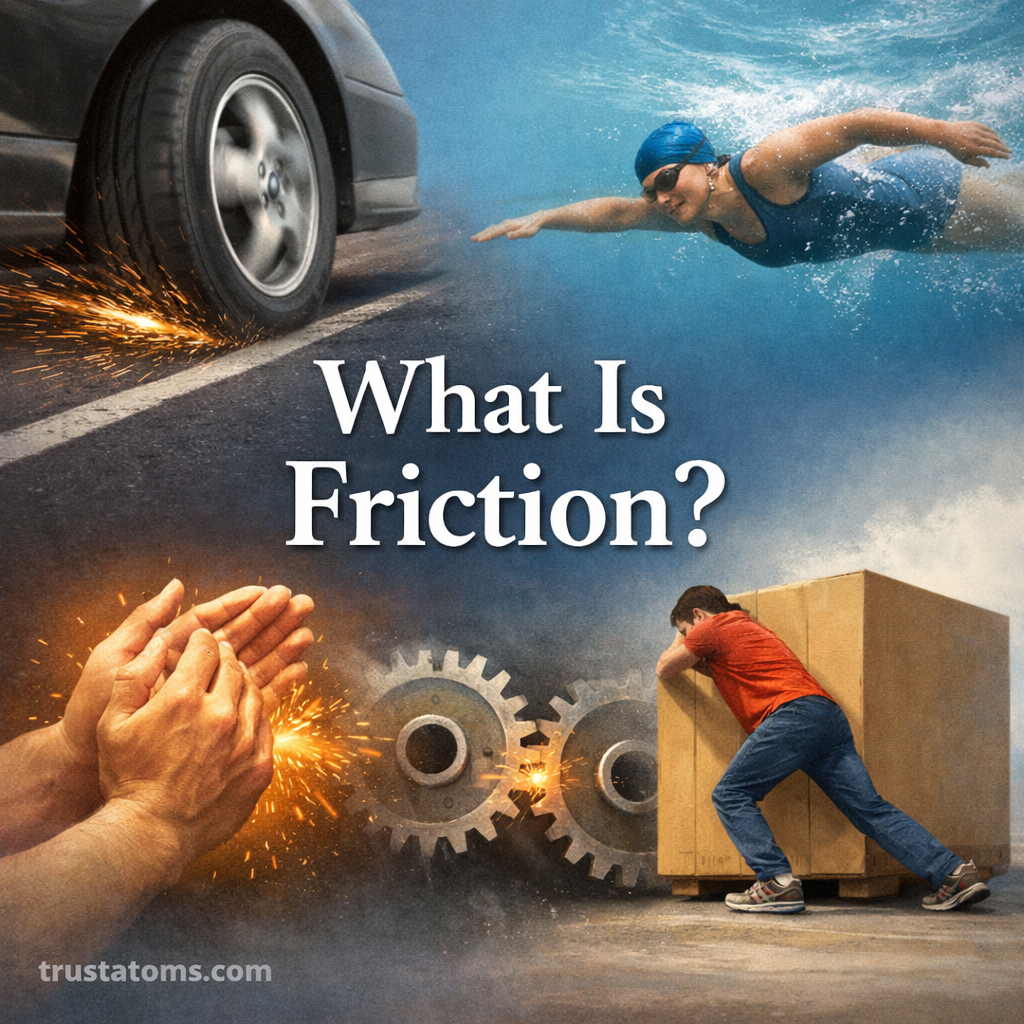
What Is Friction?

Contextual illustration showing examples of friction including a car tire on pavement, a swimmer moving through water, hands rubbing together, and a person pushing a box, with the title “What Is Friction?” and trustatoms.com watermark.
Illustration showing real-world examples of friction in everyday life. trustatoms.com

Friction is a force that resists motion when two surfaces come into contact.

Any time you slide a book across a table, walk across the floor, or drive a car down the road, friction is involved. Without friction, movement would be nearly impossible to control.

In this guide, you’ll learn:

  • What friction is
  • Why friction happens
  • The different types of friction
  • The friction formula
  • Real-world examples
  • Why friction is both useful and problematic
Continue reading “What Is Friction?”

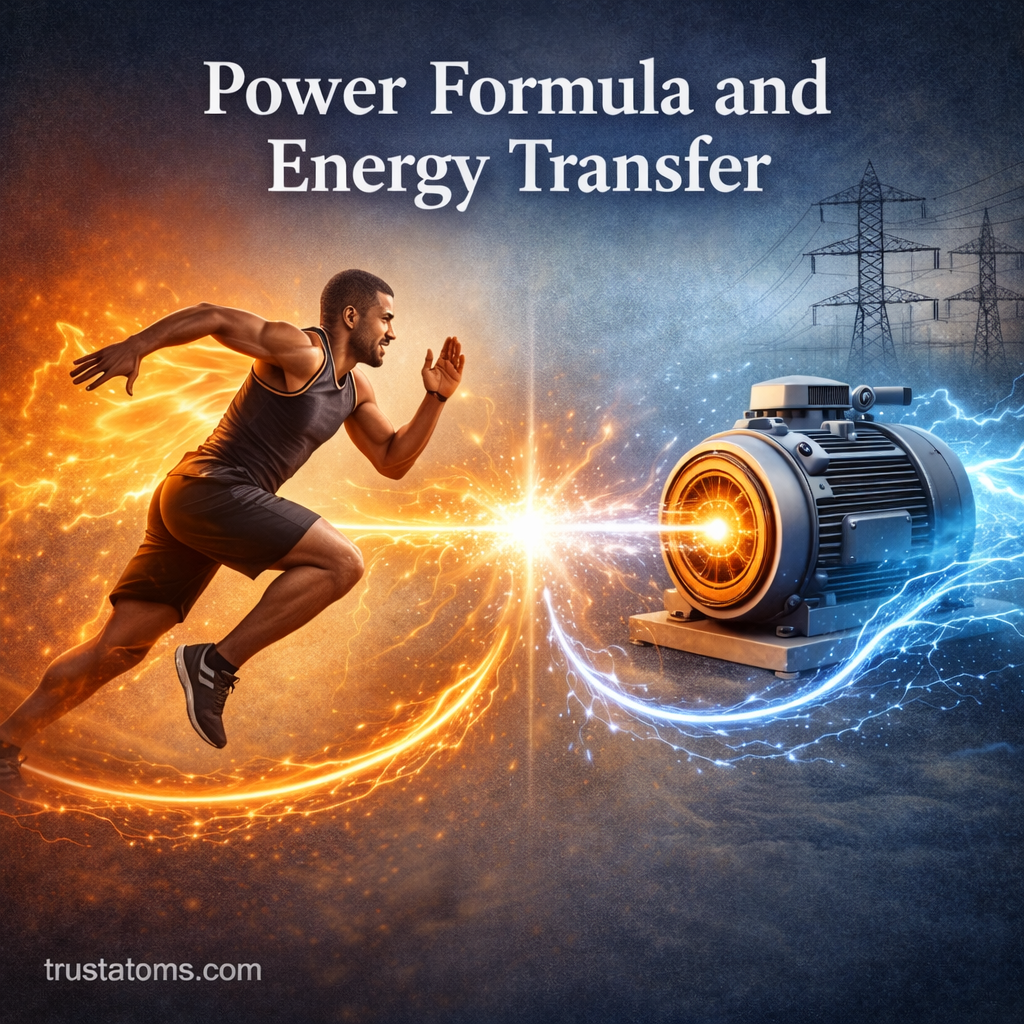
Power Formula and Energy Transfer

Illustration showing a sprinter and an industrial motor connected by flowing energy, representing power and energy transfer in physics.
Human effort and mechanical systems compared to illustrate how energy transfer determines power. trustatoms.com

Power and energy are deeply connected in physics.

Whenever energy moves from one place to another — whether in a light bulb, a car engine, or your own muscles — power tells us how fast that transfer happens.

Understanding the power formula helps explain how machines work, why devices heat up, and how efficiently systems use energy.

Continue reading “Power Formula and Energy Transfer”

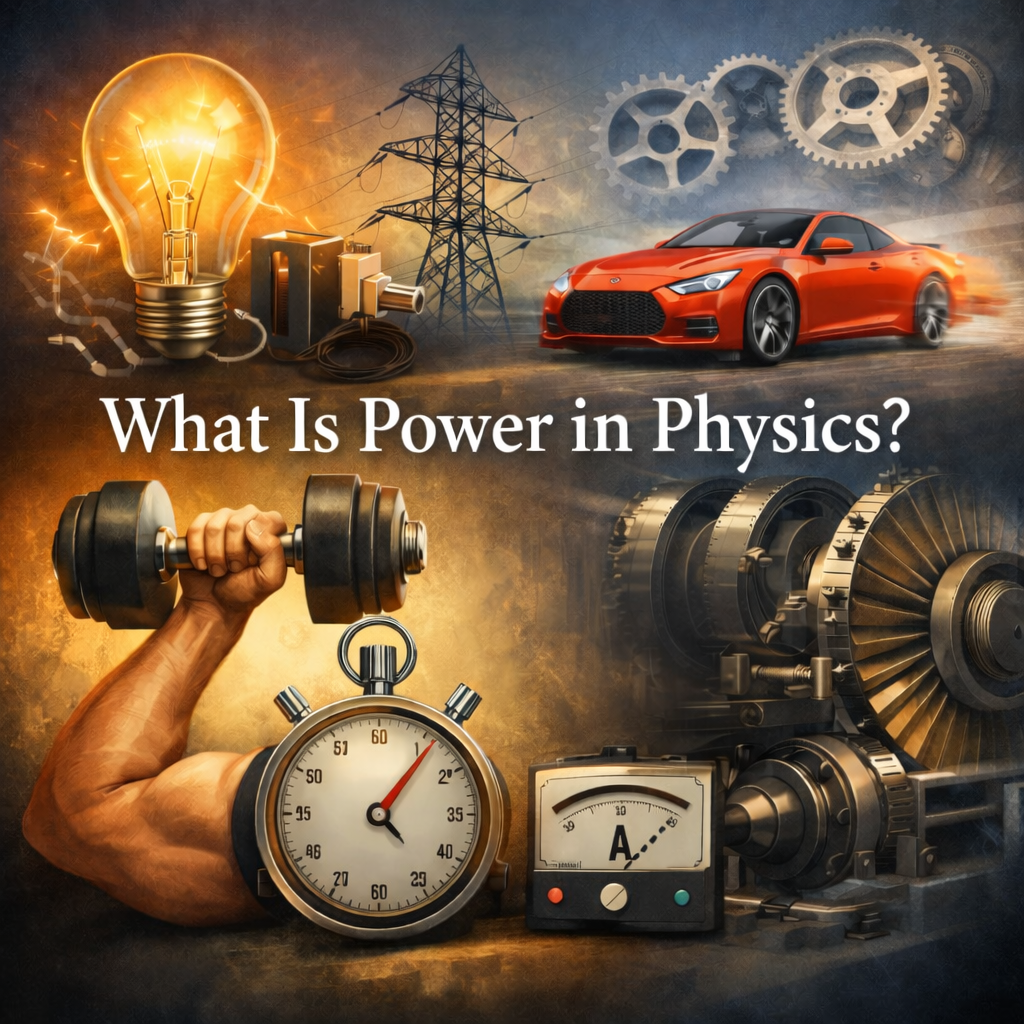
What Is Power in Physics?

Educational illustration explaining power in physics with light bulb, power lines, red sports car, dumbbell, stopwatch, turbine engine, and trustatoms.com watermark.
Illustration representing power in physics through motion, electricity, machinery, and time. trustatoms.com.

Power is one of the most important concepts in physics — and one of the most misunderstood.

When people hear the word “power,” they often think of strength or force. But in physics, power has a very specific meaning. It describes how fast work is done or energy is transferred.

Understanding power helps explain everything from how engines work to how quickly your phone charges.

Continue reading “What Is Power in Physics?”

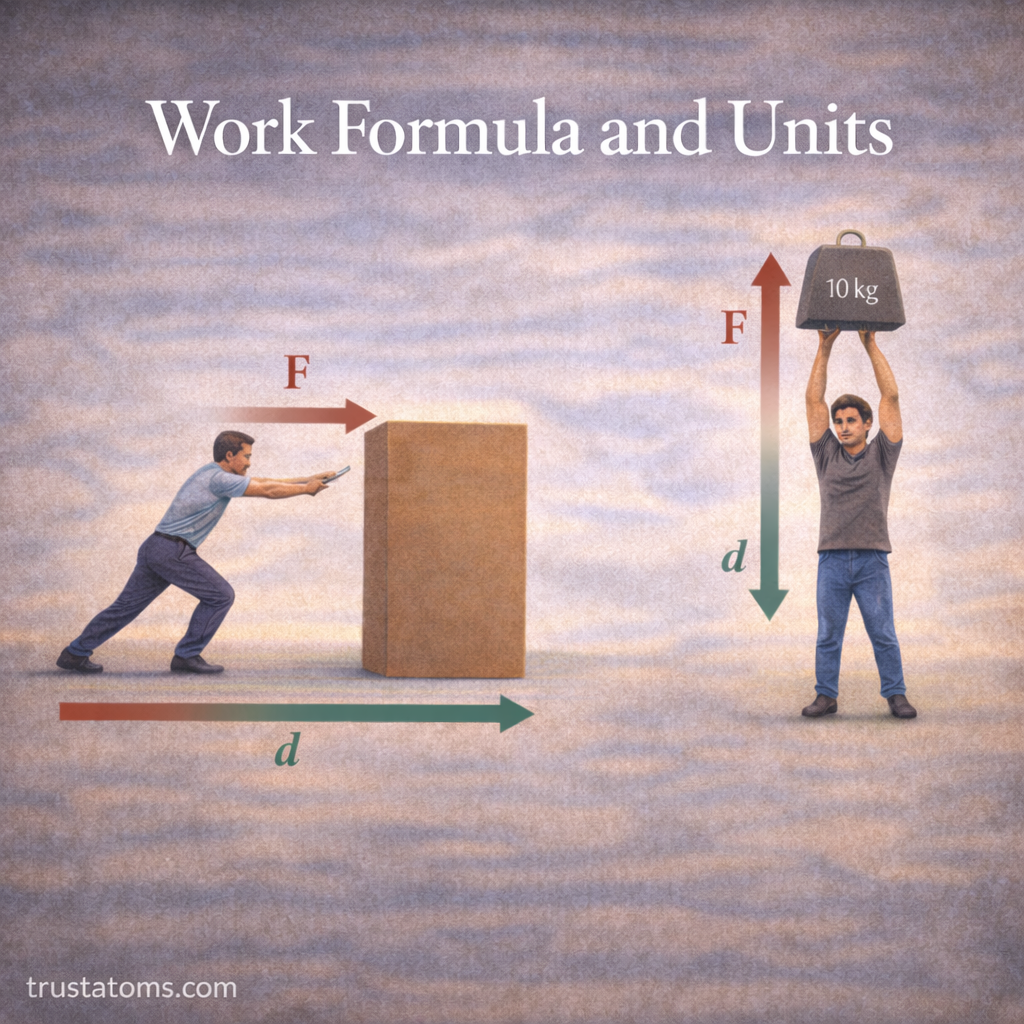
Work Formula and Units

Illustration showing examples of work in physics with a man pushing a box and another lifting a weight, demonstrating force and motion, trustatoms.com.
Work in physics illustrated through pushing and lifting examples, trustatoms.com.

In physics, work has a precise definition. It doesn’t simply mean effort — it refers to energy transferred when a force causes an object to move.

Understanding the work formula and its units is essential for mastering mechanics, energy, and motion.

In this guide, you’ll learn:

  • The work formula
  • The full equation with angles
  • The SI units of work
  • Step-by-step calculation examples
  • How work connects to energy
Continue reading “Work Formula and Units”

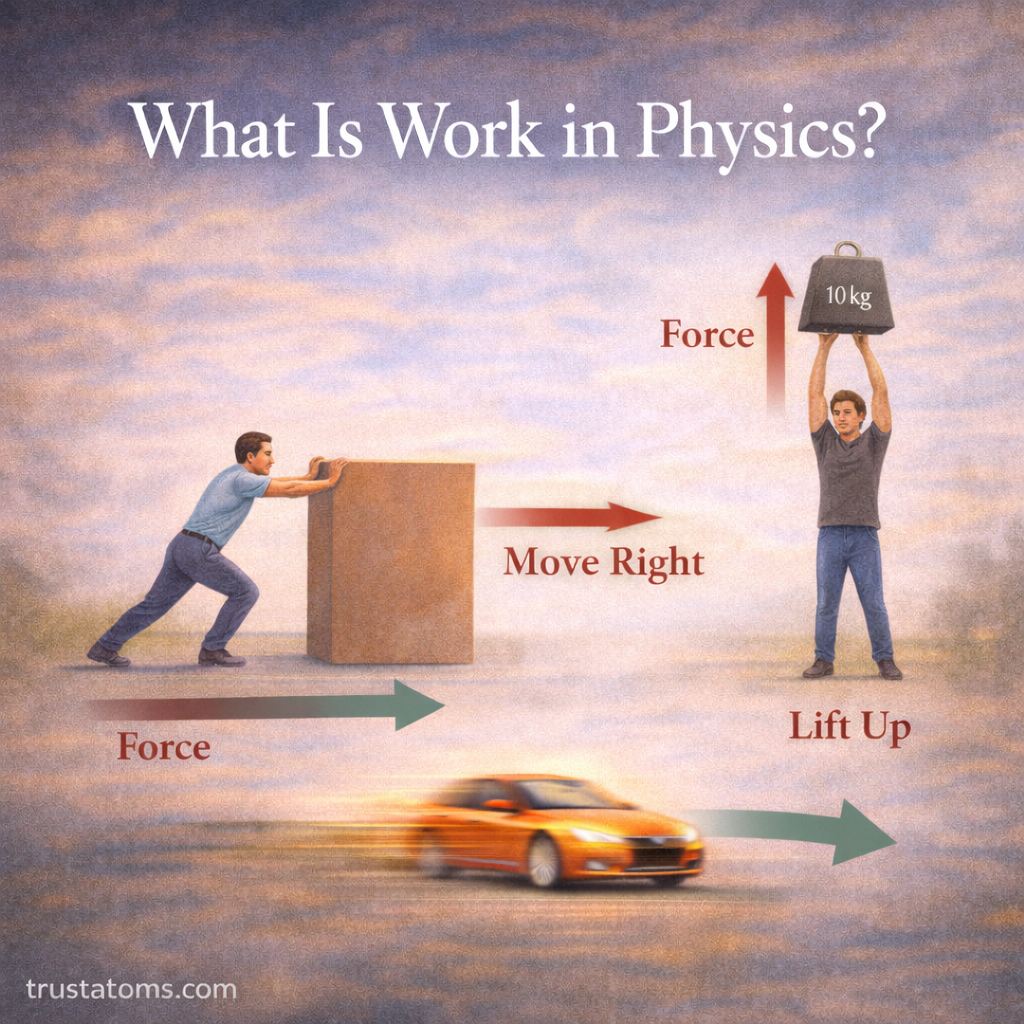
What Is Work in Physics?

Educational physics illustration showing examples of work including pushing a box, lifting a 10 kg weight, and a moving car with force arrows.
Illustration explaining the concept of work in physics using force and motion examples. trustatoms.com

In everyday language, “work” means effort. In physics, work has a very specific meaning.

Work happens only when a force causes an object to move.

If there is no movement, no work is done — no matter how tired you feel.

In this guide, you’ll learn:

  • The definition of work in physics
  • The work formula
  • How to calculate work step by step
  • Real-world examples
  • The connection between work and energy
Continue reading “What Is Work in Physics?”

Law of Conservation of Energy Explained

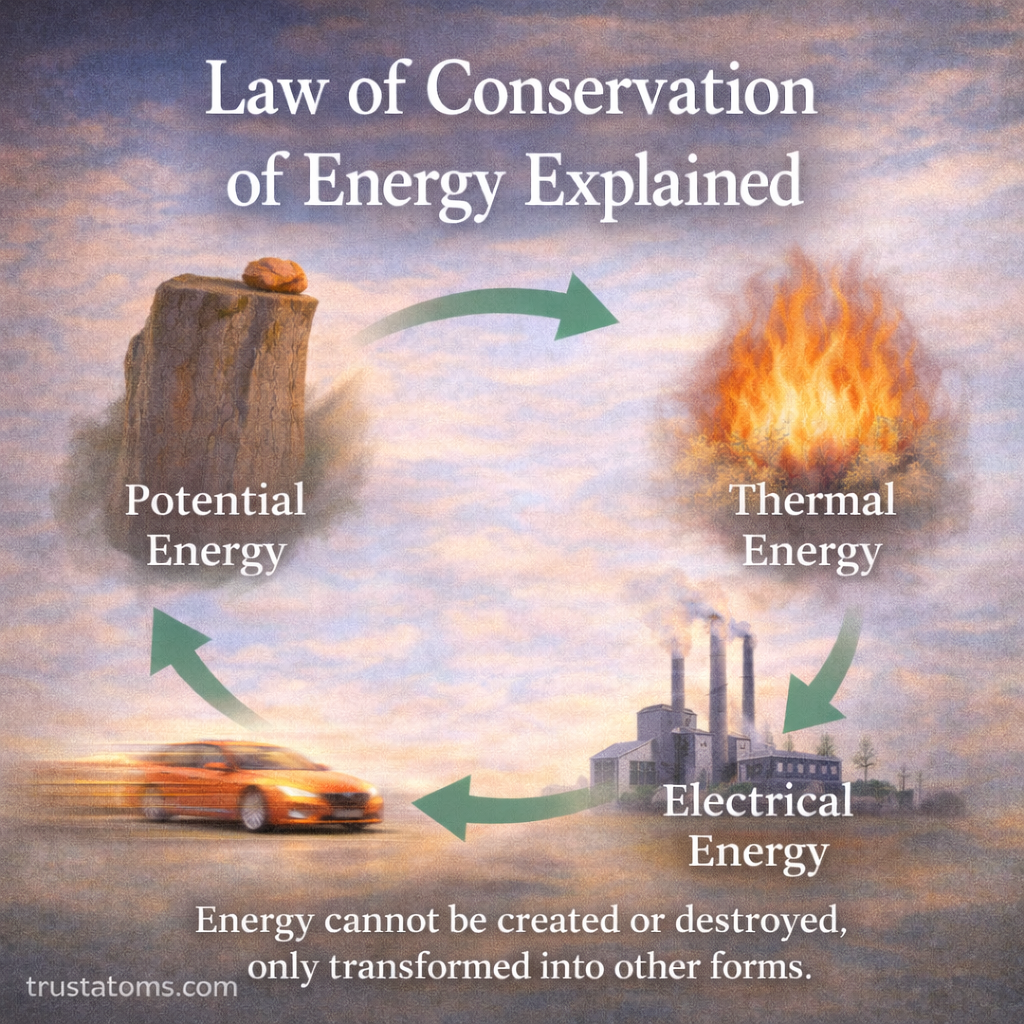
Educational physics illustration showing transformation between potential, kinetic, thermal, and electrical energy in a conservation cycle.
Illustration explaining how energy transforms between different forms while remaining conserved. trustatoms.com

Energy powers everything — from moving cars to shining stars. But one of the most important principles in physics tells us something surprising:

Energy cannot be created or destroyed.

This idea is known as the Law of Conservation of Energy. It is one of the most fundamental laws in science and applies to every physical system.

In this guide, you’ll learn:

  • What the law states
  • How it works mathematically
  • Real-world examples
  • How it connects to kinetic and potential energy
  • Why it matters in physics and engineering
Continue reading “Law of Conservation of Energy Explained”

Potential vs Kinetic Energy

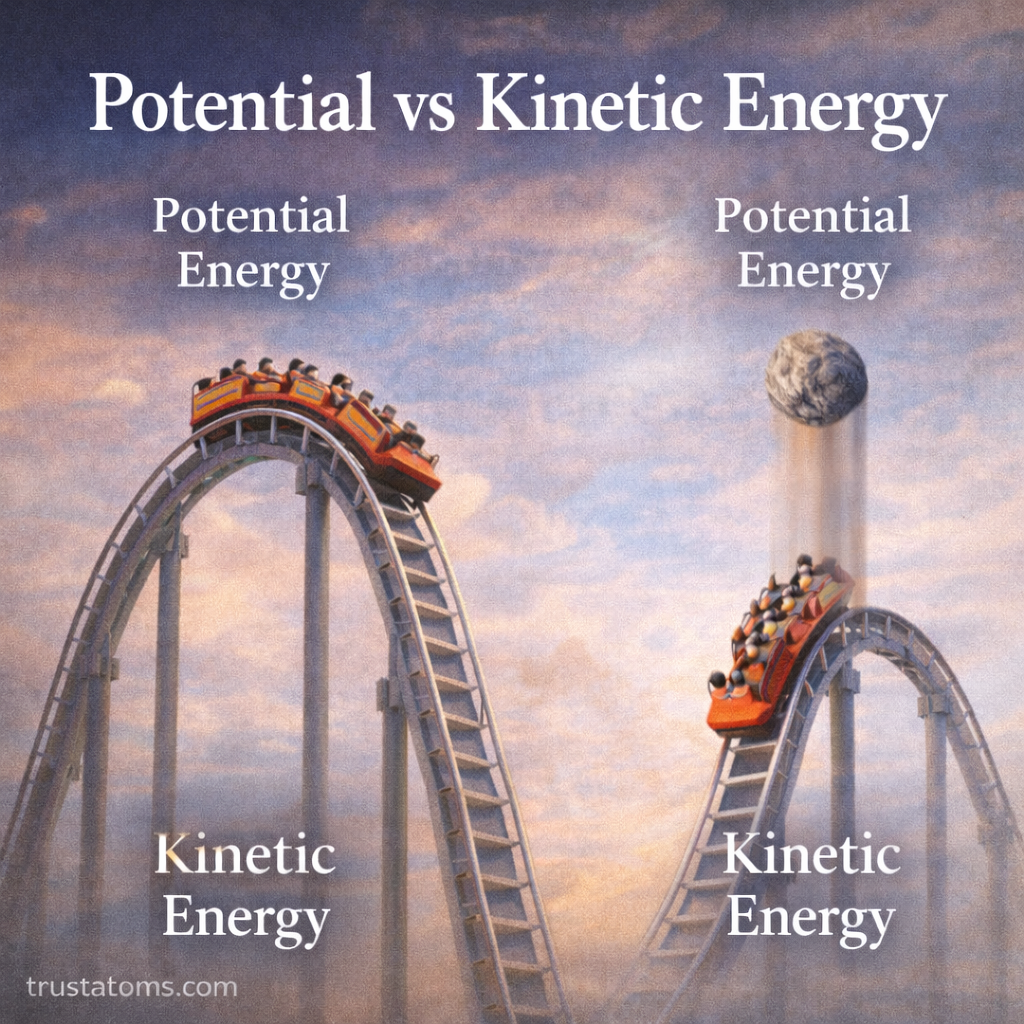
Educational illustration comparing potential and kinetic energy using a roller coaster at the top and bottom of a hill.
Illustration showing the difference between potential and kinetic energy during motion. trustatoms.com

Energy is the ability to do work. In physics, two of the most important forms of energy are potential energy and kinetic energy.

Understanding the difference between them helps explain how roller coasters move, how batteries power devices, and how objects fall.

In this guide, you’ll learn:

  • What potential energy is
  • What kinetic energy is
  • The formulas for each
  • The key differences
  • How they transform into each other
Continue reading “Potential vs Kinetic Energy”

What Is Potential Energy?

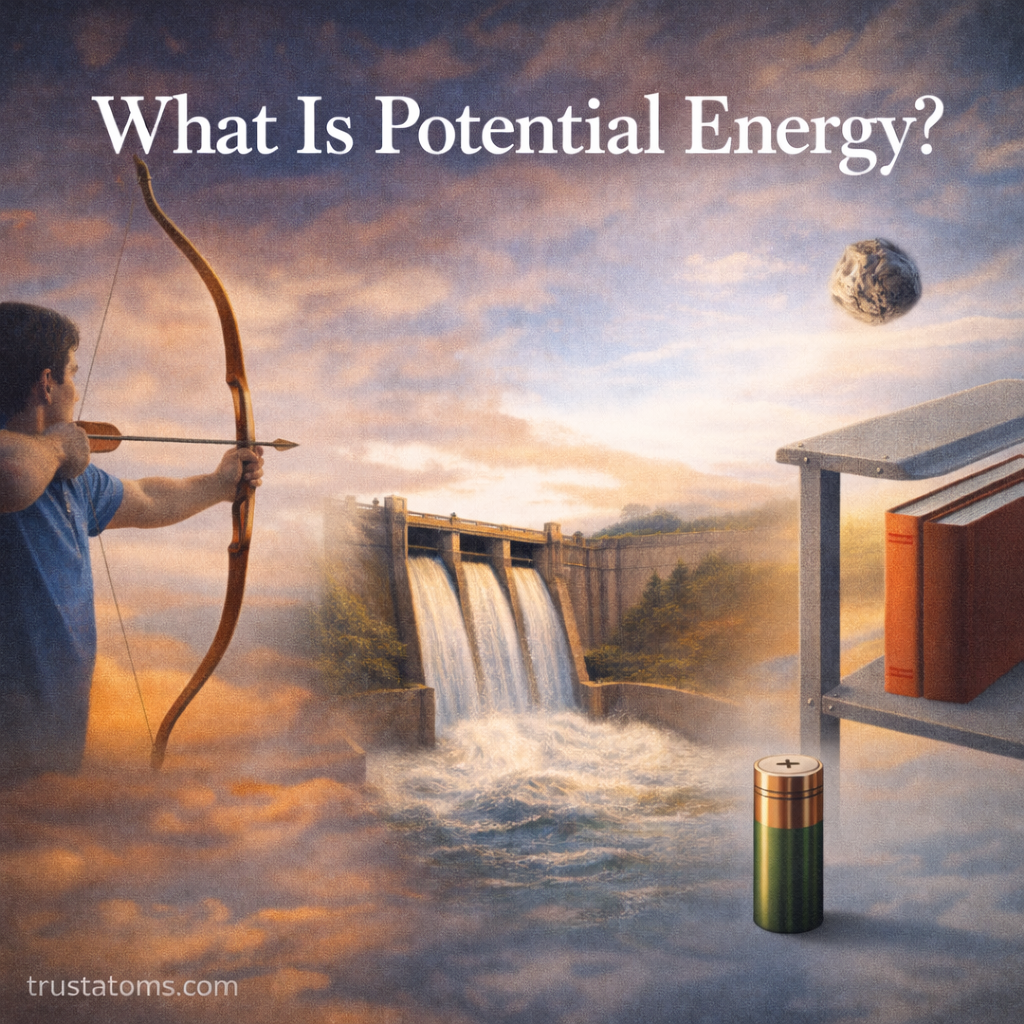
Educational illustration showing examples of potential energy including a drawn bow, hydroelectric dam, book on a shelf, battery, and gravitational height.
Illustration explaining different forms of potential energy including gravitational, elastic, and chemical energy. trustatoms.com

Potential energy is stored energy.

It is the energy an object has because of its position, condition, or configuration — not because it is moving.

From a stretched rubber band to water held behind a dam, potential energy represents stored power waiting to be released.

In this guide, you’ll learn:

  • What potential energy is
  • The main types of potential energy
  • The gravitational potential energy formula
  • Real-world examples
  • How it connects to kinetic energy
Continue reading “What Is Potential Energy?”

Kinetic Energy Formula and Examples

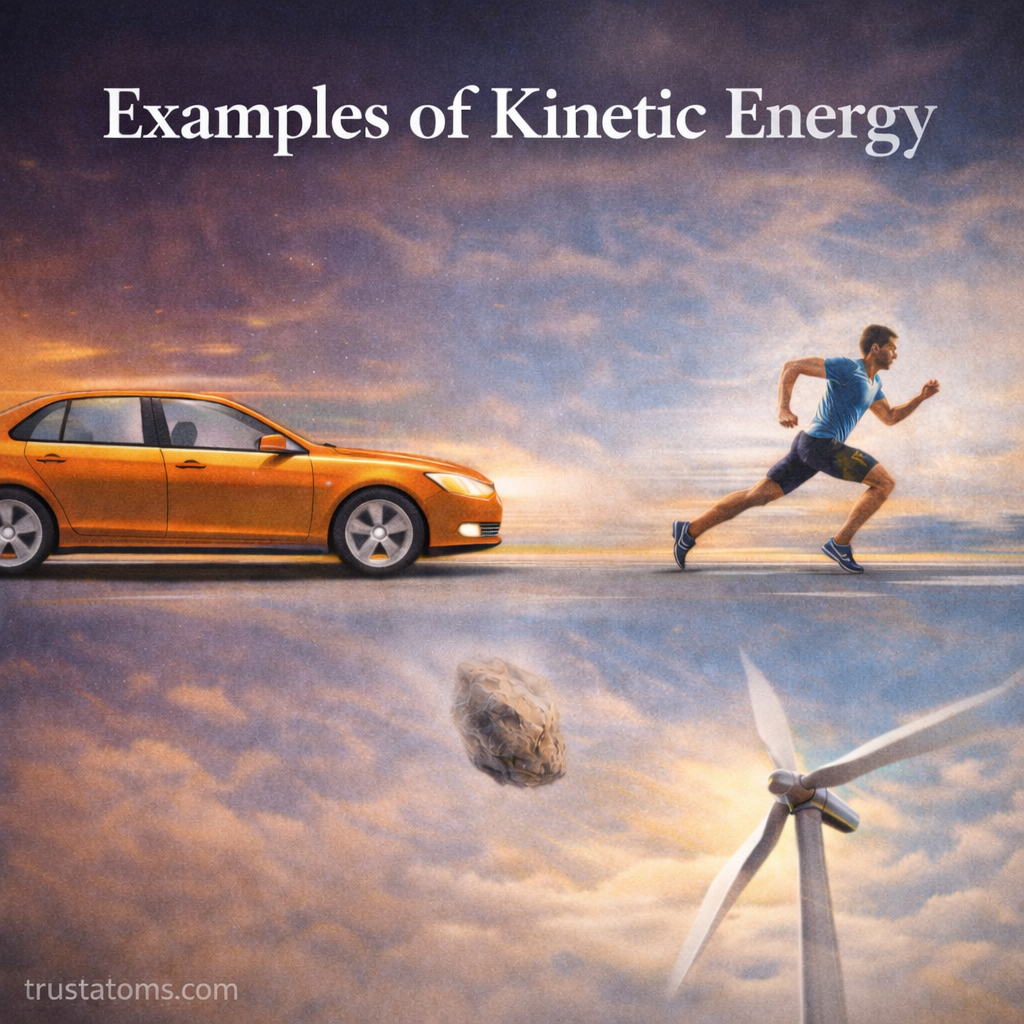
Illustration showing examples of kinetic energy including a moving car, a running athlete, a falling rock, and a spinning wind turbine.
Examples of kinetic energy shown through everyday motion including a car, runner, falling rock, and wind turbine. trustatoms.com

Kinetic energy is the energy an object has because it is moving.

From speeding cars to flowing rivers, kinetic energy explains how motion carries power. In this guide, you’ll learn the kinetic energy formula, how to use it, and see clear step-by-step examples.

Continue reading “Kinetic Energy Formula and Examples”