What Is Pressure in Physics?

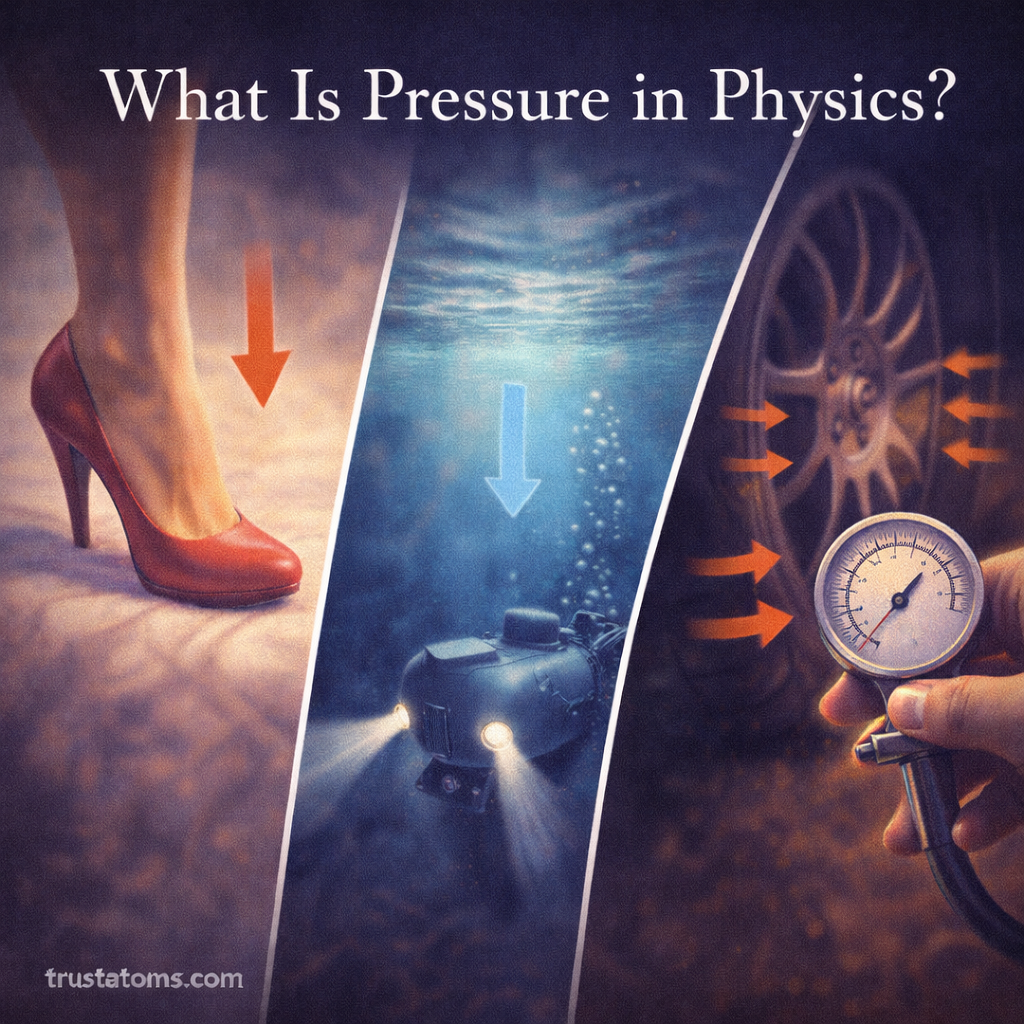
Illustration showing a high heel applying force to the ground, a deep-sea submersible underwater, and a tire pressure gauge measuring air pressure, titled “What Is Pressure in Physics?” with trustatoms.com watermark.
Conceptual illustration of pressure in physics showing force over area, underwater depth pressure, and tire air pressure measurement. trustatoms.com

Pressure in physics is the amount of force applied over a given area.

In simple terms, pressure tells us how concentrated a force is. The same force applied over a small area produces more pressure than when spread over a large area.

Pressure plays a crucial role in fluid dynamics, weather systems, engineering, and even everyday experiences like walking in snow or using a knife.

Continue reading “What Is Pressure in Physics?”

What Is Bernoulli’s Principle?

Illustration showing airflow over an airplane wing, fluid moving through a narrow pipe, and a spray bottle demonstrating Bernoulli’s Principle, with trustatoms.com watermark.
Conceptual illustration of Bernoulli’s Principle showing airplane lift, pressure changes in a pipe, and spray bottle fluid flow. trustatoms.com

Bernoulli’s Principle is a fundamental concept in fluid dynamics that explains the relationship between a fluid’s speed and its pressure.

In simple terms, it states:

When a fluid moves faster, its pressure decreases.

This principle helps explain how airplanes fly, how spray bottles work, and why wind can lift roofs during storms.

It is one of the most important ideas in physics for understanding the motion of liquids and gases.

Continue reading “What Is Bernoulli’s Principle?”

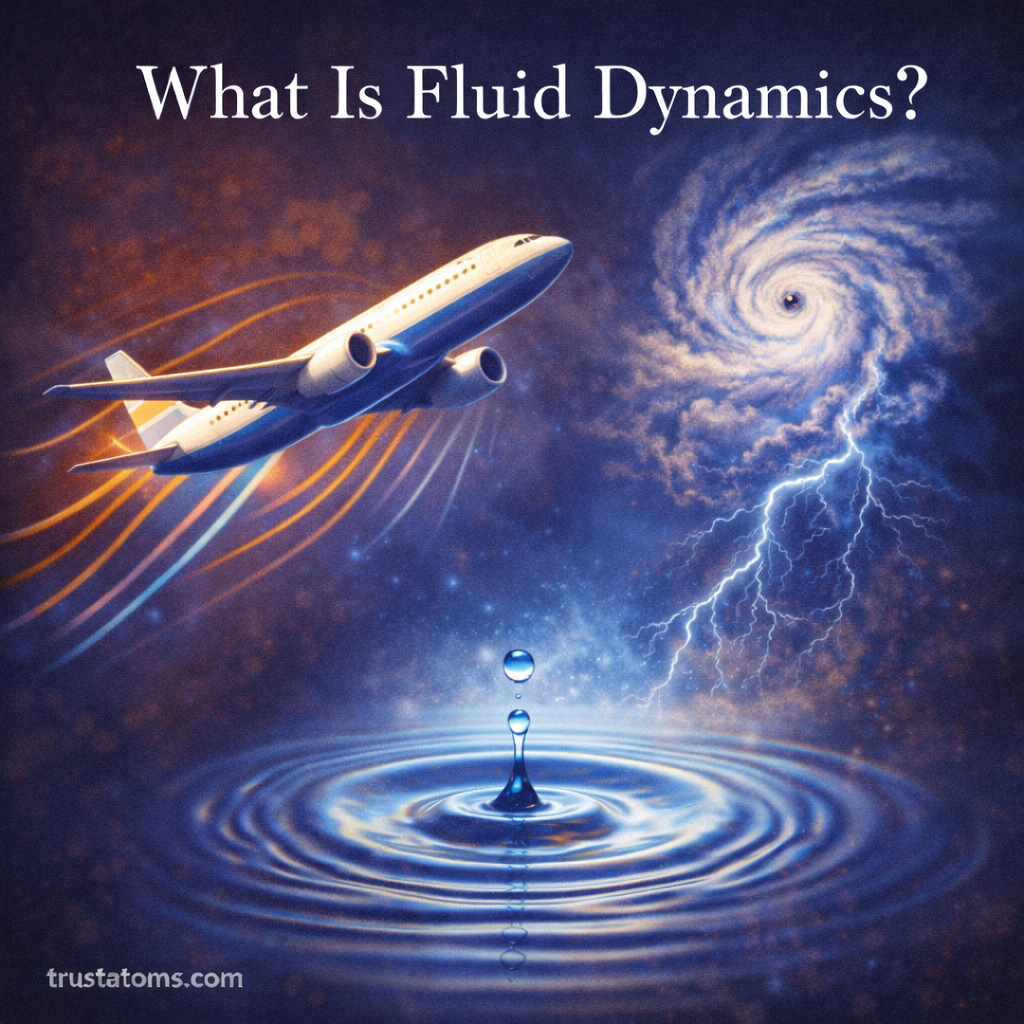
What Is Fluid Dynamics?

Illustration showing an airplane with airflow lines, a swirling hurricane, and water ripples demonstrating fluid motion, titled “What Is Fluid Dynamics?” with trustatoms.com watermark.
Conceptual illustration of fluid dynamics showing airflow over an airplane, hurricane rotation, and water ripple motion. trustatoms.com

Fluid dynamics is the branch of physics that studies how liquids and gases move.

It explains how water flows through pipes, how air moves around airplane wings, how blood circulates in the body, and even how weather systems form.

Anytime a liquid or gas is in motion, fluid dynamics helps describe and predict its behavior.

Continue reading “What Is Fluid Dynamics?”

What Is Plasma?

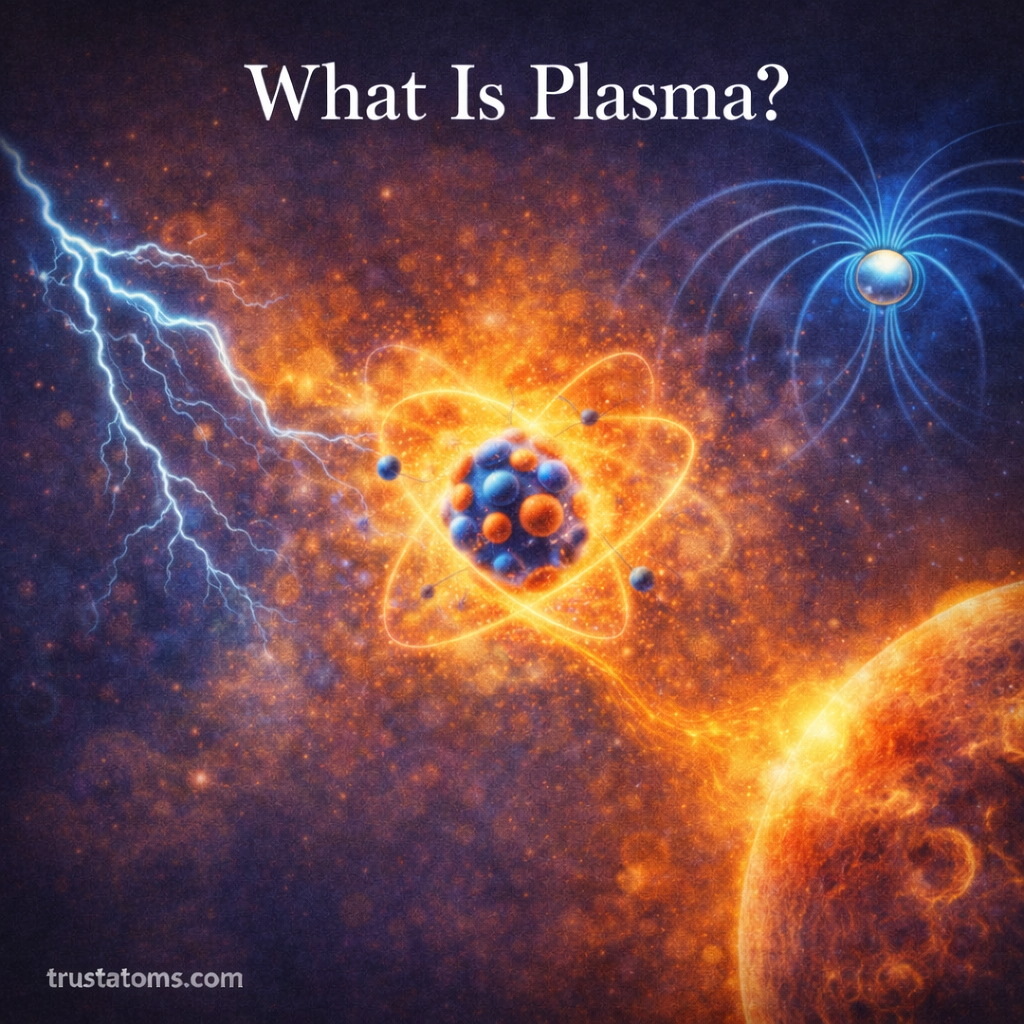
Illustration of glowing ionized plasma with lightning, magnetic field lines, and solar activity, titled “What Is Plasma?” with trustatoms.com watermark.
Conceptual illustration of plasma as an ionized state of matter, showing charged particles, lightning, and solar plasma activity. trustatoms.com

Plasma is often called the fourth state of matter. While most people are familiar with solids, liquids, and gases, plasma is just as important — and far more common in the universe.

Plasma forms when a gas becomes so energized that its atoms lose electrons. This creates a mixture of positively charged ions and free electrons.

Unlike ordinary gases, plasma conducts electricity and responds strongly to magnetic fields.

Continue reading “What Is Plasma?”

What Is the Schrödinger Equation?

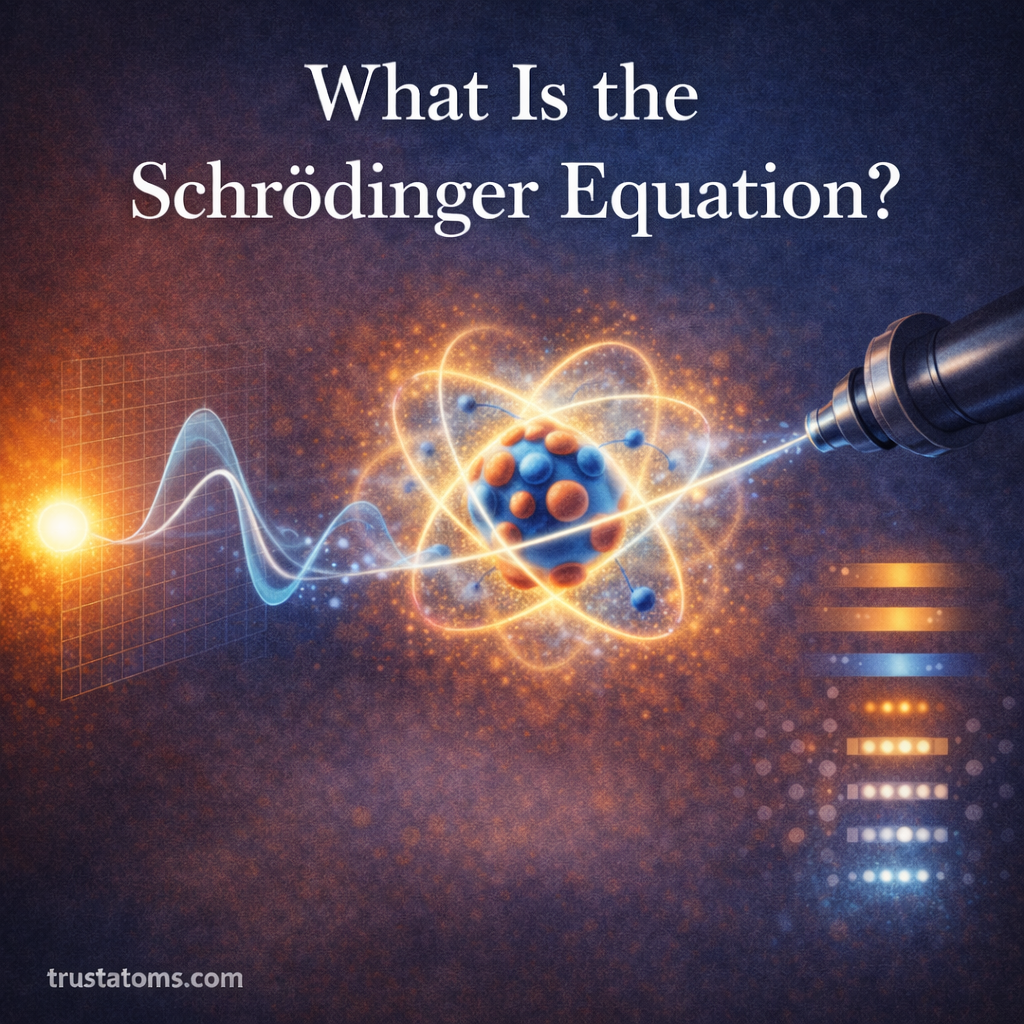
Illustration of an atom surrounded by a glowing probability cloud and wave pattern representing the Schrödinger equation, with the title “What Is the Schrödinger Equation?” and trustatoms.com watermark.
Conceptual illustration showing atomic probability clouds and wave behavior representing the Schrödinger equation in quantum mechanics. trustatoms.com

The Schrödinger equation is one of the most important equations in quantum mechanics. It describes how quantum systems — such as electrons, atoms, and molecules — behave over time.

In simple terms, the Schrödinger equation tells us how the wave function of a particle evolves. The wave function contains all the measurable information about a quantum system.

Just as Newton’s laws describe motion in classical physics, the Schrödinger equation describes motion at the atomic and subatomic scale.

Continue reading “What Is the Schrödinger Equation?”

What Is Wave–Particle Duality?

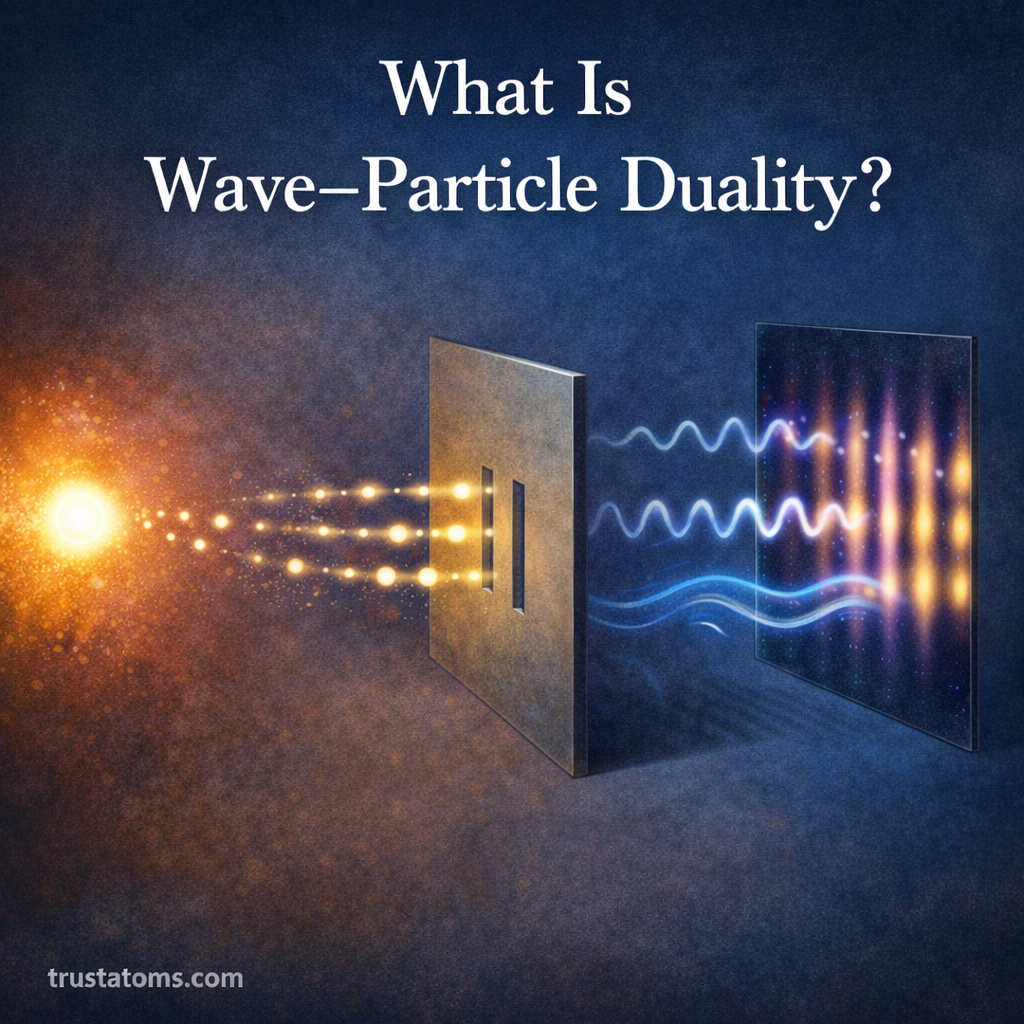
Illustration of the double-slit experiment showing particles passing through slits and forming a wave interference pattern with the title “What Is Wave–Particle Duality?” and trustatoms.com watermark.
Conceptual illustration of wave–particle duality showing particle paths and wave interference behavior in a double-slit experiment. trustatoms.com

Wave–particle duality is a fundamental concept in quantum physics stating that light and matter can behave both like waves and like particles.

In everyday life, waves and particles seem completely different. Water waves spread out and interfere. Particles like baseballs move along clear paths. But at the atomic and subatomic scale, nature does not follow our everyday intuition.

Wave–particle duality shows that light and tiny particles such as electrons do not fit neatly into one category.

Continue reading “What Is Wave–Particle Duality?”

What Is Radioactive Decay?

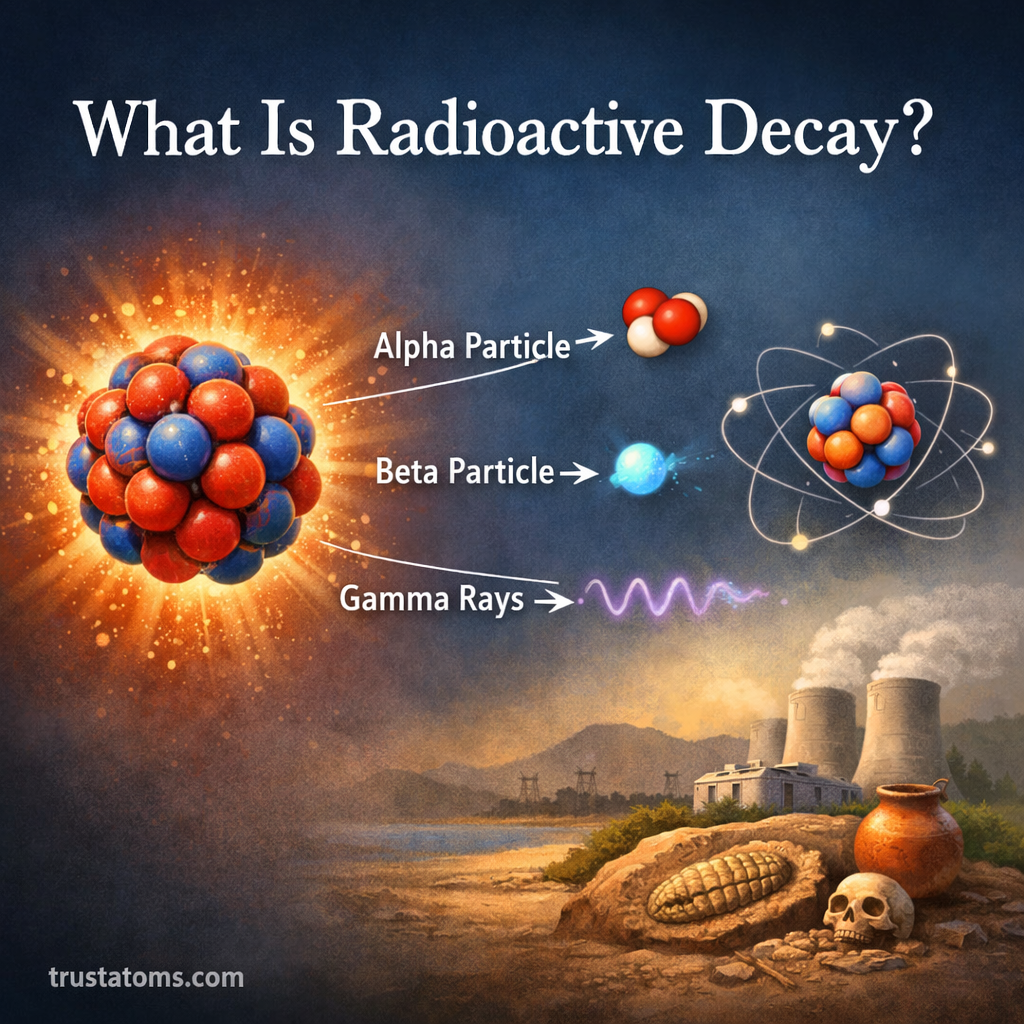
Contextual illustration showing an unstable atomic nucleus emitting alpha, beta, and gamma radiation with the title “What Is Radioactive Decay?” and trustatoms.com watermark.
Illustration explaining how unstable atomic nuclei release alpha, beta, and gamma radiation during radioactive decay. trustatoms.com

Radioactive decay is a natural process where an unstable atomic nucleus releases energy by emitting radiation. Over time, this process transforms the original atom into a different element or a more stable form of the same element.

Radioactive decay happens spontaneously. It does not require heat, pressure, or chemical reactions. It is driven entirely by the internal structure of the atom’s nucleus.

Understanding radioactive decay is essential in physics, nuclear energy, medicine, geology, and even archaeology.

Continue reading “What Is Radioactive Decay?”

What Is Nuclear Energy?

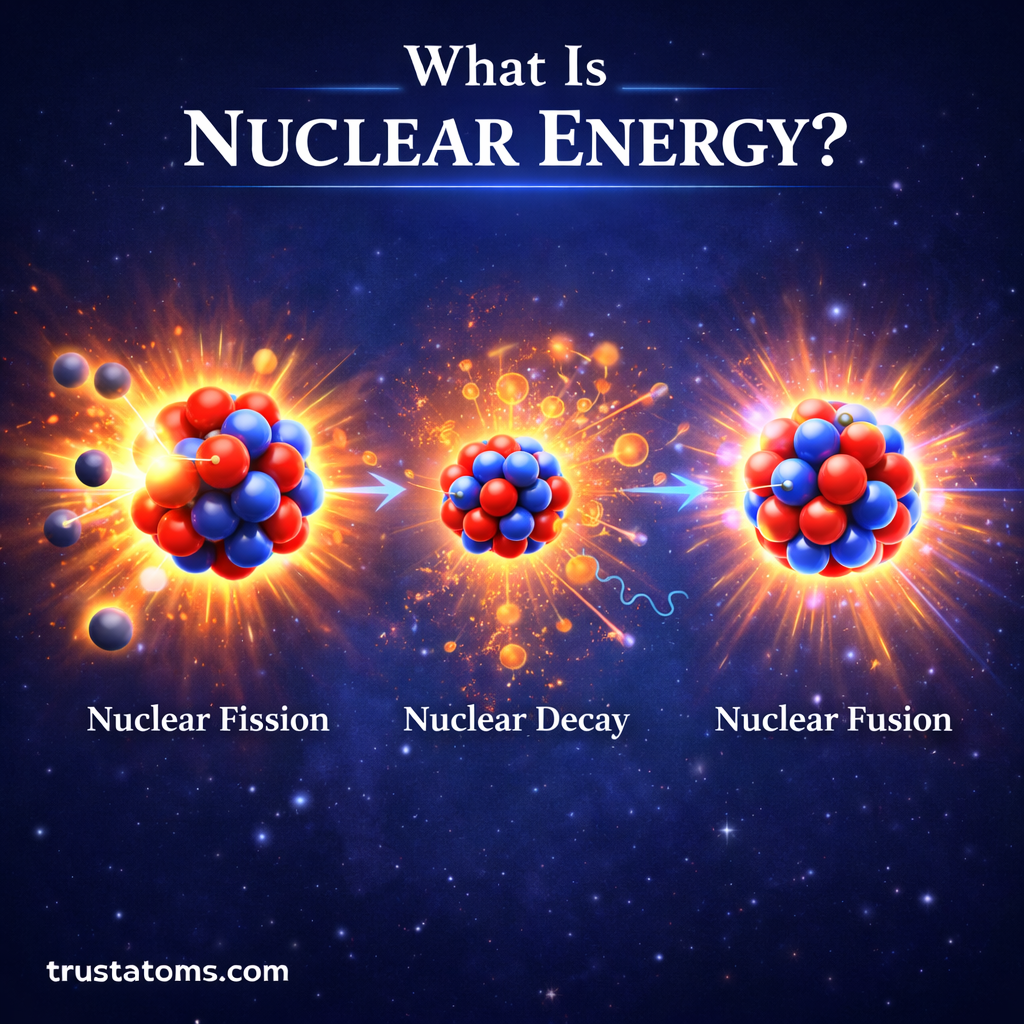
Illustration showing nuclear fission, radioactive decay, and nuclear fusion processes with atomic nuclei releasing energy.
Visual overview of nuclear energy through fission, decay, and fusion processes. trustatoms.com

Nuclear energy is the energy stored in the nucleus of an atom. It is released when atomic nuclei change through processes such as fission, fusion, or radioactive decay.

Unlike chemical energy — which comes from electron interactions — nuclear energy comes from changes inside the atom’s core. Because the nucleus holds enormous binding energy, even small changes can release massive amounts of power.

Nuclear energy plays a major role in electricity generation, medicine, and scientific research.

Continue reading “What Is Nuclear Energy?”

What Is Atomic Structure?

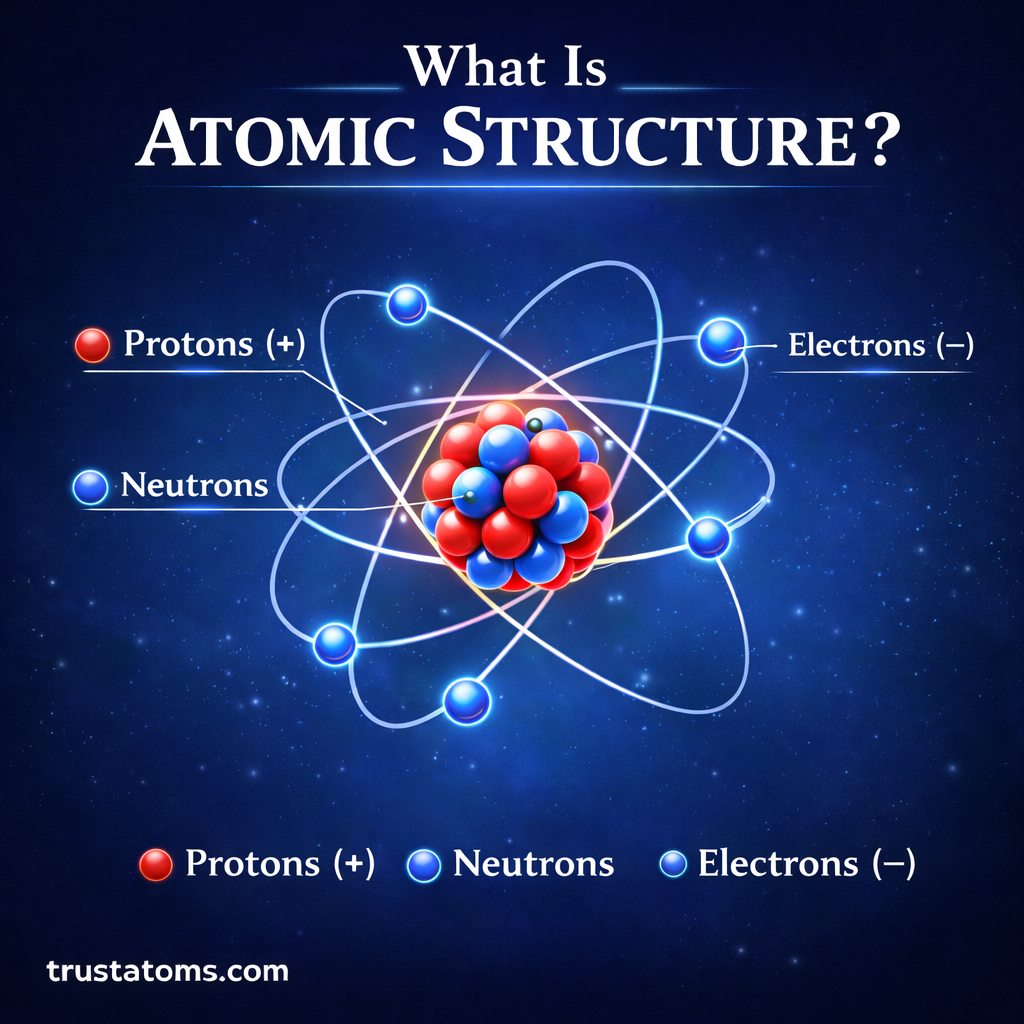
Simple atomic structure diagram showing a nucleus with protons and neutrons and electrons orbiting around it on a dark blue background.
Simple diagram illustrating the basic structure of an atom with protons, neutrons, and electrons. trustatoms.com

Atomic structure refers to the arrangement of particles inside an atom. It explains how protons, neutrons, and electrons are organized and how they determine the properties of elements.

Everything around you — air, water, metals, living organisms — is made of atoms. Understanding atomic structure is key to understanding chemistry, electricity, radiation, and even modern technology.

Atomic structure forms one of the foundations of physics.

Continue reading “What Is Atomic Structure?”

What Is the Speed of Light?

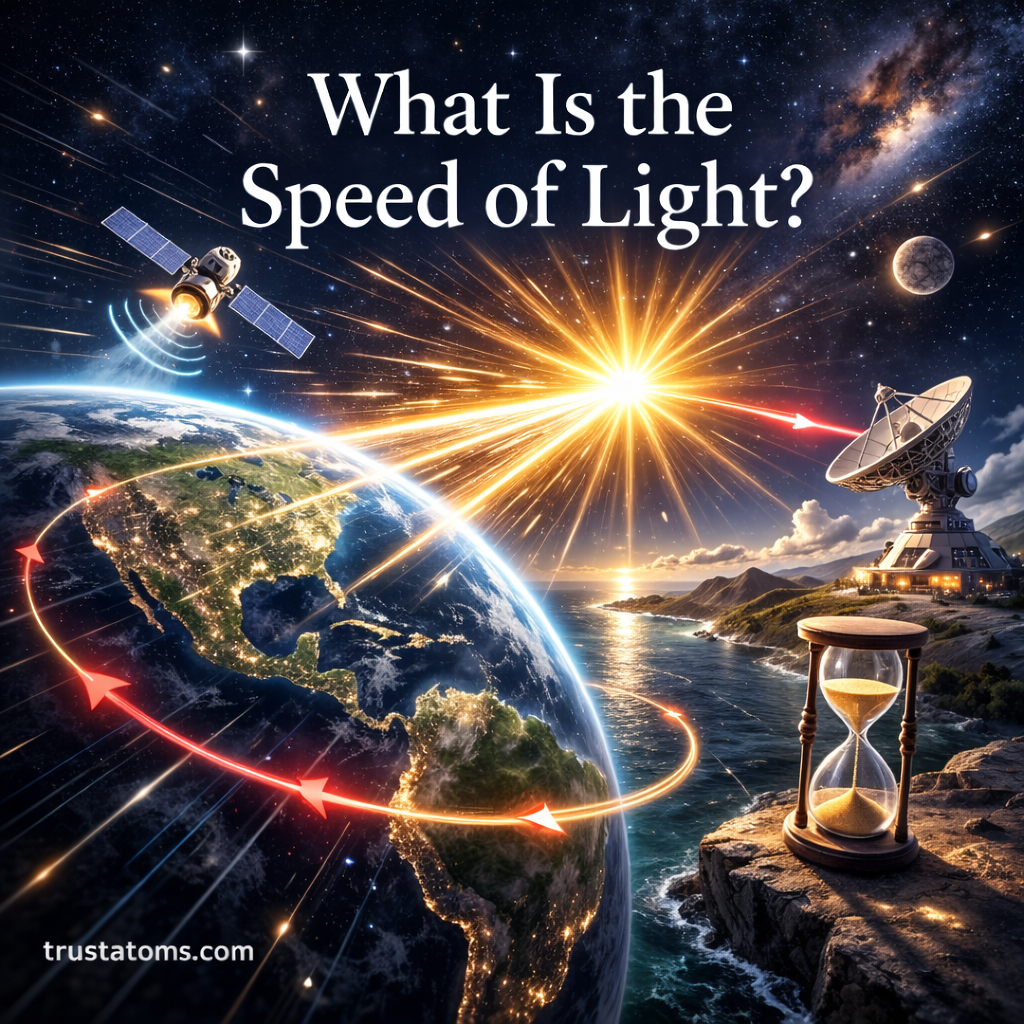
Illustration showing a bright beam of light traveling through space past Earth, satellites, and a radio telescope representing the speed of light.
Conceptual visualization of the speed of light traveling through space and connecting Earth with distant objects. trustatoms.com

The speed of light is one of the most important constants in physics. It represents the maximum speed at which energy, information, and matter can travel in the universe.

In a vacuum, light travels at approximately:

299,792,458 meters per second

That’s about 300,000 kilometers per second or 186,282 miles per second.

To put that into perspective, light can travel around the Earth more than seven times in just one second.

Continue reading “What Is the Speed of Light?”