Quantum Decoherence in Measurement Theory

Illustration showing quantum superposition transitioning to a measured classical state, representing quantum decoherence in measurement theory.
Conceptual illustration of quantum decoherence as a quantum system interacts with a measuring device and environment. trustatoms.com

Quantum mechanics describes a world where particles can exist in multiple states at once. Yet when we measure a system, we always observe a definite outcome.

Why?

Quantum decoherence offers one of the most important explanations in modern physics. It helps clarify how quantum superpositions appear to “collapse” into classical reality during measurement — without requiring mysterious forces or conscious observers.

In measurement theory, decoherence explains how interactions with the environment suppress quantum interference, giving rise to the stable, classical world we experience.

Continue reading “Quantum Decoherence in Measurement Theory”
Fractal Geometry in Chaotic Systems

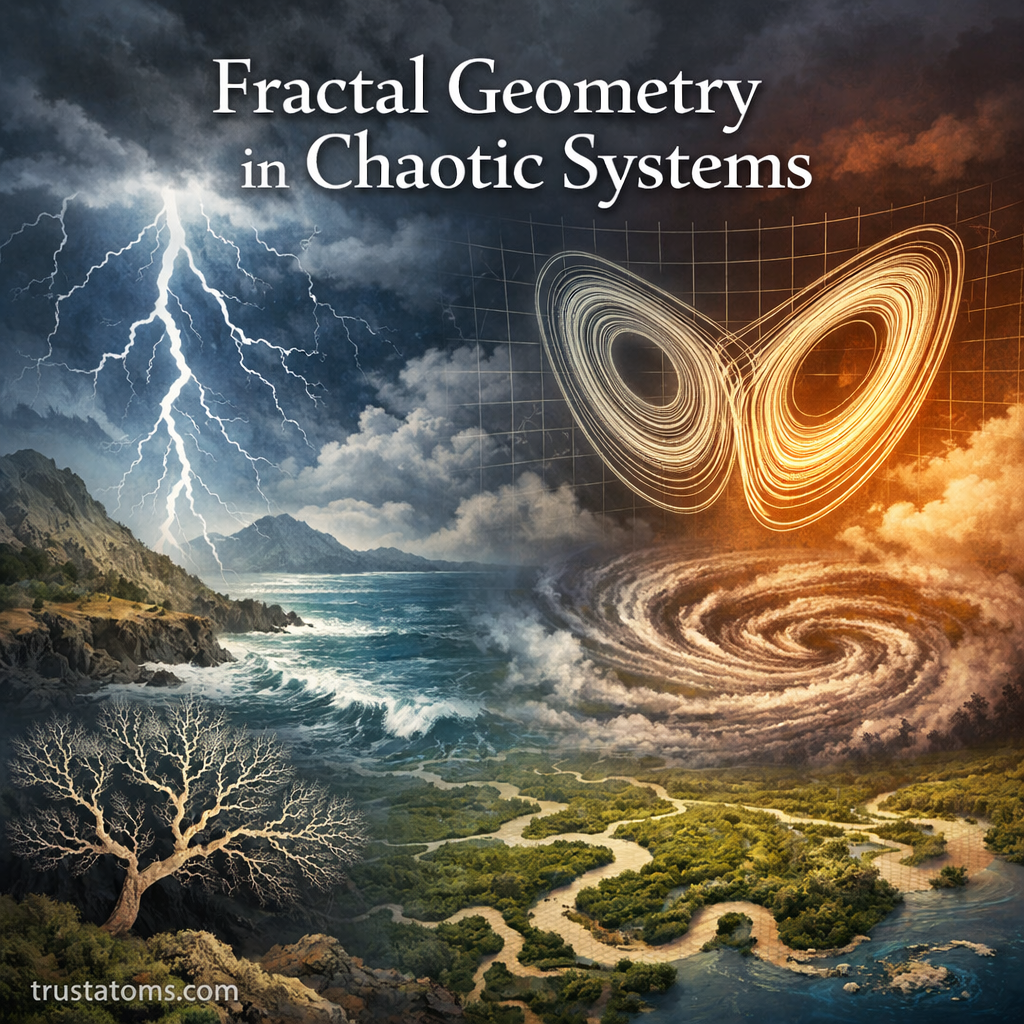
Illustration showing fractal patterns in chaotic systems, including lightning branches, turbulent ocean waves, a strange attractor pattern, and a winding river landscape.
Fractal patterns emerging in chaotic natural systems such as lightning, turbulence, and river networks. trustatoms.com

Fractal geometry reveals a hidden order inside what looks like randomness. From lightning bolts and coastlines to turbulent fluids and weather patterns, many chaotic systems produce intricate shapes that repeat at different scales. These patterns, known as fractals, help scientists understand how complexity emerges in nature.

In physics, fractal geometry provides a bridge between chaos theory and real-world phenomena. It explains how unpredictable systems can still follow underlying mathematical rules, even when their behavior seems wildly irregular.

Continue reading “Fractal Geometry in Chaotic Systems”

Nonlinear Wave Equations in Physical Systems

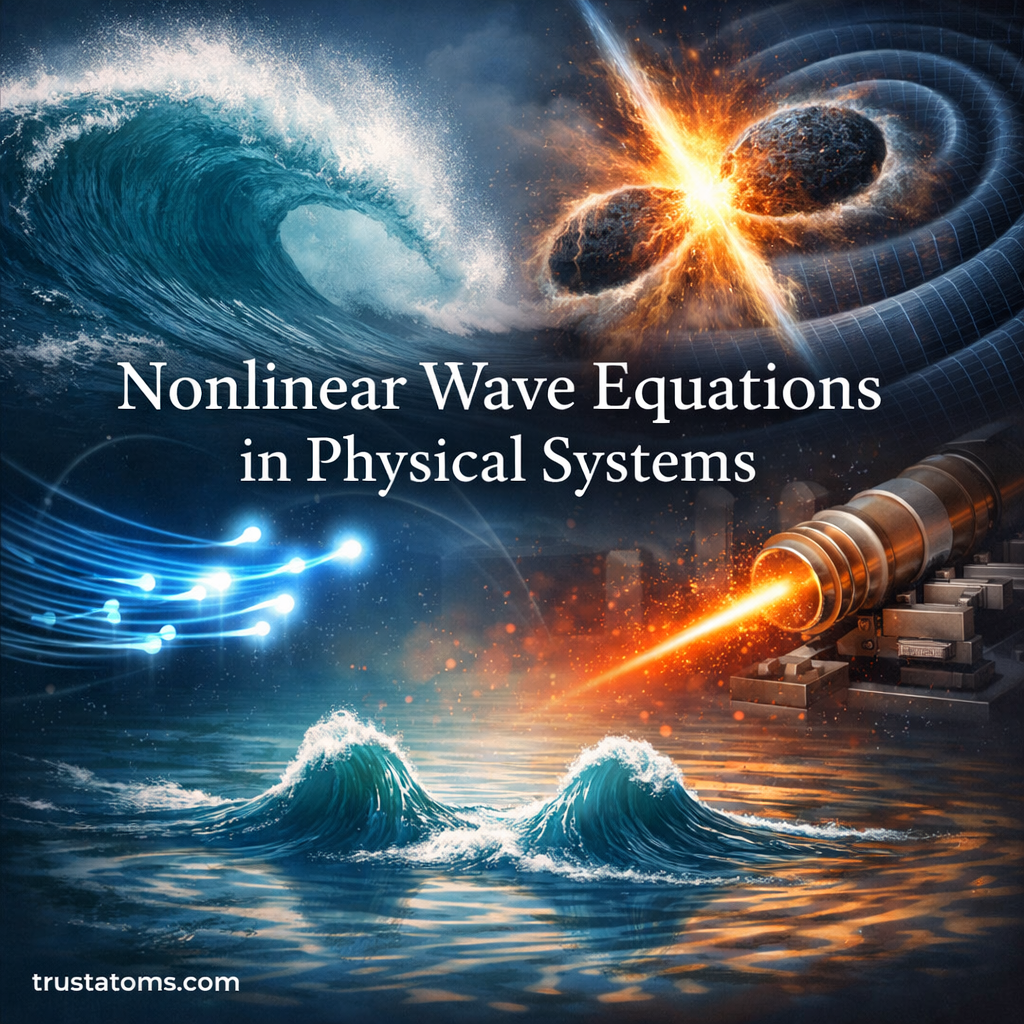
Contextual illustration showing nonlinear wave interactions in ocean water, optical fibers, and space with the title “Nonlinear Wave Equations in Physical Systems” and trustatoms.com watermark.
Illustration representing nonlinear wave behavior in physical systems including water waves, optical pulses, and cosmic interactions. trustatoms.com

Waves are everywhere — from ocean swells and sound vibrations to light pulses in fiber optics and shock waves in space. While many wave phenomena can be described using simple linear equations, the real world is rarely that neat.

In many physical systems, waves interact with themselves, distort, steepen, and even form stable localized structures. These behaviors are governed by nonlinear wave equations — mathematical models that describe how waves evolve when their amplitude affects their speed, shape, or interaction with other waves.

Understanding nonlinear wave equations is essential in modern physics, engineering, and applied mathematics.

Continue reading “Nonlinear Wave Equations in Physical Systems”

Navier–Stokes Equations in Fluid Dynamics

Illustration of Navier–Stokes equations in fluid dynamics showing airflow around an airplane and fluid motion inside industrial pipes.
Conceptual illustration representing Navier–Stokes equations applied to aerodynamic and industrial fluid systems. trustatoms.com.

The Navier–Stokes equations are the fundamental mathematical framework used to describe fluid motion. From the airflow over an airplane wing to the circulation of oceans and the flow of blood through arteries, these equations govern how fluids move.

Despite being written down in the 19th century, the Navier–Stokes equations remain at the heart of modern physics, engineering, and applied mathematics. They are powerful, predictive — and notoriously difficult to solve.

In this guide, we’ll explore what the Navier–Stokes equations describe, why they matter, and why they remain one of the most challenging problems in science.

Continue reading “Navier–Stokes Equations in Fluid Dynamics”

Turbulence Modeling in Fluid Systems

Illustration of turbulence modeling in fluid systems showing airflow around an aircraft, ocean wave turbulence, and combustion flow dynamics.
Conceptual illustration of turbulence modeling across aerospace, ocean, and combustion fluid systems. trustatoms.com.

Turbulence is one of the most complex and fascinating phenomena in physics. From swirling smoke and crashing ocean waves to airflow over aircraft wings, turbulent motion appears everywhere in nature and engineering.

Despite being governed by well-known equations, turbulence remains one of the greatest unsolved challenges in classical physics.

Turbulence modeling helps scientists and engineers predict chaotic fluid motion when exact solutions are impossible. In this guide, we’ll explore what turbulence is, why it’s so difficult to describe, and the main modeling approaches used in fluid systems.

Continue reading “Turbulence Modeling in Fluid Systems”

Bose–Einstein and Fermi–Dirac Statistics

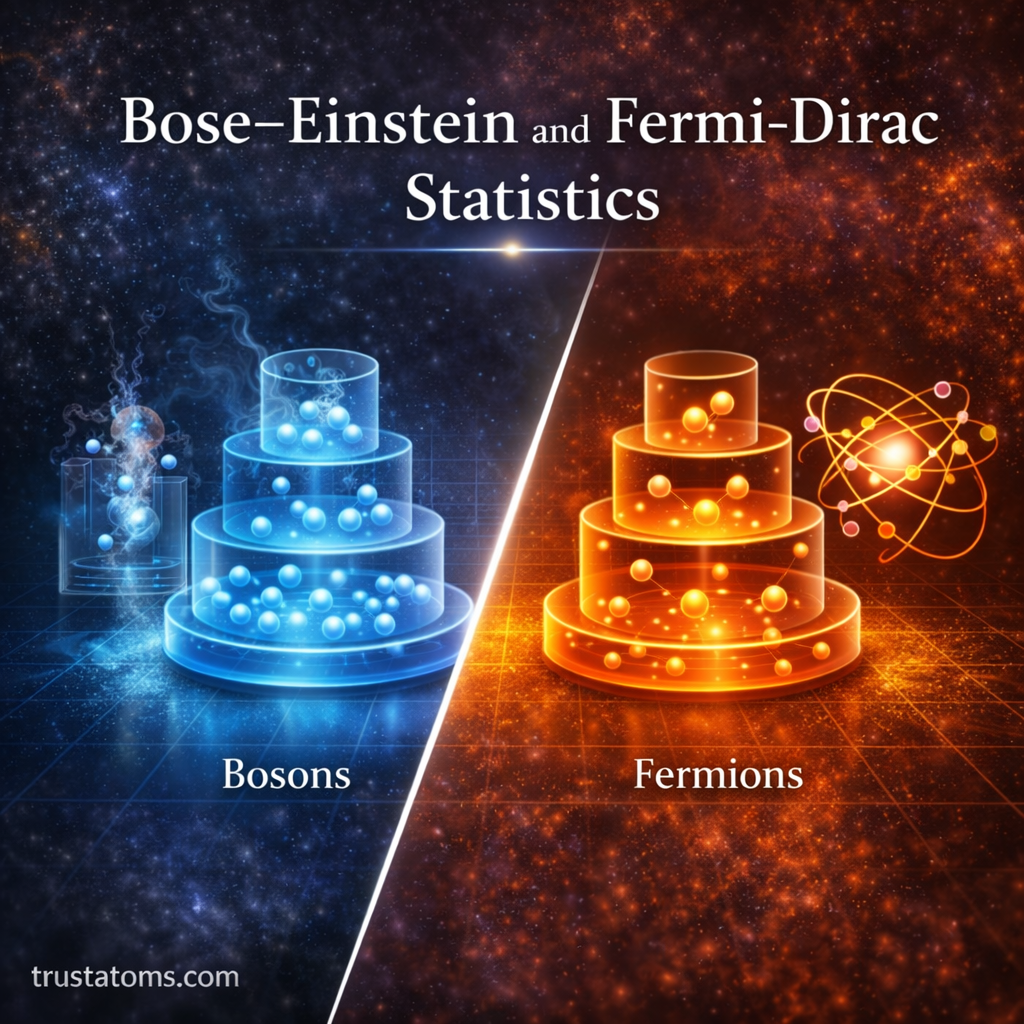
Split illustration comparing Bose–Einstein and Fermi–Dirac statistics, showing bosons sharing energy states and fermions filling separate energy levels.
Conceptual split diagram illustrating the difference between bosons and fermions in quantum statistical distributions. trustatoms.com.

In classical physics, particles are treated as distinguishable and independent. But at very small scales — especially at low temperatures or high densities — nature behaves differently.

Particles become indistinguishable, and quantum effects dominate.

This is where Bose–Einstein and Fermi–Dirac statistics replace classical Boltzmann statistics. These two quantum statistical frameworks explain how particles distribute themselves among energy states when quantum mechanics cannot be ignored.

Understanding these statistics is essential for modern physics, from semiconductors to neutron stars.

Continue reading “Bose–Einstein and Fermi–Dirac Statistics”

Boltzmann Statistics in Energy Distributions

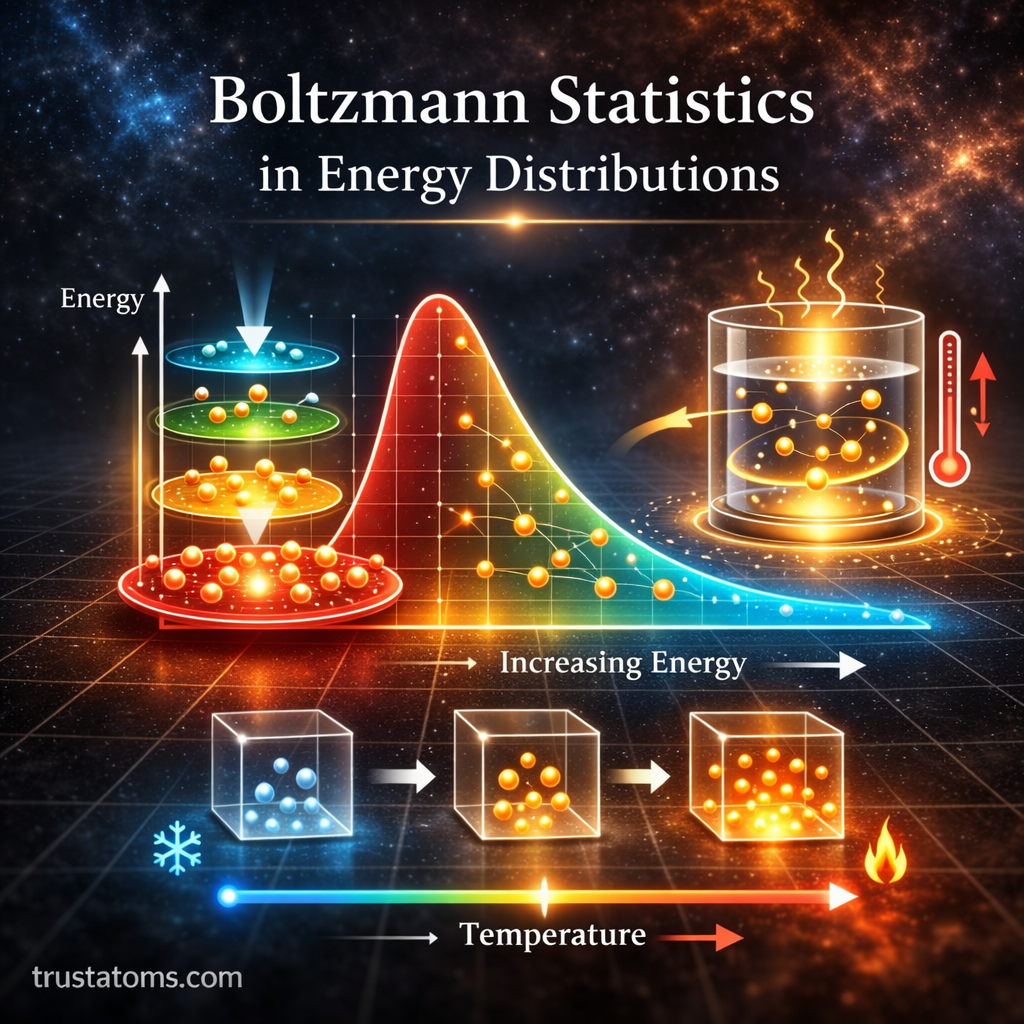
Illustration of Boltzmann statistics showing particle energy distribution curve with low energy high probability and high energy low probability regions.
Conceptual diagram illustrating Boltzmann statistics and the distribution of particle energies at different temperatures. trustatoms.com.

Boltzmann statistics explains how particles distribute themselves among different energy levels in a system at thermal equilibrium. It is one of the cornerstones of statistical physics and provides the bridge between microscopic particle behavior and macroscopic thermodynamic properties.

Whether describing gas molecules, atoms in a solid, or particles in a plasma, Boltzmann statistics helps answer a fundamental question:

How likely is a particle to occupy a particular energy state?

In this guide, we’ll break down what Boltzmann statistics is, how energy distributions emerge, and why this concept is essential across physics and chemistry.

Continue reading “Boltzmann Statistics in Energy Distributions”

Thermodynamic Ensembles in Statistical Physics

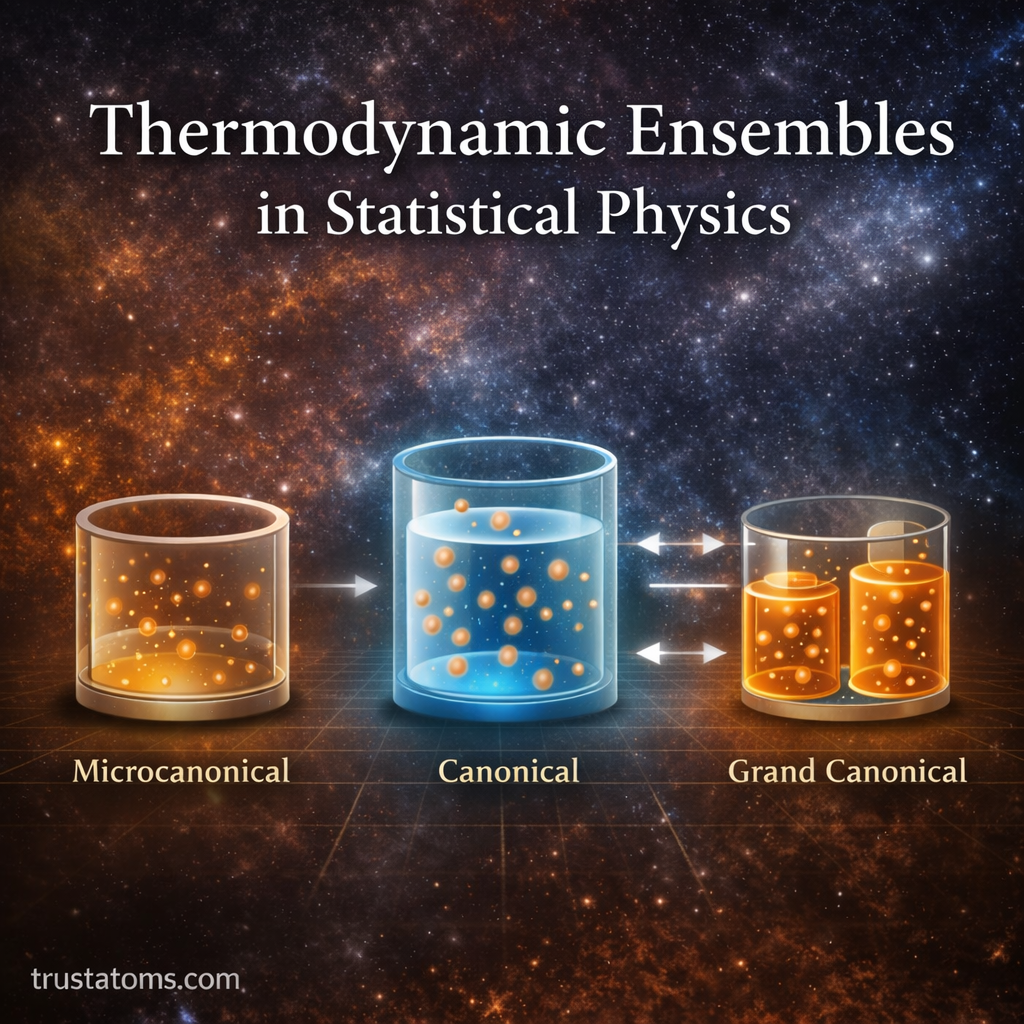
Illustration of thermodynamic ensembles in statistical physics showing microcanonical, canonical, and grand canonical systems with particle containers.
Conceptual diagram illustrating microcanonical, canonical, and grand canonical ensembles in statistical physics. trustatoms.com.

Thermodynamic ensembles are one of the most powerful tools in statistical physics. They allow physicists to connect microscopic particle behavior with macroscopic thermodynamic laws such as temperature, pressure, and entropy.

Instead of tracking every particle individually — which is practically impossible for systems containing trillions upon trillions of particles — statistical physics uses ensembles: large collections of possible system states that obey certain constraints.

In this guide, we’ll explore what thermodynamic ensembles are, why they matter, and how the three main types — microcanonical, canonical, and grand canonical — differ.

Continue reading “Thermodynamic Ensembles in Statistical Physics”

Higgs Mechanism in Mass Generation

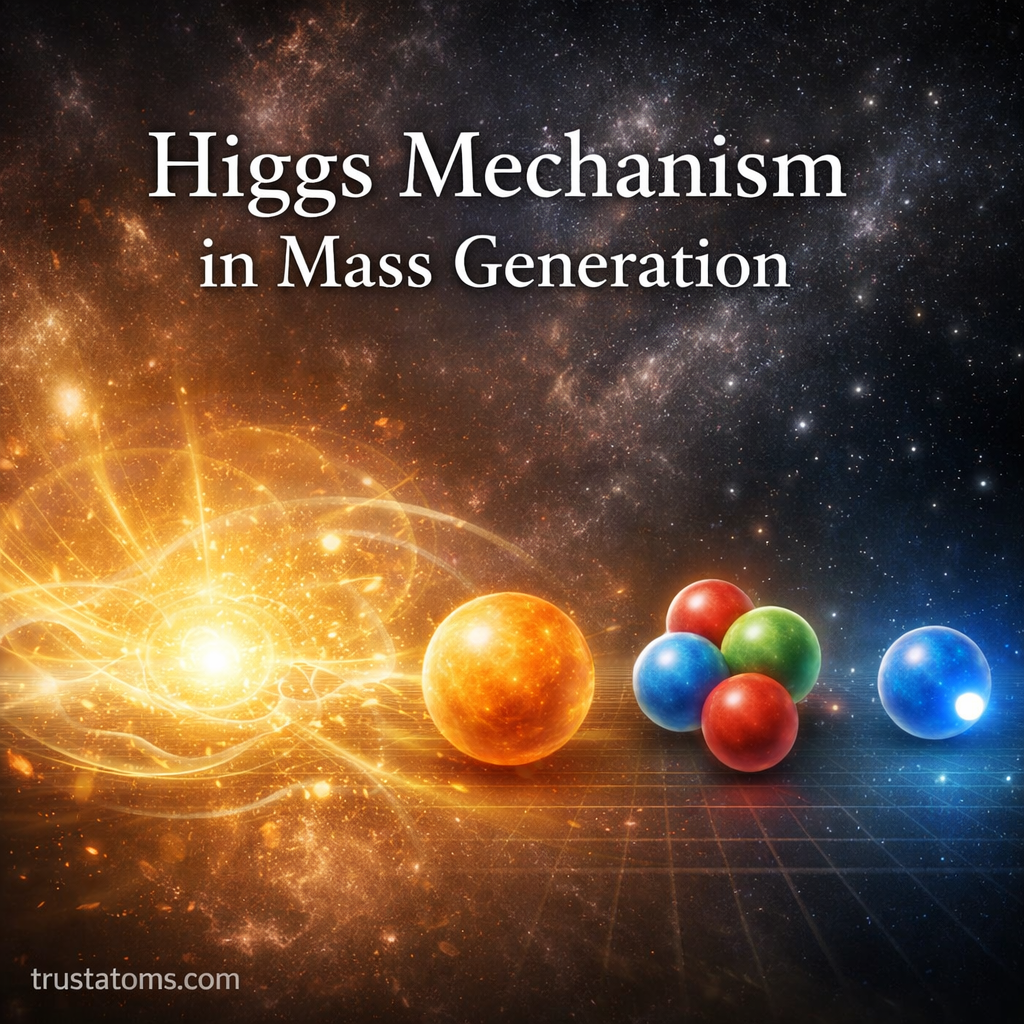
Contextual illustration of the Higgs mechanism in mass generation showing particles interacting with a glowing Higgs field against a cosmic background.
Conceptual illustration of the Higgs mechanism showing particles interacting with the Higgs field in space. trustatoms.com.

The Higgs mechanism is one of the most important ideas in modern physics. It explains how fundamental particles acquire mass without breaking the mathematical symmetry that governs the universe at its most basic level.

Before this concept was introduced, physicists had equations that worked beautifully — except for one major problem: they predicted that many particles should have no mass at all. The Higgs mechanism solved that puzzle and became a central pillar of the Standard Model of particle physics.

In this guide, we’ll explore what the Higgs mechanism is, how it works, and why it matters for understanding the structure of reality.

Continue reading “Higgs Mechanism in Mass Generation”

Quantum Chromodynamics in Particle Physics

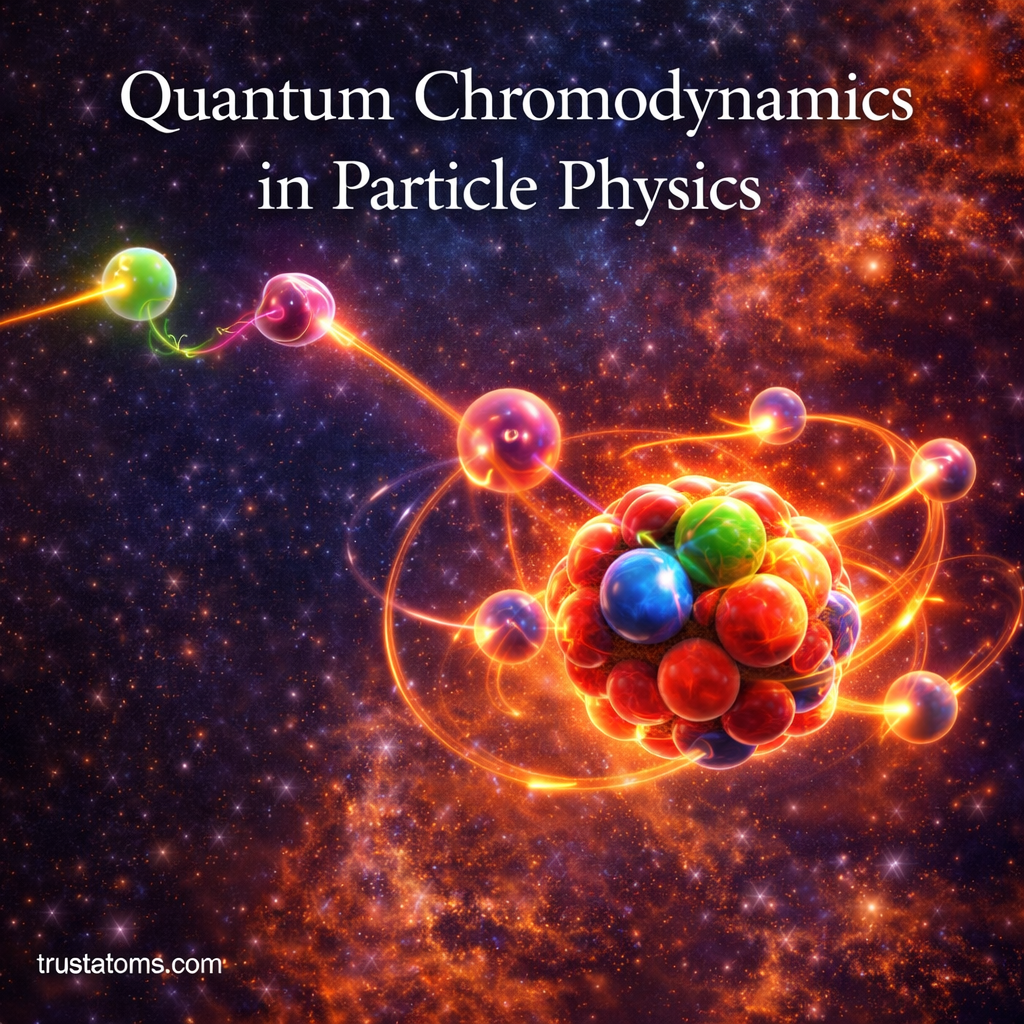
Conceptual illustration of quarks bound by gluons inside a proton, representing quantum chromodynamics in particle physics.
Illustration of quarks and gluon interactions demonstrating quantum chromodynamics and the strong nuclear force. trustatoms.com.

Quantum Chromodynamics (QCD) is the theory that explains how quarks and gluons interact through the strong nuclear force.

It is a central pillar of the Standard Model of particle physics and describes how protons, neutrons, and other hadrons are formed — and why quarks are never observed in isolation.

In this guide, we’ll break down what quantum chromodynamics is, how it works, and why it is essential to understanding matter at the most fundamental level.

Continue reading “Quantum Chromodynamics in Particle Physics”