Surface Tension in Fluid Interfaces

Illustration showing surface tension in fluid interfaces with a water strider on water, a droplet on a leaf, and laboratory examples including a capillary tube and soap bubble.
Illustration demonstrating surface tension in natural and laboratory fluid interfaces. trustatoms.com

Surface tension is one of the most fascinating and visually striking phenomena in physics. It explains why water forms droplets, why insects can walk on ponds, and why bubbles maintain their spherical shape.

At its core, surface tension arises from molecular forces acting at the boundary between fluids — most commonly between a liquid and air.

In this article, we’ll explore what surface tension is, why it occurs, how it’s measured, and why it plays a critical role in nature and technology.

Continue reading “Surface Tension in Fluid Interfaces”
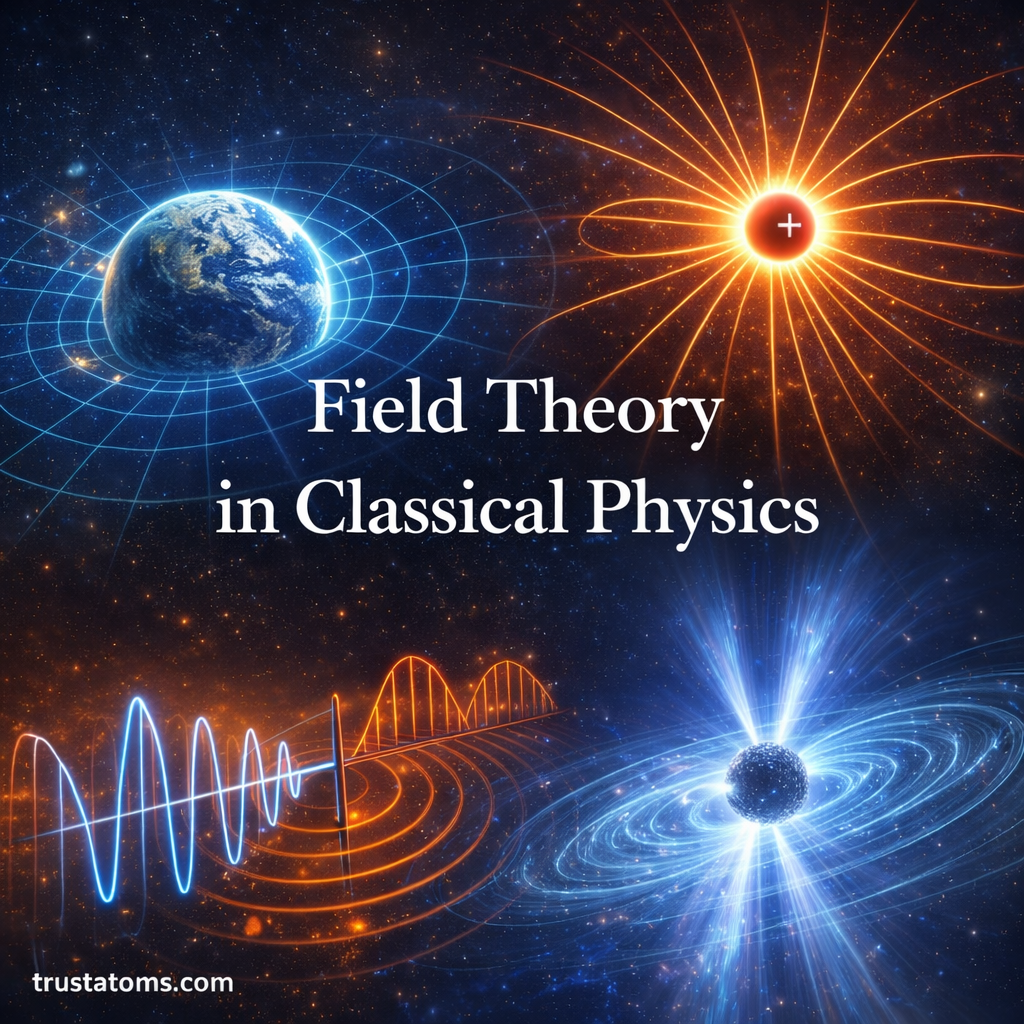

Field Theory in Classical Physics

Illustration showing gravitational, electric, and magnetic fields in classical physics, including Earth’s gravitational field, electric field lines around a charge, and electromagnetic wave propagation.
Conceptual illustration of gravitational, electric, and magnetic fields in classical physics. trustatoms.com

Field theory in classical physics provides one of the most powerful ways to describe how forces act across space. Instead of imagining objects pulling or pushing each other directly, field theory describes how physical quantities exist at every point in space and influence matter locally.

From gravity shaping planetary motion to electric and magnetic forces guiding charged particles, classical field theory forms the foundation of modern physics.

This article explains what a field is, how classical field theory developed, and why it remains essential in science today.

Continue reading “Field Theory in Classical Physics”

Conservation of Angular Momentum in Astrophysical Systems

Illustration of conservation of angular momentum in astrophysical systems showing a spiral galaxy, pulsar beams, and a rotating black hole accretion disk in space.
Astrophysical illustration showing how angular momentum conservation shapes galaxies, neutron stars, and black holes. trustatoms.com

The conservation of angular momentum is one of the most powerful principles in physics. It explains why spinning ice skaters rotate faster when they pull in their arms — and on a much larger scale, why stars collapse into rapidly spinning neutron stars and why galaxies form rotating disks.

In astrophysics, angular momentum shapes the structure and evolution of planets, stars, black holes, and entire galaxies.

This article explores what angular momentum is, why it is conserved, and how it governs some of the most dramatic events in the universe.

Continue reading “Conservation of Angular Momentum in Astrophysical Systems”

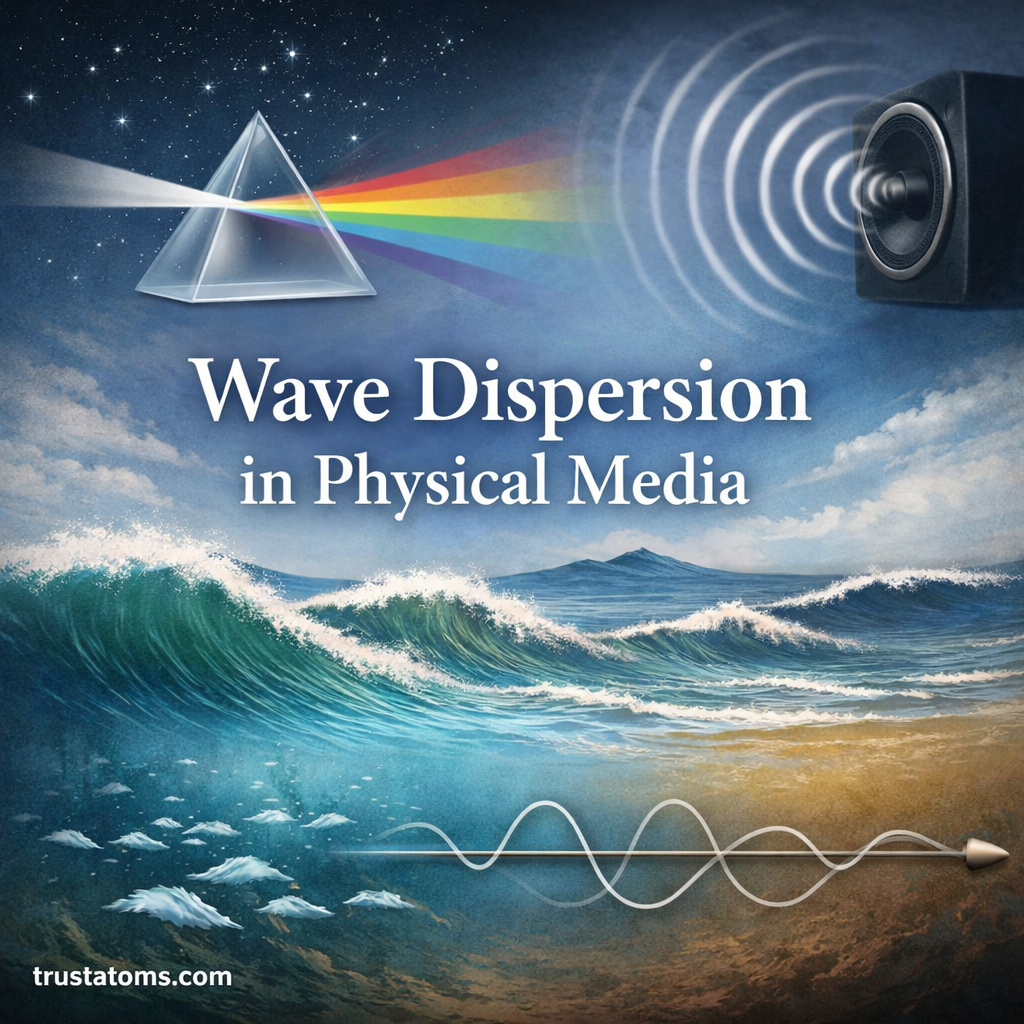
Wave Dispersion in Physical Media

Illustrated diagram showing wave dispersion in physical media including light splitting through a prism, ocean waves spreading, sound waves radiating, and a wave packet stretching over distance.
Illustration of wave dispersion in physical media, showing how different wave types spread as they travel. trustatoms.com

Wave dispersion is one of the most important — and often misunderstood — concepts in physics. It explains why ocean swells stretch out over distance, why a prism splits white light into colors, and why signals traveling through materials can lose clarity.

In simple terms, dispersion occurs when different frequencies (or wavelengths) of a wave travel at different speeds through a physical medium.

This article breaks down wave dispersion in physical media in a clear, practical way — with real-world examples and the physics behind it.

Continue reading “Wave Dispersion in Physical Media”

Stress and Strain in Solid Mechanics

Illustration comparing tensile stress stretching a metal rod and compressive stress squeezing a solid cylinder.
Conceptual diagram illustrating tensile and compressive stress and resulting strain in solid materials. trustatoms.com

Every structure around us — from bridges and skyscrapers to smartphones and aircraft — must withstand forces without failing.

The science that studies how solid materials respond to applied forces is called solid mechanics.

At its core are two fundamental concepts:

  • Stress
  • Strain

Understanding stress and strain allows engineers and physicists to predict how materials will deform, bend, stretch, compress, or break under load.

Continue reading “Stress and Strain in Solid Mechanics”

Elastic and Plastic Deformation in Materials

Illustration comparing elastic deformation of a spring and plastic deformation of a bent paperclip.
Conceptual diagram showing elastic recovery and permanent plastic deformation in materials. trustatoms.com

When materials are subjected to forces, they respond by changing shape. Sometimes that change is temporary. Other times, it is permanent.

These two types of mechanical behavior are known as elastic deformation and plastic deformation.

Understanding the difference is essential in physics, engineering, materials science, construction, aerospace design, and manufacturing.

From bending a paperclip to designing skyscrapers, deformation governs how structures survive — or fail — under stress.

Continue reading “Elastic and Plastic Deformation in Materials”

Entropic Forces in Statistical Mechanics

Illustration showing polymer elasticity and osmotic motion representing entropic forces in statistical mechanics.
Conceptual illustration of entropic forces in statistical mechanics, including polymer recoil and osmotic behavior. trustatoms.com

Forces usually bring to mind pushes and pulls caused by fields — gravity, electromagnetism, or mechanical contact.

But in statistical mechanics, some forces arise for a completely different reason.

They are not driven by energy minimization alone, but by entropy maximization.

These are called entropic forces.

Entropic forces play a central role in:

  • Polymer elasticity
  • Osmosis
  • Colloidal interactions
  • Biological molecular motion
  • Emergent gravity theories

Understanding entropic forces helps explain how large-scale behavior emerges from microscopic randomness.

Continue reading “Entropic Forces in Statistical Mechanics”

Electromagnetic Wave Propagation in Media

Illustration showing electromagnetic waves refracting through glass and propagating through different media like air and water.
Conceptual diagram of electromagnetic wave propagation through different media including refraction and transmission effects. trustatoms.com

Electromagnetic waves — including radio waves, microwaves, visible light, X-rays, and gamma rays — are fundamental carriers of energy and information. In a vacuum, they travel at the speed of light.

But most real-world applications involve waves moving through materials, not empty space.

When electromagnetic waves enter a medium like air, water, glass, or fiber optic cable, their behavior changes. They can slow down, bend, reflect, weaken, or even get absorbed.

Understanding electromagnetic wave propagation in media is essential for telecommunications, optics, materials science, and modern engineering.

Continue reading “Electromagnetic Wave Propagation in Media”

Relativistic Time and Length Contraction

Illustration showing time dilation and length contraction with a moving spacecraft and clock in a spacetime grid background.
Conceptual illustration of relativistic time dilation and length contraction in special relativity. trustatoms.com

Space and time are not fixed backdrops to the universe. According to Einstein’s theory of relativity, they are flexible and depend on motion.

Two of the most surprising consequences of this theory are:

  • Time dilation (moving clocks run slower)
  • Length contraction (moving objects shrink along the direction of motion)

These effects only become noticeable at speeds close to the speed of light, but they have been experimentally confirmed many times. Understanding them reshapes how we think about motion, distance, and even reality itself.

Continue reading “Relativistic Time and Length Contraction”

Spin and Angular Momentum in Quantum Systems

Illustration showing atomic orbital motion and particle spin representing spin and angular momentum in quantum systems.
Conceptual illustration of spin and angular momentum in quantum systems. trustatoms.com

Quantum mechanics reveals a world that behaves very differently from everyday physics. Among its most fascinating concepts are spin and angular momentum — properties that shape atomic structure, chemistry, magnetism, and even modern technologies like MRI and quantum computing.

In classical physics, angular momentum describes how objects rotate. But in quantum systems, angular momentum is quantized, and spin does not mean what you might expect. This article breaks down both ideas clearly and shows how they connect to real physical phenomena.

Continue reading “Spin and Angular Momentum in Quantum Systems”