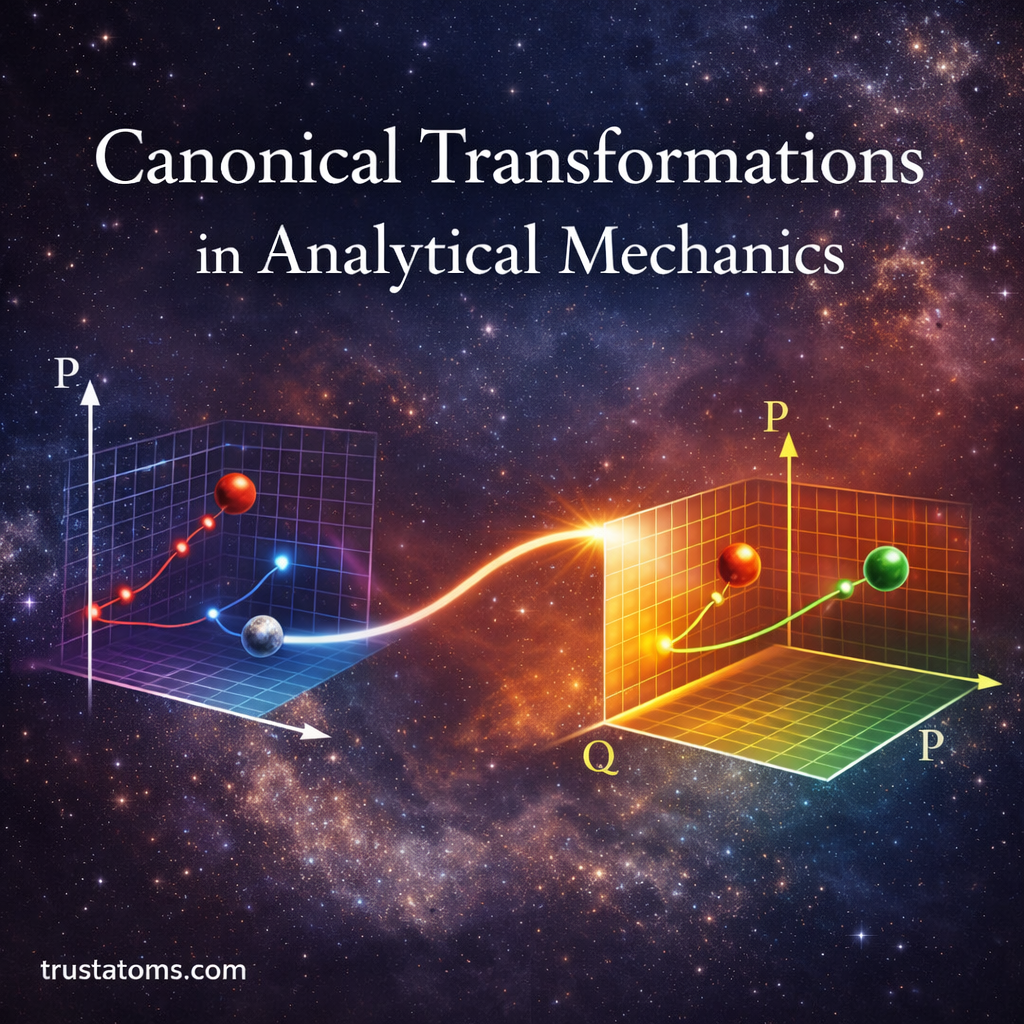
Canonical Transformations in Analytical Mechanics

Illustration of canonical transformations in analytical mechanics showing phase space grids transforming between coordinate systems with overlay title and trustatoms.com watermark.
Conceptual illustration of phase space transformation between canonical coordinate systems in Hamiltonian mechanics. trustatoms.com

In classical mechanics, solving equations of motion can quickly become complicated.

But what if you could change coordinates in a way that preserves the physics while making the math easier?

That is exactly what canonical transformations do.

They are one of the most powerful tools in analytical mechanics, especially within Hamiltonian mechanics. Canonical transformations allow physicists to reformulate a problem into a simpler one — without changing the underlying physical behavior.

This article explains what canonical transformations are, why they matter, and how they connect to deeper ideas like symmetry and conservation laws.

Continue reading “Canonical Transformations in Analytical Mechanics”
Variational Principles in Physical Systems

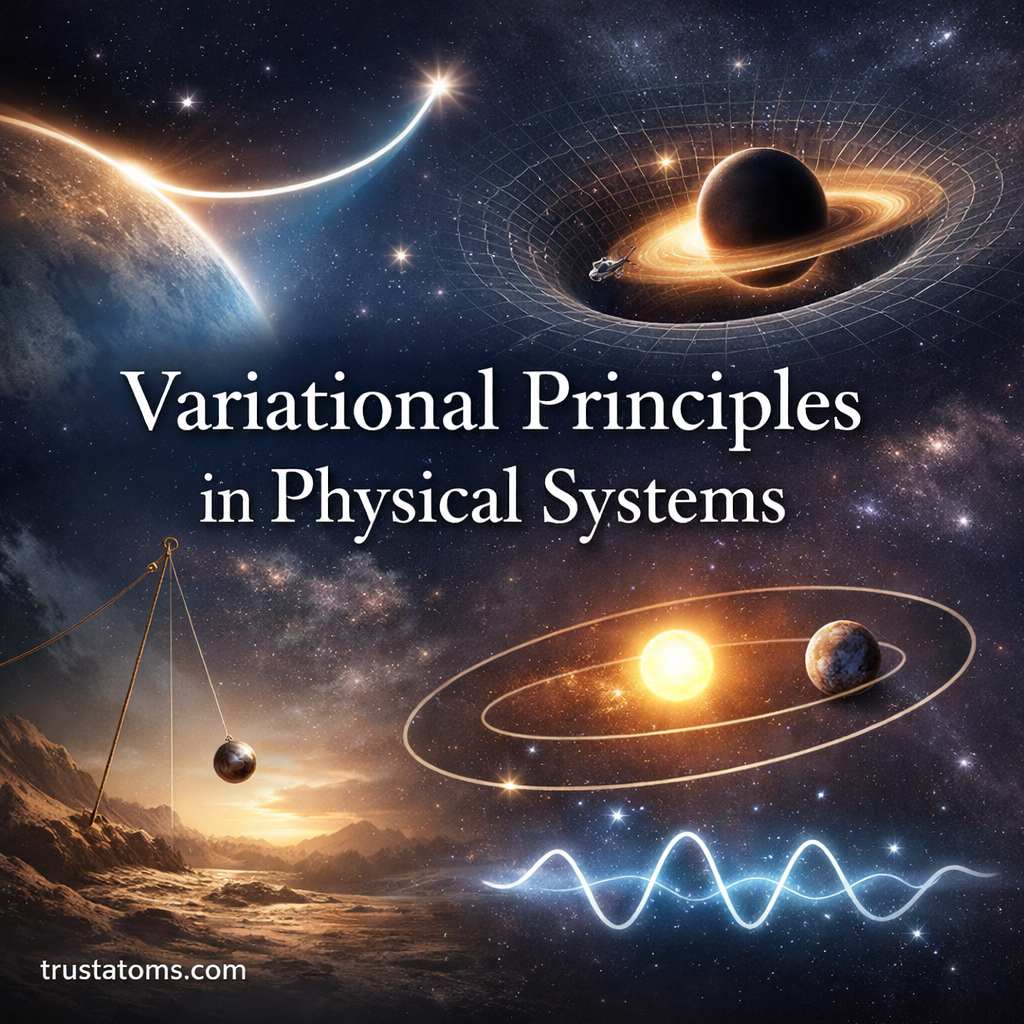
Contextual illustration of variational principles in physical systems showing light paths, planetary motion, spacetime curvature, and wave behavior with the title overlay and trustatoms.com watermark.
Illustration representing how physical systems follow optimization principles across mechanics, optics, relativity, and quantum physics. trustatoms.com

Why does light take the fastest path?
Why do planets follow smooth elliptical orbits?
Why does a hanging chain curve the way it does?

Across physics, the answer often comes down to one powerful idea: nature optimizes.

Variational principles reveal that many physical systems behave as if they are minimizing (or extremizing) something. Instead of focusing on forces directly, we focus on what quantity is optimized.

This article breaks down variational principles in a clear, practical way—connecting classical mechanics, optics, relativity, and even quantum theory.

Continue reading “Variational Principles in Physical Systems”

Lagrangian Formulation of Motion

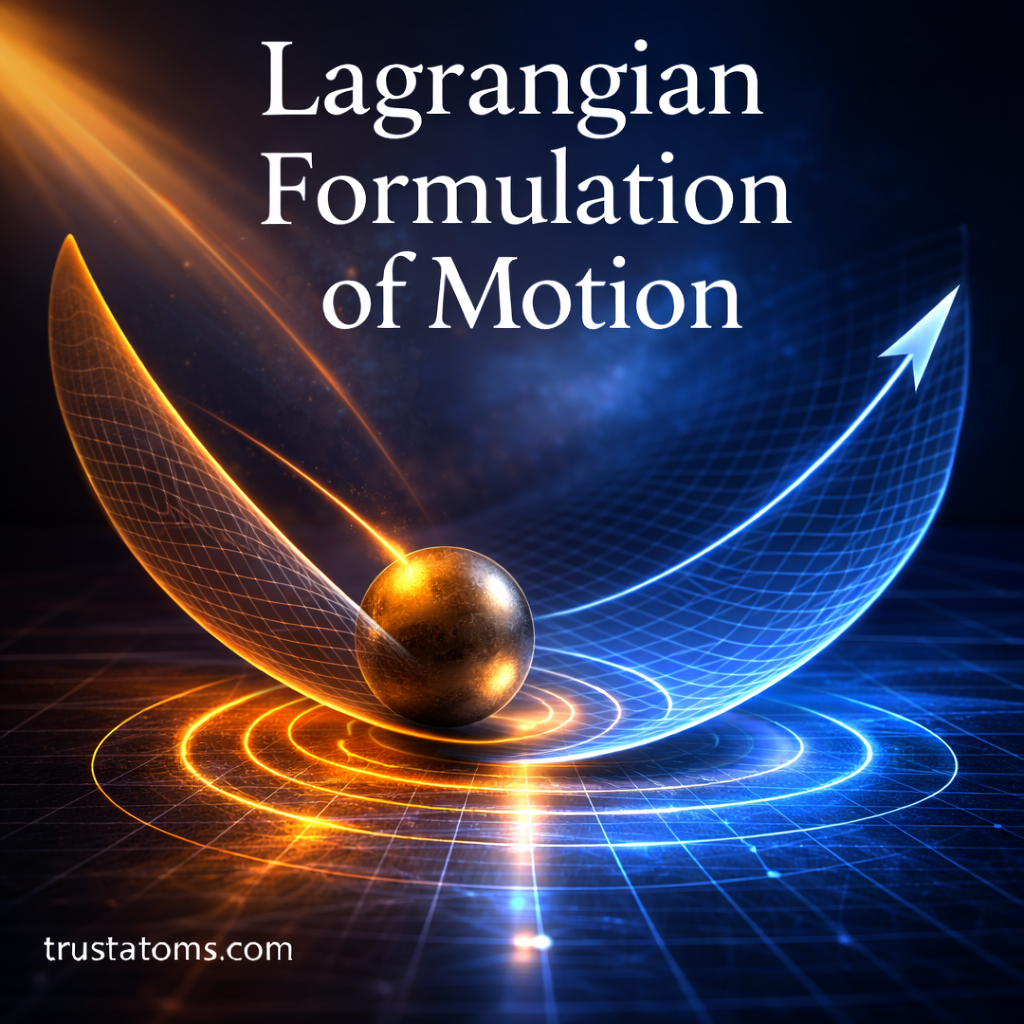
Illustration of the Lagrangian formulation of motion showing an energy surface and particle trajectory, with trustatoms.com watermark.
Conceptual diagram representing the Lagrangian formulation of motion, highlighting energy landscapes and optimal motion paths. trustatoms.com.

The Lagrangian formulation of motion is one of the most elegant ways to describe how physical systems evolve over time. Instead of focusing directly on forces — as Newtonian mechanics does — the Lagrangian approach focuses on energy.

This reformulation simplifies complex systems, reveals deep physical symmetries, and lays the groundwork for modern physics, including quantum mechanics and field theory.

In this article, we’ll explore what the Lagrangian formulation is, how it works, and why it remains essential in classical and modern physics.

Continue reading “Lagrangian Formulation of Motion”

Hamiltonian Mechanics in Classical Systems

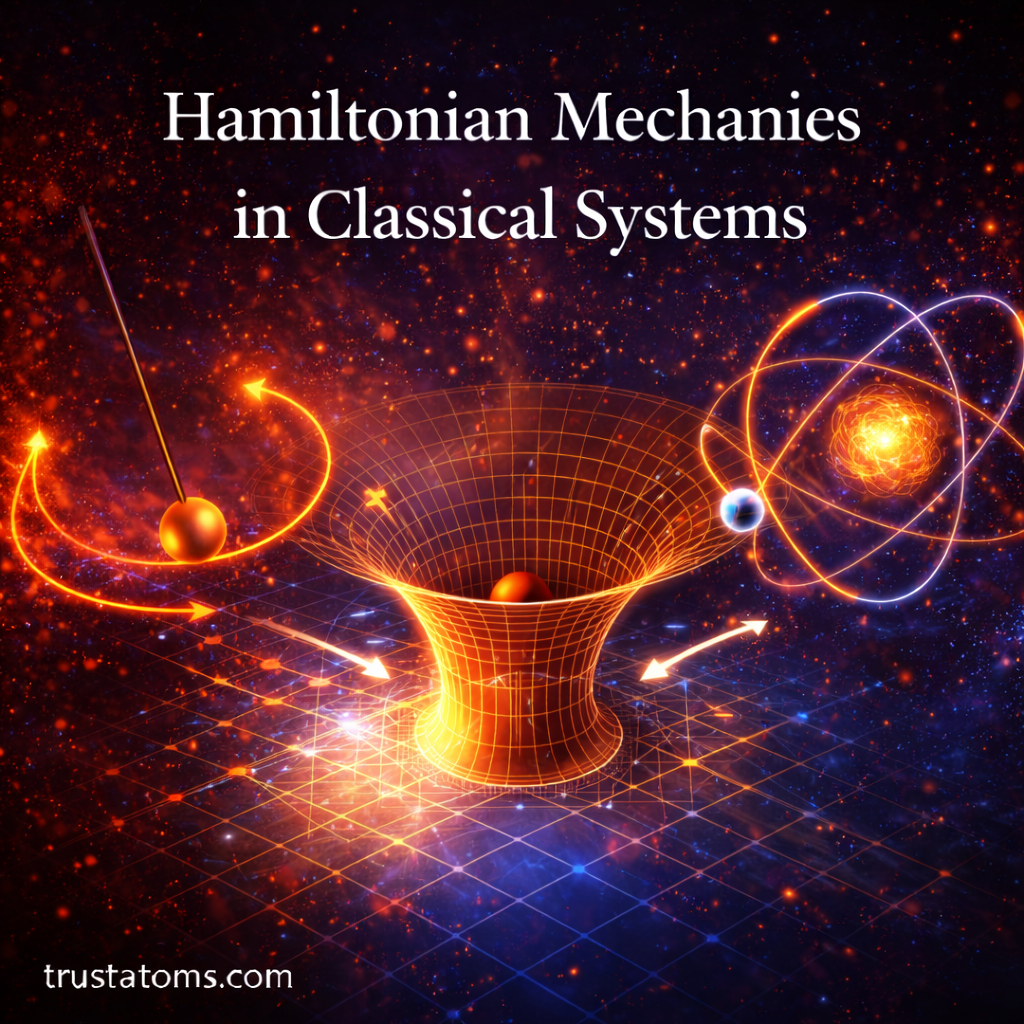
Illustration of Hamiltonian mechanics in classical systems showing phase space motion and energy surfaces, with trustatoms.com watermark.
Conceptual diagram representing Hamiltonian mechanics in classical systems, highlighting phase space trajectories and energy-based motion. trustatoms.com.

Hamiltonian mechanics is one of the most elegant and powerful formulations of classical mechanics. While Newton’s laws describe motion in terms of forces, and Lagrangian mechanics focuses on energy differences, Hamiltonian mechanics reformulates motion using energy functions and phase space.

This framework not only simplifies many complex mechanical systems but also serves as a bridge between classical physics and quantum mechanics.

In this article, we’ll explore what Hamiltonian mechanics is, how it works, and why it remains essential in modern physics.

Continue reading “Hamiltonian Mechanics in Classical Systems”

Radiative Heat Transfer in Thermal Systems

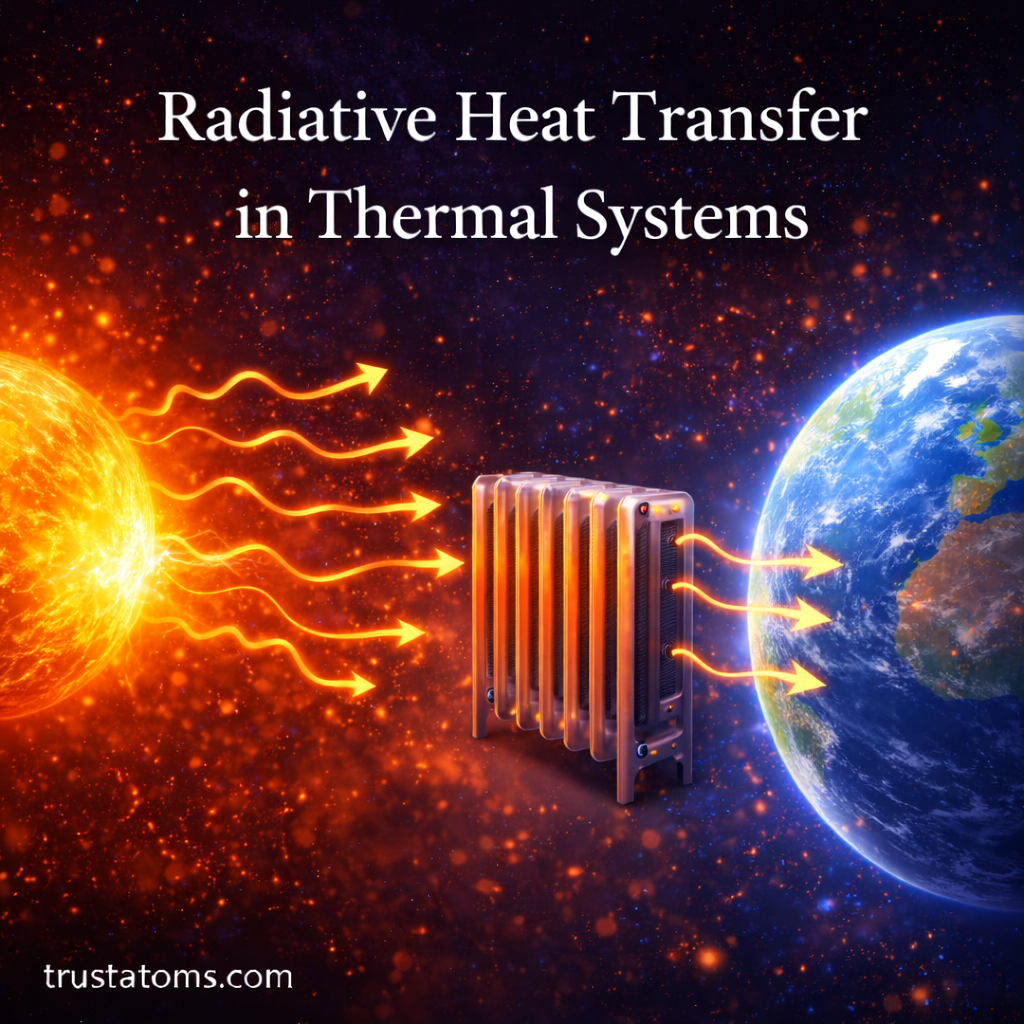
Illustration of radiative heat transfer in thermal systems showing heat energy emitted as electromagnetic radiation between objects, with trustatoms.com watermark.
Conceptual diagram demonstrating radiative heat transfer through electromagnetic waves between heated objects. trustatoms.com.

Heat can move from one place to another in three primary ways:

  • Conduction
  • Convection
  • Radiation

Radiative heat transfer is unique because it does not require matter. Unlike conduction and convection, radiation can transfer energy through empty space.

This is how heat from the Sun reaches Earth and how thermal energy escapes into space. In physics and engineering, understanding radiative heat transfer is essential for designing power plants, spacecraft, insulation systems, and high-temperature equipment.

In this article, we’ll explore how radiative heat transfer works, the physical laws that govern it, and why it plays a critical role in thermal systems.

Continue reading “Radiative Heat Transfer in Thermal Systems”

Photoelectric Effect in Quantum Theory

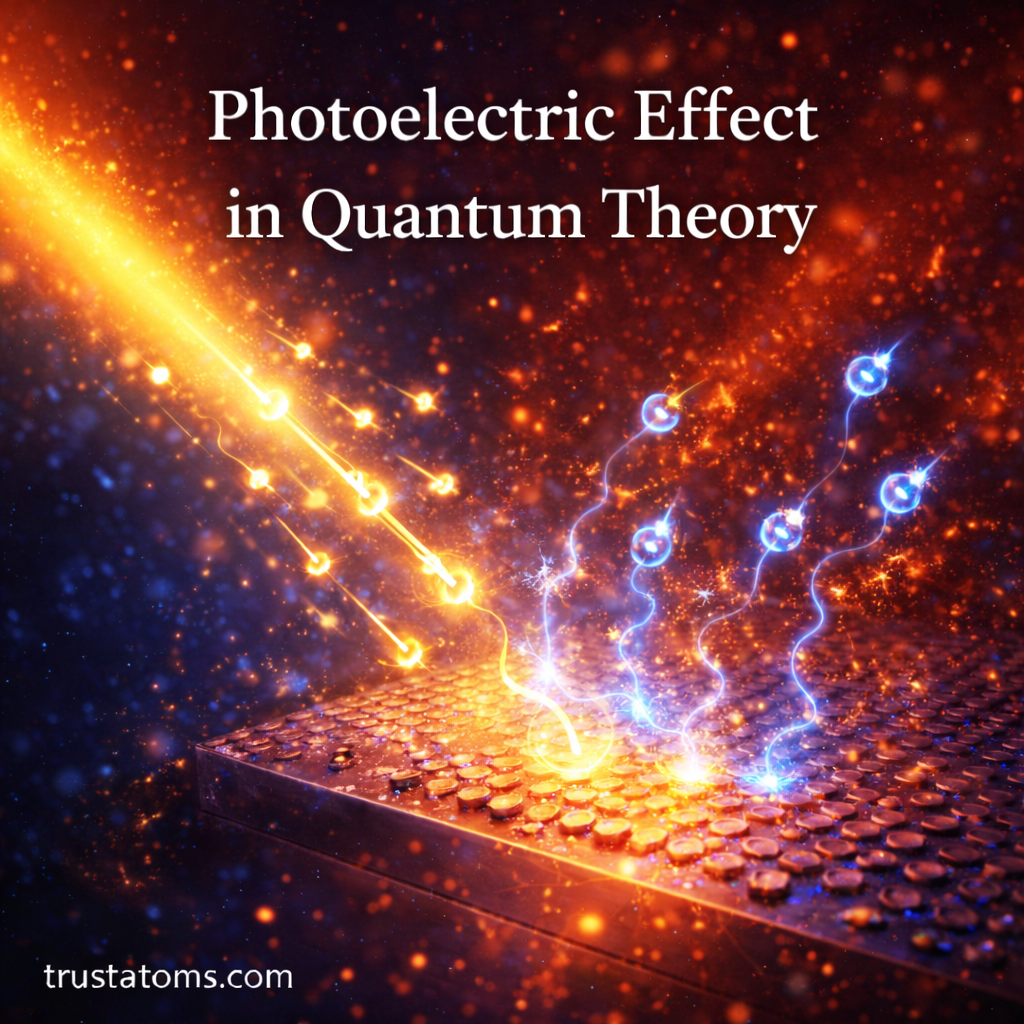
Illustration of the photoelectric effect showing photons striking a metal surface and ejecting electrons, with trustatoms.com watermark.
Conceptual diagram of the photoelectric effect demonstrating photons ejecting electrons from a metal surface. trustatoms.com.

The photoelectric effect is one of the most important experiments in modern physics. It demonstrated that light does not behave purely as a wave — it also behaves like a particle.

This discovery reshaped our understanding of energy, laid the foundation for quantum theory, and helped launch the modern age of electronics and solar power.

In this article, we’ll explore what the photoelectric effect is, why it challenged classical physics, and how it fits into quantum theory.

Continue reading “Photoelectric Effect in Quantum Theory”

Charge Carrier Dynamics in Semiconductors

Illustration of charge carrier dynamics in semiconductors showing electron and hole movement across a p–n junction with trustatoms.com watermark.
Conceptual diagram of charge carrier dynamics in semiconductors, highlighting electron and hole movement across a p–n junction. trustatoms.com.

Every smartphone, computer chip, and solar panel depends on a deep principle in solid-state physics: charge carrier dynamics in semiconductors.

Unlike metals, where electrons flow freely, semiconductors carefully control how electric charge moves. The behavior of charge carriers — electrons and “holes” — determines how transistors switch, how LEDs emit light, and how solar cells generate electricity.

In this article, we’ll explore what charge carriers are, how they move, and why their dynamics are central to modern technology.

Continue reading “Charge Carrier Dynamics in Semiconductors”

Crystal Lattice Structures in Solid State Physics

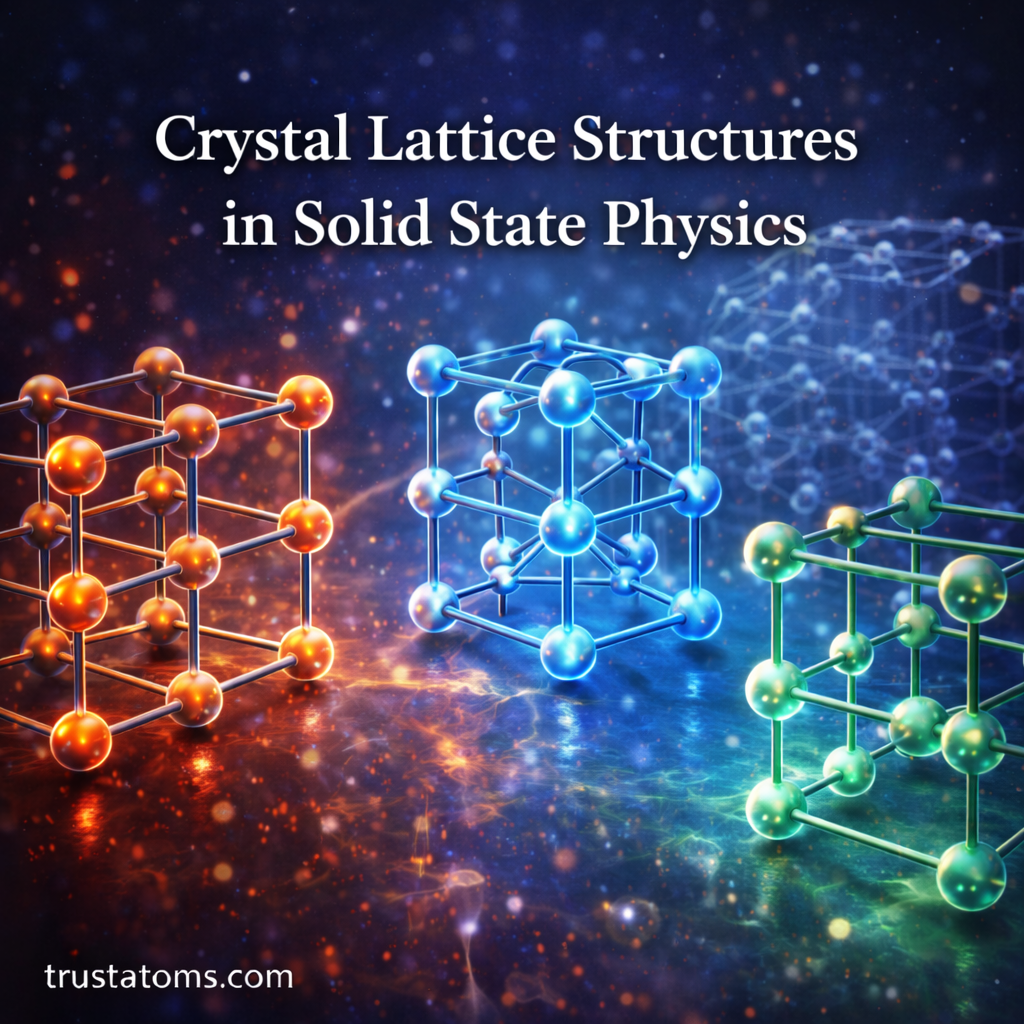
Illustration of crystal lattice structures in solid state physics showing cubic and hexagonal atomic arrangements with trustatoms.com watermark.
Conceptual diagram of crystal lattice structures in solid state physics, highlighting repeating atomic arrangements in crystalline solids. trustatoms.com.

At the microscopic level, solid materials are not random collections of atoms. Instead, their atoms are arranged in highly ordered, repeating patterns known as crystal lattice structures.

These structures determine many of a material’s physical properties — including strength, conductivity, hardness, and optical behavior. In solid state physics, understanding crystal lattices is essential for explaining how metals conduct electricity, how semiconductors power electronics, and how diamonds achieve extreme hardness.

In this article, we’ll explore what crystal lattice structures are, how they form, and why they are foundational to modern physics and materials science.

Continue reading “Crystal Lattice Structures in Solid State Physics”

Superconductivity in Condensed Matter

Illustration of superconductivity in condensed matter showing magnetic levitation above magnets with trustatoms.com watermark.
Conceptual illustration of superconductivity in condensed matter demonstrating magnetic levitation and the Meissner effect. trustatoms.com.

Superconductivity is one of the most fascinating phenomena in condensed matter physics. It describes a state in which certain materials conduct electricity with zero electrical resistance and expel magnetic fields when cooled below a critical temperature.

Discovered over a century ago, superconductivity continues to reshape our understanding of matter and promises transformative applications in energy, medicine, and transportation.

In this article, we’ll explore what superconductivity is, how it works at the atomic level, why it only occurs under special conditions, and where it’s already changing the world.

Continue reading “Superconductivity in Condensed Matter”

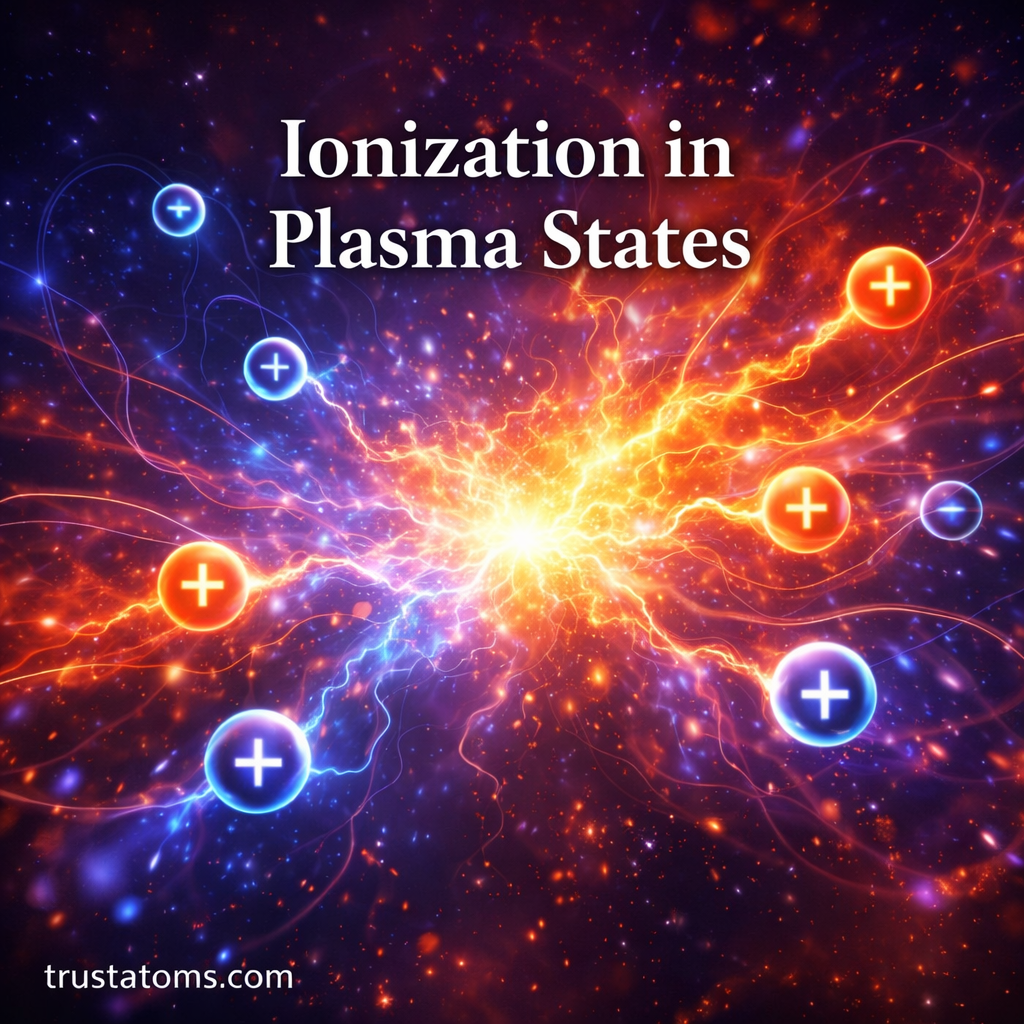
Ionization in Plasma States

Illustration showing ionization in plasma states with charged particles and glowing plasma field, featuring trustatoms.com watermark.
Conceptual illustration of ionization in plasma states, showing how atoms become charged and form electrically conductive plasma. trustatoms.com.

When most people think of matter, they think of solids, liquids, and gases. But there’s a fourth fundamental state that dominates the visible universe: plasma.

Plasma is often described as an “ionized gas,” but what does that actually mean? And how does ionization transform ordinary matter into something that behaves completely differently?

In this article, we’ll explore ionization in plasma states, how it happens, where plasma exists, and why it plays a critical role in physics, energy research, and space science.

Continue reading “Ionization in Plasma States”