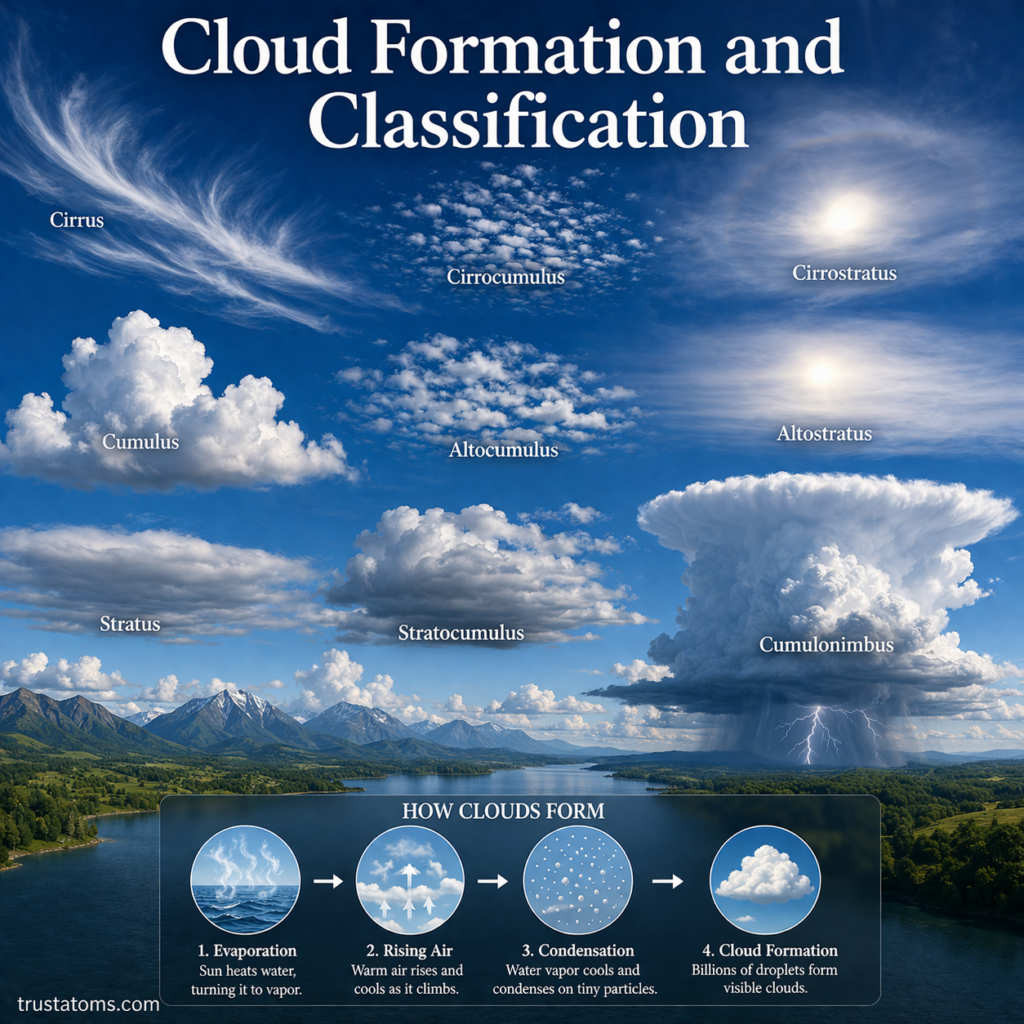
Clouds are one of the most visible and fascinating features of Earth’s atmosphere. They play a critical role in weather, climate, and the water cycle, helping regulate temperature and distribute moisture around the planet.
Understanding how clouds form and how they are classified can help you better interpret weather patterns and predict changes in the sky.
What Are Clouds?
Clouds are made up of tiny water droplets or ice crystals suspended in the air. They form when water vapor in the atmosphere cools and condenses.
Key Components of Clouds
- Water vapor (invisible gas)
- Condensed water droplets or ice crystals
- Tiny particles (dust, salt, or smoke) that act as condensation nuclei
Without these particles, clouds would not easily form.
How Clouds Form
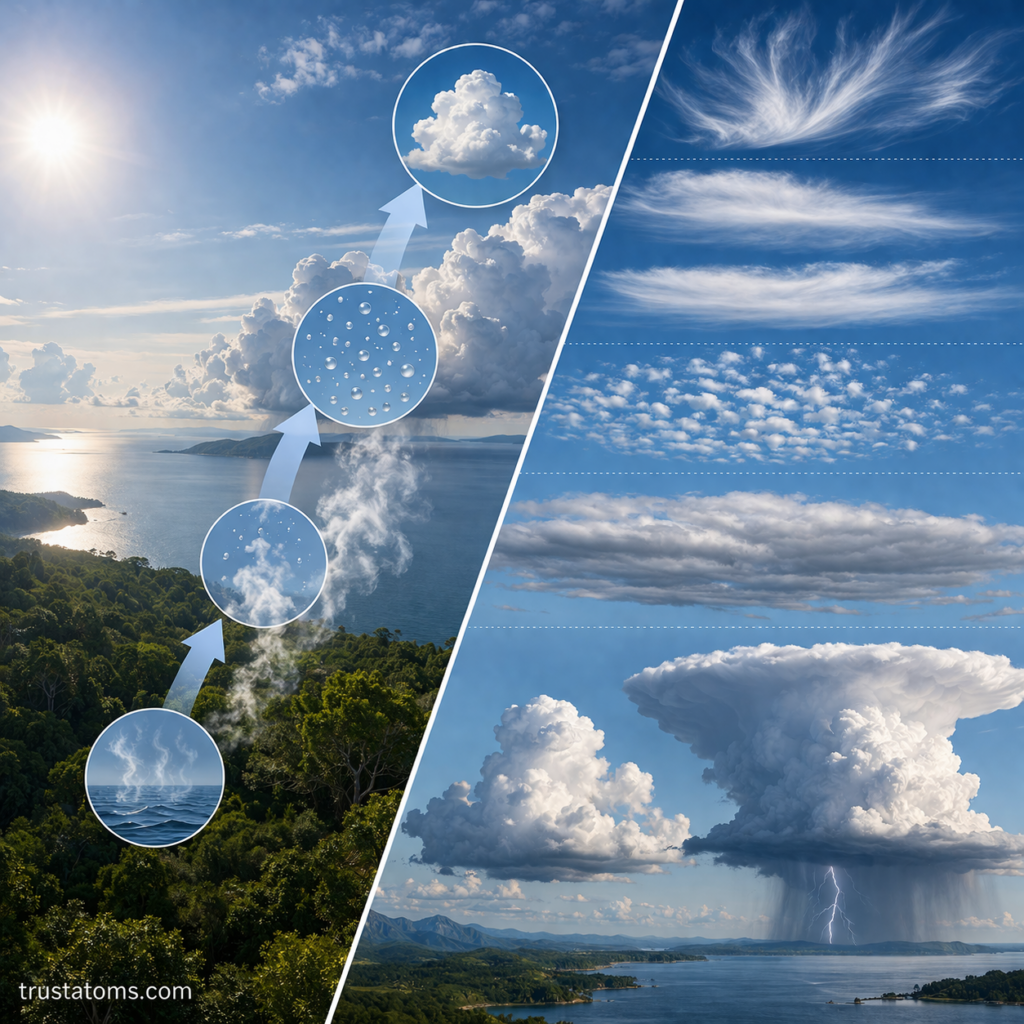
Cloud formation is part of the water cycle and involves several key steps.
The Process of Cloud Formation
- Evaporation
Water from oceans, lakes, and land surfaces turns into water vapor - Cooling Air
Rising air expands and cools as it moves upward - Condensation
Water vapor condenses into tiny droplets around particles - Cloud Development
Billions of droplets group together to form visible clouds
The Role of Rising Air
Clouds typically form when air rises and cools.
Common Causes of Rising Air
- Surface heating (warm air rises)
- Mountains forcing air upward (orographic lifting)
- Air masses colliding (frontal lifting)
- Converging winds
As air rises, pressure decreases, causing expansion and cooling—key conditions for condensation.
Cloud Classification Basics
Clouds are classified based on two main factors:
- Shape (form)
- Altitude (height in the atmosphere)
This system helps meteorologists identify weather conditions and predict changes.
The Three Main Cloud Types (by Shape)
1. Cirrus Clouds
- Thin, wispy, and feather-like
- Made mostly of ice crystals
- Found at high altitudes
What they indicate:
- Fair weather
- Possible weather changes ahead
2. Cumulus Clouds
- Puffy, white, cotton-like appearance
- Flat bases and rounded tops
- Form in rising warm air
What they indicate:
- Fair weather when small
- Possible storms if they grow larger
3. Stratus Clouds
- Low, gray, and uniform layers
- Cover large portions of the sky
What they indicate:
- Overcast conditions
- Light precipitation or drizzle
Cloud Types by Altitude
Clouds are also grouped based on their height in the atmosphere.
High-Level Clouds (Above ~6,000 m / 20,000 ft)
- Cirrus (Ci)
- Cirrostratus (Cs)
- Cirrocumulus (Cc)
Characteristics:
- Made of ice crystals
- Thin and wispy
- Often indicate stable conditions or incoming weather systems
Mid-Level Clouds (2,000–6,000 m / 6,500–20,000 ft)
- Altostratus (As)
- Altocumulus (Ac)
Characteristics:
- Composed of water droplets and ice crystals
- Often signal approaching storms
Low-Level Clouds (Below 2,000 m / 6,500 ft)
- Stratus (St)
- Stratocumulus (Sc)
- Nimbostratus (Ns)
Characteristics:
- Dense and thick
- Associated with overcast skies and precipitation
Vertical Development Clouds
- Cumulonimbus (Cb)
- Towering cumulus
Characteristics:
- Extend through multiple layers
- Associated with strong weather events
Cumulonimbus: The Storm Cloud
Cumulonimbus clouds are the most powerful cloud type.
Key Features
- Tall, towering structure
- Flat anvil-shaped top
- Can reach the upper atmosphere
What They Produce
- Thunderstorms
- Heavy rain
- Lightning
- Tornadoes
- Hail
Why Clouds Matter
Clouds are essential for Earth’s climate and weather systems.
Key Roles
- Regulate temperature by reflecting sunlight
- Trap heat in the atmosphere
- Transport water through the water cycle
- Signal changing weather conditions
How to Identify Clouds in Everyday Life
You can often predict weather by observing clouds.
Quick Tips
- Wispy cirrus → fair weather now, changes later
- Puffy cumulus → generally fair conditions
- Dark, towering clouds → possible storms
- Thick gray layers → steady rain likely
Common Misconceptions About Clouds
Myth: Clouds are weightless
- Clouds can weigh millions of pounds due to the amount of water they contain
Myth: All clouds bring rain
- Many clouds do not produce precipitation
Final Thoughts
Cloud formation and classification provide valuable insight into how Earth’s atmosphere works. By learning to recognize different cloud types and understanding how they form, you can better interpret weather patterns and anticipate changes in the environment.
From light, wispy cirrus clouds to towering storm systems, clouds are a dynamic and essential part of life on Earth.