Coastal landforms are constantly shaped and reshaped by the powerful forces of waves, tides, and currents. Along shorelines around the world, wave action plays a central role in carving cliffs, forming beaches, and creating dramatic features like arches and sea stacks.
Understanding how waves interact with land helps explain why coastlines look the way they do—and why they are always changing.
What Is Wave Action?
Wave action refers to the movement and energy of ocean waves as they interact with the shoreline.
Waves are generated primarily by wind blowing across the surface of the ocean. As they travel, they carry energy toward the coast, where that energy is released through:
- Erosion (wearing away land)
- Transportation (moving sediments)
- Deposition (dropping materials in new locations)
These three processes work together to shape coastal landscapes over time.
How Waves Shape the Coastline
Wave action affects coastlines through several key mechanisms.
Hydraulic Action
This occurs when waves crash against rocks, forcing air and water into cracks. The pressure weakens the rock, causing pieces to break off.
Abrasion (Corrasion)
Waves carry sand, pebbles, and rocks that scrape and grind against the shoreline, gradually wearing it down like sandpaper.
Attrition
As rocks and sediments collide with each other in the water, they break into smaller, smoother pieces over time.
Solution (Corrosion)
Some rocks, such as limestone, are dissolved by slightly acidic seawater, contributing to coastal erosion.
Major Coastal Landforms Created by Erosion
Wave erosion creates some of the most striking features along coastlines.
Sea Cliffs
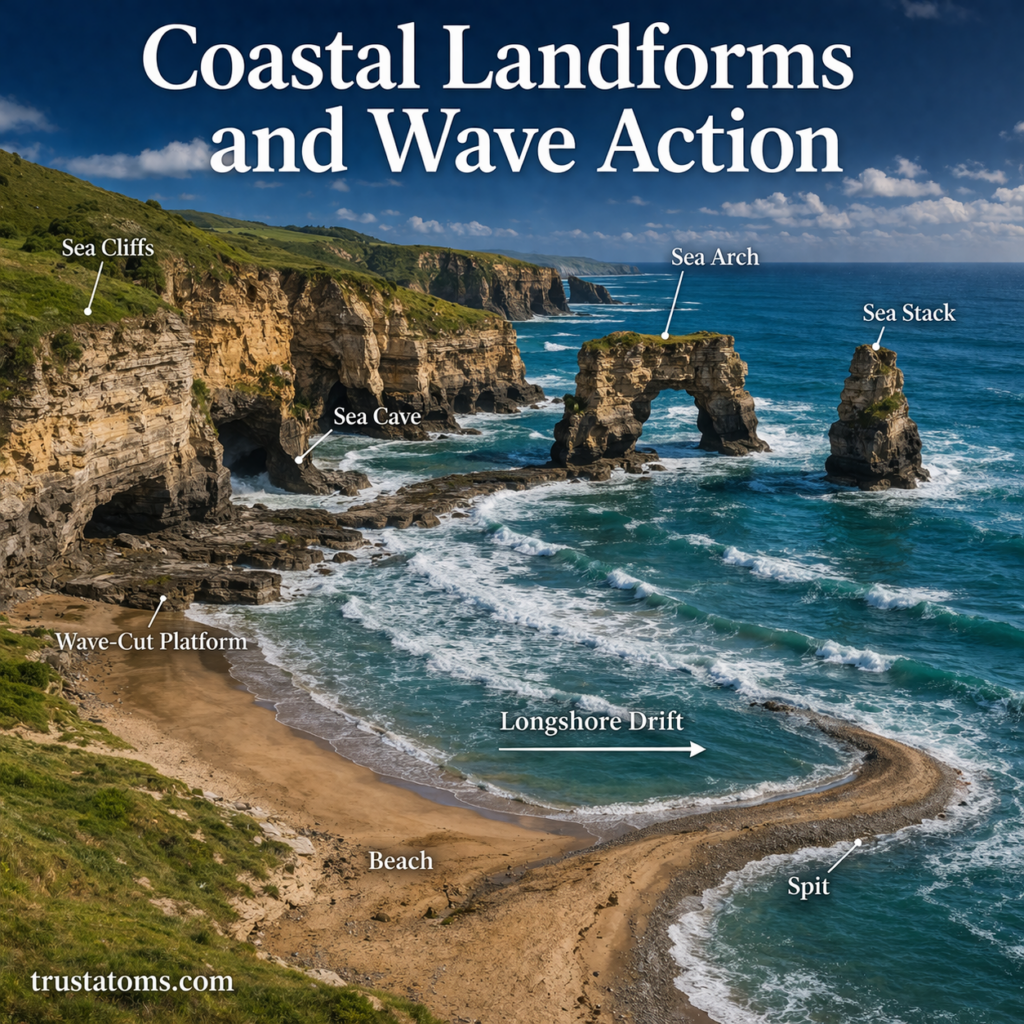
Steep rock faces formed when waves erode the base of coastal land. Over time, undercutting causes sections of the cliff to collapse.
Wave-Cut Platforms
Flat, rocky surfaces at the base of cliffs created as waves erode the shoreline and the cliff retreats inland.
Sea Caves
Caves form when waves exploit weaknesses in rock, enlarging cracks and hollowing out sections of the coastline.
Sea Arches
When erosion continues through a headland, it can create an arch that connects two sides of a rock formation.
Sea Stacks
When arches collapse, isolated pillars of rock remain standing in the ocean—these are called sea stacks.
Coastal Landforms Created by Deposition
Not all wave action destroys land—sometimes it builds it.
Beaches
Beaches form when waves deposit sand, gravel, and other sediments along the shoreline.
Factors that influence beach formation include:
- Wave energy
- Sediment supply
- Coastal slope
Sandbars
Sandbars are submerged or partially exposed ridges of sand formed by wave and current activity.
Spits
Spits are narrow stretches of sand or gravel that extend from the coastline into the sea, formed by longshore drift.
Barrier Islands
Barrier islands are long, narrow landforms that run parallel to the coast, protecting the mainland from strong waves and storms.
Longshore Drift: Moving Sediment Along the Coast
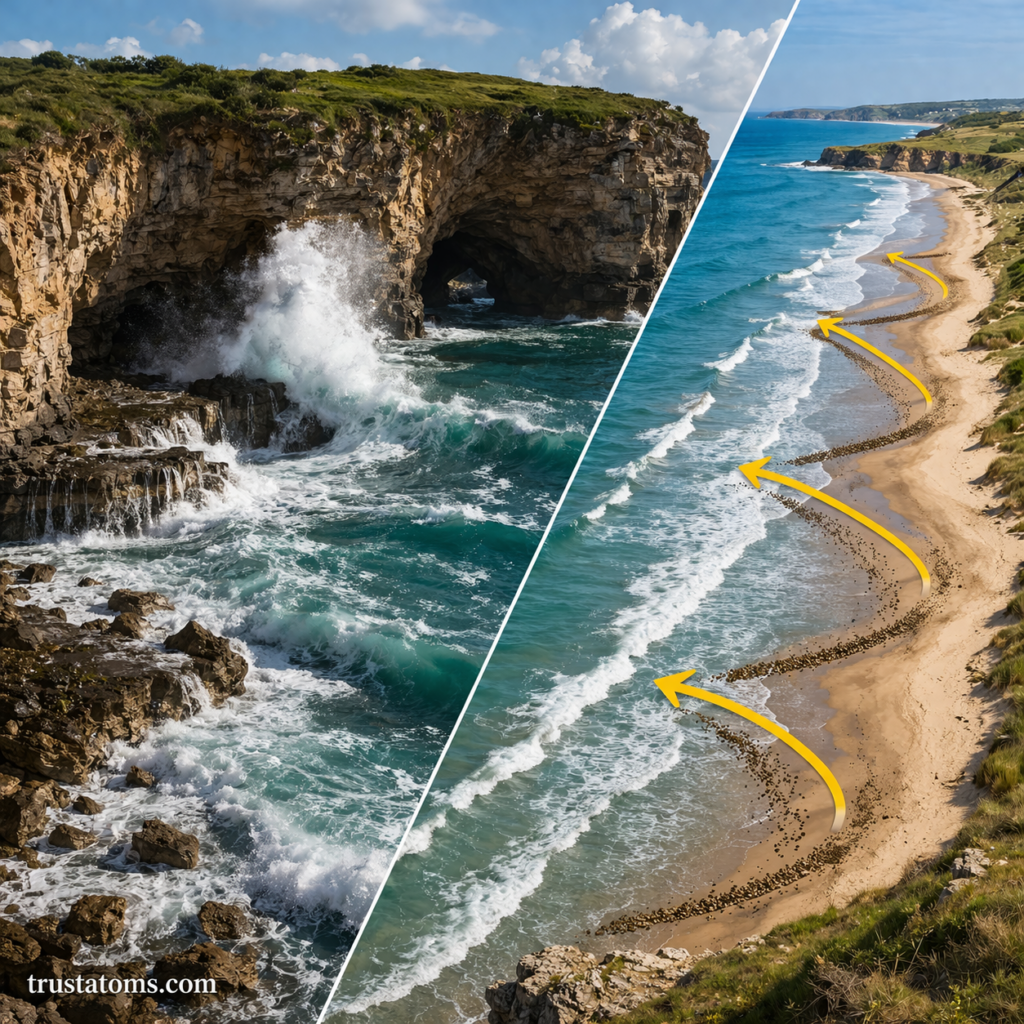
Longshore drift is a key process in shaping coastal landforms.
It occurs when waves approach the shore at an angle, causing sediment to move in a zigzag pattern along the coastline.
How It Works
- Waves carry sediment up the beach at an angle
- Gravity pulls the sediment straight back down
- Repeated motion moves material along the shore over time
This process is responsible for building features like spits and redistributing sand along beaches.
Factors That Influence Coastal Landforms
Not all coastlines look the same. Several factors determine how wave action shapes a particular area.
Rock Type
- Hard rocks (like granite) resist erosion
- Soft rocks (like clay or sandstone) erode more quickly
Wave Energy
- High-energy waves cause rapid erosion
- Low-energy waves promote deposition
Tides
Tidal range affects how much of the coastline is exposed to wave action.
Human Activity
Coastal development, seawalls, and breakwaters can alter natural processes, sometimes protecting land but also disrupting sediment movement.
Erosional vs Depositional Coasts
Coastlines can generally be classified based on dominant processes.
Erosional Coasts
- Characterized by cliffs, caves, arches, and stacks
- Common in areas with strong wave action
- Often rugged and steep
Depositional Coasts
- Characterized by beaches, spits, and barrier islands
- Found in areas with lower wave energy
- Typically flatter and more stable
Why Coastal Landforms Matter
Coastal landforms are not just visually striking—they are essential to both natural systems and human life.
Environmental Importance
- Provide habitats for marine and coastal species
- Protect inland areas from storms and flooding
- Support ecosystems like dunes and wetlands
Economic and Social Value
- Attract tourism and recreation
- Support fishing and coastal industries
- Provide natural protection for coastal communities
Coastal Hazards and Challenges
While coastlines are beautiful, they can also be unpredictable and hazardous.
Coastal Erosion
- Loss of land due to wave action
- Threatens homes, roads, and infrastructure
Storm Surges
- Elevated sea levels during storms can flood coastal areas
- Barrier islands and dunes help reduce impact
Sea Level Rise
- Caused by climate change
- Increases erosion and flooding risks
Managing Coastal Environments
To protect coastlines, scientists and planners use various management strategies.
Hard Engineering
- Seawalls
- Groynes
- Breakwaters
These structures aim to control wave energy but can disrupt natural sediment flow.
Soft Engineering
- Beach nourishment (adding sand)
- Dune restoration
- Managed retreat
These approaches work with natural processes to maintain coastal balance.
Final Thoughts
Coastal landforms are shaped by the constant interaction between land and sea. Through erosion, transportation, and deposition, waves create a dynamic and ever-changing environment.
From towering sea cliffs to sandy beaches, these features tell the story of powerful natural forces at work. Understanding wave action not only helps us appreciate coastal beauty but also prepares us to manage and protect these valuable landscapes for the future.