The Coriolis effect is one of the most important forces shaping Earth’s weather systems. It influences how air moves across the planet, affects wind patterns, and plays a key role in the formation of storms.
Without the Coriolis effect, global weather patterns would look completely different, and many of the systems we rely on for forecasting would not exist in their current form.
What Is the Coriolis Effect?
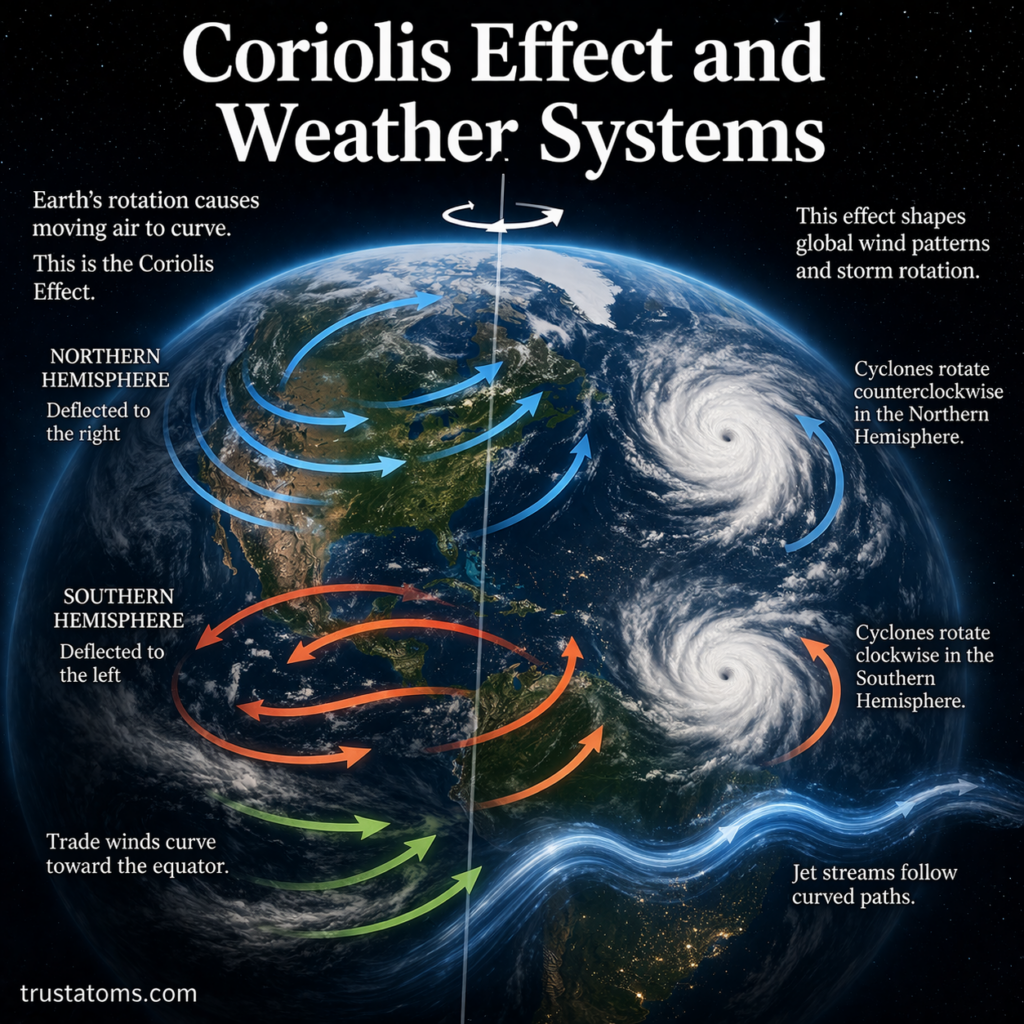
The Coriolis effect is the apparent deflection of moving objects—such as air or water—caused by Earth’s rotation.
As Earth spins, different parts of the planet move at different speeds. This causes moving air to curve rather than travel in a straight line.
Key Concept
- It is not a force you can feel directly
- It is an effect of Earth’s rotation
- It becomes more noticeable over long distances
How the Coriolis Effect Works
Earth rotates from west to east. Because of this:
- Objects moving north or south appear to curve
- The amount of deflection depends on latitude
Direction of Deflection
- Northern Hemisphere → deflects to the right
- Southern Hemisphere → deflects to the left
Where It Is Strongest
- Strongest near the poles
- Weakest near the equator
Why the Coriolis Effect Occurs
The effect exists because Earth is a rotating sphere.
Key Reasons
- Different latitudes move at different speeds
- The equator moves faster than the poles
- Moving air retains its original momentum
As air travels across latitudes, it appears to shift direction due to these differences.
The Coriolis Effect and Wind Patterns
The Coriolis effect plays a major role in shaping global wind systems.
Impact on Winds
- Prevents air from moving directly north or south
- Creates curved wind paths
- Helps form major wind belts
Examples
- Trade winds curve westward
- Westerlies curve eastward
- Polar winds follow curved paths
The Coriolis Effect and Atmospheric Circulation
Global atmospheric circulation depends heavily on the Coriolis effect.
How It Influences Circulation Cells
- Deflects air in the Hadley, Ferrel, and Polar cells
- Maintains consistent wind directions
- Helps distribute heat across the planet
Without this effect, air would move in simple straight lines between the equator and poles.
The Coriolis Effect and Weather Systems
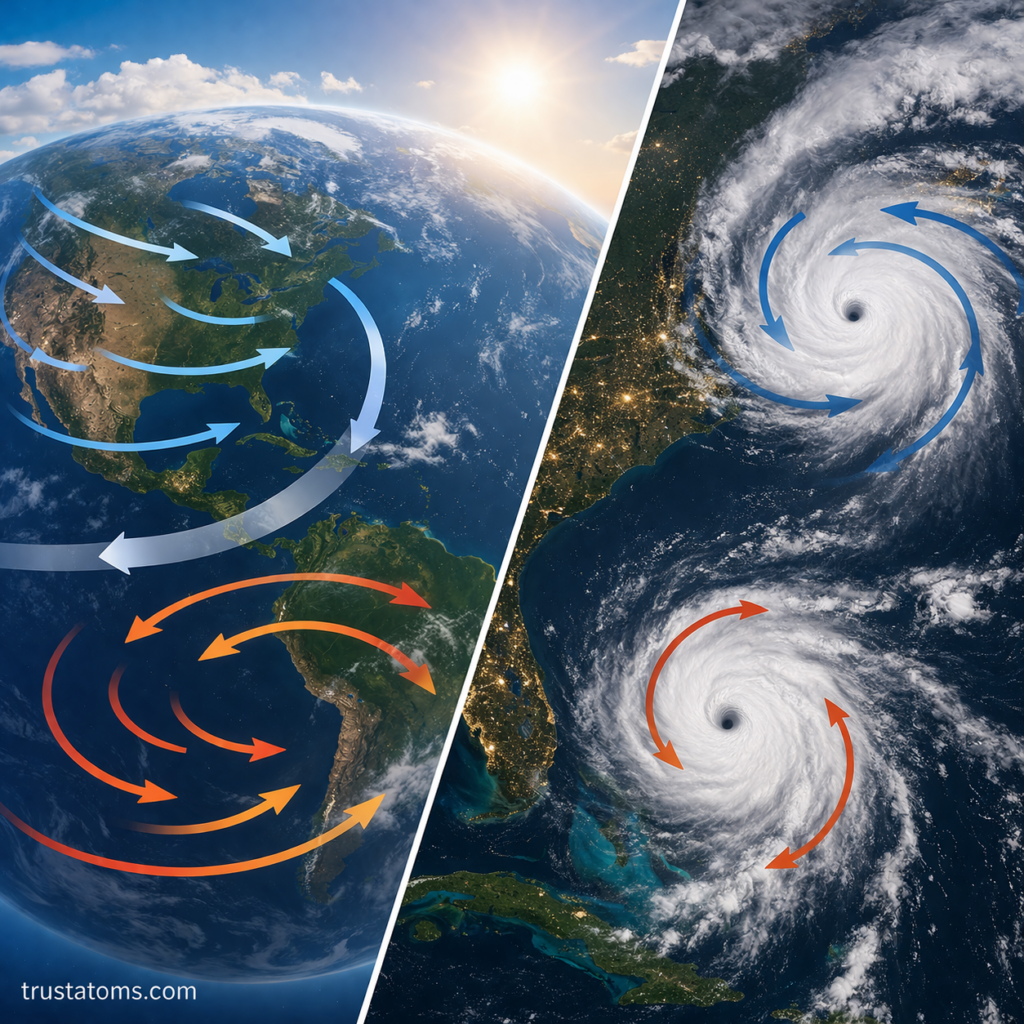
The Coriolis effect is essential in the development and behavior of weather systems.
1. Storm Rotation
- Causes cyclones to spin
- Determines direction of rotation
Rotation patterns:
- Northern Hemisphere → counterclockwise
- Southern Hemisphere → clockwise
2. Pressure Systems
- Air moving toward low pressure is deflected
- Creates circular wind patterns around pressure centers
Results:
- High-pressure systems rotate outward
- Low-pressure systems rotate inward
3. Jet Streams
- The Coriolis effect helps guide jet stream paths
- Maintains their west-to-east flow
- Contributes to their wave-like patterns
Real-World Examples
You can observe the Coriolis effect in many natural phenomena:
- Hurricanes rotating in opposite directions across hemispheres
- Trade winds shaping ocean currents
- Jet streams influencing flight paths and weather
Common Misconceptions
Myth: It affects small-scale motion like water draining
- The Coriolis effect is too weak to influence small systems like sinks or toilets
Myth: It is a physical force you can feel
- It is an apparent effect caused by Earth’s rotation, not a direct force
Why the Coriolis Effect Matters
Understanding the Coriolis effect is essential for:
- Weather forecasting
- Climate science
- Aviation and navigation
- Ocean circulation studies
It helps scientists predict storm movement, wind behavior, and global climate patterns.
Key Takeaways
- The Coriolis effect is caused by Earth’s rotation
- It deflects moving air and water
- It shapes wind patterns and storm systems
- It is strongest near the poles and weakest at the equator
Final Thoughts
The Coriolis effect may be invisible, but its impact on Earth’s weather systems is profound. From guiding winds to shaping powerful storms, it is a key factor in how our atmosphere behaves.
By understanding this concept, you gain deeper insight into the forces that drive weather patterns across the globe.