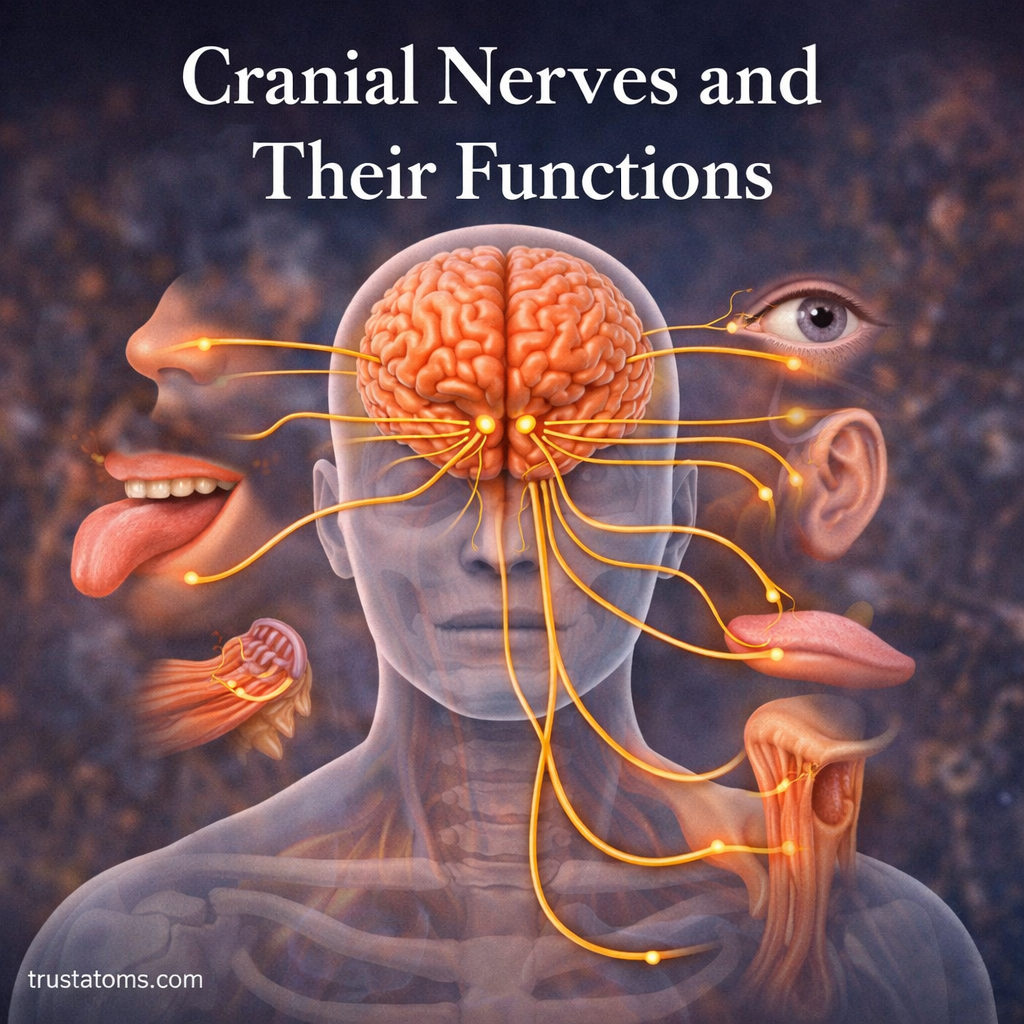
Cranial nerves are a group of 12 pairs of nerves that originate directly from the brain rather than the spinal cord. These nerves play a critical role in controlling sensory perception, muscle movement, and essential body functions in the head, neck, and some internal organs.
They allow the brain to process sensory information such as smell, vision, hearing, taste, and facial sensation while also controlling movements like eye motion, facial expressions, and swallowing.
Understanding cranial nerves helps explain how the nervous system manages many everyday actions that occur without conscious thought.
What Are Cranial Nerves?
Cranial nerves are part of the peripheral nervous system, but they connect directly to structures in the brain. Each cranial nerve has a specific number and name, based on the order in which it emerges from the brain.
These nerves carry three main types of signals:
- Sensory signals – information traveling from sensory organs to the brain
- Motor signals – commands sent from the brain to muscles
- Mixed signals – nerves that carry both sensory and motor information
Together, cranial nerves control many of the body’s most important sensory and motor functions.
The 12 Cranial Nerves
Each cranial nerve is numbered using Roman numerals (I–XII) and has a specific role.
I – Olfactory Nerve
The olfactory nerve is responsible for the sense of smell.
Key functions include:
- Detecting odor molecules in the nasal cavity
- Sending smell signals to the brain’s olfactory centers
This nerve plays a major role in flavor perception and environmental awareness.
II – Optic Nerve
The optic nerve transmits visual information from the eyes to the brain.
Its functions include:
- Carrying signals from the retina
- Allowing the brain to interpret images
- Supporting visual perception such as color and movement
Damage to the optic nerve can result in vision loss.
III – Oculomotor Nerve
The oculomotor nerve controls several muscles that move the eyes.
Functions include:
- Moving the eye upward, downward, and inward
- Controlling eyelid elevation
- Regulating pupil size
This nerve helps coordinate smooth eye movements and visual focus.
IV – Trochlear Nerve
The trochlear nerve controls a single eye muscle called the superior oblique muscle.
This muscle helps:
- Rotate the eye
- Move the eye downward and inward
The trochlear nerve is the smallest cranial nerve but plays an important role in precise eye movement.
V – Trigeminal Nerve
The trigeminal nerve is the largest cranial nerve and is responsible for facial sensation and chewing.
It has three major branches:
- Ophthalmic branch – sensation from the forehead and eyes
- Maxillary branch – sensation from the upper jaw and cheeks
- Mandibular branch – sensation from the lower jaw and motor control for chewing
This nerve is essential for both sensation and motor function in the face.
VI – Abducens Nerve
The abducens nerve controls the lateral rectus muscle, which moves the eye outward.
Its primary function is:
- Allowing the eye to move away from the nose
This movement helps coordinate horizontal eye motion.
VII – Facial Nerve
The facial nerve controls facial expressions and several sensory functions.
Key roles include:
- Controlling facial muscles
- Supporting taste sensation from the front two-thirds of the tongue
- Regulating tear and saliva production
This nerve allows people to smile, frown, blink, and show emotion.
VIII – Vestibulocochlear Nerve
The vestibulocochlear nerve manages both hearing and balance.
It contains two components:
- Cochlear nerve – responsible for hearing
- Vestibular nerve – responsible for balance and spatial orientation
This nerve allows the brain to interpret sound and maintain equilibrium.
IX – Glossopharyngeal Nerve
The glossopharyngeal nerve serves both sensory and motor functions.
It helps with:
- Taste from the back of the tongue
- Swallowing
- Monitoring blood pressure and oxygen levels
- Saliva production
This nerve plays an important role in throat and circulatory regulation.
X – Vagus Nerve
The vagus nerve is the longest cranial nerve and extends beyond the head and neck into the chest and abdomen.
It regulates many automatic body functions, including:
- Heart rate
- Digestion
- Breathing
- Swallowing
- Voice production
Because it controls so many organs, the vagus nerve is essential for maintaining internal balance.
XI – Accessory Nerve
The accessory nerve controls muscles involved in head and shoulder movement.
Its functions include:
- Turning the head
- Shrugging the shoulders
- Stabilizing neck movements
It mainly activates the sternocleidomastoid and trapezius muscles.
XII – Hypoglossal Nerve
The hypoglossal nerve controls movements of the tongue.
These movements are essential for:
- Speaking
- Swallowing
- Chewing
- Moving food during digestion
Without this nerve, coordinated tongue movement would not be possible.
Types of Cranial Nerves
Cranial nerves can be grouped into three categories based on function.
Sensory Cranial Nerves
These nerves primarily carry sensory information to the brain.
Examples include:
- Olfactory nerve (smell)
- Optic nerve (vision)
- Vestibulocochlear nerve (hearing and balance)
Motor Cranial Nerves
Motor cranial nerves control muscle movement.
Examples include:
- Oculomotor nerve
- Trochlear nerve
- Abducens nerve
- Accessory nerve
- Hypoglossal nerve
Mixed Cranial Nerves
Mixed nerves carry both sensory and motor signals.
Examples include:
- Trigeminal nerve
- Facial nerve
- Glossopharyngeal nerve
- Vagus nerve
These nerves coordinate complex sensory and motor activities.
Why Cranial Nerves Are Important
Cranial nerves are essential for everyday sensory experiences and motor control.
They allow the body to:
- See, hear, smell, and taste
- Move the eyes and face
- Maintain balance
- Control swallowing and speech
- Regulate internal organs
Without these nerves, many basic human functions would not be possible.
How Doctors Test Cranial Nerve Function
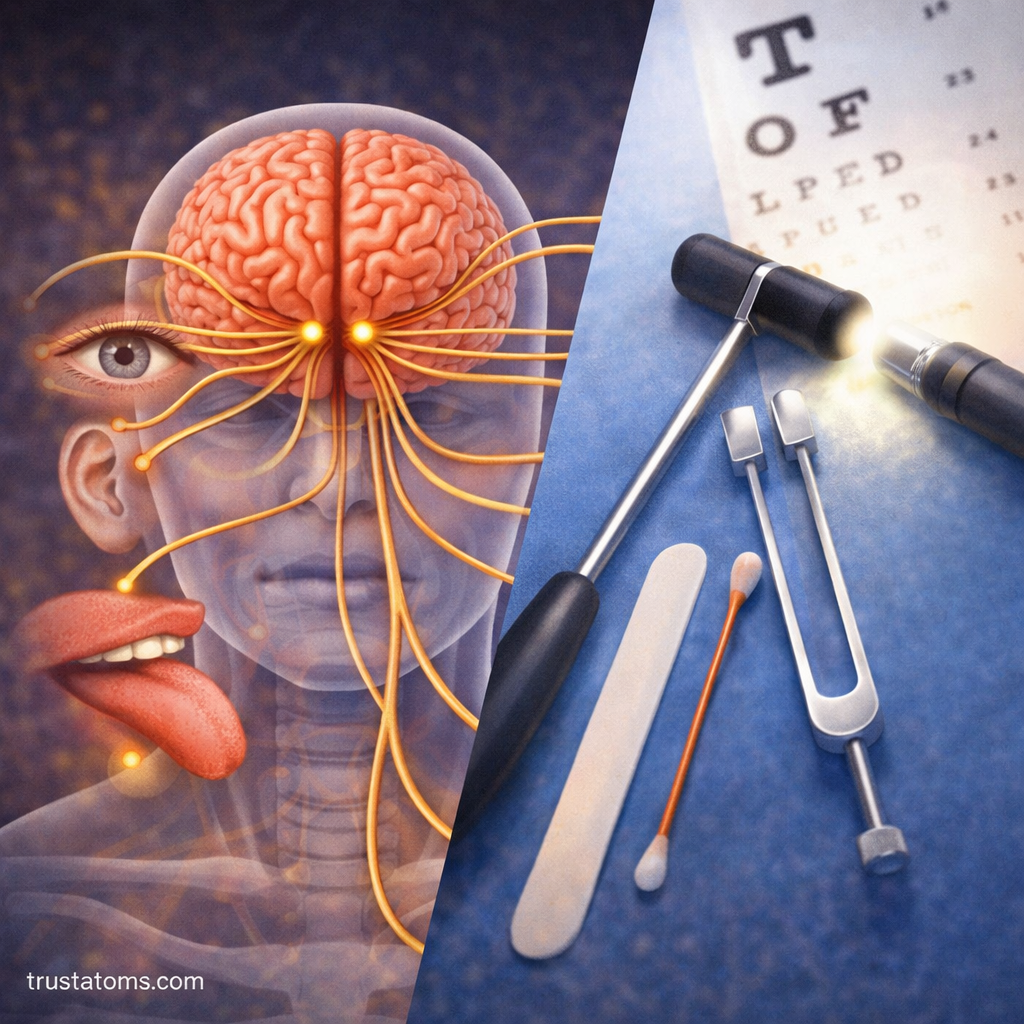
During neurological examinations, doctors often test cranial nerve function to evaluate brain health.
Common tests include:
- Checking pupil reactions to light
- Testing eye movement
- Evaluating facial muscle strength
- Assessing hearing ability
- Observing tongue and swallowing movements
These tests help identify potential damage or neurological disorders.
Final Thoughts
The 12 cranial nerves form a vital communication network between the brain and many parts of the body. They control essential sensory abilities such as sight, smell, hearing, and taste while also managing muscle movements and internal organ functions.
By coordinating sensory input and motor responses, cranial nerves help maintain balance, facial expression, communication, and many automatic body processes. Understanding these nerves provides valuable insight into how the nervous system supports daily life and overall health.