Walking is one of the most fundamental human movements, yet it involves a highly coordinated interaction between muscles, joints, nerves, and balance systems. Gait mechanics refers to how the body moves during walking—an efficient, repeatable pattern that allows humans to travel with minimal energy expenditure.
Understanding gait mechanics is important in fields like physical therapy, sports science, and rehabilitation, as even small abnormalities can affect posture, balance, and long-term joint health.
What Is Gait?
Gait is the pattern of movement of the limbs during locomotion. In walking, it describes how the legs and feet coordinate with the rest of the body to produce forward motion.
A normal gait is:
- Smooth and rhythmic
- Energy-efficient
- Symmetrical between both sides of the body
- Stable enough to maintain balance
The Gait Cycle Explained
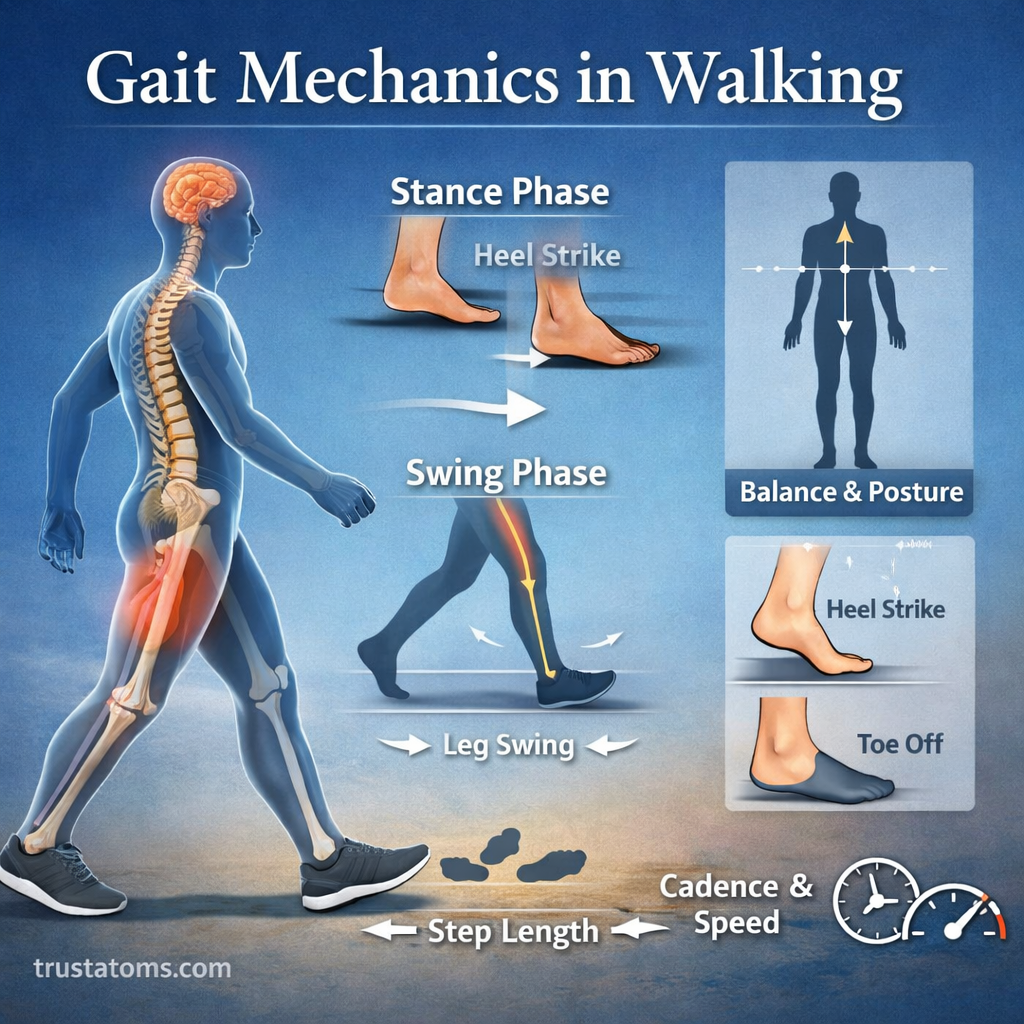
The gait cycle is the sequence of movements that occur between two consecutive contacts of the same foot with the ground.
It is divided into two main phases:
1. Stance Phase (About 60%)
This phase occurs when the foot is in contact with the ground and supporting body weight.
Sub-phases include:
- Heel strike (initial contact)
- Loading response (weight transfer)
- Midstance (body passes over the foot)
- Terminal stance (heel lifts off)
- Toe-off (foot leaves the ground)
2. Swing Phase (About 40%)
This phase occurs when the foot is off the ground and moving forward.
Sub-phases include:
- Initial swing (foot lifts and accelerates forward)
- Mid-swing (leg passes under the body)
- Terminal swing (leg prepares for next heel strike)
Key Components of Gait Mechanics
Several systems work together to produce efficient walking:
Joint Movement
Different joints contribute at specific times:
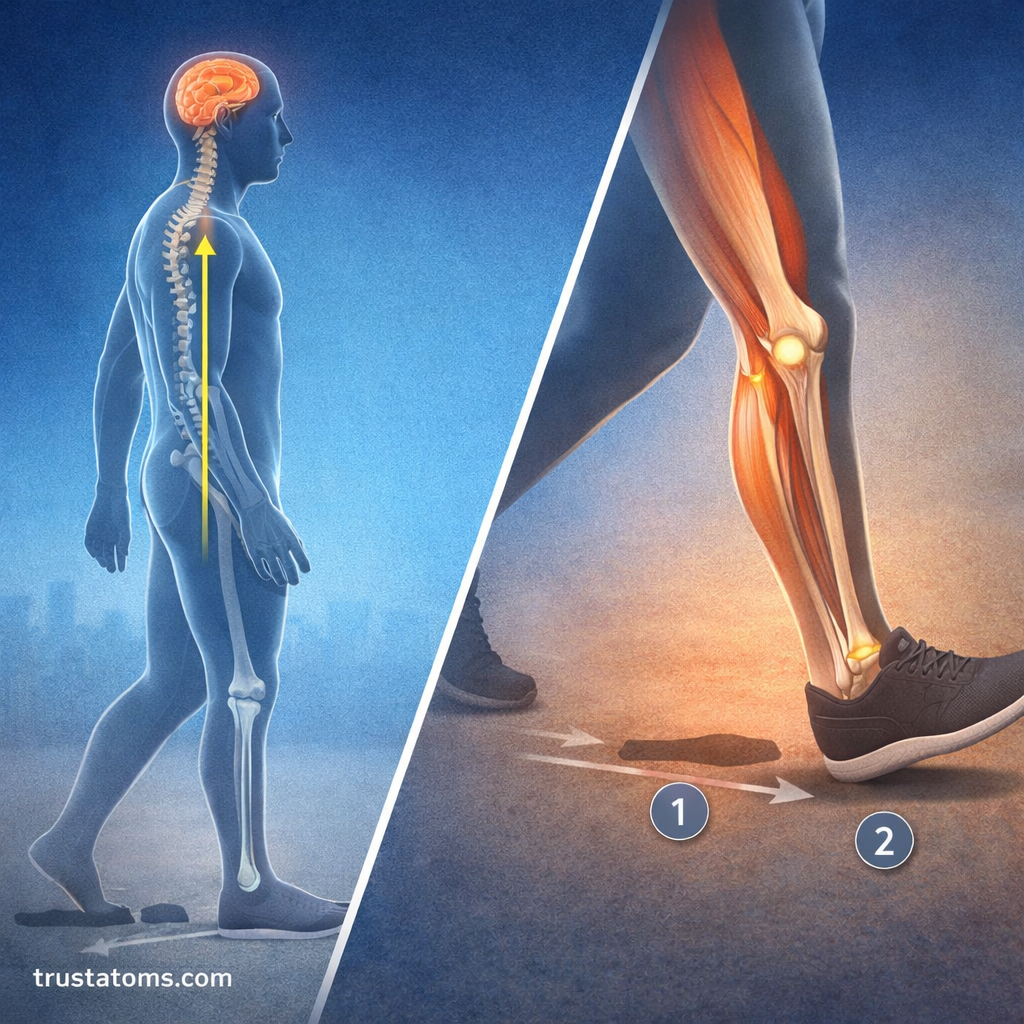
- Hip: flexion and extension for forward movement
- Knee: flexion for shock absorption and clearance
- Ankle: plantarflexion and dorsiflexion for push-off and control
Muscle Activity
Muscles activate in coordinated patterns:
- Quadriceps stabilize the knee during stance
- Hamstrings decelerate the leg during swing
- Calf muscles generate push-off power
- Gluteal muscles maintain pelvic stability
Balance and Stability
Walking requires constant balance adjustments:
- The center of mass shifts with each step
- The base of support alternates between feet
- The nervous system coordinates posture and movement
Spatial and Temporal Parameters
Gait can also be described using measurable variables:
Spatial Parameters
- Step length: distance between steps
- Stride length: distance between two contacts of the same foot
- Step width: lateral distance between feet
Temporal Parameters
- Cadence: steps per minute
- Walking speed: distance covered over time
- Step time: duration of each step
These parameters help clinicians assess normal vs. abnormal walking patterns.
Energy Efficiency in Walking
Human walking is optimized for energy conservation. Several features contribute to this:
- The pendulum-like motion of the legs
- Elastic energy storage in tendons
- Minimal vertical displacement of the body
- Coordinated muscle activation patterns
Efficient gait reduces fatigue and allows for sustained movement over long distances.
Common Gait Variations
Gait can vary depending on age, health, and conditions.
Normal Variations
- Children: shorter steps and wider stance
- Older adults: reduced speed and shorter stride
- Athletes: more controlled and efficient patterns
Abnormal Gait Patterns
Some examples include:
- Antalgic gait: shortened stance phase due to pain
- Trendelenburg gait: hip drop from weak gluteal muscles
- Shuffling gait: reduced foot clearance
- Steppage gait: exaggerated lifting due to foot drop
These variations often indicate underlying issues in the musculoskeletal or nervous system.
The Role of the Nervous System
Walking is not purely mechanical—it is controlled by the nervous system.
Key components include:
- Brain: plans and initiates movement
- Spinal cord: coordinates rhythmic patterns
- Sensory feedback: adjusts movement based on environment
Proprioception (body position awareness) plays a critical role in maintaining smooth and stable gait.
Why Gait Mechanics Matter
Understanding gait mechanics has practical applications in many areas:
- Injury prevention by identifying inefficient movement patterns
- Rehabilitation after surgery or neurological conditions
- Athletic performance optimization
- Fall risk assessment in older adults
Even small deviations in gait can lead to long-term joint stress or imbalance if not addressed.
Final Thoughts
Gait mechanics in walking is a complex yet highly efficient system that integrates movement, balance, and coordination. Each step involves precise timing between muscles, joints, and the nervous system to produce smooth and stable motion.
By studying gait, researchers and clinicians can better understand how the body moves, detect abnormalities, and improve overall mobility and quality of life.