Glaciers are powerful natural forces that shape Earth’s surface over thousands to millions of years. These massive, slow-moving bodies of ice carve valleys, transport rock, and create unique landforms that tell the story of past climates.
Understanding glacial landforms and ice movement helps explain how landscapes evolve and how ice has influenced regions across the world.
What Is a Glacier?
A glacier is a large mass of ice formed from compacted snow that moves slowly over land due to gravity.
Glaciers form in areas where:
- Snowfall exceeds melting over long periods
- Temperatures remain low year-round
- Snow compresses into dense ice layers
Over time, this ice becomes thick enough to begin flowing.
How Glaciers Move
Despite appearing solid, glaciers are constantly in motion. Their movement is driven by gravity and the internal deformation of ice.
Types of Glacial Movement
Internal Flow
- Ice deforms under its own weight
- Occurs deep within the glacier
- Moves slowly and continuously
Basal Sliding
- Glacier slides over the ground
- Often aided by meltwater beneath the ice
- Can increase movement speed
Types of Glaciers
Glaciers are categorized based on their size and location:
Valley (Alpine) Glaciers
- Found in mountainous regions
- Flow downhill through valleys
- Shape steep, narrow landscapes
Continental Glaciers (Ice Sheets)
- Cover large land areas
- Found in places like Antarctica and Greenland
- Shape entire continents
Erosion by Glaciers
Glaciers are powerful agents of erosion. As they move, they reshape the land through:
Plucking
- Ice freezes onto rock and pulls pieces away
- Creates jagged landscapes
Abrasion
- Rocks embedded in ice scrape the ground
- Smooths and polishes surfaces
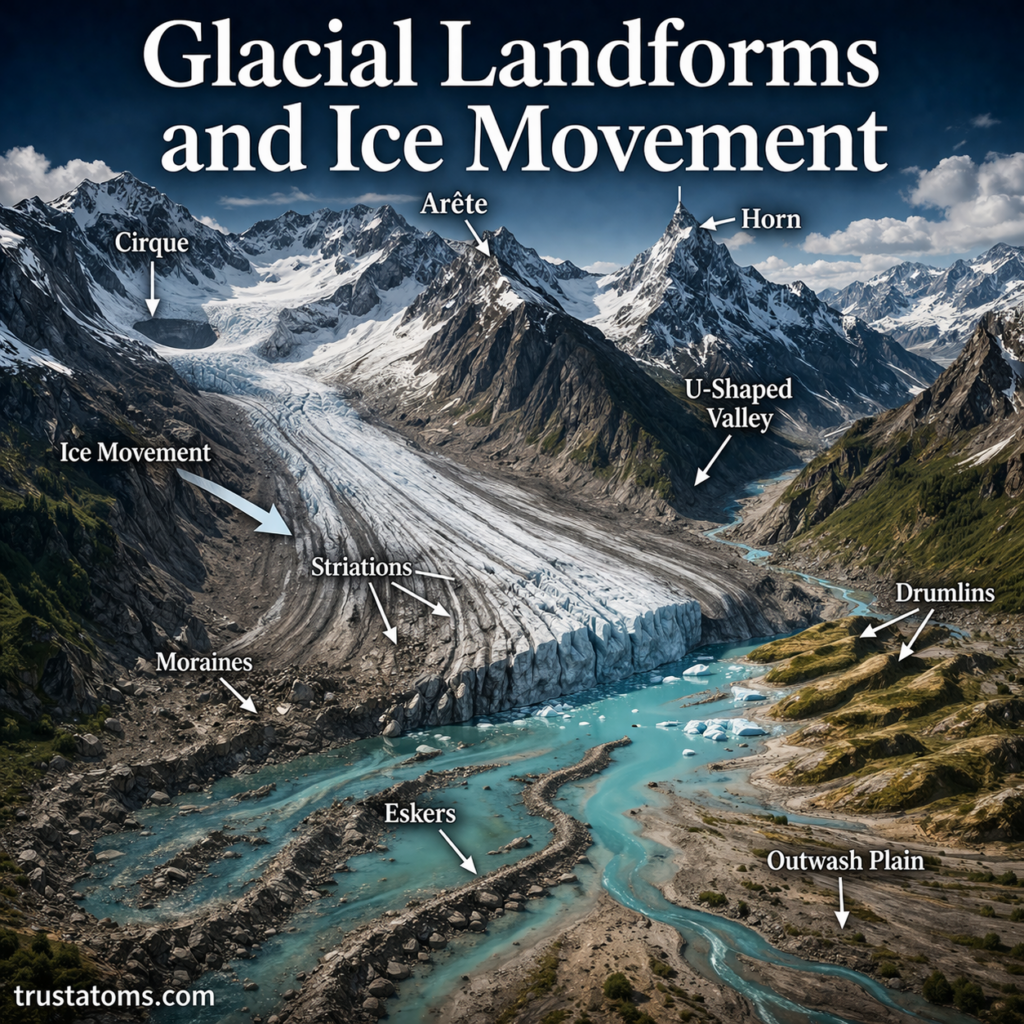
- Leaves scratches called striations
Major Glacial Landforms
Glacial movement creates a wide variety of distinctive landforms.
U-Shaped Valleys
- Formed when glaciers widen and deepen valleys
- Characterized by steep sides and flat bottoms
Cirques
- Bowl-shaped depressions at the head of a glacier
- Often where glaciers begin
Arêtes
- Sharp ridges formed between two cirques
Horns
- Pointed mountain peaks formed by erosion from multiple sides
Depositional Landforms
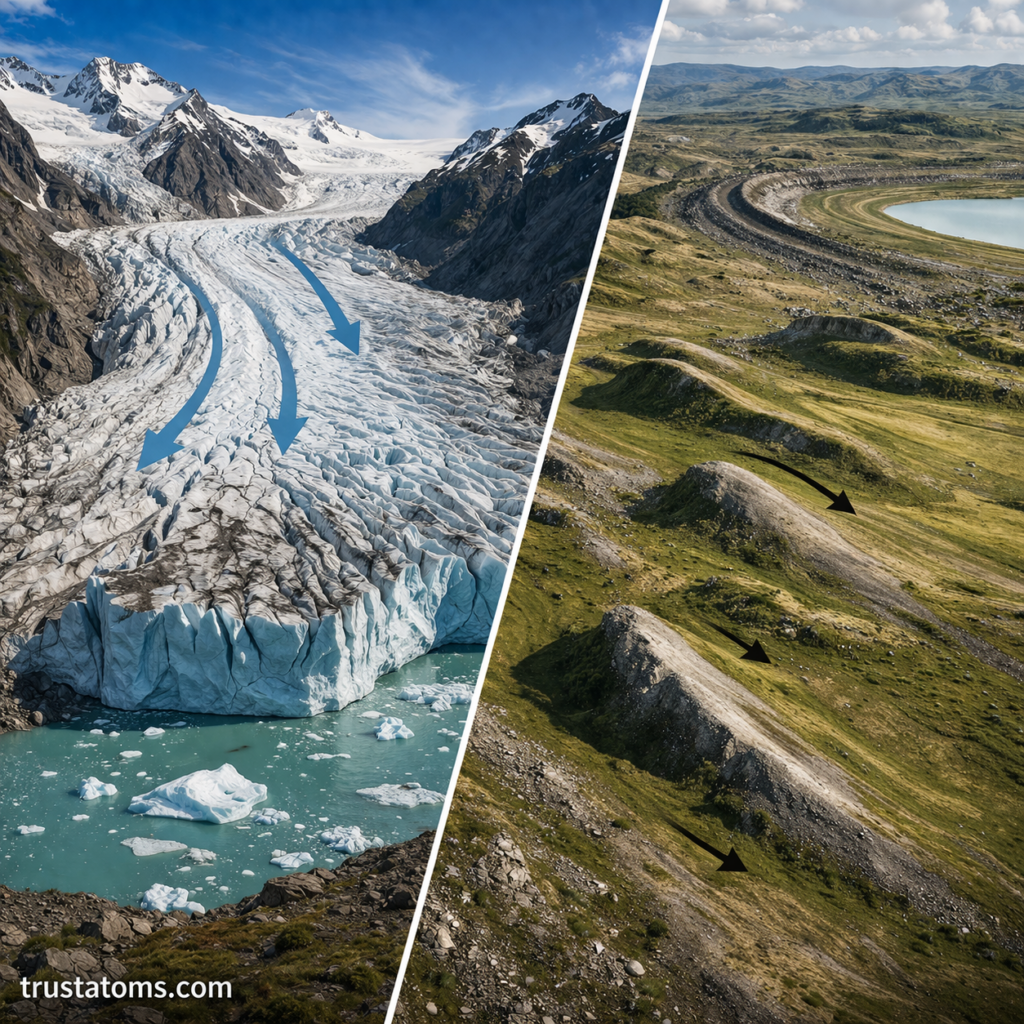
As glaciers melt, they deposit the material they carried, forming new features.
Moraines
- Ridges of debris left behind by glaciers
- Types include lateral, medial, and terminal moraines
Drumlins
- Smooth, elongated hills shaped by moving ice
- Indicate direction of glacier movement
Eskers
- Long, winding ridges of sand and gravel
- Formed by meltwater streams beneath glaciers
Outwash Plains
- Flat areas formed by sediment deposited by meltwater
Glacial Ice and Climate
Glaciers are closely linked to Earth’s climate.
- Grow during colder periods (glacial periods)
- Shrink during warmer periods (interglacial periods)
- Serve as indicators of climate change
Studying glaciers helps scientists understand past and future climate trends.
How Glaciers Shape Landscapes
Over time, glaciers dramatically alter Earth’s surface:
- Transform V-shaped river valleys into U-shaped valleys
- Carve fjords along coastlines
- Create lakes in depressions left behind
- Redistribute sediments across large areas
Regions once covered by ice often have distinct geological features.
Evidence of Past Glaciation
Even where glaciers no longer exist, evidence of their presence remains:
- Striations on rock surfaces
- Erratics (large rocks transported far from their origin)
- Glacial till deposits
- U-shaped valleys and cirques
These clues allow scientists to reconstruct ancient ice coverage.
Why Glacial Landforms Matter
Glacial landforms are important for several reasons:
- Provide insight into Earth’s climatic history
- Influence ecosystems and water systems
- Affect soil distribution and fertility
- Help predict future environmental changes
They also shape some of the most scenic landscapes on Earth.
Common Misconceptions
Glaciers Don’t Move
Glaciers do move—just very slowly, often only a few centimeters to meters per day.
Ice Only Covers Cold Regions
Glaciers exist primarily in cold regions, but they have historically covered much larger areas of Earth.
Glaciers Only Erode
Glaciers both erode and deposit material, shaping the landscape in multiple ways.
Final Thoughts
Glacial landforms and ice movement reveal the immense power of ice over geological time. Through erosion and deposition, glaciers carve mountains, shape valleys, and leave lasting marks on the landscape.
By studying these processes, we gain a deeper understanding of Earth’s history and the forces that continue to shape its surface today.