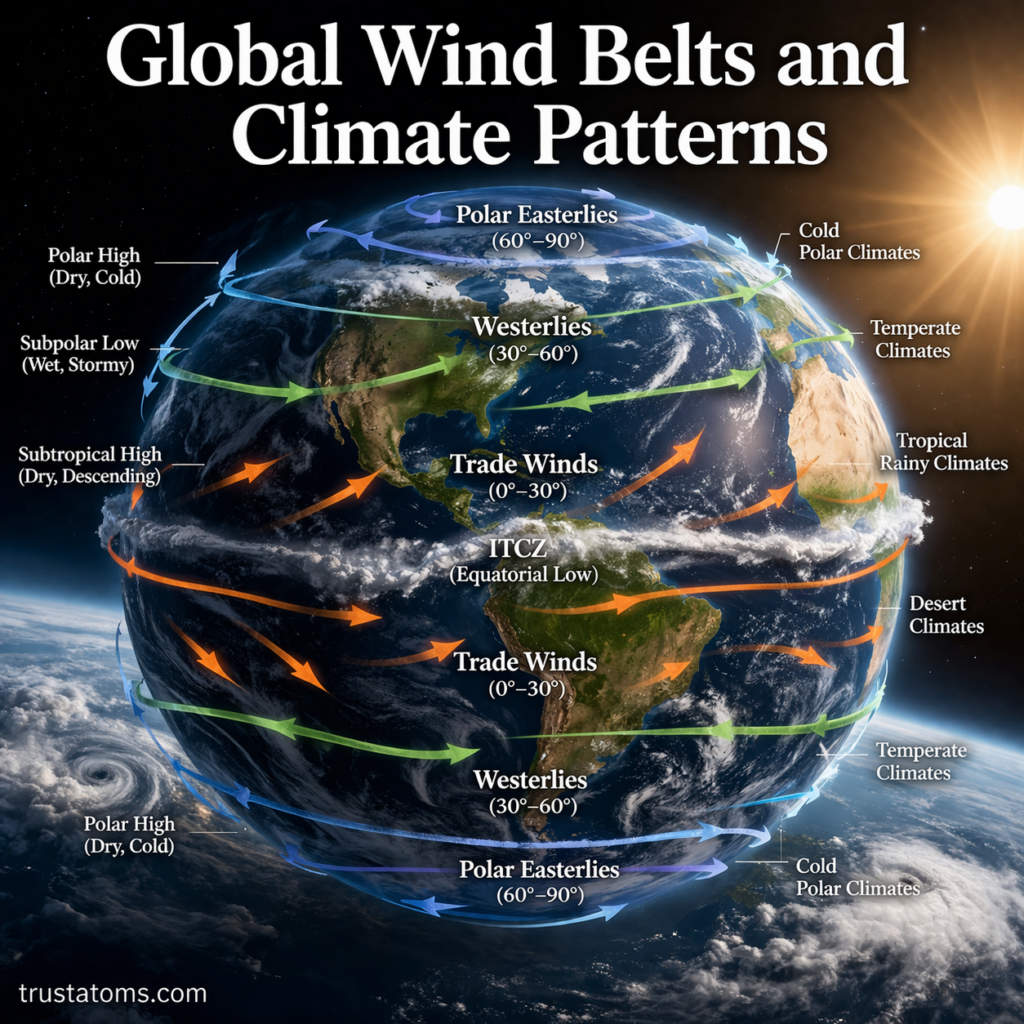
Global wind belts are large-scale patterns of air movement that circulate around the Earth. These winds play a crucial role in distributing heat, moisture, and energy—directly influencing climate zones and weather systems across the planet.
Understanding global wind belts helps explain why some regions are hot and dry, while others are wet and stormy.
What Are Global Wind Belts?
Global wind belts are consistent patterns of prevailing winds that form due to uneven heating of Earth’s surface and the planet’s rotation.
Why Wind Belts Form
- The Sun heats the equator more than the poles
- Warm air rises near the equator and cool air sinks near the poles
- Earth’s rotation (Coriolis effect) deflects moving air
This combination creates distinct wind patterns in different latitude zones.
The Three Major Wind Belts
Earth is divided into three primary wind belts in each hemisphere.
1. Trade Winds (0°–30° Latitude)
Trade winds blow from east to west toward the equator.
Key Features
- Found between the equator and 30° latitude
- Blow from the northeast in the Northern Hemisphere
- Blow from the southeast in the Southern Hemisphere
- Steady and reliable
Climate Impact
- Bring warm, moist air toward the equator
- Contribute to tropical rainfall
- Help drive ocean currents
2. Westerlies (30°–60° Latitude)
Westerlies blow from west to east in the mid-latitudes.
Key Features
- Found between 30° and 60° latitude
- Stronger and more variable than trade winds
- Influence much of North America and Europe
Climate Impact
- Carry weather systems across continents
- Bring moist air from oceans inland
- Influence storm tracks and seasonal weather
3. Polar Easterlies (60°–90° Latitude)
Polar easterlies are cold winds that blow from east to west near the poles.
Key Features
- Found between 60° latitude and the poles
- Cold, dry air masses
- Generally weaker and less consistent
Climate Impact
- Contribute to cold polar climates
- Interact with warmer air at lower latitudes
- Help form polar weather systems
The Role of Pressure Belts
Wind belts are closely linked to global pressure zones.
Major Pressure Zones
- Equatorial Low (ITCZ): Rising warm air, heavy rainfall
- Subtropical Highs: Descending dry air, desert regions
- Subpolar Lows: Rising air, frequent storms
- Polar Highs: Cold, sinking air
These pressure differences drive air movement and maintain wind patterns.
The Coriolis Effect
Earth’s rotation causes moving air to curve rather than travel in straight lines.
How It Works
- Air is deflected to the right in the Northern Hemisphere
- Air is deflected to the left in the Southern Hemisphere
Why It Matters
- Shapes the direction of wind belts
- Influences ocean currents
- Affects storm rotation (e.g., hurricanes)
How Wind Belts Influence Climate
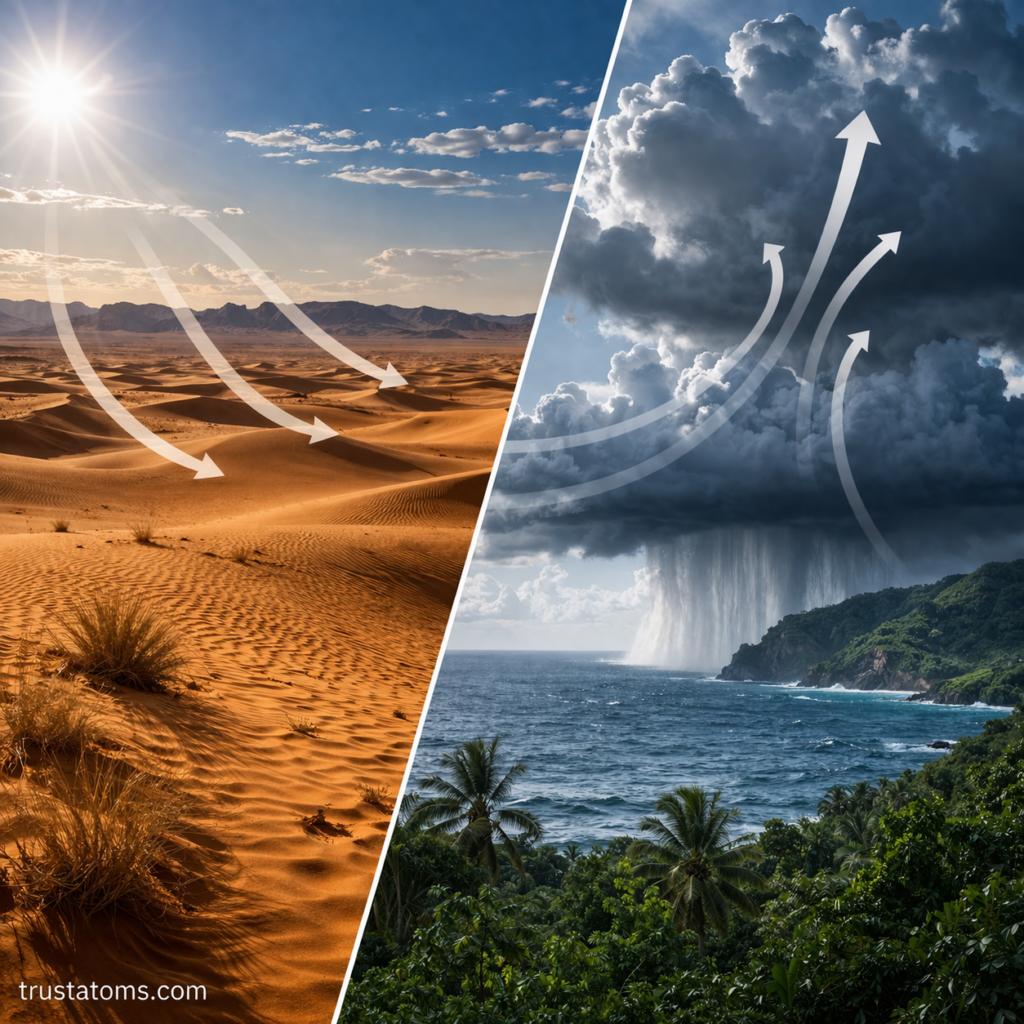
Global wind belts help determine long-term climate patterns.
Temperature Distribution
- Transport heat from the equator toward the poles
- Help balance global temperatures
Rainfall Patterns
- Rising air leads to clouds and precipitation
- Sinking air creates dry conditions
Examples
- Tropical Rainforests: Near the equator with heavy rainfall
- Deserts: Around 30° latitude with dry, sinking air
- Temperate Regions: Variable weather influenced by westerlies
Wind Belts and Ocean Currents
Wind belts also drive major ocean currents.
Key Connections
- Trade winds push warm surface water westward
- Westerlies move water across mid-latitudes
- Ocean currents redistribute heat globally
This interaction plays a major role in regulating climate.
Seasonal Shifts and Variability
Wind belts are not fixed—they shift slightly throughout the year.
Causes of Movement
- Earth’s tilt and seasonal changes
- Migration of the Intertropical Convergence Zone (ITCZ)
Effects
- Monsoons in South Asia and Africa
- Seasonal rainfall changes
- Shifting weather patterns
Why Global Wind Belts Matter
Understanding wind belts is essential for predicting weather and climate behavior.
Key Importance
- Helps forecast storms and weather systems
- Explains climate zones and ecosystems
- Supports navigation and aviation planning
- Aids in climate science and modeling
Final Thoughts
Global wind belts are a fundamental part of Earth’s climate system. By redistributing heat and moisture, they shape weather patterns, influence ocean currents, and define climate zones around the world.
From tropical rainforests to arid deserts, these invisible air currents play a powerful role in shaping life on Earth.