The greenhouse effect is a natural process that keeps Earth warm enough to support life. Without it, the planet would be too cold for most living organisms to survive.
In atmospheric science, understanding the greenhouse effect is essential for explaining global temperatures, weather patterns, and climate change.
What Is the Greenhouse Effect?
The greenhouse effect occurs when certain gases in Earth’s atmosphere trap heat.
These gases allow sunlight to enter the atmosphere but prevent some of the heat from escaping back into space.
In simple terms
- Sunlight comes in → warms Earth
- Earth releases heat → some escapes
- Some heat is trapped → keeps the planet warm
This process creates a stable and livable climate.
How the Greenhouse Effect Works
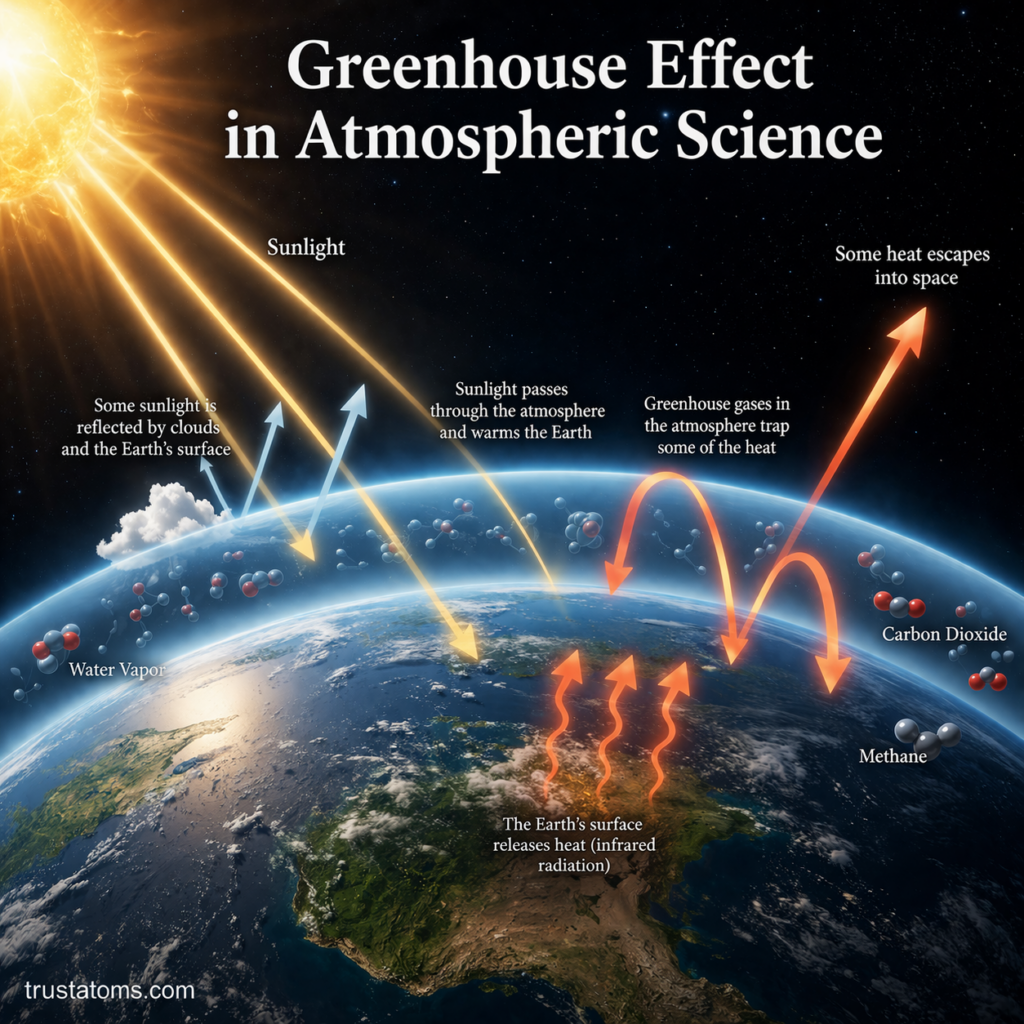
The greenhouse effect involves a series of energy transfers between the Sun, Earth’s surface, and the atmosphere.
Step-by-step process
- Solar radiation from the Sun reaches Earth
- Some energy is reflected back into space
- The rest is absorbed by land and oceans
- Earth emits heat as infrared radiation
- Greenhouse gases absorb and re-emit some of this heat
- Heat is retained in the lower atmosphere
This cycle continuously regulates Earth’s temperature.
Major Greenhouse Gases
Several gases contribute to the greenhouse effect. Each has a different ability to trap heat.
Key greenhouse gases
- Water vapor
- Carbon dioxide (CO₂)
- Methane (CH₄)
- Nitrous oxide (N₂O)
- Ozone (O₃)
Important notes
- Water vapor is the most abundant greenhouse gas
- CO₂ is the most significant long-term driver of climate change
- Methane is more powerful than CO₂ but less abundant
Natural vs Enhanced Greenhouse Effect
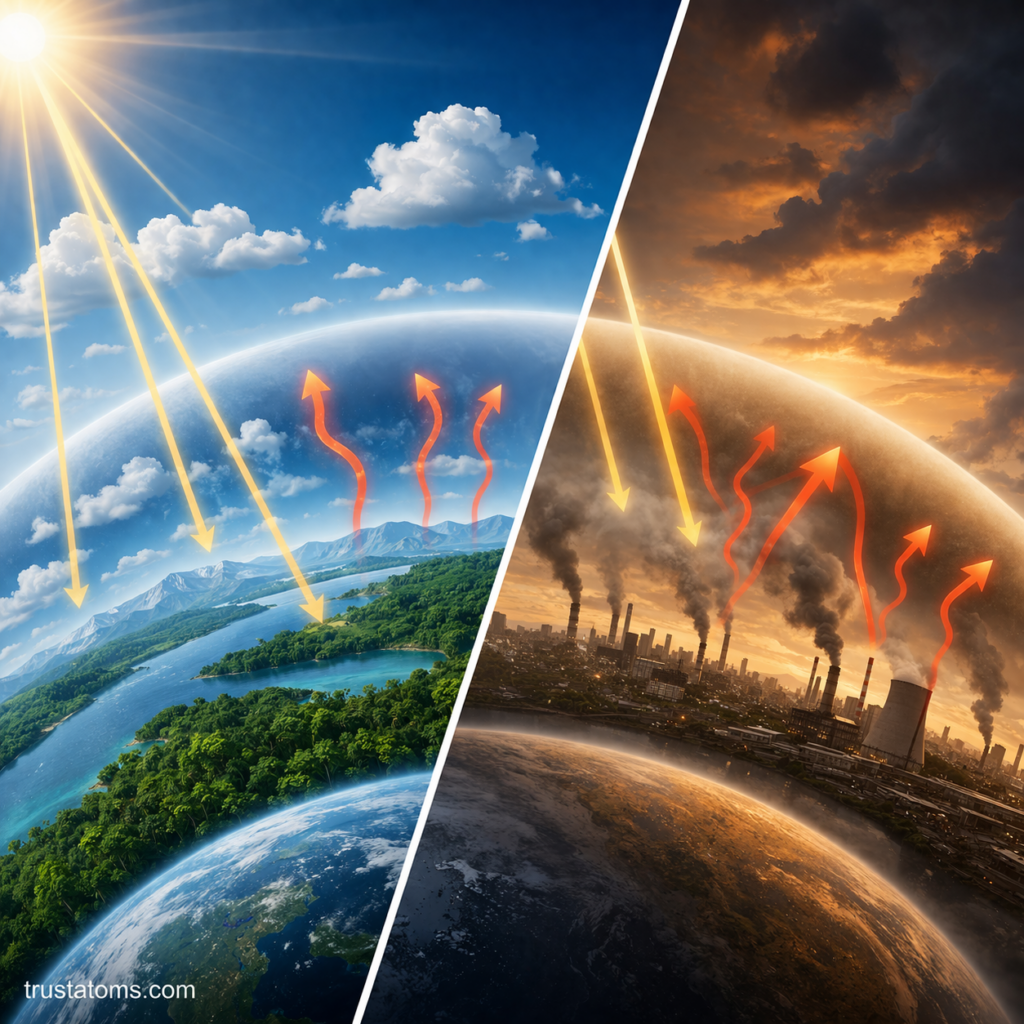
There are two types of greenhouse effect processes to understand.
Natural greenhouse effect
- Occurs without human influence
- Keeps Earth’s average temperature around 15°C (59°F)
- Essential for life
Enhanced greenhouse effect
- Caused by increased greenhouse gases from human activities
- Traps more heat than normal
- Leads to global warming
Human activities contributing to this include:
- Burning fossil fuels
- Deforestation
- Industrial processes
- Agriculture
Why the Greenhouse Effect Is Important
The greenhouse effect plays a vital role in maintaining Earth’s climate system.
Benefits
- Keeps temperatures stable
- Allows liquid water to exist
- Supports ecosystems and biodiversity
Without it, Earth’s average temperature would be about -18°C (0°F), making life as we know it impossible.
The Role of the Atmosphere
Earth’s atmosphere acts like a thermal blanket.
Layers involved
- Troposphere: where most greenhouse gases are concentrated
- Stratosphere: contains ozone that absorbs harmful UV radiation
How it regulates heat
- Absorbs outgoing infrared radiation
- Re-radiates heat in all directions
- Slows the rate of heat loss to space
This balance is what stabilizes Earth’s climate.
Greenhouse Effect and Climate Change
The greenhouse effect is closely linked to modern climate change.
What’s happening today
- Increased CO₂ levels from human activity
- More heat trapped in the atmosphere
- Rising global temperatures
Key impacts
- Melting glaciers and ice caps
- Rising sea levels
- More frequent extreme weather events
- Changes in ecosystems and wildlife
Even small increases in greenhouse gases can significantly affect global systems over time.
Common Misconceptions
There are several misunderstandings about the greenhouse effect.
Myth vs reality
- Myth: The greenhouse effect is entirely bad
- Reality: It is essential for life
- Myth: It works exactly like a greenhouse
- Reality: The mechanism is different but conceptually similar
- Myth: Only CO₂ matters
- Reality: Multiple gases contribute to heat trapping
Understanding these distinctions is key to grasping climate science accurately.
How Scientists Study the Greenhouse Effect
Researchers use multiple tools and methods to study atmospheric processes.
Methods include
- Satellite observations
- Climate models
- Atmospheric measurements
- Ice core data
These tools help scientists track changes in greenhouse gases and predict future climate trends.
What Can Influence the Greenhouse Effect?
Several factors can strengthen or weaken the greenhouse effect.
Natural factors
- Volcanic eruptions
- Solar radiation changes
- Ocean circulation
Human factors
- Fossil fuel emissions
- Land use changes
- Industrial pollution
Understanding these influences helps guide environmental policy and sustainability efforts.
Final Thoughts
The greenhouse effect is a fundamental process in atmospheric science. It keeps Earth warm and habitable, but when intensified by human activity, it contributes to global warming and climate change.
By understanding how it works, we can better appreciate the delicate balance that supports life—and the importance of protecting it.