The human hearing system allows us to detect, interpret, and respond to sound. From conversations and music to environmental cues, hearing plays a vital role in communication and awareness.
This process begins when sound waves enter the ear and ends when the brain interprets them as meaningful auditory information. Understanding ear structure and sound transduction reveals how this complex system works seamlessly in everyday life.
Overview of the Hearing System
The hearing system consists of:
- The ears (capture and process sound)
- The auditory nerve (transmits signals)
- The auditory cortex in the brain (interprets sound)
Sound is processed in three main stages:
- Sound wave collection
- Mechanical vibration
- Neural signal conversion
Structure of the Ear
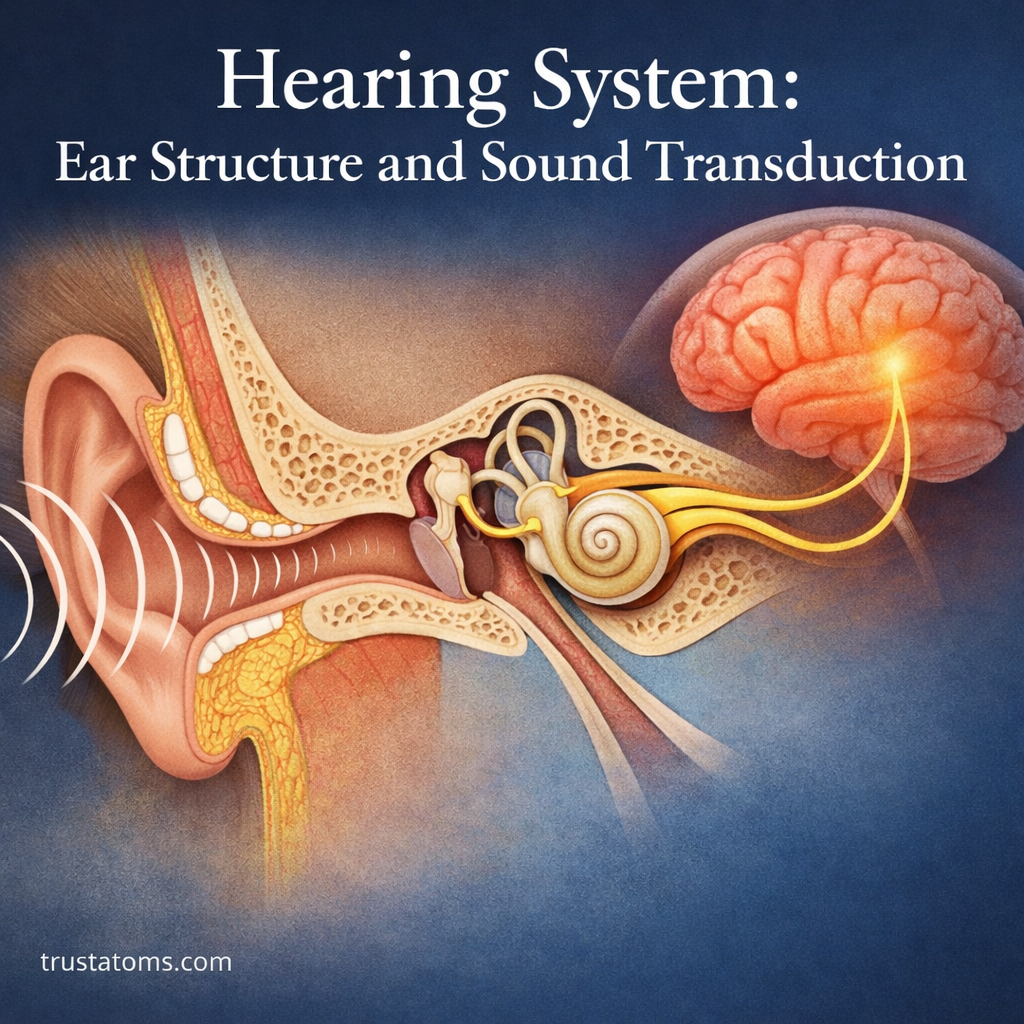
The ear is divided into three main sections, each with a specific role in hearing.
Outer Ear
The outer ear captures sound and directs it inward.
Key Components
- Pinna (Auricle)
The visible part of the ear that collects sound waves. - Ear Canal (External Auditory Canal)
A tube that channels sound toward the eardrum.
Middle Ear
The middle ear amplifies sound vibrations.
Key Components
- Eardrum (Tympanic Membrane)
Vibrates in response to sound waves. - Ossicles (Tiny Bones)
Three small bones that amplify vibrations:- Malleus (hammer)
- Incus (anvil)
- Stapes (stirrup)
- Eustachian Tube
Balances air pressure between the middle ear and the environment.
Inner Ear
The inner ear converts vibrations into electrical signals.
Key Components
- Cochlea
A spiral-shaped, fluid-filled structure responsible for sound transduction. - Hair Cells
Specialized sensory cells that detect vibration and initiate neural signals. - Semicircular Canals
Primarily involved in balance (not hearing, but part of the inner ear system).
Path of Sound Through the Ear
Sound travels through the ear in a step-by-step process.
Step-by-Step Process
- Sound waves enter the outer ear
The pinna collects sound and directs it into the ear canal. - Vibration of the eardrum
Sound waves cause the tympanic membrane to vibrate. - Amplification by ossicles
The malleus, incus, and stapes increase the strength of vibrations. - Transmission to the cochlea
Vibrations reach the oval window and enter the fluid-filled cochlea. - Fluid movement inside the cochlea
Sound waves create ripples in cochlear fluid. - Activation of hair cells
Movement of fluid bends hair cells, triggering electrical signals.
Sound Transduction: From Vibration to Neural Signal
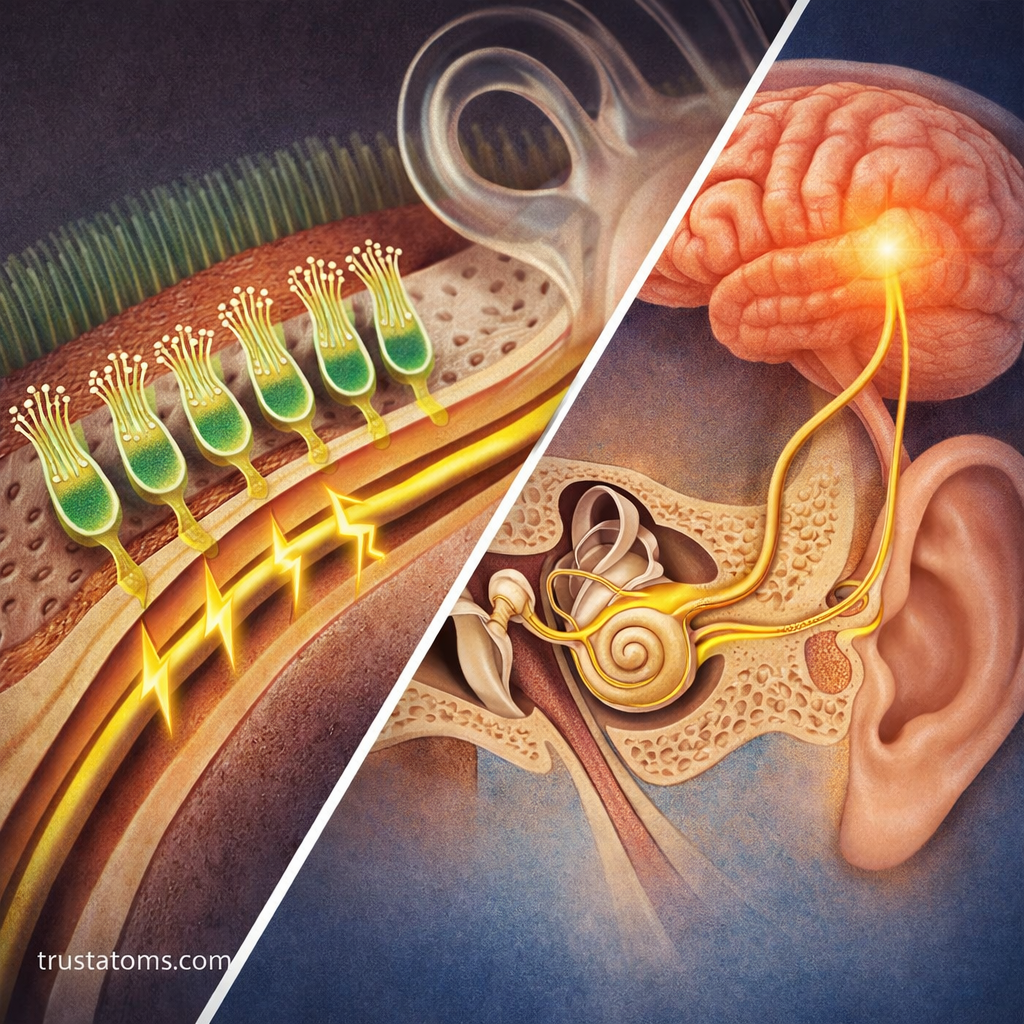
Sound transduction is the process of converting mechanical vibrations into electrical impulses.
How It Works
- Fluid movement in the cochlea stimulates hair cells.
- Hair cells convert mechanical energy into electrical signals.
- Signals are sent to the auditory nerve.
This process allows the brain to interpret sound intensity and frequency.
Frequency and Pitch Detection
Different sounds have different frequencies, which the ear interprets as pitch.
Key Concepts
- High-frequency sounds
Detected at the base of the cochlea. - Low-frequency sounds
Detected toward the apex (end) of the cochlea.
This spatial arrangement is known as tonotopic organization.
Signal Transmission to the Brain
After sound is converted into electrical signals, it travels to the brain.
Auditory Pathway
- Signals travel via the auditory nerve
- Pass through the brainstem
- Reach the thalamus
- Arrive at the auditory cortex in the temporal lobe
Sound Processing in the Brain
The brain interprets sound signals into meaningful information.
Functions of the Auditory Cortex
- Identifies pitch and volume
- Distinguishes speech from noise
- Recognizes patterns like music and rhythm
- Determines sound location
This allows us to understand language, enjoy music, and respond to our environment.
Protective Mechanisms of Hearing
The ear has built-in features to protect against damage.
Natural Protections
- Earwax (Cerumen)
Traps dust and debris. - Acoustic Reflex
Muscles in the middle ear reduce vibration from loud sounds. - Eustachian Tube Regulation
Maintains pressure balance to prevent damage.
Common Hearing Problems
Disruptions in ear structure or function can impair hearing.
Conductive Hearing Loss
- Caused by issues in the outer or middle ear
- Examples:
- Earwax blockage
- Fluid buildup
- Eardrum damage
Sensorineural Hearing Loss
- Caused by damage to the inner ear or auditory nerve
- Examples:
- Aging (presbycusis)
- Noise exposure
- Hair cell damage
Other Conditions
- Tinnitus – ringing or buzzing in the ears
- Otitis Media – middle ear infection
Why the Hearing System Matters
The hearing system is essential for communication, safety, and quality of life.
Key takeaways:
- The ear transforms sound waves into electrical signals.
- Different ear structures play specialized roles in hearing.
- The brain interprets sound into meaningful experiences.
- Damage at any stage can affect hearing ability.
Final Thoughts
The hearing system is a sophisticated network that converts invisible sound waves into rich auditory experiences. Through a combination of mechanical movement and neural processing, the ear and brain work together to help us interact with the world.
Understanding ear structure and sound transduction not only enhances appreciation for hearing but also highlights the importance of protecting this vital sense.