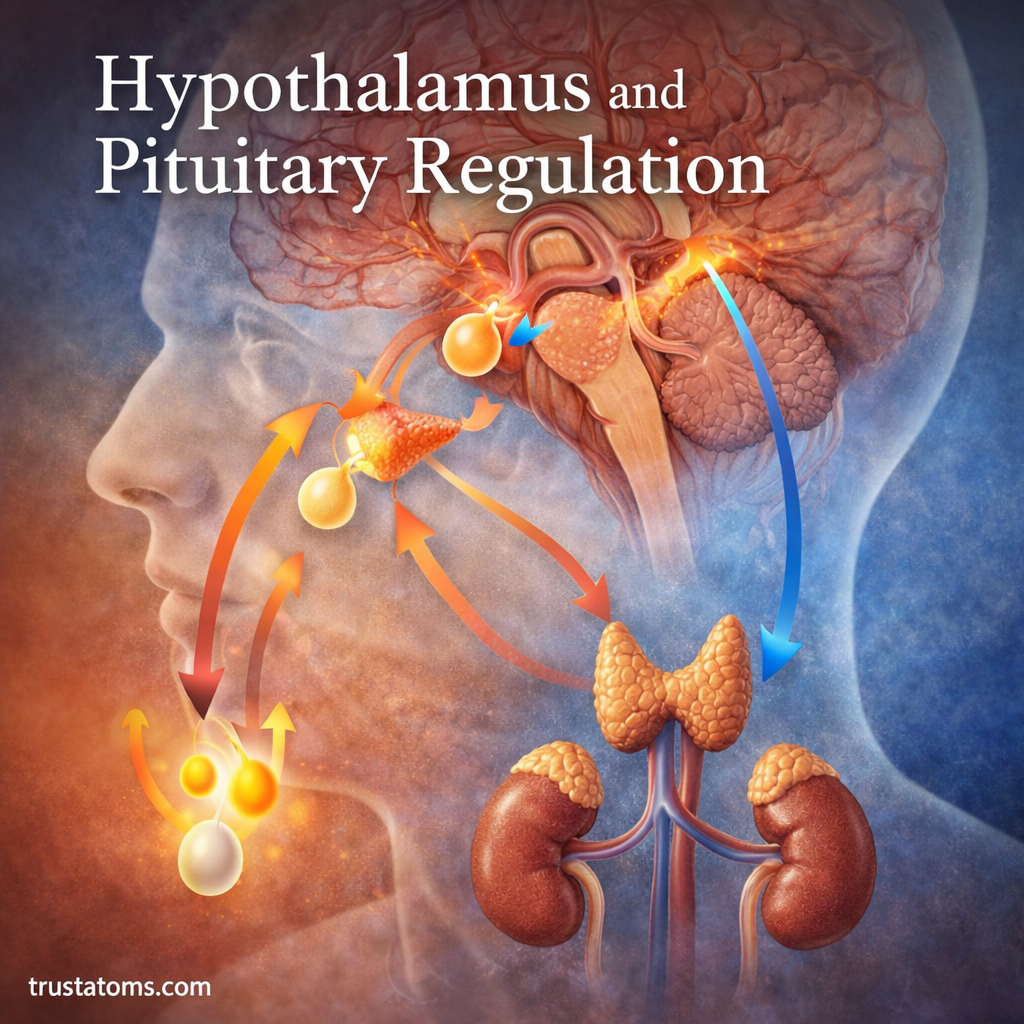
The hypothalamus and pituitary gland form one of the most important control systems in the human body. Together, they regulate hormone production, maintain internal balance, and coordinate communication between the nervous and endocrine systems.
Often referred to as the body’s “control center,” this partnership ensures that hormones are released at the right time, in the right amounts, and for the right functions.
What Is the Hypothalamus?
The hypothalamus is a small but critical region located in the brain, just above the pituitary gland. It acts as a link between the nervous system and the endocrine system.
Key Functions of the Hypothalamus
- Maintains homeostasis (internal balance)
- Regulates body temperature, hunger, and thirst
- Controls emotional responses
- Produces hormones that influence the pituitary gland
- Integrates signals from the nervous system
The hypothalamus responds to changes in the body and environment, then sends instructions to the pituitary gland to adjust hormone levels accordingly.
What Is the Pituitary Gland?
The pituitary gland is a small, pea-sized structure located just below the hypothalamus. It is often called the “master gland” because it controls many other endocrine glands.
Major Roles of the Pituitary Gland
- Releases hormones that regulate other glands
- Controls growth and development
- Influences reproduction and lactation
- Helps manage stress responses
The pituitary works under direct control of the hypothalamus, making it a key part of the endocrine system’s command chain.
How the Hypothalamus and Pituitary Work Together
The hypothalamus and pituitary gland communicate through both neural signals and blood vessels. This allows precise control over hormone release.
Step-by-Step Regulation Process
- The hypothalamus detects changes in the body
- It releases signaling hormones (releasing or inhibiting hormones)
- These signals travel to the pituitary gland
- The pituitary releases its own hormones into the bloodstream
- Target glands or tissues respond accordingly
This system ensures that the body can adapt quickly and maintain balance.
The Anterior vs Posterior Pituitary
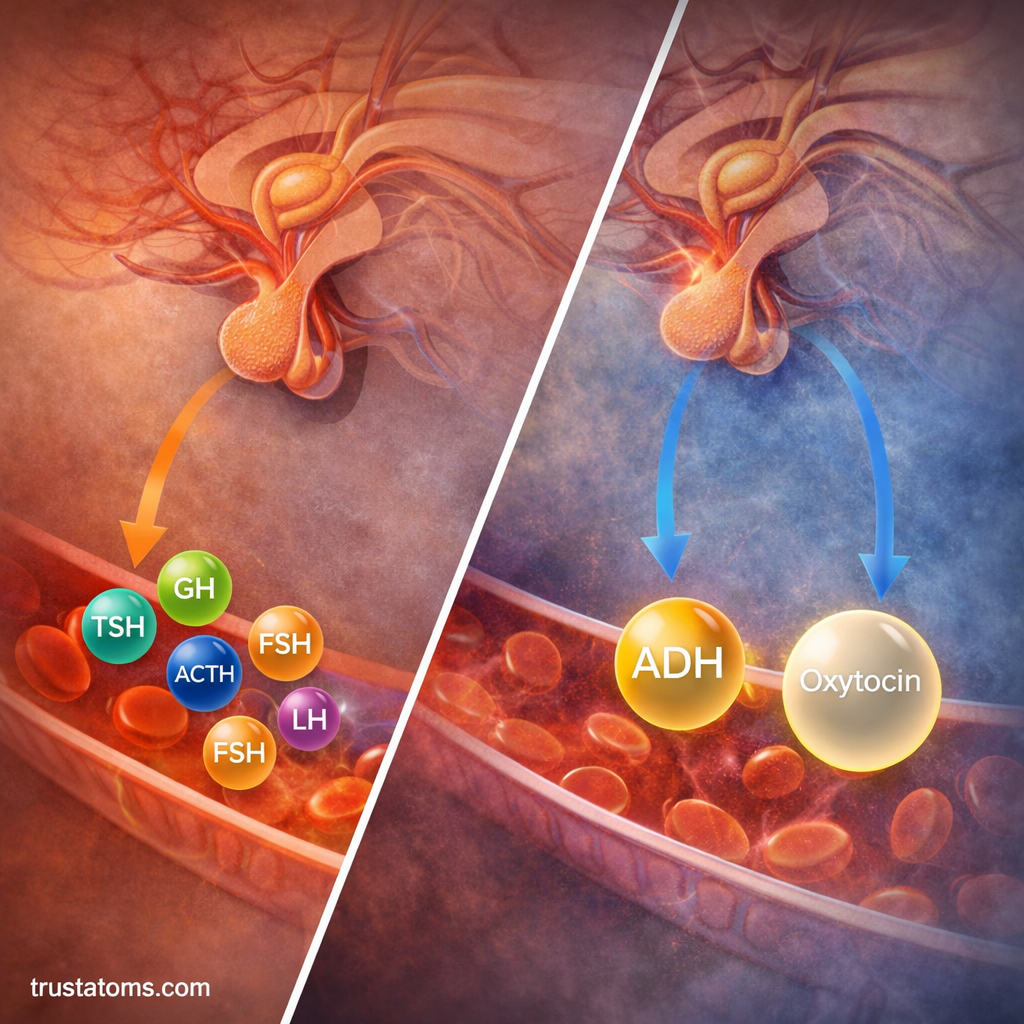
The pituitary gland has two main sections, each with different roles.
Anterior Pituitary (Front Portion)
The anterior pituitary produces and releases its own hormones in response to signals from the hypothalamus.
Key hormones include:
- Growth hormone (GH) – regulates growth and metabolism
- Thyroid-stimulating hormone (TSH) – controls the thyroid gland
- Adrenocorticotropic hormone (ACTH) – stimulates adrenal glands
- Follicle-stimulating hormone (FSH) and luteinizing hormone (LH) – regulate reproduction
- Prolactin – supports milk production
Posterior Pituitary (Back Portion)
The posterior pituitary does not produce hormones. Instead, it stores and releases hormones made by the hypothalamus.
Key hormones include:
- Oxytocin – involved in childbirth and social bonding
- Antidiuretic hormone (ADH) – regulates water balance
Hormonal Feedback Loops
The hypothalamus and pituitary rely on feedback loops to maintain proper hormone levels.
Negative Feedback
Most regulation occurs through negative feedback, where the output of a system reduces or shuts down further production.
Example:
- The hypothalamus releases a hormone that stimulates the pituitary
- The pituitary stimulates the thyroid gland
- Once enough thyroid hormone is produced, it signals the hypothalamus and pituitary to reduce activity
This prevents hormone levels from becoming too high.
Why This System Is So Important
The hypothalamus-pituitary connection controls many essential body functions.
Key Processes Regulated
- Growth and development
- Metabolism and energy balance
- Stress response
- Reproductive cycles
- Water and electrolyte balance
Without proper regulation, these processes can become disrupted, leading to health issues.
Common Disorders Related to This System
When the hypothalamus or pituitary gland does not function correctly, it can affect multiple systems in the body.
Examples include:
- Growth hormone deficiency or excess
- Hypopituitarism (reduced hormone production)
- Pituitary tumors
- Diabetes insipidus (ADH imbalance)
- Thyroid regulation disorders
Because this system controls so many glands, even small problems can have widespread effects.
Everyday Example of Regulation
A simple example of this system in action is the body’s response to stress:
- The hypothalamus detects stress signals
- It stimulates the pituitary gland
- The pituitary signals the adrenal glands
- The adrenal glands release cortisol
This chain reaction helps the body respond and adapt to stressful situations.
Final Thoughts
The hypothalamus and pituitary gland work together as a central control system for hormone regulation. By coordinating signals between the brain and endocrine glands, they ensure the body maintains balance and responds effectively to changes.
Understanding this relationship provides insight into how the body manages complex processes and why hormonal balance is essential for overall health.