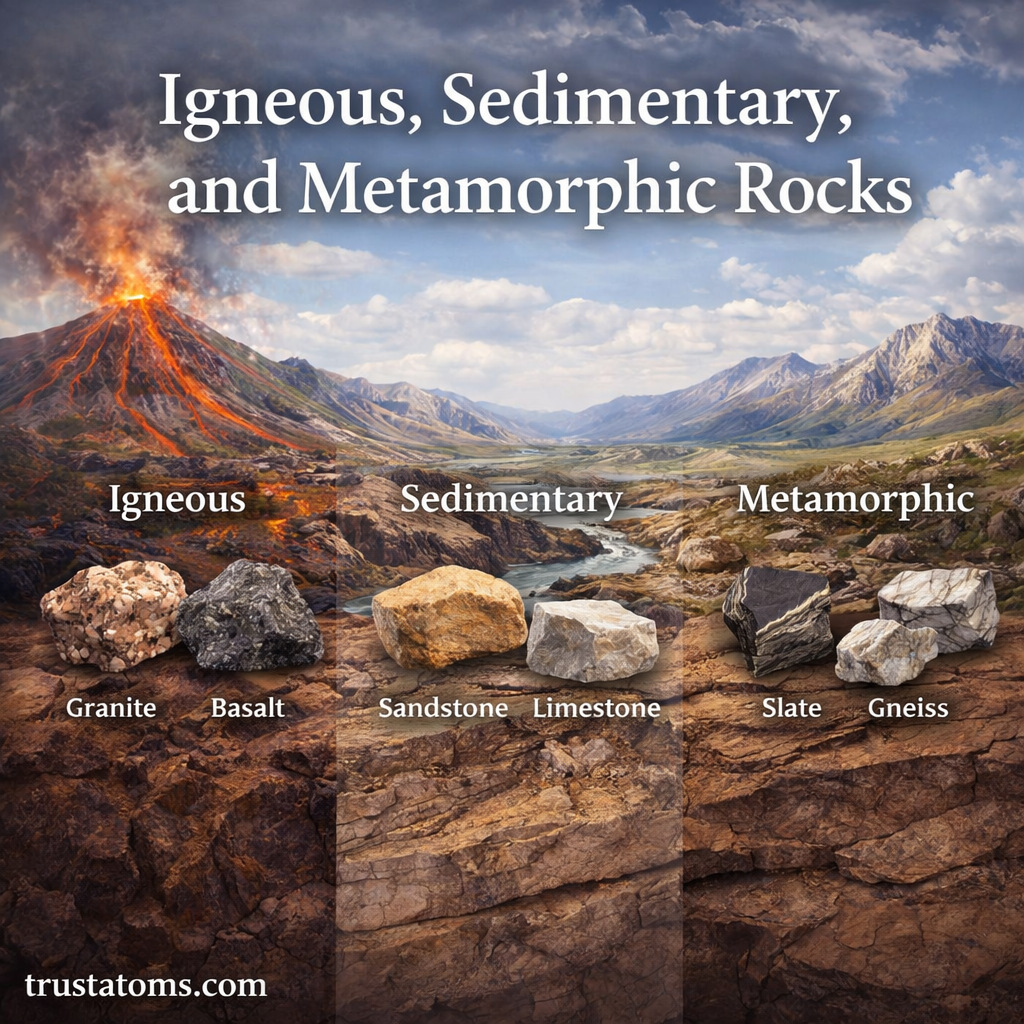
Rocks are the building blocks of Earth’s surface, and they come in three main types: igneous, sedimentary, and metamorphic. Each type forms in a different way and provides important clues about Earth’s history and processes.
Understanding these rock types helps explain how landscapes form, how natural resources develop, and how the planet changes over time.
What Are the Three Types of Rocks?
All rocks are classified into three categories based on how they form:
- Igneous rocks – formed from molten material
- Sedimentary rocks – formed from accumulated sediments
- Metamorphic rocks – formed from existing rocks altered by heat and pressure
Each type is part of the larger rock cycle, constantly transforming from one form to another.
Igneous Rocks
Igneous rocks form when molten rock cools and solidifies. This molten material is called magma when it is below the surface and lava when it reaches the surface.
Types of Igneous Rocks
- Intrusive (plutonic) – form beneath Earth’s surface
- Extrusive (volcanic) – form at or above the surface
Key Characteristics
- Often have a crystalline texture
- May contain visible mineral grains (slow cooling)
- Usually do not contain fossils
Examples of Igneous Rocks
- Granite – forms slowly underground, with large crystals
- Basalt – forms quickly from lava, with fine grains
- Obsidian – a glass-like rock formed by rapid cooling
Why Igneous Rocks Matter
Igneous rocks help scientists understand volcanic activity and the formation of Earth’s crust.
Sedimentary Rocks
Sedimentary rocks form from the accumulation, compaction, and cementation of sediments. These sediments can come from broken rock fragments, minerals, or organic material.
Types of Sedimentary Rocks
- Clastic – formed from fragments of other rocks
- Chemical – formed from dissolved minerals
- Organic – formed from remains of plants and animals
Key Characteristics
- Often layered (stratified)
- Frequently contain fossils
- Usually softer than other rock types
Examples of Sedimentary Rocks
- Sandstone – formed from compacted sand
- Limestone – formed from marine organisms or chemical deposits
- Shale – formed from fine clay particles
Why Sedimentary Rocks Matter
Sedimentary rocks provide valuable information about Earth’s past environments and often contain fossils that reveal ancient life.
Metamorphic Rocks
Metamorphic rocks form when existing rocks are changed by heat, pressure, or chemically active fluids—without melting.
Types of Metamorphic Rocks
- Foliated – have a layered or banded appearance
- Non-foliated – do not have visible layers
Key Characteristics
- Form deep within Earth
- Can be harder and denser than original rock
- Often show patterns or textures from mineral alignment
Examples of Metamorphic Rocks
- Marble – formed from limestone
- Slate – formed from shale
- Gneiss – formed from granite or other rocks
Why Metamorphic Rocks Matter
Metamorphic rocks reveal the intense conditions inside Earth and help scientists understand tectonic activity.
Comparing the Three Rock Types
Each rock type has distinct features that set it apart.
Quick Comparison
- Igneous rocks: formed from cooling magma or lava
- Sedimentary rocks: formed from compressed sediments
- Metamorphic rocks: formed from heat and pressure
Key Differences
- Formation process
- Texture and structure
- Presence of fossils (common in sedimentary, rare in others)
- Location of formation (surface vs. deep underground)
How Rocks Transform in the Rock Cycle
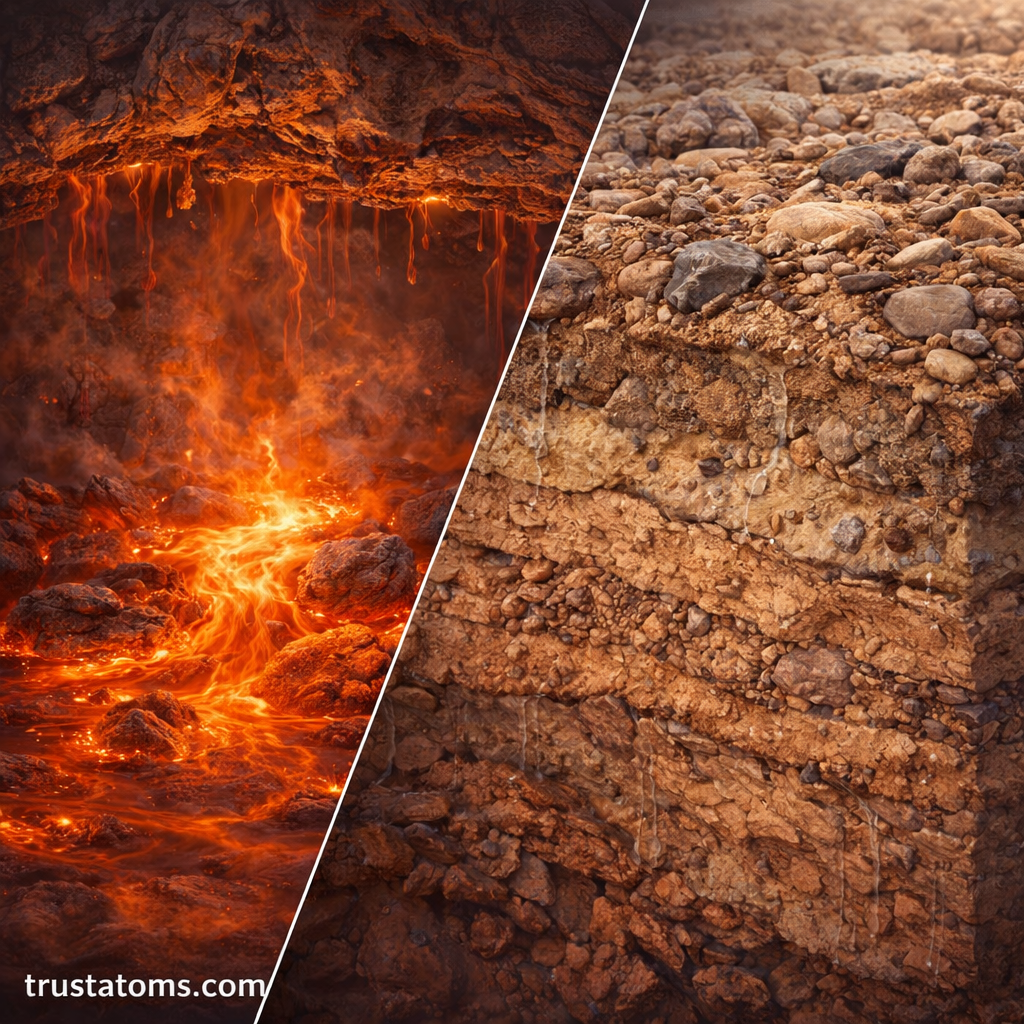
Rocks are not permanent—they continuously change through the rock cycle.
Example Transformations
- Igneous rock → weathering → sedimentary rock
- Sedimentary rock → heat and pressure → metamorphic rock
- Metamorphic rock → melting → igneous rock
These transformations can occur in many different sequences depending on environmental conditions.
Real-World Importance of Rock Types
Understanding rock types has practical applications in everyday life and science.
Common Uses
- Construction materials (granite, limestone, marble)
- Natural resources (coal, oil, minerals)
- Soil formation for agriculture
- Studying Earth’s history and climate
Rocks are not just natural features—they are essential resources.
Final Thoughts
Igneous, sedimentary, and metamorphic rocks each tell a different part of Earth’s story. From volcanic eruptions to ocean sediments and deep underground transformations, these rock types reveal how the planet is constantly changing.
By understanding how rocks form and interact, we gain valuable insight into Earth’s processes, history, and future.