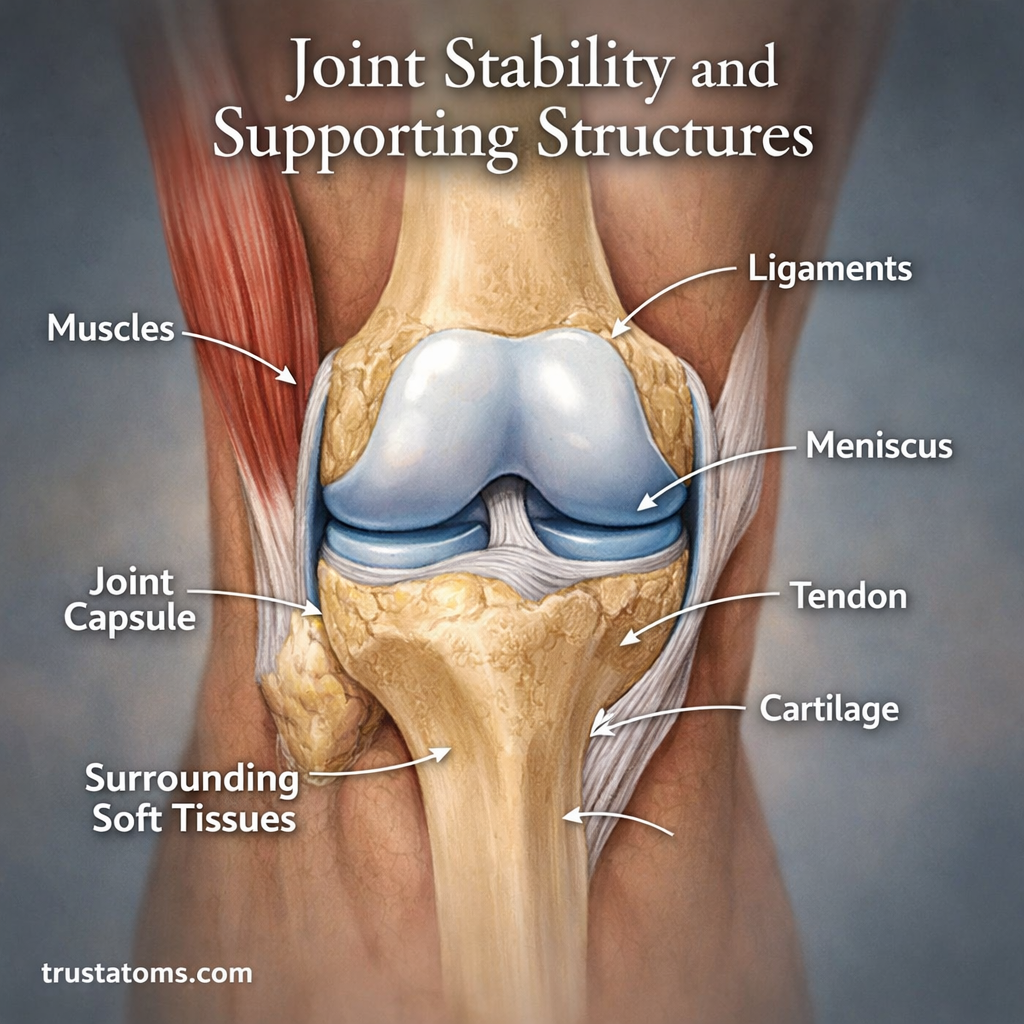
Joint stability is essential for safe, controlled movement in the human body. Every time you walk, lift, or rotate a limb, your joints must balance mobility with stability to prevent injury. This balance is maintained by a combination of anatomical structures that work together to support, guide, and protect joint movement.
Understanding joint stability and its supporting structures helps explain how the body maintains alignment, absorbs forces, and adapts to physical demands.
What Is Joint Stability?
Joint stability refers to the ability of a joint to maintain proper alignment and function during movement or when subjected to external forces.
A stable joint:
- Moves within a safe range of motion
- Resists excessive or abnormal movement
- Maintains structural integrity under load
Without sufficient stability, joints become more vulnerable to injury, dislocation, and long-term damage.
Types of Joints and Stability Differences
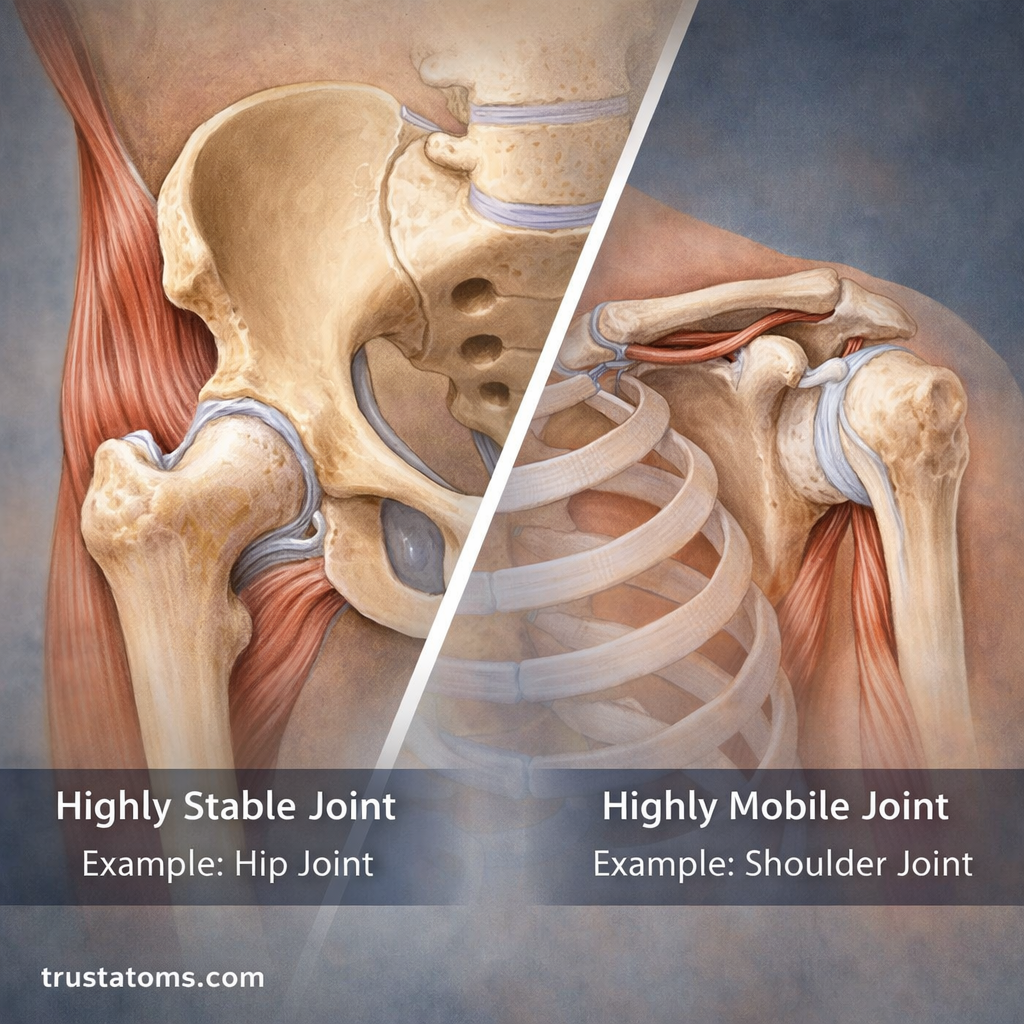
Different joints in the body offer varying levels of stability and mobility.
Highly Stable Joints
- Example: Hip joint
- Deep socket structure provides strong support
- Designed for weight-bearing and durability
Highly Mobile Joints
- Example: Shoulder joint
- Wide range of motion
- Less structural stability, relies more on soft tissues
Moderately Stable Joints
- Example: Knee joint
- Balances mobility and support
- Requires strong ligaments and muscles for stability
Key Supporting Structures of Joint Stability
Joint stability depends on several structures working together.
Ligaments
Ligaments are strong bands of connective tissue that connect bone to bone.
- Limit excessive movement
- Guide joint motion
- Provide passive stability
They are especially important in joints like the knee and ankle.
Tendons
Tendons connect muscles to bones and contribute to joint stability through movement.
- Transfer force from muscle contraction
- Provide dynamic stability
- Help control joint positioning
Muscles
Muscles are one of the most important contributors to joint stability.
- Actively stabilize joints during movement
- Adjust tension based on activity
- Protect joints from sudden forces
Strong, well-coordinated muscles significantly reduce injury risk.
Joint Capsule
The joint capsule is a fibrous structure that encloses the joint.
- Holds joint components together
- Contains synovial fluid
- Provides overall structural support
Cartilage
Cartilage covers the ends of bones within joints.
- Reduces friction
- Absorbs shock
- Helps distribute load evenly
Healthy cartilage is essential for smooth and stable joint function.
Synovial Fluid
Synovial fluid is a lubricating liquid inside the joint capsule.
- Reduces friction between surfaces
- Nourishes cartilage
- Enhances smooth movement
Static vs. Dynamic Stability
Joint stability can be divided into two main types:
Static Stability
- Provided by non-moving structures
- Includes ligaments, joint capsule, and bone structure
- Maintains alignment at rest
Dynamic Stability
- Provided by muscles and tendons
- Active during movement
- Adjusts to changing forces and positions
Both types are essential for proper joint function.
Factors That Affect Joint Stability
Several factors influence how stable a joint is.
Joint Structure
- Deeper sockets increase stability
- Shallow joints rely more on soft tissues
Muscle Strength
- Strong muscles improve dynamic stability
- Weak muscles increase injury risk
Flexibility
- Balanced flexibility allows proper movement
- Excessive flexibility may reduce stability
Neuromuscular Control
- Coordination between nerves and muscles
- Helps maintain joint alignment during movement
Previous Injuries
- Ligament damage can reduce stability
- Increases risk of re-injury
Common Joint Stability Issues
When joint stability is compromised, several problems can occur.
Sprains
- Stretching or tearing of ligaments
- Often caused by sudden or excessive movement
Dislocations
- Bones are forced out of alignment
- Common in highly mobile joints like the shoulder
Chronic Instability
- Repeated joint giving way
- Often due to weakened ligaments or muscles
Overuse Injuries
- Repeated stress leads to tissue fatigue
- Can affect tendons and supporting structures
How the Body Maintains Joint Stability
The body uses multiple systems to maintain joint stability:
- Structural support from bones and ligaments
- Muscle activation to control movement
- Sensory feedback (proprioception) to adjust positioning
These systems work together to keep joints aligned and functioning properly.
Improving and Maintaining Joint Stability
Maintaining joint stability is important for both everyday function and long-term health.
Strength Training
- Builds muscle support around joints
- Enhances dynamic stability
Balance and Coordination Exercises
- Improve neuromuscular control
- Reduce risk of falls and injuries
Flexibility Training
- Maintains healthy range of motion
- Prevents stiffness without compromising stability
Proper Movement Techniques
- Reduces unnecessary stress on joints
- Encourages safe, efficient movement patterns
Injury Prevention
- Gradual progression in activity
- Adequate rest and recovery
Key Takeaways
- Joint stability is the ability to maintain proper alignment during movement
- It depends on both static structures (ligaments, bones) and dynamic structures (muscles, tendons)
- Different joints prioritize stability or mobility depending on their function
- Factors like strength, flexibility, and coordination influence stability
- Weak or damaged structures can lead to instability and injury
- Regular exercise and proper movement help maintain healthy joints
Final Thoughts
Joint stability is a complex but essential aspect of human anatomy. It allows the body to move freely while maintaining control and protection against injury. From ligaments and cartilage to muscles and neural control, multiple systems work together to support each joint.
By understanding how these structures function and interact, you can better appreciate the importance of maintaining strength, coordination, and overall joint health throughout life.