Joints are the connection points between bones that allow your body to move in different ways. From bending your elbow to rotating your shoulder, joints make movement possible while also providing stability.
Understanding joint types and their range of motion helps explain how the human body performs both simple and complex movements.
What Is a Joint?
A joint is a location where two or more bones meet. Joints can be classified based on their structure and function, which directly influence how much movement they allow.
Main Functions of Joints
- Enable movement
- Provide stability
- Support body weight
- Absorb mechanical stress
Structural Classification of Joints
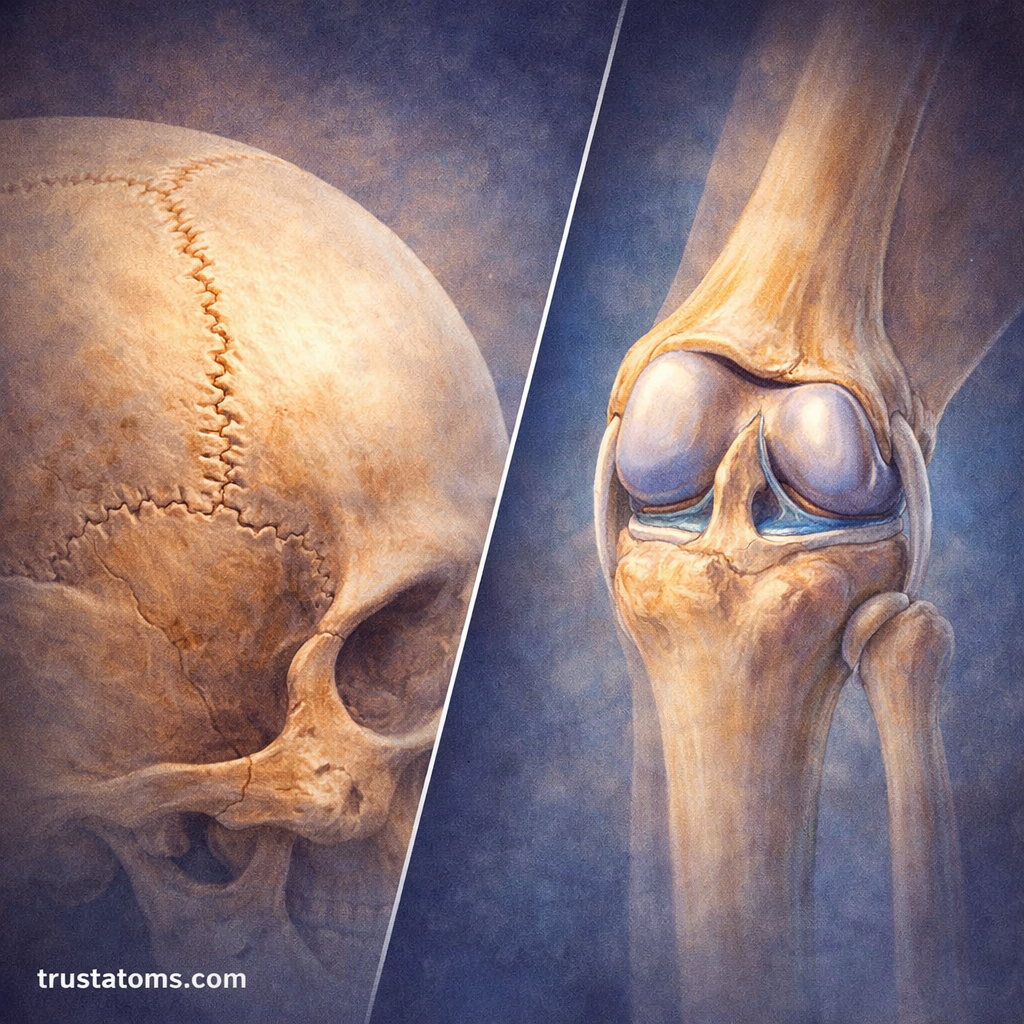
Joints are commonly grouped into three structural categories based on the material that connects the bones.
Fibrous Joints
Fibrous joints are connected by dense connective tissue and allow little to no movement.
Examples:
- Sutures in the skull
- Teeth anchored in jaw sockets
Key Characteristics:
- No joint cavity
- Extremely stable
- Minimal flexibility
Cartilaginous Joints
These joints are connected by cartilage and allow limited movement.
Examples:
- Intervertebral discs (spine)
- Pubic symphysis
Key Characteristics:
- Slightly flexible
- Absorb shock
- No fluid-filled cavity
Synovial Joints
Synovial joints are the most common and allow the greatest range of motion.
Examples:
- Knees
- Shoulders
- Hips
Key Characteristics:
- Fluid-filled joint cavity
- Smooth cartilage surfaces
- Surrounded by a joint capsule
Functional Classification of Joints
Joints can also be classified based on how much movement they allow.
Synarthrosis (Immovable)
- No movement
- Found in skull sutures
Amphiarthrosis (Slightly Movable)
- Limited movement
- Found in the spine
Diarthrosis (Freely Movable)
- Wide range of motion
- Most synovial joints fall into this category
Types of Synovial Joints and Their Movements
Synovial joints are further divided into specific types based on their shape and movement capabilities.
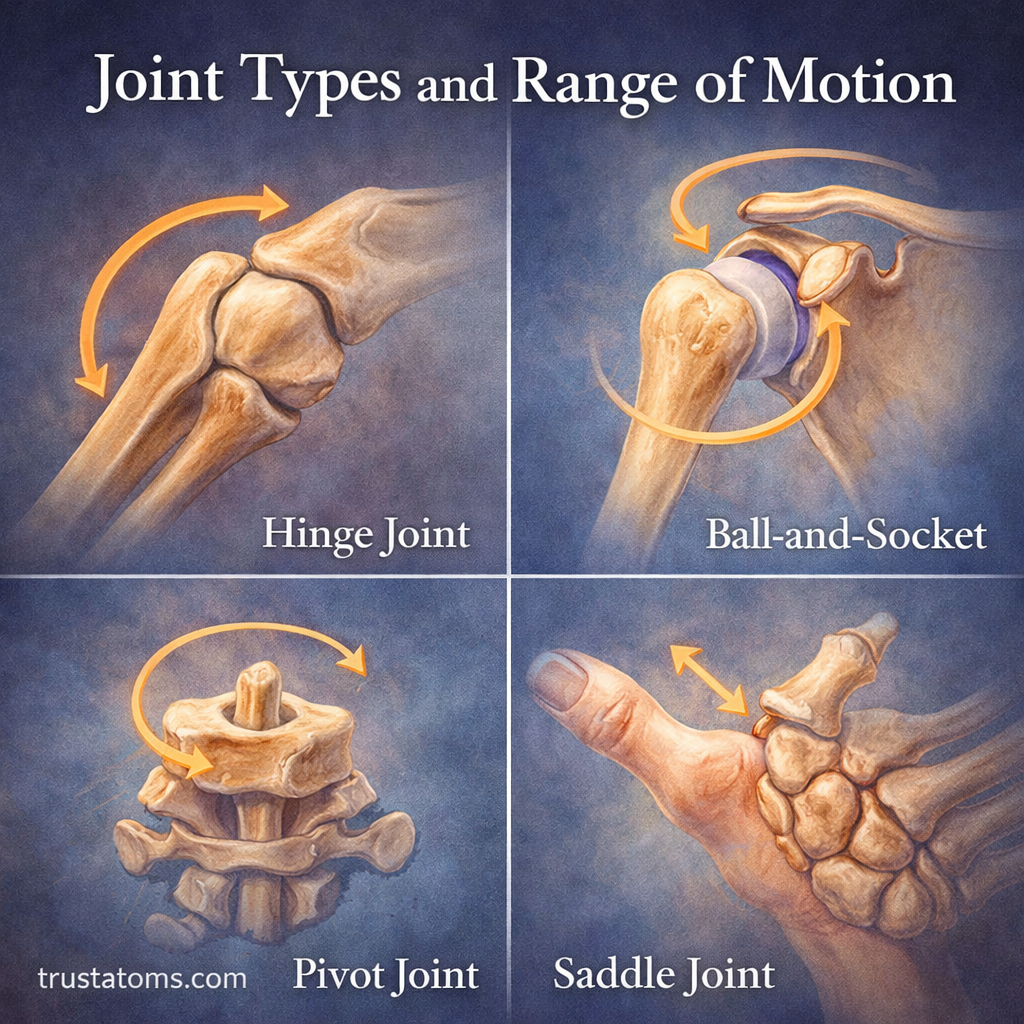
Ball-and-Socket Joints
Allow movement in multiple directions, including rotation.
Examples:
- Shoulder
- Hip
Range of Motion:
- Flexion and extension
- Abduction and adduction
- Rotation
Hinge Joints
Allow movement in one direction, similar to a door hinge.
Examples:
- Elbow
- Knee
Range of Motion:
- Flexion
- Extension
Pivot Joints
Allow rotational movement around a single axis.
Examples:
- Neck (atlas and axis vertebrae)
Range of Motion:
- Rotation
Condyloid (Ellipsoidal) Joints
Allow movement in two planes without full rotation.
Examples:
- Wrist
Range of Motion:
- Flexion and extension
- Side-to-side movement
Saddle Joints
Allow movement similar to condyloid joints but with greater flexibility.
Examples:
- Thumb joint
Range of Motion:
- Flexion and extension
- Abduction and adduction
- Limited rotation
Gliding (Plane) Joints
Allow bones to slide past each other.
Examples:
- Small joints in the hands and feet
Range of Motion:
- Limited sliding movements
Understanding Range of Motion (ROM)
Range of motion refers to how far a joint can move in different directions.
Types of Range of Motion
- Active ROM – movement performed by muscles
- Passive ROM – movement applied by an external force
- Functional ROM – movement needed for daily activities
Factors That Affect Range of Motion
Several factors influence how flexible or restricted a joint can be.
Biological Factors
- Age
- Genetics
- Joint structure
Lifestyle Factors
- Physical activity level
- Stretching habits
- Injury history
Structural Components
- Muscle length and strength
- Ligament flexibility
- Joint capsule condition
Common Joint Movements Explained
Understanding basic joint movements makes it easier to visualize how joints function.
- Flexion: Decreasing the angle between bones
- Extension: Increasing the angle
- Abduction: Moving away from the body
- Adduction: Moving toward the body
- Rotation: Turning around an axis
- Circumduction: Circular movement
Why Joint Health Matters
Healthy joints are essential for mobility, balance, and overall physical performance.
Benefits of Maintaining Joint Health
- Improved flexibility
- Reduced risk of injury
- Better posture and alignment
- Enhanced athletic performance
Ways to Support Joint Health
- Stay physically active
- Maintain a healthy weight
- Strengthen surrounding muscles
- Use proper movement techniques
Common Misconceptions About Joints
- More flexibility is always better (too much can reduce stability)
- All joints move the same way (each type has specific limits)
- Joint pain always means damage (it can also result from stiffness or overuse)
Final Thoughts
Joints are fundamental to how your body moves and functions. From immovable skull joints to highly flexible shoulder joints, each type plays a specific role in balancing stability and mobility.
By understanding joint types and range of motion, you gain a clearer picture of how the body works—and how to keep it moving efficiently for years to come.